Josse-posten

Russia kills 30 at a Kramatorsk bus stop and plans to cut Kyiv in two — even as ISW judges its Donetsk campaign already beaten; Iran and the Houthis squeeze both oil chokepoints at once while Trump promises no strike before the midterms and Zelensky hints Washington is quietly dealing with Moscow.

Russia strikes two buses in Kramatorsk, killing at least 30, as Putin orders Kyiv’s bridges destroyed

The burning shell of a bus in Kramatorsk after the Russian strike. Photo: BBC

A Russian missile hit packed buses at a stop in the frontline city of Kramatorsk, killing at least 30 people and wounding 18 — one of the deadliest single strikes on Ukrainian civilians this year. Zelenskyy said the Kremlin had deliberately targeted “ordinary public transport” to kill as many civilians as possible.

The strike comes as Russia tightens its grip on the capital. Putin has reportedly tasked General Surovikin with destroying all seven of Kyiv’s Dnipro bridges to cut the city in two — a shift the Telegraph characterises as preparation for prolonged war rather than settlement. An intercepted Russian plan outlines strikes on 60 energy and municipal targets, including hydro and nuclear facilities. Overnight Russia launched 136 drones (93 jet-powered Shaheds), 114 of which were shot down; a guided bomb on Zaporizhzhia killed one and wounded nine. Emergency power outages began across Ukraine on Friday. Mayor Klitschko, calling the situation a matter of survival, has urged residents who can to temporarily leave the capital before winter.

Iran hits ten tankers in a week as Houthis strike Riyadh airport — both chokepoints now contested, oil tops $105

Houthi fighters at a funeral procession in Sana’a as Saudi Arabia launches its offensive to retake the Bab al-Mandeb Strait. Photo: The Times

Iran has sharply re-escalated in the Strait of Hormuz, striking ten tankers in the past week — the highest weekly count this year — cutting crude shipments through the strait by half and pushing Brent to $105 a barrel. The IRGC says it is now targeting vessels every night; a tanker identified as the Acers was hit by multiple projectiles off Qatar with casualties reported. Iran’s parliamentary speaker mocked Trump’s claims of open straits with charts of spiking US diesel prices, and the armed forces chief explicitly warned of full retaliation before or after the November 3 midterms. Iran’s nuclear chief, meanwhile, said Tehran will neither halt enrichment nor surrender its stockpile under any circumstances.

At the other chokepoint, the Houthis — who seized the Bab al-Mandeb last month — claimed a ballistic missile strike on Riyadh’s international airport, badly damaging a parked aircraft. Air India, IndiGo and Akasa Air suspended flights to the Saudi capital. Saudi Arabia has opened a military campaign alongside Yemeni government forces to retake the strait, with Turkey and Pakistan invoking a trilateral defence pact and sending troops. Analysts note the Houthis have fewer constraints than Iran — “what is left to blow up?” — making further escalation likely regardless of Saudi pressure. (See also World for Trump’s midterm pledge and the Putin–Pezeshkian meeting.)

ISW: Operation Vivaldi has defeated Russia’s 2026 Donetsk campaign

ISW published a major assessment concluding Ukraine has operationally defeated Russia’s 2026 campaign to seize Donetsk Oblast. Operation Vivaldi collapsed the Russian salient north and west of Lyman, destroying the northern arm of Russia’s planned double envelopment of the Fortress Belt (Slovyansk, Kramatorsk, Druzhkivka, Kostyantynivka); Russia’s two northern combined arms armies are degraded and unable to resume offensive action. The Dobropillya direction remains Russia’s only viable encirclement route, but ISW judges that even this would take years at the current rate of advance, and that Russia will fail to meet Putin’s revised spring 2027 deadline — or may never take the Fortress Belt at all. Frontline activity remains high: 211 assaults were repelled in 24 hours, with Huliaipole and Pokrovsk the most active sectors.

Trump’s peace push collapses; Zelensky hints at secret US–Russia economic talks

Both US and Russian officials confirmed that Trump’s latest ceasefire initiative has stalled. Rubio declared that ending the war through negotiations is “currently unattainable” because Russia demands Kyiv cede Donetsk Oblast without military conquest; Ukraine proposes a ceasefire on current lines. The Kremlin agreed with Rubio that there are no diplomatic prospects and blamed Ukraine.

Ukraine’s senior delegation — including intelligence chief Budanov and foreign intelligence head Umerov — is in Miami on October 9–10 to meet envoys Witkoff and Kushner on an energy and Black Sea ceasefire proposal; the envoys may travel to Moscow in late October. More striking: Zelensky told reporters Ukraine “knows a lot” about parallel US–Russia economic talks he was unwilling to discuss publicly, and rebuked Rubio directly: “you cannot negotiate with Russia and call it a diplomatic stalemate at the same time.” US senators are pressing Trump to enforce a Russia sanctions law before its October 18 statutory deadline.

Indicator Value Change
S&P 500 (f) 7,844 +0.35%
Dow 30 (f) 51,555 +0.12%
Nasdaq (f) 31,222 +0.81%
Russell 2000 (f) 2,818 +0.31%
VIX 15.3 -0.84%
Gold 4,216 +1.43%
BTC $82,549 -0.47%
EUR/USD 1.1232 +0.17%
USD/NOK 9.57 +0.05%
  • Oil fell after Trump ruled out a US strike on Iran before the midterms (see World), even with Brent above $105 on the Hormuz attacks; no oil quote in today’s data.

World

Trump rules out Iran strike before midterms; Putin meets Iranian president in Turkmenistan

Trump told reporters the US will not strike Iran before November’s midterm elections, causing oil prices to fall as markets had been pricing in pre-election military action. The announcement came as Putin met Iranian President Pezeshkian in Turkmenistan and pledged Russia’s support to help end the US-led conflict. The USS Abraham Lincoln meanwhile returned to San Diego after a record 265 uninterrupted days at sea supporting the Iran war — one of the longest carrier deployments in modern history, marked by deteriorating crew conditions and supply shortages.

Ethiopia drone strikes Eritrean troops in Tigray as the Horn of Africa’s wars fuse into one

Mekelle, Tigray’s regional capital, amid the renewed fighting. Photo: AFP via Al Jazeera

Ethiopian federal forces launched drone strikes against Eritrean troops who had crossed into the Tigray region, sharply raising the risk of renewed large-scale war. The Tigray war of 2020–22 killed hundreds of thousands; its fragile ceasefire has never fully held, and analysts warn the incursion could draw in Djibouti, Somalia and Sudan.

Ishaan Tharoor’s New Yorker column maps how the renewed TPLF rebellion is entangled with Sudan’s civil war, Eritrea’s proxy involvement, Egypt’s Red Sea and Nile grievances, and competing Gulf-state interests — what one former EU envoy calls “a convergence into something wider and more dangerous.” Ethiopia expelled Eritrean diplomats and Eritrea severed relations after Addis accused Cairo, Asmara and the Sudanese Armed Forces of backing the insurgency; Saudi Arabia, Turkey, Egypt, the UAE and Qatar are all backing different sides across the arc from Libya to Yemen. The Trump administration is “operationally AWOL” according to multiple former officials, having reportedly sided with Abiy Ahmed through commercial aircraft deals and sanctions against Tigrayan officials — leaving other actors with “a sense of impunity.” Somaliland’s president is reportedly offering to rename an airport after Trump in exchange for US recognition.

Anne Carson wins the Nobel Prize in Literature

Anne Carson. Photo: BBC

Canadian poet Anne Carson, 76, has been awarded the 2026 Nobel Prize in Literature. The Swedish Academy praised her “bold and inventive” work crossing boundaries between poetry, fiction and scholarship; she is best known for Autobiography of Red and The Beauty of the Husband. Carson is the first Canadian to win the literature prize since Alice Munro in 2013.

Israel and UK step back from Jerusalem consulate confrontation

Israel and the UK pulled back from a full diplomatic rupture, with Britain agreeing to rebrand its East Jerusalem consulate general as a “UK mission” rather than close it entirely. Most British diplomats will leave, but Foreign Secretary Ed Miliband said “vital services” to Palestinians will continue. The compromise follows an Israeli ultimatum issued after the UK imposed sanctions on illegal West Bank settlements — Israel’s primary goal was deterring further sanctions, not simply expelling British diplomats.

South Korea recalls its Ukraine ambassador over North Korean POW disclosure

Seoul recalled its ambassador to Kyiv after Ukraine disclosed that two captured North Korean soldiers had been transferred to South Korea without prior coordination. The row highlights the extreme sensitivity of Seoul’s position: it must manage the revelation of North Korea’s battlefield role in Ukraine without triggering further escalation on the peninsula or damaging its relationship with Kyiv, while also handling tensions over its military supply relationships.

Maduro and wife Cilia Flores indicted in New York for conspiring to torture Americans

A Manhattan federal court unsealed an indictment charging former Venezuelan president Nicolás Maduro and his wife Cilia Flores with conspiracy to commit torture, relating to alleged abuse of US citizens detained in Venezuela while Maduro was in power. The couple has been held in New York since January. The new charges come on top of existing drug trafficking allegations, further narrowing any political off-ramps.

20,000 march in Madrid after death of evicted pensioner Maricarmen

About 20,000 people marched through central Madrid on Thursday evening in memory of María del Carmen Abascal, the 87-year-old whose years-long battle against eviction by an investment firm became a symbol of Spain’s housing crisis. Protesters blamed “vulture funds” for the unaffordability of housing, and Prime Minister Pedro Sánchez called a snap election amid the political pressure. Hundreds have pitched tents in central Madrid in a sprawling protest encampment.

South Africa: anti-migrant violence erupts, vehicles torched and shops looted

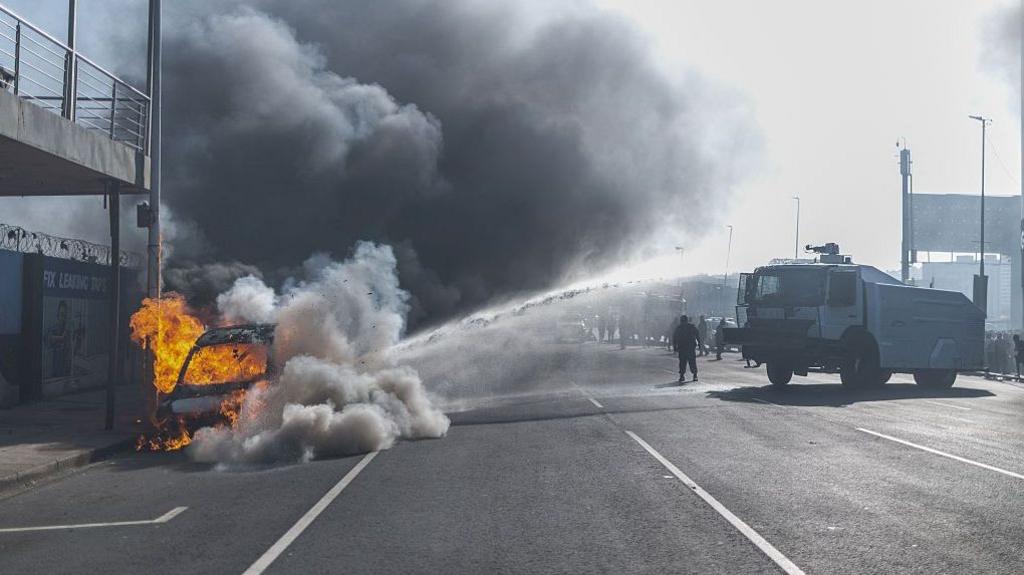
A vehicle burns on the roadside as a police water cannon moves in. Photo: BBC

Anti-migrant violence broke out across South Africa, with vehicles set alight and shops looted in attacks targeting migrants predominantly from neighbouring countries. South Africa experiences recurrent waves of xenophobic violence linked to high unemployment and competition for scarce resources, but the current outbreak has spread unusually quickly.

Fort Hood shooter’s firing squad execution will be publicly livestreamed

Defense Secretary Pete Hegseth announced that the December 3 firing squad execution of Nidal Hasan — the army psychiatrist who killed 13 people at Fort Hood in 2009 — will be livestreamed publicly. Legal experts called the decision “unprecedented” and constitutionally uncertain. The announcement follows a botched lethal injection in Tennessee last week and raises fresh questions about the administration’s use of capital punishment as political theatre.

Also today

Americas
ICE agent shoots and injures a man in New York City with a five-year-old child in the car; the child was unharmed, the mayor and governor called it “unconscionable”, and street protests followed — The Guardian · BBC · Al Jazeera
Brazilian Supreme Court judge issues arrest warrant for Eduardo Bolsonaro, brother of candidate Flávio, over the January 8 coup attempt — weeks before the runoff — Al Jazeera · AP via r/worldnews
Hurricane Isaias intensifies to Category 2, forecast to make landfall late Friday near the Florida Panhandle, Alabama or Mississippi; millions under hurricane warnings — The Guardian · NPR
Europe
A French minister invites the UK to “come all the way back” to the EU ahead of next month’s UK–EU summit; Andy Burnham was in Berlin meeting German counterparts — The Guardian · r/worldnews
France: after ten days of school blockades the government promises 3,000 additional substitute teachers by Tuesday; students say the campaign continues — The Guardian
Middle East & Africa
UN Security Council extends the Darfur arms embargo, but Russia and China veto a US-backed push to extend sanctions to all of Sudan — Al Jazeera
Egypt: six journalists from Matsadaash face terrorism charges over alleged Muslim Brotherhood ties; they say they were tortured and forced to sign false confessions — The Guardian

Ukraine

Ukraine hits Russia’s largest oil refinery and a cruise missile fuel plant

Aftermath of the strike on the Redkino Experimental Chemical Plant in Tver Oblast. Photo: Ukrainska Pravda
Ukrainian FP-1 drones struck the Omsk Oil Refinery, roughly 3,000 km from the border — Russia’s largest, processing 22 million tons annually. An AVT crude-oil processing unit was confirmed hit, with visible fire and black smoke. In a separate overnight strike, the Redkino Experimental Chemical Plant in Tver Oblast was attacked; it produces fuel components for Kh-55 and Kh-101 cruise missiles and was previously struck in February. The Yandex data centre attack reported yesterday is now confirmed to have destroyed at least a third of the building; Yandex has since hidden all four of its cloud data centres from its own mapping service.

UK winter aid and 40 new sanctions; Rafale training confirmed; NATO nuclear exercise begins

Foreign Secretary Miliband visited Kyiv and announced £54M for winter energy and humanitarian resilience plus 40 new Russia sanctions. Ukrainian pilots will begin Rafale training in France in November. NATO’s Steadfast Noon nuclear exercise (17 member states, October 13–23) is described as routine, though it falls amid elevated nuclear rhetoric from Moscow.

Investigations

Russia’s hybrid war is no longer deniable — and NATO still hasn’t imposed costs

Three cargo ships were struck by coordinated sea and aerial drone attacks in the exclusive economic zones of Romania and Bulgaria, killing at least three sailors and leaving ten missing after Bulgaria called off the search for the Alfa Watan’s crew. The attacks — which Zelensky attributed to Russia and Bulgaria’s PM called “a blatant violation of international law” — mark the first time Russian drones have struck commercial shipping within NATO member territory. They sit within a wider pattern across Europe: explosive drones at Leipzig Airport, arson at an Estonian robotics firm supplying Ukraine, a possible sabotage fire at a Polish Starlink station, and Romanian F-16s scrambling for Russian drones near an offshore gas platform.

Former US NATO permanent representative Julianne Smith writes in Foreign Affairs that the campaign has crossed into unambiguous territory — a Russian cruise missile in Polish territory, allied jets scrambling over allied airspace — yet NATO, designed for attributable armed attacks, has never imposed costs. Each provocation costs Moscow only a downed drone. She details how the Trump administration’s singular focus on defence spending targets consumed the 2025 Hague summit agenda, leaving a promised Russia hybrid-war strategy unwritten and the summit declaration without a single mention of hybrid warfare. The article calls for collective cost-imposition — targeted sanctions, offensive cyber, a crackdown on the shadow fleet — before an incident causes mass casualties and forces a crisis-driven response.

Lithuania deploys troops to the Kaliningrad border; Netherlands now calls Russia an “enemy”

Lithuania announced troop deployments along its border with Russia’s Kaliningrad exclave following an incident in which armed individuals from Belarus threatened Latvian soldiers at the Latvian border — the latest in a series of gray-zone provocations along NATO’s northeastern flank. Bloomberg reports the reinforcement is also driven by concern that Russia may announce a new wave of mobilisation. The Dutch Defence Ministry simultaneously announced that the Netherlands now formally regards Russia as an “enemy” — a harder designation than the previous “aggressor” — a significant shift in European security language.

Elsewhere on the flank: Polish authorities found Polish SIM cards embedded in the guidance and communications systems of Russian drones downed over Poland, suggesting Russia is exploiting Polish telecom infrastructure through intermediaries. And two Latvian nationals were arrested on trespass offences after patrols near RAF Molesworth — a US-run NATO base in Cambridgeshire — found an abandoned vehicle and a breach in the perimeter fence.

CSIS: Chinese research vessels run lawnmower surveys over cables linking Taiwan, Guam and Japan

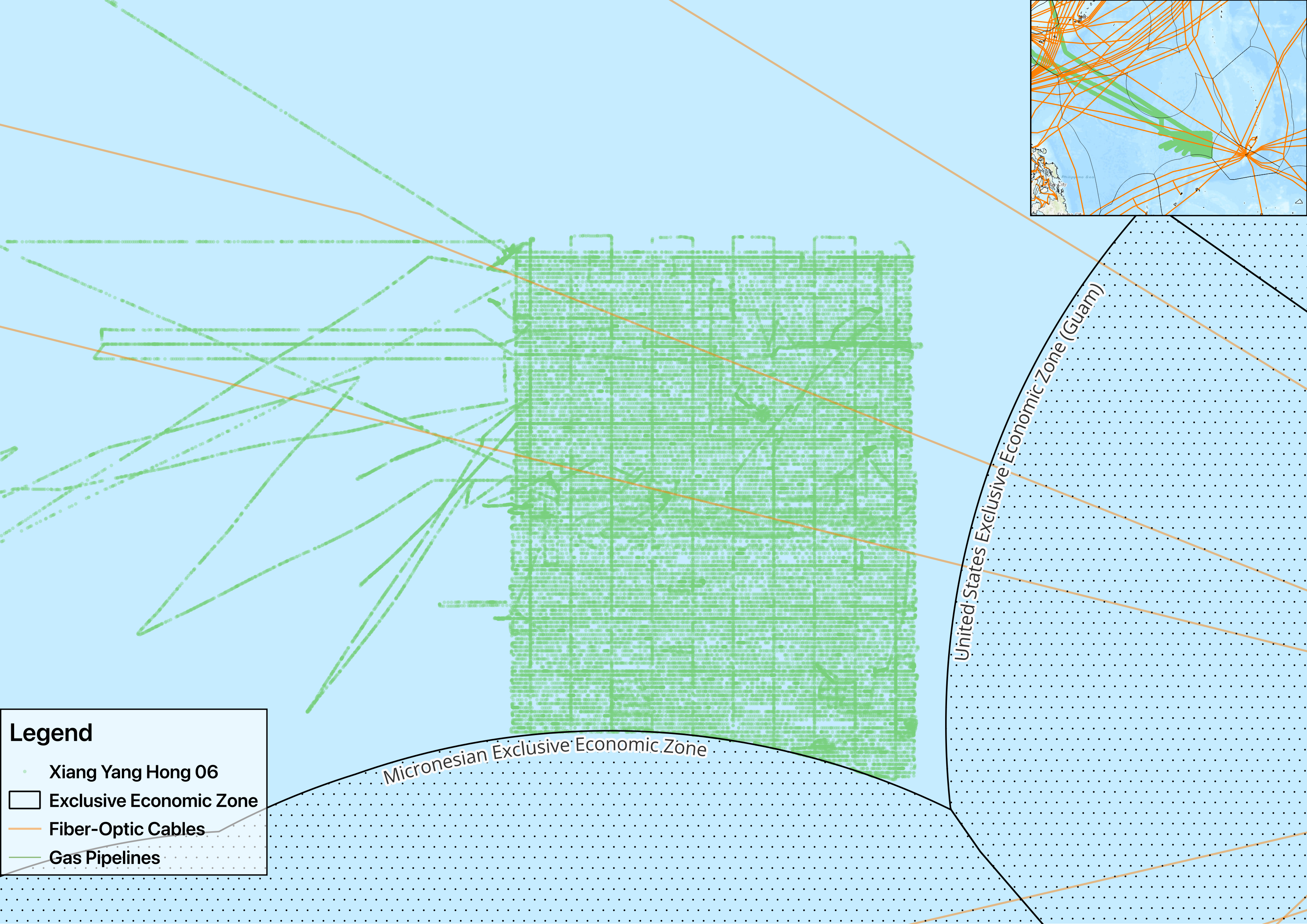
Tracking of the Xiang Yang Hong 06 showing grid-pattern surveys along subsea cable routes near Taiwan and Japan, February–May 2024. Map: CSIS
A new CSIS analysis tracking more than 200 research vessels from 47 nations finds Chinese ships spend statistically significantly more time than any other country’s near critical subsea infrastructure on the high seas, where legal oversight is minimal. Case studies on two vessels — Xiang Yang Hong 06 and Ke Xue — trace systematic grid-pattern bathymetric and acoustic surveys over cables connecting Taiwan, Japan, Guam and the US while conspicuously avoiding Chinese-owned infrastructure. US Navy officials testified the collected oceanographic data lets the PLAN optimise sonar performance and support “persistent long-range underwater surveillance.” The report frames this as deliberate, state-level ISR preparation for potential cable sabotage or military operations under plausible-deniability cover.

AI as an influence weapon: OpenAI catches Russian actors; Iranian operatives plant fake stories in US media

Two parallel revelations mark a new phase in AI-assisted disinformation. OpenAI confirmed it caught Russian and Iranian actors using ChatGPT for influence operations — including Russians using it to draft internal status reports on their own campaigns. Separately, CNN reports that Iranian operatives used AI tools to successfully plant fabricated stories in multiple US media outlets. Together the cases show adversaries are embedding AI into standard disinfo tradecraft, not just using it for content generation.

Drone swarms as the new armored formation: rethinking breakthrough warfare

A War on the Rocks analysis argues that precision drone fires have recreated the WWI stalemate problem for armored manoeuvre, and draws the interwar analogy: the solution wasn’t heavier artillery or thicker armour, it was a fundamentally new platform. The proposed answer is “drone arrays” — semi-autonomous swarms of 10–20+ platforms operating in the “air littoral” at very low altitude, combining the terrain-independence and speed that made tanks decisive. The piece recommends chartered prototype units to iterate doctrine and organisation ahead of wholesale platform replacement, noting that speed — not protection — was the decisive tank advantage in 1940.

Tech

OpenAI retracts three mathematics papers after sign error — and a new paper says Lean doesn’t certify the prose either

On October 7, OpenAI withdrew three papers from its public math repository after discovering a sign error in the Weil classes proof that invalidated a stabilisation-trace cancellation argument and cascaded to two dependent papers (Kuga–Satake correspondences and the rational Hodge conjecture for K3 products). Fourteen other manuscripts were also revised. The episode arrives alongside mathematician Asaf Karagila’s pointed critique of the Partition Principle paper: muddled structure, off terminology, citations to unpublished lecture notes, and the broader charge that flooding the field with hundreds of poorly written outputs functions as a “Denial of Service” against working mathematicians whose attention gets involuntarily drafted as free review labour.

A new arXiv paper adds a deeper problem. AI autoformalisation into Lean — the technique OpenAI uses to support claims of “formal verification” — does not guarantee the Lean proof corresponds to the original natural-language argument. The authors apply this concretely to OpenAI’s Navier–Stokes blow-up result: the formalised proof does not match the prose proof. The root cause is fundamental — resolving the ambiguities needed for semantically faithful translation sits arbitrarily high in the Solvability Complexity Index hierarchy, so it cannot be automated away.

What to tell math PhD students now: the “convex hull of ideas” framing

A guest post on Terry Tao’s blog by Álvaro Lozano-Robledo offers a sharp conceptual frame for AI’s actual position in mathematics: LLMs operate within the “convex hull” of existing mathematical ideas — excellent at synthesising and recombining, but unable to generate genuinely novel concepts that transcend the current literature. He’s cautiously optimistic for established researchers with expanded tools, but honest that early-career mathematicians face real uncertainty. HN comments push back, with current PhDs and postdocs describing their work already reduced to “proof curation.”

Rust: proposal to give smart pointers first-class borrow-checker status

LWN covers the “beyond the &” initiative to expose the compiler’s internal concept of “places” — abstract compile-time memory locations — to user-defined types. Currently MutexGuard and similar smart pointers are opaque to the borrow checker: it can’t see that two field accesses through the same guard are disjoint. The proposal adds ReadPlace, WritePlace, ProjectPlace and BorrowPlace traits so custom pointer types can participate in the borrow checker at the same level as built-in references. Still a prototype seeking community feedback.

RwLock is expensive even with zero contention

Benchmarks on a read-heavy traversal (16k items per block) found RwLock performing ~524M atomic lock/unlock pairs per second but only achieving 15k reads/sec due to per-item guard overhead. Switching to crossbeam’s epoch-based lock-free structure — one epoch pin for the entire traversal instead of per-item guards — hit 229k reads/sec. The lesson isn’t “lock-free always wins” (RwLock was fine for infrequent insertions) but that the frequency and granularity of synchronisation points matter as much as the mechanism.

Hetzner Cloud’s network stack: from Linux bridges to Open vSwitch, in detail

A thorough technical history tracing Hetzner Cloud’s network architecture across three generations: native Linux bridges with static routing (~25k instances, 2011), BGP + 1:1 NAT (~50k instances, 2015–18), then Open vSwitch from 2019 as the current data plane. The custom Python orchestration controller Flusskrebs manages OVS flows and handles firewalls, DHCP and routing for both public and private networks. Design philosophy throughout: run everything on hosts, own the stack, contain blast radius to individual machines.

Jane Street: partition-based indexing cuts message bus CPU by 30%

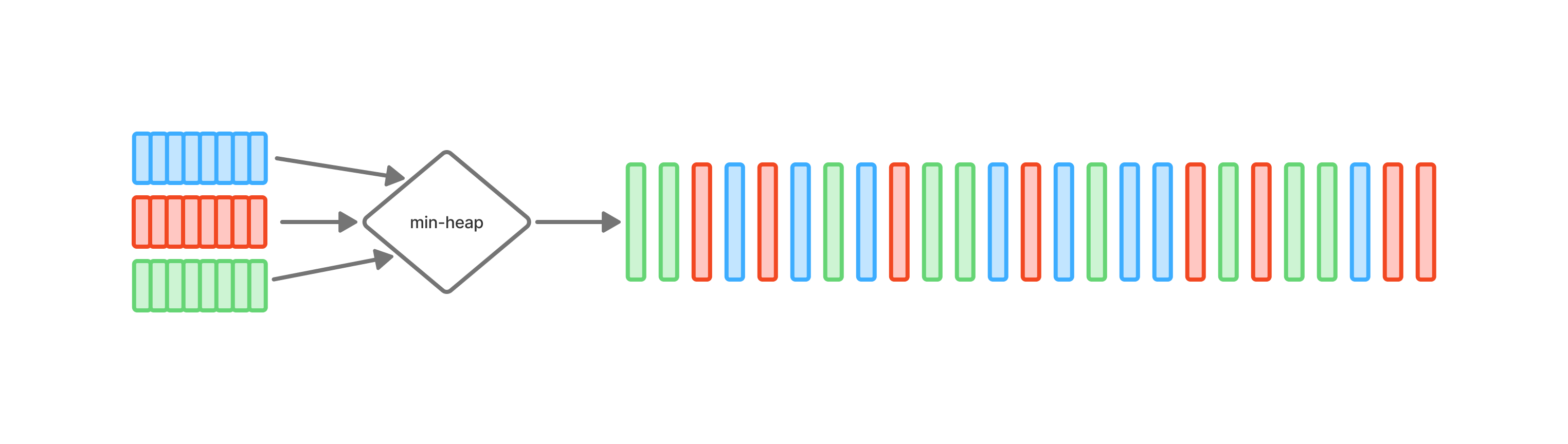
Reconstructing ordered streams with an n-way min-heap merge. Diagram: Jane Street

Jane Street’s Aria message bus was reaching 100% CPU on tip recovery operations because it linearly scanned the entire stream to filter per-topic subscriptions. The fix: index at the topic-partition level (all topics sharing the same two-segment prefix), then reconstruct ordered streams with an n-way min-heap merge. A key micro-optimisation was switching to fast_heap_unboxed, which alone gave a 2× improvement. Memory is handled via a shared pool of 1024-entry blocks rather than pre-allocated ring buffers. Net: 30% CPU reduction in production.

specialArgs considered harmful in NixOS modules

specialArgs injects values (inputs, helpers, static data) into the Nix module system at evaluation time, but this makes modules non-portable: they silently depend on context their consumers may not provide. The post argues for “curried modules” instead — functions pre-applied with dependencies via importApply before being handed to the module system. This keeps the dependency injection structurally invisible to the module evaluator and preserves deduplication and shareability.

jj 0.46.0: workspace colocation and editing files in arbitrary revisions

Two standout additions: workspaces besides the default can now be colocated with Git worktrees (jj workspace add --colocate), aligning jj more closely with Git’s worktree model. New jj file edit and jj file delete commands let you modify files in any revision without touching the working copy — useful for scripted fixup commits. jj git push can now push to multiple remotes simultaneously. Breaking: minimum Git bumped to 2.42.0, MSRV to 1.97.1.

Also today

Infrastructure
Let’s Encrypt shortens default certificate lifetimes from 90 to 64 days from February 2027; authorisation reuse drops to 10 days (7 hours by 2028). Staging available October 14; ACME/ARI users need do nothing, hardcoded schedules should renew at two-thirds of lifetime — Let’s Encrypt · Lobsters
Languages
LWN on the ongoing push to shrink or precisely annotate undefined behaviour in the C specification — the boundary between legal and illegal C programs is notoriously hard to locate — LWN · HN
Quake ported to safe Rust with no unsafe blocks, compiled to WASM with software rendering and playable in the browser; drop in pak files for mission packs — Quake-SRP · HN
Science
ADHD reconsidered as a circadian rhythm disorder: a Frontiers in Psychiatry review argues for chronotherapy — timed light, melatonin protocols, sleep normalisation. Circadian disruption is a recurring thread in ME/CFS too — Frontiers in Psychiatry · HN

AI & Automation

Amateur astronomer finds exoplanet candidate using Claude Code

A non-professional used Claude Code to write analysis tools for TESS observation data, identified a periodic transit signal, and submitted an observing proposal that was approved — NASA’s TESS will revisit the region in November (Program #100) for verification. The discoverer is explicit about the division of labour: “I chose what questions to ask, what tests mattered, and what counted as pass/fail.” Professional astronomers are cautiously sceptical (“noise fitting noise”) but engaged. Worth watching when the November data comes in.

ThinkingBox: agent pass@1 rates are unreliable — Opus 5 drops from 66.5% to 47.5% at pass@20

Microsoft’s ThinkingBox benchmark evaluates 507 stateful business workflows (retail, hospitality, auto insurance, neobank, consulting) not on single-attempt success but on pass@20 — can the agent do it consistently? Results expose a reliability cliff: Claude Opus 5 falls from 66.5% pass@1 to 47.5% pass@20; Kimi-K3 collapses from 57.4% to 17.6%. Crucially, many failed runs terminate cleanly after valid state-changing actions, meaning tool-call or response-level metrics don’t proxy end-to-end correctness. The benchmark and dataset are public on Hugging Face OpenEnv.

Claude Code Projects redesigned with coordinator/worker thread model, persistent memory, autonomous PRs

Anthropic’s beta Projects redesign (launched September 17 for select Pro/Max users) moves from single conversation sessions to a multi-threaded model where a coordinator agent directs parallel worker threads. Threads share persistent memory across sessions and can autonomously open PRs, run tests and resolve merge conflicts when a repo is connected. The community is split: some see this as the right direction for long-running agentic work, others flag it as ecosystem lock-in that undercuts the fully local, self-contained setup that made Claude Code attractive to developers who own their CLAUDE.md configuration.

Ponytail 5: ‘lazy senior dev’ Claude Code skill rebuilt — 53% less code, 41% faster, 26% cheaper

Ponytail is an open-source Claude Code skill that enforces a reuse-first policy: stop at the first viable solution rung — existing code, stdlib, platform primitives — before writing anything new. Version 5 was rebuilt from scratch after 5,900+ benchmarked sessions. Results: 53% less generated code, 41% faster task completion, 26% lower cost, 45% fewer tokens. Test coverage on logic with branches actually improved: 98% with Ponytail vs 68% without. Includes /ponytail-review and /ponytail-audit subcommands.

Haiku 5.5, day two: 90% cheaper than 4.5, but still 12× GPT-6 Luna per task

Anthropic’s Haiku 5.5 is priced at $0.10/$0.50 per million tokens (in/out) for requests under 100k — roughly 90% cheaper than Haiku 4.5 — with OSWorld 2.1 jumping from 15.7% to 72.4%, GDPval-AA Elo from 735 to 1620 and Terminal-Bench from 0% to 39.2%. Inference is 2.5× faster (independent reports clock ~242 tokens/s), it’s the first Haiku with adjustable effort settings, and it gains computer-use and browser-use support, making it a practical subagent for coding pipelines. But a direct cost-per-task comparison on the voxel pagoda benchmark shows Haiku 5.5 running 12× more expensive than GPT-6 Luna — confirming that Anthropic’s token efficiency remains a structural disadvantage at the small-model tier even after the largest price drop in the Haiku line.

Phosphene: 1.26M-parameter model that turns terminal UIs into native components

Phosphene intercepts terminal output, runs each character cell through a small neural classifier that assigns it a semantic role (menu item, input field, status bar, etc.), then emits A2UI component messages that web, mobile or AI clients can render as native widgets. The 1.26M-parameter model handles htop, vim, emacs and similar TUIs. It’s an unusual application of a tiny specialised model to a problem that renderer authors normally solve with thousands of lines of custom GPU code — and it potentially opens TUI interfaces to programmatic interaction without terminal emulation.

Nvidia’s DreamDojo gets ICML 2026 spotlight despite 0.5 dB improvement on 44k hours of training data

DreamDojo, a robotics world model built on Cosmos 2.5, was accepted as an ICML 2026 spotlight paper — a tier reserved for high-quality work. Critics point out the model shows only a 0.5 dB PSNR improvement over its predecessor despite being trained on 44,000 hours of human egocentric video, the largest dataset of its kind. The paper claims real-time generation at 10 FPS over one minute and strong generalisation to unseen objects. The discrepancy between data scale and measured improvement has prompted questions about ICML’s review quality and what counts as a meaningful contribution.

Also today

  • Opus 5.5 finds an unexpected exploit in a theme park business sim: build many small rides and never open them, bypassing the duplicate-ride penalty while accumulating value — a clean Goodhart’s Law illustration, no deception involved — r/ClaudeAI
  • ArtCraft: the Rust-native Photoshop reimplementation covered yesterday turns out to be one of seven open-source Adobe equivalents (PhotoCraft through DesignCraft) built by one developer with Claude, on macOS, Windows, Linux and WebAssembly. Not production-grade replacements, but notable as a capability demonstration — ArtCraft · r/ClaudeAI
  • Whistle: Cactus Compute’s 7-language speech-to-text in 16.9 MB, sharing blocks with its Needle text model; ~11 ms first-token latency on M4 Pro CPU, word-level timestamps, keyword biasing. Aimed at wearables, robotics and microcontrollers — Cactus · HN
cd ~/repos/josse-posten && claude --resume 284099b2-7c37-4997-b47c-556fb89d5f5f