Russia’s largest strike wave in weeks hits Kyiv as drones sink
merchant ships in NATO waters, Iran’s plot against RAF Fairford comes
into focus, and a former German spy chief is arrested for
treason.
Russia’s
largest strike wave in weeks batters Kyiv, Pryluky and Kremenchuk as the
Black Sea becomes a hybrid front
Russia launched 161 aerial assets against 18 locations overnight —
missiles, Shaheds, and jet drones in a single mass wave — a day after
Zelensky warned that intelligence showed a large-scale attack was being
prepared. Pryluky in Chernihiv Oblast was hit hardest: an apartment
building and a children’s centre destroyed, four killed. Kremenchuk took
hits on residential high-rises with fatalities. Kyiv suffered ballistic
missile strikes across three districts, killing two; an unexploded
ballistic missile was found in a residential area in Darnytskyi
district. Zaporizhzhia’s transport infrastructure was also struck, and
train travel across Ukraine is increasingly disrupted as Russia targets
rail.
At sea, the war has crossed into NATO waters. Within 48 hours,
unidentified aerial and naval drones struck three merchant vessels in
Romanian and Bulgarian exclusive economic zones: one ship sunk off
Romania with two dead, two targeted off Bulgaria — one sunk, crew
killed; one damaged. Zelenskyy attributed the attacks to Russia;
Bulgaria’s defence minister said attribution remains unclear, and
Romania has not assigned blame. (Also covered in Ukraine)
Ukraine’s
oil war escalates: tanker ablaze off Sochi, Moscow pipeline hit, and the
world’s stockpile buffer nearly gone
Ukrainian maritime drones set the Liberian-flagged AFRAMAX RIO crude
tanker ablaze off the Black Sea resort of Sochi, producing a massive
fire visible along the coast; the 23-member Indian crew was rescued.
Separately, drones struck the Volodarskaya pipeline dispatch station
near Moscow, 442 km from the border. Ukraine’s MoD reports that strikes
since March have now disabled over 51% of Russia’s refining
capacity.
Russia’s response is telling: the Ministry of Finance announced a
fivefold increase in daily forex and gold purchases starting October 7,
explicitly to devalue the ruble and offset a 10-billion-ruble revenue
shortfall — a direct acknowledgement that the campaign is cutting into
state finances.
The cushion on the other side is thin. Energy executives warned this
week that the world has nearly depleted the strategic stockpile buffer
accumulated over recent years, just as Venezuela’s second-largest
refinery, El Palito, suspended operations after an explosion — adding to
supply constraints already tightened in the Black Sea, Persian Gulf, and
Red Sea.
IRGC
recruited British nationals to hit RAF Fairford with drones and car
bombs
Iran’s Revolutionary Guards planned a multi-pronged attack on US B-1
bombers at RAF Fairford: British nationals were recruited to deliver
drones and car bombs, with a planned village diversion — modeled
explicitly on Ukraine’s Operation Spider’s Web, which smuggled more than
100 drones into Russia via lorries in June 2025. US intelligence led to
the bombers being removed from the base on September 27. Counter-terror
police arrested five British nationals and one British-Iranian.
Trump hinted at the threat publicly while Rubio described the
withdrawal as a “routine reallocation,” a jarring contradiction in the
US public posture. The incident raises acute questions about base
perimeter security against insider-assisted drone attacks.
The FlyDubai investigation is also widening: New Zealand launched its
own probe into co-pilot Hamam al-Hammami after it emerged he spent 175
days in the country as recently as 2019, and an Australian Jewish group
called for an inquiry into his time in Melbourne. The question is how
his radicalisation went undetected across multiple Western
countries.
August Hanning, who directed Germany’s BND foreign intelligence
service from 1998 to 2005 and later served as state secretary in the
Interior Ministry, was arrested on suspicion of passing classified
information to a foreign intelligence service. The foreign power has not
been named. The arrest is extraordinary given Hanning’s seniority and
his decades at the centre of German national security.
It lands the same week that his successor at the BND, Martin Jaeger,
told parliament that Germany risks being drawn into direct violent
conflict with Russia, and the same day a former senior CIA official
pleaded guilty to exposing a clandestine human source to a foreign
government. (Also covered in Investigations)
Three
years since October 7: Israel commemorates as Gaza confronts its
devastation and the West Bank nears a tipping point
Israel marked the third anniversary of the Hamas-led attack that
killed 1,200 people and triggered a conflict now in its fourth year.
Israelis gathered at memorials; survivors of kibbutz Nir Oz, where 47
were killed and 76 taken hostage, grapple with whether to rebuild. In
Gaza, three years of war have killed tens of thousands, destroyed more
than 60% of structures, and collapsed healthcare, education, and basic
services. A National Conservatism conference opened in Jerusalem
simultaneously, drawing US and European far-right figures alongside
Trump administration officials.
In the West Bank, armed settlers attacked AFP photographer Jaafar
Ashtiyeh with rifle butts while he covered settler violence against
olive farmers, hospitalising him. Israeli soldiers were present
throughout but did not intervene. The olive harvest, a recurring
flashpoint, is only getting under way, with incidents sharply up from
previous years. A War on the Rocks analysis argues conditions are now
worse than in either 1987 or 2000; the question is not whether violence
escalates but whether it tips into an organized uprising or stays
fragmented — the distinction that determines whether containment is
possible. (Also covered in Investigations)
| Indicator |
Value |
Change |
| S&P 500 (f) |
7,873 |
-0.01% |
| Dow 30 (f) |
51,711 |
-0.20% |
| Nasdaq (f) |
31,447 |
-0.11% |
| Russell 2000 (f) |
2,841 |
-0.27% |
| VIX |
15.23 |
+1.47% |
| Gold |
4,164 |
-0.56% |
| BTC |
$84,124 |
-1.66% |
| EUR/USD |
1.1190 |
-0.56% |
| USD/NOK |
9.56 |
+0.04% |
- Flat futures and a quiet VIX despite tankers burning off Sochi
and in Hormuz, and executives warning the oil stockpile buffer is nearly
gone (see Leader)
World
Houthis
strike Aden airport; Saudi-backed forces launch Taiz offensive; tanker
hit in Hormuz
Houthi forces fired two missiles at Aden International Airport, with
at least one hitting the runway minutes before a Cairo-bound flight was
due to land. Saudi forces intercepted a Houthi ballistic missile near
Riyadh. Separately, Yemen’s Saudi-backed government launched an
offensive to retake the al-Waziiya district in Taiz province, a
mountainous area key to controlling Mocha port. In the Strait of Hormuz,
a tanker was attacked; Oman evacuated 11 injured Indian crew members
from the stricken vessel.
Democrats
now favoured in key Senate races; Collins breaks with Trump as he
suggests Iran could ‘take out’ Los Angeles
New projection models show Democrats with a clear edge in enough
Senate races to potentially flip the chamber, as Trump’s record-low
approval and the Iran war continue to drag on Republican candidates.
Maine Senator Susan Collins became the most prominent Republican to draw
a firm line in a televised debate, saying she opposes the Iran war and
Canada tariffs. Other Republican candidates are navigating a narrower
tightrope — distancing from the president while trying to avoid a party
split.
The president did not make it easier. Trump made remarks implying
Iran could “take out” Los Angeles and San Diego, which the White House
framed as a warning about the dangers of a nuclear Iran. Gavin Newsom
called the comments “deranged”; politicians from both parties, including
Republicans with military constituencies, condemned them.
Russian media reported a second death connected to the suspected
pneumonic plague cluster in Siberia, following last week’s death of
Vector Institute-linked lab technician Darya Shipilova. Russian
authorities have quarantined hundreds of contacts but say no plague
pathogen was detected in those tested, and the WHO assessed the epidemic
risk as low after identifying all known contacts.
Washington is not satisfied. The State Department issued a formal
démarche to Moscow over the death at the “anti-plague” institute, urging
Russia to fulfil its WHO reporting obligations after it failed to
disclose details about an incident at a facility handling some of the
world’s most dangerous pathogens. Rubio publicly called on Russia to
share more; Russia has offered to cooperate with the US on infectious
disease response.
Separately, Kenya’s health ministry confirmed the country’s first
Ebola death — a citizen who arrived from the Democratic Republic of
Congo on Saturday and died shortly after. Twenty-eight contacts are
being monitored as the outbreak continues to spread rapidly through
north-eastern DRC.
France:
mass school protests erupt across the country; Iran summons French
ambassador
More than 250,000 people — mostly school students and their
supporters — took to the streets across France on October 6–7, demanding
increased education funding and an end to police violence. Riot police
deployed tear gas and water cannons in Paris, Marseille, Lille, and
elsewhere; thousands were arrested. The demonstrations follow the case
of a 15-year-old losing a hand to a police stun grenade. In a sharp
diplomatic signal, Iran summoned France’s ambassador to protest the
government’s treatment of the demonstrators.
India
removes 130 million from voter rolls; mass protests erupt
India’s government has cut approximately 130 million people from the
electoral rolls ahead of upcoming elections, sparking nationwide
protests led in part by the “Cockroach” youth movement, which previously
forced the education minister to resign. Critics say the deletions
disproportionately target constituencies likely to vote against the
ruling BJP and amount to voter suppression at an unprecedented
scale.
EU
plans 15-year probation for new member states — a direct Orbán
lesson
The EU is developing a proposal to impose a 15-year probation period
on newly admitted member states, during which they could face penalties
and have privileges suspended if they backslide on rule of law and
democratic standards. The mechanism is explicitly designed to prevent a
repeat of Hungary under Viktor Orbán, with significant implications for
accession candidates including Ukraine, Moldova, and the Western
Balkans.
Meanwhile EU trade negotiators travelled to Beijing for two days of
crunch talks on China’s record €1 billion-a-day trade surplus with
Europe, with Chinese EV and hybrid exports the central battleground.
Member states have hardened their positions after months of failed
negotiation, raising the prospect of substantial new tariffs if no deal
emerges.
US
death row inmate survives lethal injection — believed to be first
ever
Christa Pike regained consciousness and was described as “awake and
speaking” after her execution by lethal injection appeared to fail.
Lawyers and medical experts called the apparent survival unprecedented,
saying she is the only known person to have survived a lethal injection.
Whether a second attempt would constitute cruel and unusual punishment
remains unresolved; the Tennessee prison chief resigned over the
weekend.
Nobel
Physics Prize: IceCube neutrino observatory wins for detecting ‘ghost
particles’ from space
Belgian physicist Francis Halzen has been awarded the 2026 Nobel
Prize in Physics for his foundational work on the IceCube Neutrino
Observatory, a cubic-kilometre detector embedded in the Antarctic ice
sheet. The instrument detects high-energy neutrinos — near-massless
particles that pass through almost all matter — from distant cosmic
sources including black holes and supernovae, opening a new window on
the high-energy universe.
Also today
- Africa & Middle East
-
Sudan’s army chief al-Burhan rejects peace talks, vows to retake all RSF
territory as fresh clashes kill at least 10 civilians and displace 5,500
in West Kordofan and Blue Nile — Al
Jazeera
-
Libya’s parliament ousts longtime Speaker Aguila Saleh after 12 years, a
key interlocutor for both European governments and Russia — Al
Jazeera
- Europe
-
AfD’s Tobias Rausch elected speaker of a German state parliament — the
first time, and through AfD bloc votes alone — BBC
-
Finland orders Google to halt construction on two data centres after it
failed to carry out required environmental impact assessments — BBC · The
Guardian · Al
Jazeera
- Americas & Pacific
-
US accomplice James Codey Bryant arrested over the Tumbler Ridge school
shooting; the primary suspect reportedly discussed attack planning with
ChatGPT — The
Guardian
-
Argentina moves to block Falkland Islands offshore oil development as
part of a sovereignty strategy “by peaceful means” — The
Guardian
-
Australia’s High Court blocks a coal mine expansion on climate grounds,
a precedent that could affect dozens of pending resource applications —
Al
Jazeera
Ukraine
Drones
sink ships in NATO waters off Bulgaria and Romania — attribution
disputed
Within 48 hours, unidentified aerial and naval drones struck three
merchant vessels in NATO exclusive economic zones: one ship sunk off
Romania (two dead), two targeted off Bulgaria (one sunk, crew killed;
one damaged). Among them was a civilian grain vessel sunk by Russian
drones inside Romania’s EEZ. Zelenskyy stated the Ukrainian Navy is in
contact with Bulgarian counterparts and attributed the attacks to
Russia. Bulgaria’s defence minister said attribution remains unclear;
Romania has not assigned blame. The strikes in NATO EEZs represent a
significant escalation of Black Sea hybrid warfare, regardless of the
perpetrator.
Chonhar
Bridge span collapses, severing Crimea’s main overland supply route
Satellite imagery from September 26 and 30 confirms that Ukrainian
strikes have collapsed a span of the Chonhar Bridge, the key road link
connecting occupied Kherson Oblast to Crimea. The bridge was damaged by
mid-August but intact; by September 30 a span had fallen. The collapse
significantly disrupts Russian military logistics to and from
Crimea.
Russian
losses surge in early October; Ukrainian counterattacks expand across
Donetsk
Russian confirmed personnel losses in the first five days of October
ran 39.7% higher than the same period in September. Ukrainian
counterattacks are visibly broadening: the Kostiantynivka front now
extends to Rusyn Yar, and Operation Vivaldi near Lyman continues to
strain the Russian Western Grouping of Forces — which ISW sources report
has suffered 8,000 deserters and more than 1,000 casualties per week for
six months. Russia’s highest offensive tempo remains around Dobropillya,
where it is attempting to encircle the Fortress Belt, but ISW found no
confirmed advances and debunked milblogger claims that the city is
partially encircled. The General Staff counted 202 combat clashes on
October 6.
Investigations
Germany’s
intelligence chief warns parliament: Russia’s shadow war is escalating
toward armed conflict
BND head Martin Jaeger told the annual parliamentary intelligence
hearing that Germany risks being drawn into direct violent conflict with
Russia, citing the attempted drone attack on Leipzig airport in August
as an example of Moscow’s escalating hybrid campaign. “The confrontation
we are facing with Russia has taken on a new, more dangerous dimension,”
he said. German authorities now assess Moscow as willing to risk kinetic
incidents on NATO territory — a pattern of sabotage, cyberattacks, and
influence campaigns that is intensifying rather than plateauing.
On the eastern flank, the Kremlin issued a formal warning to
Lithuania after officials there signalled openness to hosting NATO
nuclear-sharing arrangements, calling the move a “red line” and
threatening unspecified consequences. Estonia has deployed troops to its
border.
David Rush, a former CIA senior official, pleaded guilty to abusing
his position to acquire hundreds of gold bars and Florida real estate
valued at over $40 million as part of a broader $200 million scheme.
Rush also admitted to revealing the identity of a clandestine human
source to a foreign government. The foreign power and the fate of the
compromised source have not been disclosed. Together with the Hanning
arrest in Berlin, it makes for an unusually bad day for the Western
intelligence establishment. (Also covered in Leader)
European
rearmament is wasting 44 cents per euro through procurement
fragmentation
Investigate Europe documents the cost of Europe’s inability to
procure defence equipment jointly: with €1.2 trillion in planned
spending through 2030, the European Parliament estimates 44 cents of
every euro is wasted compared to an integrated approach. Europe fields
178 different weapons systems versus the US’s 30; Ukraine’s commanders
described managing the resulting “technological zoo” as a severe
logistical burden. Germany’s Puma infantry fighting vehicle costs around
€20M per unit because it is procured in small national batches; the
CV90, standardized across nine countries, costs around €10M. Despite a
Defence Readiness Roadmap, only 10% of European defence spending flows
through joint EU procurement — governments consistently prioritize
national industrial sovereignty over efficiency.
Iran
will need 2–3 years to rebuild its missile and drone arsenal
War on the Rocks assesses the damage inflicted by Israeli and US
strikes in 2024–2026: over 40 ballistic missile sites, nearly 20 cruise
missile facilities, and more than 20 drone production centres were hit,
severing supply chains and rolling back decades of self-sufficiency.
Iran’s three near-term options — assembling from pre-war stockpiles,
buying from Russia, China or North Korea, or rebuilding underground —
all face serious constraints: continued sanctions and Israeli covert
operations, high detection risk for new facilities, and the hazards of
moving dangerous processes underground. Critical bottleneck capabilities
could recover in months, but broader industrial production likely
requires 2–3 years — a window that shapes near-term calculations across
the region, including Tehran’s turn to proxies and plots like the one
against RAF Fairford.
The
myth of military victory: all modern wars end at the bargaining
table
Biddle, Winter-Levy, and Zhukov in Foreign Affairs make a careful,
data-driven argument that “military victory” — forcing a prostrate enemy
to accept terms without negotiation — is a dangerous myth that has
driven every recent strategic miscalculation. Even World War II: Japan
surrendered with 6 million soldiers still in the field, after the
Potsdam Declaration implicitly conceded that Hirohito could keep his
throne. Iraq 2003: the US disarmed the uniformed military in seven weeks
but then suffered 33,000 casualties over eight more years because Sunni
Baathists rejected the implicit terms on offer. The pattern repeats in
Afghanistan, Gaza, and Ukraine. Battlefield success shifts bargaining
leverage; it never replaces bargaining. The myth has led the Trump
administration into an Iran stalemate, Netanyahu into a Gaza war with no
endgame, and Putin into a quagmire — and could trap Washington in a
Taiwan conflict if it assumes military dominance translates into a clean
outcome.
The
West Bank is at its most volatile since 2000 — and the conditions for
intifada are worsening
War on the Rocks sets out why conditions in the West Bank are now
worse than in either 1987 or 2000: systematic settler violence
increasingly occurring with IDF acquiescence, severe constriction of
Palestinian daily life, and virtually no sense of any political future.
The key uncertainty isn’t whether violence will continue to escalate —
it almost certainly will — but whether it tips into an organized
uprising, as in the first intifada, built on civil society structures
and mass participation, or remains fragmented and sporadic. That
distinction, not the level of violence itself, determines whether
containment is possible. Tuesday’s beating of an AFP photographer in
front of watching soldiers is the texture of the problem. (Also
covered in Leader)
A Bellingcat investigation found that two US nonprofits — Ekal USA
and Sewa USA — whose founding leadership has documented ties to India’s
RSS Hindu nationalist organization received at least $24.4 million from
donor-advised funds between 2020 and 2024, out of a combined $117.8M in
total contributions. Ekal USA’s chairman was a former VHP Houston
chapter president who regularly hosted RSS leaders; Sewa USA is linked
to Sewa Bharati, prominently featured on the RSS website. Donor-advised
funds allow near-anonymous giving with minimal IRS oversight, meaning
the original donors are largely untraceable. The investigation raises
broader questions about US charitable law being used to fund Hindu
nationalist infrastructure abroad — the same week India’s government
struck 130 million people from its voter rolls.
China
is entering a century of demographic decline — and political paralysis
is making it worse
Carl Minzner’s Foreign Affairs essay is one of the more unsettling
long-form analyses of China’s trajectory in recent years. China’s total
population is already falling 3–4 million per year; by the 2040s it may
shed 10 million annually — more than New York City. The one-child policy
plus East Asian fertility collapse means the pension system covering 500
million urban workers faces insolvency by the mid-2030s, yet retirement
age reform has been glacially slow to protect urban party
constituencies. Xi Jinping’s consolidation into one-man rule has
produced the same rigidity that characterized the late Ming dynasty:
cadres execute central mandates regardless of consequences, with
Shanghai’s COVID lockdown the emblematic case, and nativist
anti-foreign-spy messaging has made immigration — the standard
demographic remedy — politically toxic; a 2025 STEM visa triggered a
furious xenophobic backlash. Minzner closes with a warning: demographic
decline combined with political erosion can hollow out any great power,
including the United States.
AI
and the kill chain: two War on the Rocks essays on where the real risks
lie
On biosecurity, the magazine stakes out a pragmatic middle ground: AI
cannot yet synthesize truly novel pathogens (designs must remain at
least 92% identical to existing viruses), but it substantially lowers
the barrier to enhancing transmissibility, immune evasion, and
cross-species infection. Anthropic disclosed five cases of users
concealing their nationality while requesting pathogen enhancement
assistance from Claude. The case for preparedness over prohibition: DNA
synthesis order screening, export controls on synthesis instruments,
prototype vaccines for major viral families, and wastewater
surveillance. The threat profile more closely resembles natural pandemic
risk than an extinction-level scenario — which matters for how
governments prioritize.
On targeting, Dan Summers argues that the speed and scale advantages
of AI-enabled kill chains could paradoxically undermine Western
strategic power if automation eliminates meaningful human oversight. The
West’s 80-year advantage rested not just on deterrence but on the moral
legitimacy of accountable, discriminate warfare — something
authoritarian rivals cannot credibly claim. Racing to match them
concedes that asymmetry. The proposed fix: use AI to redesign oversight
so it can operate at machine speed, rather than removing oversight to
achieve speed. “Restraint is the architecture of the legitimacy that
holds alliances together.”
Tech
Three
ccTLD hijacks yield counterfeit TLS certs for Google and major
services
Attackers seized control of three country-code top-level domains —
.gh (Ghana), .sl (Sierra Leone), and .as (American Samoa) — then rewrote
authoritative DNS records for targeted domains to pass automated domain
control validation and mint unauthorized TLS certificates for Google and
unnamed major services. Crucially, neither the CAs nor the domain owners
were compromised: the attack exploited the trust chain’s fundamental
dependence on DNS integrity. Google updated Chrome to block identified
certs and is working with CAs on revocation, but warns that browser-side
intervention isn’t reliable and urges domain owners to monitor
Certificate Transparency logs and publish restrictive CAA records. Any
undiscovered certificates remain live threats.
OSC
7501: a terminal protocol for programs to announce their own status
Mitchell Hashimoto (Ghostty) proposes OSC 7501, a terminal escape
sequence letting programs emit structured key=value state —
idle, working, done,
blocked, or error — with optional progress
percentage and human-readable reason. This replaces the fragile
heuristics (screen-scraping, window title patterns) that notification
tools currently use to guess program state. Implemented in Ghostty’s
libghostty and Rex, with proof-of-concept integrations already in Claude
Code, Terraform, and Homebrew. Works cleanly over SSH and in
containers.
In the same spirit of glanceable status, Montray is a small GTK
utility that puts a tray icon showing the health of monitored systemd
services — green, yellow or red, click for details — so you know a
background service has crashed without digging into
systemctl status.
COSMIC DE is
closing the gap with KDE Plasma
Detailed feature comparison: COSMIC, System76’s Rust-based desktop,
now has instant appearance changes without reloads, system-wide corner
radius and density controls, per-surface dark/light colorschemes,
per-panel opacity, and exportable .ron settings files.
Tiling with stacking is described as excellent. The author stops short
of “better for most users,” but the UX polish gap with Plasma is clearly
narrowing — and COSMIC’s Rust-native architecture means fewer of the
long-tail theming footguns that have historically made KDE customization
brittle.
Janet
on x32: 32-bit pointers on a 64-bit system yields 25% RAM savings with
no speed loss
The x32 Linux ABI uses 32-bit pointers while retaining full 64-bit
registers and instruction sets — unlike -m32, which halves
available registers and causes roughly 50% performance regressions.
Compiling Janet with -mx32 produces consistent 21–32% RAM
reductions across workloads with no measurable speed cost. The author
notes Janet’s nanboxed value representation is a worst case for x32
benefits (already 8 bytes per value), making the savings more
impressive. Particularly useful for long-running daemons. The ABI is
tragically underused because most distributions don’t enable it by
default.
Bidirectional
type slicing: explaining why an expression has its type
New PL theory paper introducing type slicing: given any part
of an expression’s type information, return a minimal slice of the
program that explains why that type holds. The bidirectional extension
handles both inference and checking directions. The practical payoff is
in tooling — instead of just reporting x : List[Int], an
IDE could highlight exactly which parts of the code constrain that type,
making type errors and inference results genuinely explainable.
Active thread on self-hosted email stacks. The field is remarkably
stable: NixOS mailserver (postfix + dovecot + rspamd, declarative
config) and OpenSMTPD + Dovecot + Rspamd on OpenBSD are the two dominant
setups. Postfix + Cyrus IMAPD is alive and well for 25-year veterans.
Common theme across all: outbound reputation is the hard part — SMTP2GO
or a similar relay for residential IPs; Gmail remains the worst receiver
for non-datacenter sources. No clear winner on deliverability, just
different pain distributions.
Also today
- Brut: Sam Stephenson’s single-file POSIX shell router that
dispatches CLI arguments to separately named executables — namespaces,
shared libraries, hooks, no dependencies — for when a shell script
passes 200 lines — Brut · Lobsters
- AI-generated ad-stripped clones of Photopea pile up on GitHub; DMCA
requests ignored for a month, since each repo is technically a novel
output — HN
- The art of defusing a WWII bomb: a Guardian interactive on the
physics, the procedure and the people, on a subject that quietly keeps
happening — The
Guardian · HN
AI & Automation
Claude
Code’s persistent agent catches a live crypto-miner on Ben Thompson’s
Mac
Ben Thompson’s Mac Mini was compromised via CVE-2026-65400, a macOS
screen-sharing vulnerability that granted root access. Claude Code was
running as an always-on monitoring agent on a 30-minute restart cycle.
On one restart it flagged the infection: a malicious hook injected into
/etc/zshenv, a mining script at /var/tmp/.xmr
with Chinese-language comments, and falsified 1969 timestamps meant to
evade detection. Claude halted further command execution, then helped
Thompson pinpoint the four-second breach window and remediate. The story
is less about this specific incident and more about what persistent
agentic monitoring actually buys: a security layer that catches things
no scheduled scan or human review would have noticed in real time.
“Prompt like a Butterfly, Sting like a Tracker,” accepted to PoPETs
2027, analyzed the web and mobile versions of nine chatbots — ChatGPT,
Claude, Gemini, Grok, DeepSeek, Perplexity, Le Chat, Meta AI, Copilot —
in May 2026. Key finding: multiple providers share conversation-derived
artifacts (titles, prompts, screenshots) with third-party advertising
and tracking services and expose conversation permalinks without access
controls. Claude is not in the clear. The research was disclosed to
affected providers and to European data protection authorities; the full
breakdown by provider is in the paper.
Mythos
5.1 unlocked for CVP members as Anthropic expands Cyber Verification
Program
Anthropic’s Mythos 5.1 — co-launched with Fable 5.1 as the company’s
most advanced model tier — is now accessible to users enrolled in the
Cyber Verification Program, which formally expanded October 6. CVP
members describe it as dramatically better for binary decompilation,
reverse engineering, and security research tasks that previously hit
safety walls on standard Claude tiers. The model appears under “More
Models” in the CVP-verified account UI. The expansion is the mechanism:
verified security professionals get access to capabilities gated by
default.
OpenAI
publishes AI-generated math results with Lean-verified proofs
OpenAI released a broad set of new mathematical results produced by
an internal frontier model, published as a GitHub repo with Lean
formalizations for computer-verified proofs. Average compute per result:
roughly three hours of ChatGPT Pro. Produced in consultation with an IAS
advisory group on AI and mathematics, with transparency summaries of
model reasoning and problem attempt statistics. This goes beyond
benchmarks — AI as a working research collaborator proving new results,
with machine-checkable derivations.
SWE-Race:
coding agents score near-zero on real concurrency bugs
A new benchmark built from 188 real concurrency bugs — race
conditions, deadlocks, cancellation issues — pulled from merged PRs
across 106 Python projects. Each task is graded by the project’s own
hidden tests in an offline container: no network, repo pinned to a
single commit. Three models tested so far (GLM-5.3 Flash, GPT-5.6 Luna,
DeepSeek V4 Flash) via a BenchGen agent at medium effort: best overall
pass@1 is 1.9%, though the harder 55-task subset reaches 49.9% for the
top model. The near-zero overall score isn’t cherry-picked — it reflects
a real capability gap. Concurrent correctness requires reasoning about
non-local, non-deterministic interactions that current agents struggle
with even when the fix is small.
Two
sober takes on Claude Code: the review burden, and where the money
actually goes
A developer post with unusual clarity argues that Claude Code creates
a false dilemma for teams writing real production code. If you accept AI
output with light review you’re vibe-coding, which is fine for
disposable projects but not critical systems. If you review rigorously
enough to actually catch AI errors in a complex codebase, you spend more
time than you’d have spent writing it yourself. The thread generated
substantive disagreement — several commenters described it working well
for self-contained, well-specced tasks — but the core point about the
review burden for safety-critical paths hasn’t been effectively
rebutted.
Another developer priced six months of their own transcripts at API
rates: 56% of cost came from the model re-reading the conversation on
every call (common calls were carrying 200K+ tokens), while only around
20% went to output with direct value. The practical thread on
mitigation: /clear before unrelated tasks is the
low-friction fix; more structural solutions involve context-window-aware
session management. The productivity argument lives or dies on whether
you can control the denominator.
Meanwhile LiveNerf, the 30-day independent daily benchmark tracking
whether Opus 5.5 quietly degrades post-launch, has its first 10-day
baseline complete with no missed runs and, as of day 13, no
statistically significant accuracy decline. It tests 78 calibrated
questions daily, tracks output token counts as a leading indicator, and
runs a control arm on an older Opus 5. Sensitivity is about ±7.5 points
per 10-day window.
Armin
Ronacher: Codemode is the right abstraction layer for agents
Ronacher writes about “codemode” — running JavaScript sandboxed
inside the agent harness rather than the execution environment. The
practical advantages over bare tool calls: larger structural responses
without ballooning context, direct access to internal model APIs (image
generation, classifiers), concurrent operations in a single turn, and
state persistence in the transcript. He frames MCP servers as not yet
optimized for this pattern — they should return structured JSON and
support cross-server tool discovery. His view: the ecosystem has
converged on what he argued a year ago, that code is the correct
coordination layer for agents.
Two releases point the same direction. OpenAI’s Decisions API (public
beta, gpt-6-luna only) returns typed answers to classification questions
— predicate, choice, or score — at a claimed 10x the speed of the
Responses API, aimed at routing, triage and prioritization steps in
agent pipelines. And Treg functions as “OpenRouter for tools”: a
single-endpoint proxy aggregating thousands of API endpoints with
server-side credential injection, so agents search for capabilities by
task and never touch API keys.
A
300M model learns to compress text in six languages without seeing a
word of any language during training
Researchers trained a 300M-parameter Prior-Fitted Language Model
exclusively on synthetic data from structural causal models — no real
text, no natural language, nothing linguistic. At inference, given
sufficient context, it compresses Wikipedia down to 0.9–2.4 bits/byte
across six languages (versus roughly 8 bits/byte baseline) and
outperforms gzip on source code and speech. The implication: language
acquisition may rely on universal statistical structure rather than
language-specific priors. It extends the Prior-Fitted Networks line
(TabPFN) to language and opens a question about what “knowing” language
actually requires.
Yandex Music replaced their entire candidate-generation-plus-ranking
cascade — 15+ specialized candidate generators, a pre-ranker, and a
ranker consuming hundreds of hand-engineered features — with Sona, a
single jointly-trained encoder-decoder model. Production A/B test on the
My Vibe smart speaker surface: +4.53% active users, +6.30% listening
time, +11.42% likes. The active-users gain was 2.35× that of Argus, the
strongest model the system had previously shipped. The story fits a
pattern: unified models eating specialized ML pipelines, reducing
engineering surface area while improving metrics.
OpenWAM:
Stanford’s unified framework for composable world-action models
Stanford releases OpenWAM, a composable framework integrating video
prediction with robot control via a shared 5B Wan2.2-based foundation
model. Key contributions: configurable generation order
(video-then-action, action-then-video, joint, or decoupled) without
changing the backbone; a 32K-segment counterfactual dataset; and
local-context dynamics models that transfer across tasks when only the
video predictor adapts. Achieves 98.6% on LIBERO benchmarks and 92% on
real bimanual manipulation. It addresses the fragmentation problem where
every robotics lab uses incompatible video backbones and training
procedures, making design choices impossible to compare.
 Smoke rises over Kyiv during
Russia’s missile and drone attack on October 7. Photo: Gleb
Garanich/Reuters.
 The Volodarsk dispatch center near
Konstantinovo, Moscow Oblast, on fire after a Ukrainian drone strike,
October 6.
 Former BND director August Hanning
photographed in Berlin in 2015. Photo: AP.
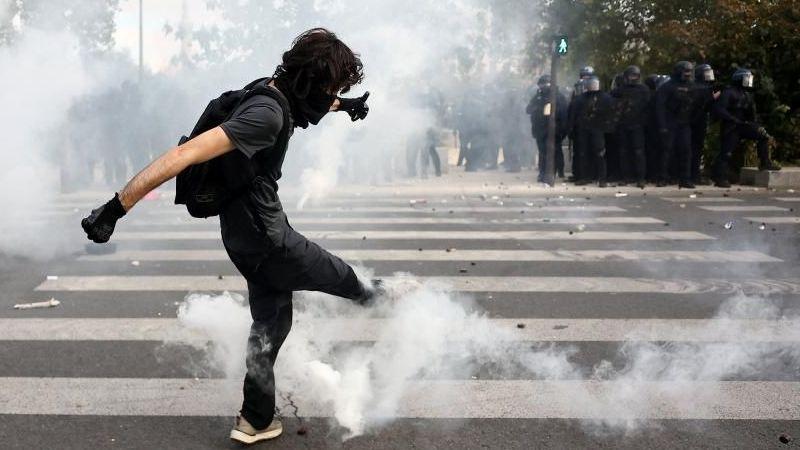 A masked student attempts to kick a
tear gas canister amid clashes with riot police in Paris. Photo:
Reuters.
 The IceCube Neutrino Observatory in
Antarctica at night, with the Milky Way overhead and the aurora on the
horizon. Photo: Yuya Makino/IceCube/NSF.
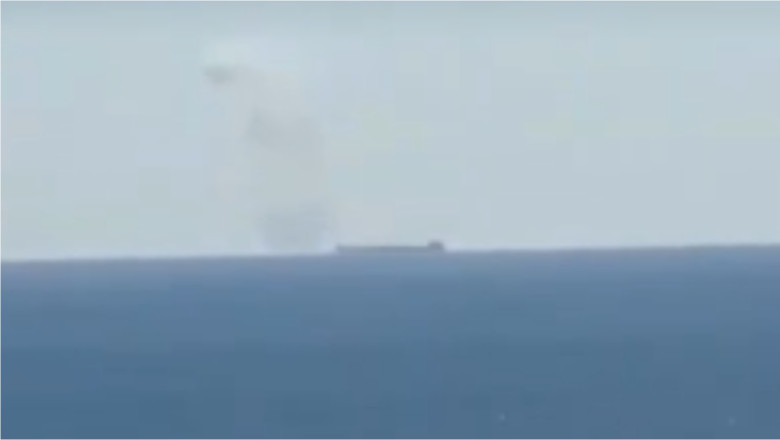 Smoke rises over the Royad Mammadov,
a cargo ship struck by a drone in Romania’s Black Sea exclusive economic
zone, October 5.
 A destroyed span of the Chonhar Road
Bridge, September 30. Source: Dnipro OSINT.
 The site of the Russian missile
attack on Pryluky, Chernihiv Oblast, October 7. Photo: National Police
of Ukraine.
 Martin Jaeger, head of Germany’s
BND, at the parliamentary hearing. Photo: Sean Gallup/Getty Images.
 A CV90 infantry fighting vehicle,
used by nine European nations and half the per-unit cost of Germany’s
nationally procured Puma. Credit: Shutterstock.
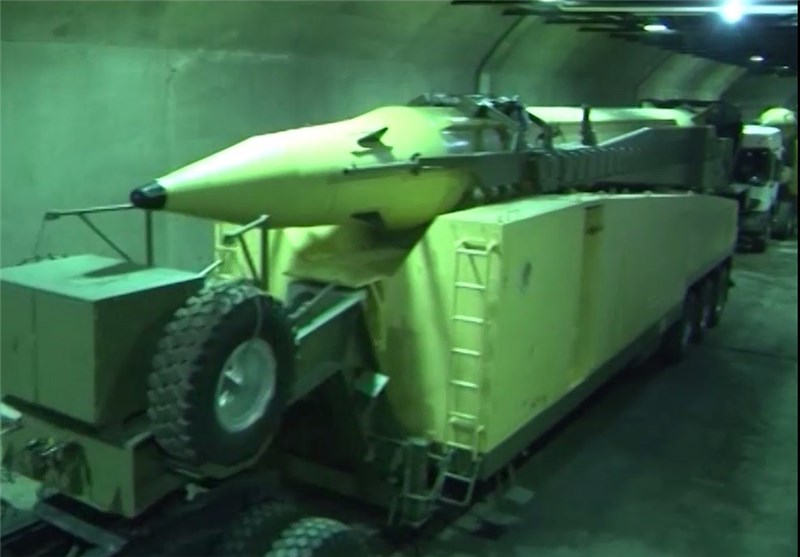 An Iranian underground missile
storage and production facility.
 RSS volunteers at a rally in India.
Credit: Prabhat Kumar Verma/ZUMA Press Wire via Reuters Connect.
 COSMIC desktop with the subtle
default frosted glass effect.
 Claude Code’s diagnostic report
listing the malicious zshenv hook, the mining script location, and
falsified timestamps.