Josse-posten

Diplomacy runs on all tracks at UNGA — Zelensky offers an energy truce while Kyiv burns and Moscow counts 450 drones, Iran dangles Hormuz, and the EU quietly lets two of Putin’s oligarchs off the list.

EU extends Russia sanctions but delists oligarchs Usmanov and Fridman in French-brokered deal

The EU renewed its Russia sanctions package — extending restrictions on nearly 3,000 individuals and entities before a deadline — but removed Alisher Usmanov and Mikhail Fridman, two figures in Putin’s inner circle, from the list after France pushed for the delisting to secure consensus. Latvia gave in to French demands, diplomats say; Ireland’s EU presidency called it “a difficult compromise.” In what appears to be a linked transaction, Azerbaijan’s President Aliyev promptly pardoned French citizen Martin Ryan after France lobbied for his release. Ukraine condemned the move as sending Moscow “the wrong signals” at a moment of active war. (See also Investigations for the parallel US sanctions carve-out.)

Zelensky at UNGA: energy truce offered, Xi invited, tariffs threatened — Kremlin sees no path to talks

At a joint press conference on the sidelines of UNGA, Zelensky and Trump both said they want the war ended before winter. Zelensky offered a ceasefire limited to long-range strikes on energy infrastructure — the US will convey the proposal to Russia — and expressed openness to a trilateral meeting with Trump and Putin. He urged Trump to bring Xi Jinping into negotiations, saying Xi “has influence on Putin,” and warned that Putin may attack a NATO country to fracture Western unity and distract from heavy Russian losses. Trump said he would deploy the Graham bill’s tariff powers “if necessary” — 100% tariffs on top buyers of Russian oil and gas — framing them as leverage rather than punishment, and signalled openness to another Putin meeting. The Kremlin responded that there is no path to peace talks yet, while again inviting Zelensky to Moscow. Finland’s Stubb told Putin “you guys are not going to win this”; Estonia’s foreign minister said Putin is “using Trump to stall for time.” Zelensky also met CIA chief Ratcliffe in Ireland ahead of UNGA.

Iran offers to reopen Hormuz within seven days after first US talks since June

Iran and the US held three hours of mediated talks at UNGA — the first since a June ceasefire collapsed — with Foreign Minister Araghchi participating alongside US envoy Witkoff, who described mediators “shuttling between” the two sides. A senior Iranian official told Reuters Iran can reopen the Strait of Hormuz within seven days if the US eases military pressure and lifts its blockade on Iranian ports, a significant relaxation from its previously onerous preconditions; Iran’s military central command confirmed the communication. Trump called it a “very good meeting” hours after threatening in his UNGA speech to “annihilate” Iran — a dual-track posture Iran’s Armed Forces warned would be met with “crushing” counterattacks. Another round is expected “in the very near future.” Oil fell over 3% on the news.

Claude Opus 5.5 and GPT-6 Sol land on the same day

Anthropic released Opus 5.5, matching Fable 5.1 on most tasks at 40% lower cost ($4/$20 per million tokens) and 30% faster than Opus 5. OpenAI answered within hours with GPT-6 Sol ($2/$10) and Luna ($0.10/$0.50), a 50%+ API price cut. Community head-to-heads show Opus 5.5 leading across the full suite, including a meaningful gap on GDPval real-office work where Sol regressed ~100 Elo; Sol’s argument is half the input price at a comparable tier. Xiaomi’s MIT-licensed MiMo-V2.6 topped the open-weight leaderboard the same day. (Full coverage in AI & Automation.)

Indicator Value Change
S&P 500 (f) 7,834.75 +0.04%
Dow 30 (f) 52,261 -0.03%
Nasdaq (f) 31,019 -0.03%
Russell 2000 (f) 2,903.4 -0.37%
VIX 14.17 -0.28%
Gold 4,350 -0.60%
BTC $85,906.67 +0.05%
EUR/USD 1.1415 -0.28%
USD/NOK 9.4685 +0.29%
  • Oil dropped over 3% (Brent to $99.18) after Iran signaled it could reopen the Strait of Hormuz within a week (see above)
  • Nasdaq futures dipped slightly overnight even as the index sits at a record close, up 17% YTD on AI-stock enthusiasm (see World)

World

Greenland deal signed at UNGA: US gets two new military bases, Denmark sovereignty reaffirmed

The US and Denmark formally signed their defence agreement at the UN General Assembly, confirming the US will build two new military bases in Greenland. Trump declared it gives Washington “permanent security control” over the Arctic territory; the signed text reaffirms Denmark’s sovereignty over Greenland, which is semi-autonomous. NATO welcomed the deal, Greenlanders expressed a mixture of hope, scepticism, and fear, and The Economist noted that despite the agreement, Trump’s months of annexation threats have “already done” lasting diplomatic harm.

UK’s Burnham meets Trump, refuses to rule out EU rejoining, freezes Chagos payments — and launches a space squadron

Andy Burnham held his first face-to-face meeting with Trump at UNGA, with Trump saying he “gets it” while criticising the Chagos Islands deal as “terrible.” Defence Secretary Streeting subsequently announced UK annual payments to Mauritius — worth at least £120m per year — have been frozen pending review of the Diego Garcia base arrangement. Burnham declined to rule out the UK eventually rejoining the EU, and Canada is pushing for a UK-Canada-EU trilateral defence structure, with the European Commission opening the door to Canada as an associate EU member. Burnham also announced a new RAF unit (No III Space Effects Squadron) to defend British satellites and a National Centre for Information Defence to counter Russian-state disinformation and deepfakes, which he called a “poisonous tide.” Separately, the UK agreed to provide defensive air support to Saudi Arabia against Houthi fighters, framing Middle East stability as directly tied to UK domestic energy costs.

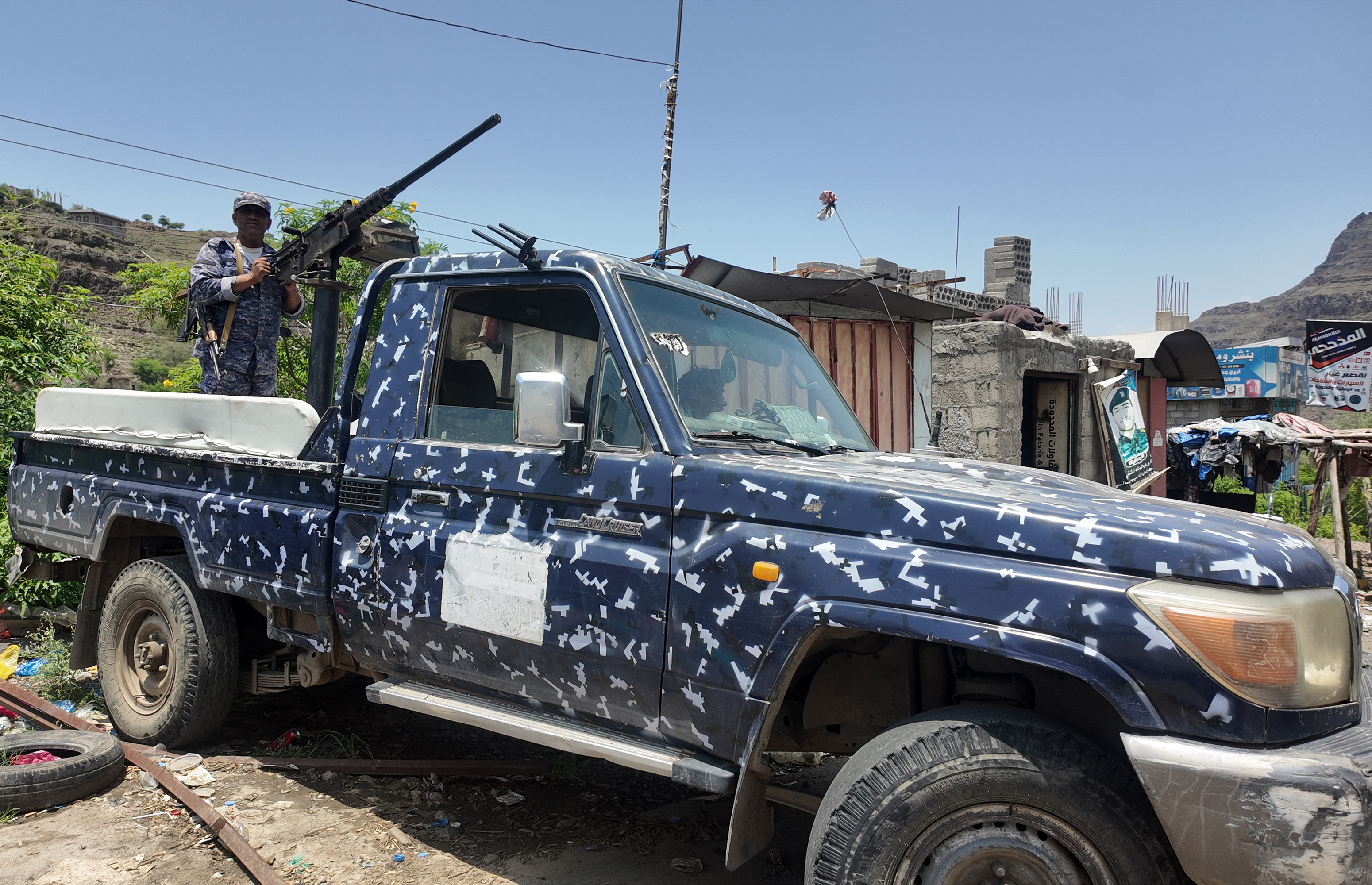
169 killed in three days as Houthis and Saudi-backed forces battle for Yemen’s Red Sea heights

A Saudi-backed Yemeni government soldier mans a gun turret at a front-line checkpoint in Taiz governorate. Photo: AFP via Al Jazeera

Up to 169 people have been killed and 158,000 displaced this month as Iran-aligned Houthis fight Saudi-backed government forces for strategic highlands overlooking Yemen’s Red Sea coast. Government forces claimed control of Mount Qarfan in Taiz — a position giving commanding fire control over surrounding valleys — after “fierce battles.” The WHO reports 674 killed and nearly 3,000 injured since renewed fighting erupted on August 6, with civilians bearing the highest costs as residential neighbourhoods in Taiz city were also shelled.

Record El Niño projected to cause 450,000 deaths in six months; Hurricane Polo explodes to Category 5

Scientists say the developing El Niño is the strongest on record, and a new study projects 450,000 additional deaths globally in the next six months from associated extreme weather. The pattern is already visible: Hurricane Polo intensified from a tropical storm to a rare Category 5 in under 24 hours off Mexico’s Pacific coast, with sustained winds of 165 mph powered by abnormally warm El Niño waters. Mexico suspended classes and shut ports in Guerrero and Michoacán, though the storm is expected to skirt the coast rather than make direct landfall.

US and China reject AI slowdown calls; Senate staff barred from the tools they’re trying to regulate

As Trump and Xi prepare for a summit expected to produce only token AI safety cooperation, both governments have rebuffed calls from AI researchers and executives for a coordinated development slowdown — each viewing such calls as an attempt to lock in the other’s disadvantage. In a pointed irony, NPR reports that US Senate staff are explicitly barred by the chamber’s sergeant at arms from using any advanced AI tools, citing data security concerns. Meanwhile, British Columbia has sued OpenAI and Sam Altman, alleging the Tumbler Ridge school shooting could have been prevented had the company warned police that the shooter was using ChatGPT — the first major state-level action of its kind in North America. None of it dented the Nasdaq, which closed at a record high, up 17% year-to-date, led by Nvidia, Apple, and Microsoft.

Also today

Americas
DOJ defends Trump’s ban on CNN, MS NOW, and Politico from White House access as a national security matter in first court hearing — NPR: hearing · NPR: outlets · BBC
The Netherlands braces for potentially devastating US sanctions against the ICC over its Iran war crimes probe; EU weighing countermeasures — AP · HN
Middle East & Africa
UN Population Fund documents a surge in violence against women in Gaza, including forced marriages; Macron says it “should shame all of us,” Canada pledges $71m for two-state efforts — BBC · Al Jazeera
Ethiopian Airlines suspends Tigray flights after Tigrayan forces seize Mekelle airport, threatening the 2022 Pretoria peace deal — Al Jazeera
US aid withdrawal has put African healthcare “under growing strain,” Accra Reset coalition report warns — Guardian
Asia-Pacific
Pakistan arrests Imran Khan’s three sisters and seals Islamabad roads ahead of a September 27 protest march; PTI says authorities are “slowly killing” him — Guardian · Al Jazeera
Philippine Senate redefines the two-thirds threshold to convict Sara Duterte, counting only senators able to participate — Inquirer · r/worldnews
Sri Lanka convicts 15 men for the 2019 Easter Sunday bombings, each sentenced to over 220 years — Guardian · BBC · Al Jazeera
Australia investigates how classified F-35 parts bound for the US went missing in Hong Kong — Guardian
UN
Erdoğan calls for stripping UNSC permanent members of veto power; leaders across UNGA describe the Council as “failing to function” — Ukrainska Pravda · Al Jazeera · r/worldnews

Ukraine

Russia strikes Kyiv with 161 drones as Ukraine fires 450 at Moscow in its largest-ever attack on the capital

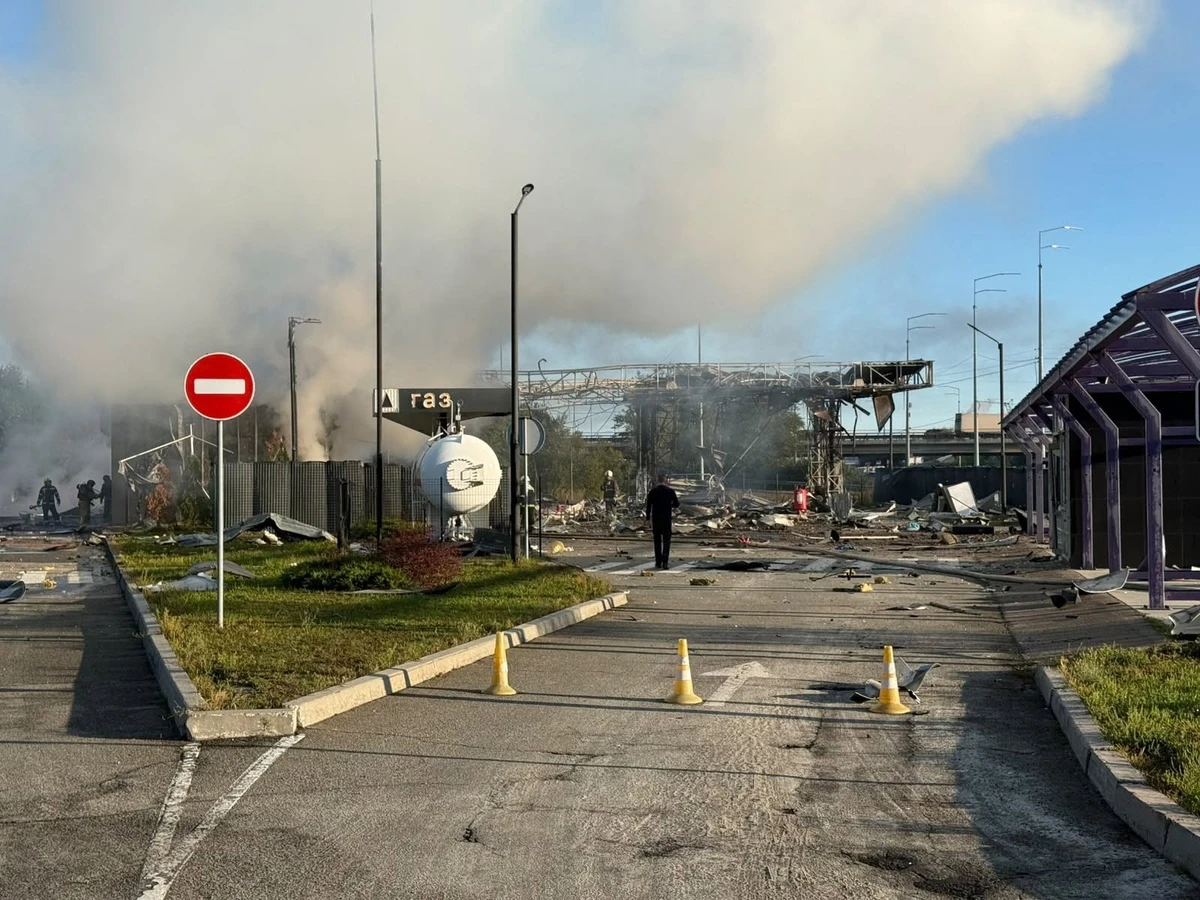
Aftermath of Russian drone strikes on Kyiv’s Holosiivskyi and Darnytskyi districts, September 23. Photo: Ukrainska Pravda

Russian drones hit Kyiv in the early hours of September 23 (161 launched, 122 downed), killing one person and injuring seven. Strikes damaged gas stations, warehouses, a business centre, a data centre hosting telecom equipment, and railway-adjacent infrastructure; urban rail was suspended. The previous night saw 212 drones and missiles hit eight oblasts, knocking out power for 100,000 in Chernihiv alone; that wave also struck a WHO warehouse near Chornomorsk and a foreign cargo ship in Odesa Oblast, killing the Ukrainian captain. Zelensky separately warned that Russia is preparing a “massive attack.”

In the other direction, Moscow’s mayor reported 450 drones intercepted overnight in what Ukrainian forces describe as their largest-ever assault on the Russian capital, killing two — hours before Zelensky’s UNGA address. Lithuania’s PM Sinkevičius told BBC Newsnight his country is prepared to “fight back” if attacked and has prepared civilian evacuation plans.

Ukraine’s refinery campaign: over 45% of Russian oil processing capacity reportedly knocked out

Ukraine struck the Bashneft-UNPZ refinery in Ufa (1,338 km from the border) and the Kuibyshev refinery in Samara on September 21–22; the Kuibyshev plant was still burning into its second day, with its primary AVT-5 distillation unit confirmed damaged by satellite imagery. The Gazpromneft-Moscow refinery halted crude processing after the September 20 strike, with repairs expected to take weeks. Defence analysts estimate over 45% of Russia’s refining capacity has been knocked out. Ukraine also confirmed shutting down a Russian diesel pipeline supplying half of Luhansk Oblast’s fuel; Russian tankers must now travel a 400 km detour. Trump acknowledged at UNGA the campaign has “dealt a serious blow” to Russia’s diesel industry, then asked Zelensky to stop; Zelensky refused to halt strikes unilaterally. Complicating matters, Rubio publicly acknowledged that Ukraine unintentionally hit oil infrastructure linked to American interests.

No territorial changes; Russia’s Dobropillya encirclement claim debunked as info-war

Neither side advanced on September 22 despite 247 recorded Russian attacks, with the heaviest fighting at Kostiantynivka (25 clashes) and Pokrovsk (23). The Russian MoD claimed encirclement of Dobropillya — a claim ISW finds unsupported by any evidence and incompatible with Ukrainian battlefield reports. ISW assesses the claim is timed to UNGA to falsely portray collapsing Ukrainian defences, and to distract from Ukrainian gains north of Lyman, where Operation Vivaldi has now recovered over 125 sq km — erasing all Russian territorial gains since March 2026. On the Dobropillya axis itself, the Azov Brigade blocked a Russian flanking attempt toward Druzhkivka’s logistics routes, killing 237 troops. Separately, Russia’s Udmurt Republic is running mobilization training for regional civil servants — an indicator ISW reads as preparation for a near-future mobilization order.

Putin wins sham election as drones strike Moscow and mobilization looms

Russia’s September parliamentary elections delivered the scripted result: United Russia took ~58% of the party-list vote and retained its constitutional supermajority. Putin personally branded the party as “his” for the first time since 2007, and the Kremlin denied registration to Yabloko — the only registered anti-war party. Ukrainian drones struck Moscow during the voting period, puncturing the narrative that ordinary citizens remain insulated from the war. RUSI highlights the underlying instability: economic deterioration, frozen negotiations, and the spectre of a new mobilization wave that — as in September 2022 — could trigger significant emigration and further erode regime credibility.

Investigations

Trump administration cleared $11M donor’s firm to deal with sanctioned Russian bank

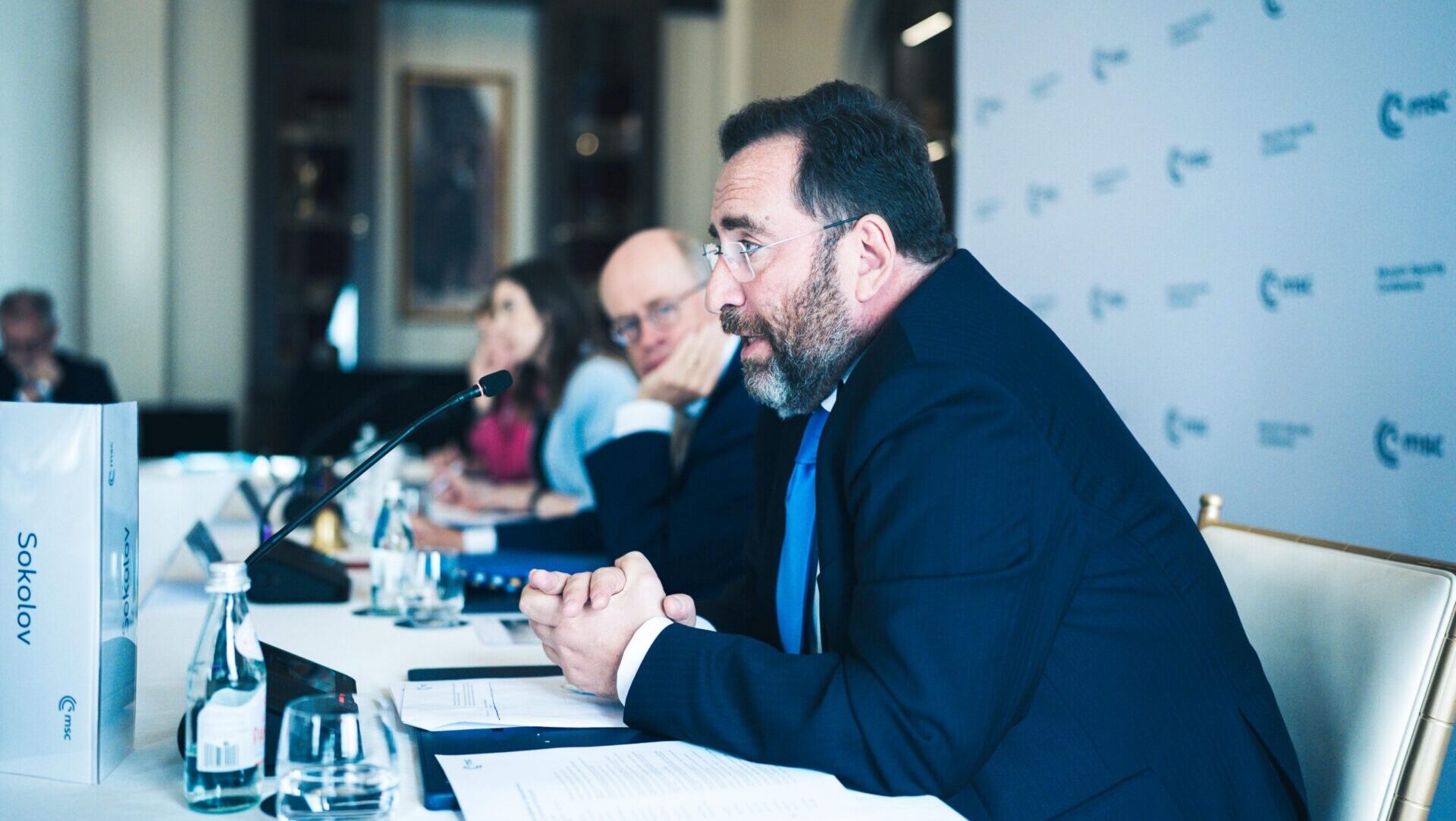
Konstantin Sokolov at the Munich Security Council’s Geoeconomics Roundtable in Washington, April 2026. Photo: ICIJ

An ICIJ investigation reveals the Treasury Department issued a special license on June 1, 2026 authorizing Dynamic Frontier Holdings — a Texas firm managed by Konstantin Sokolov — to acquire Armenia’s Teghut copper mine from VTB Bank, Russia’s state-owned financial institution sanctioned as a “critical artery” of Russia’s war economy. Sokolov donated $11 million to MAGA Inc. and was one of three dozen donors to Trump’s $350 million White House ballroom project. He was simultaneously appointed chairman of a $200 million State Department enterprise fund for Central Asia and the South Caucasus — a role that directly overlaps with his private mining investment in the region. The finding adds to a pattern of targeted Russia sanctions carve-outs that critics say undermine the US posture toward Moscow while the administration maintains public pressure on European allies to enforce compliance. (See the EU’s own oligarch carve-out on the front page.)

DOJ charges Russian intelligence network with murder-for-hire and terrorism plots in US and Europe

The Justice Department indicted five defendants — including former FSB colonel Yuri Khrameev, his FSB-officer son, and Cuban and Venezuelan co-conspirators — for operating a Kremlin-directed global assassination network. The network allegedly recruited US residents to surveil and kill a prominent Russian dissident living in America (offering $40,000 for the hit), and coordinated infrastructure attacks in Prague and Lithuania against countries supporting Ukraine. All five remain at large and face up to 20 years on terrorism financing charges.

Former CIA Berlin station chief Joseph Wippl tells iNews that Russian intelligence is “incredibly active” with covert plots across Germany and Europe, but argues the aggression will “have the reverse effect of what the Russians intend” by consolidating European security responses; Germany is “really beefing up their security services.” He flags the AfD’s pro-Putin positioning as a compounding domestic vector.

Banished to alien lands: Trump’s secret deportation deals

A major investigation by The Guardian and Forbidden Stories exposes the infrastructure behind Trump’s deportation program: secret bilateral agreements with dozens of countries have funnelled deportees into El Salvador’s prison system without legal due process, and sent others — including an Iranian woman — to countries they didn’t know existed. The investigation describes the program as a deliberate “show of force” that has cost American taxpayers billions while leaving deportees in conditions international observers describe as inhumane and legally indefensible.

US AI kill chain killed 123 Iranian schoolchildren — Pentagon investigation

Bloomberg, drawing on officials inside the Pentagon’s internal probe, reconstructs how two Tomahawk missiles destroyed Shajarah Tayyebeh Elementary School in Minab, Iran on February 28 — killing 150+ people, at least 123 of them children. A cascade of failures: Centcom’s civilian harm mitigation team was gutted from 10 to 1 person under Hegseth, satellite imagery was seven years out of date, and personnel incorrectly expected Palantir’s Maven Smart System to flag stale data — it didn’t, and Palantir says it isn’t responsible for data quality. Maven compressed target vetting from hours to minutes. The investigation has been complete “for several months” but not released. UN investigators found “reasonable grounds” to conclude the strike amounted to a war crime; Trump has publicly suggested it was Iran’s fault. The ICC’s probe into the strike is what the US is now threatening sanctions over (see World).

Kinahan cartel boss loses UAE foothold after son’s extradition

Christy Kinahan, who leads a $1.5 billion illicit network from Dubai. Image: Bellingcat

Christy Kinahan, founder of the $1.5 billion Kinahan Organised Crime Group, had his UAE residence permit cancelled on August 31 — days after his eldest son Daniel was extradited to Ireland. Bellingcat’s financial investigations team, collaborating with The Sunday Times, accessed UAE government immigration portals to track visa status changes across cartel members between July and September. Notably, Christopher Jr. — also US-sanctioned with a $5 million bounty — received a fresh two-year UAE visa, and several other lieutenants retain valid Dubai residence permits. Kinahan’s exact location is unknown; intelligence suggests he may still be in Dubai or has fled to Africa.

Allies have stopped waiting for Trump to leave — and started adapting

A major Atlantic survey of US allies finds a structural shift: governments no longer expect a return to pre-Trump American leadership regardless of the 2028 election. The evidence is concrete — rising European defence budgets, Canada’s commercial pivot toward China, Japan positioning as an arms supplier. Hours before the scheduled Ulchi Freedom Shield exercises with South Korea, Trump blindsided allies by announcing a substantial US pullback, citing inappropriate “hostility” toward North Korea. A senior European official: “The world is changing, and we can see very clearly now that America is changing too.” This is not a coordinated anti-US turn — most allies still distrust China more — but a recalibration toward genuine strategic autonomy. A companion Atlantic piece argues the US-Iran war has no exit strategy, no defined end state, and no political framework for resolution — a war shaped more by escalatory momentum than deliberate strategy.

Also today

  • Fico is cracking NATO’s Article 5 commitment before Putin tests it: European leaders warn Putin may prepare a grey-zone provocation calibrated to exploit exactly this ambiguity — TVP World · r/geopolitics
  • Merz vows to hold coalition after stinging state election defeats; Katya Adler on why Berlin’s crisis threatens Germany’s “obsession with stability” — BBC: coalition · BBC: analysis
  • The White House “cyber privateers” memo is legally untested and structurally broken: no revenue mechanism, a $1M bond, an untested CFAA exception, and an exclusion for state-backed groups that makes it toothless against Russia, China, and North Korea — War on the Rocks
  • US ends 12-year anti-ISIS coalition mission in Iraq: Operation Inherent Resolve ends September 30, leaving Iraqi sovereignty fragile and Kurdish communities exposed — War on the Rocks
  • Hackers claim to have data on every FBI employee, 404media reports; no FBI confirmation yet — 404media · archive · HN

Tech

Miri stores all env vars to target/ — secrets leak via GitHub Actions cache

Rust Security Response Team advisory: cargo miri writes all environment variables to target/ for build caching. If your CI caches target/ and allows PR builds to read that cache (common), any contributor who has previously landed a PR can trigger a workflow that extracts whatever secrets were present during the Miri run. GitHub sometimes hides overwritten commits, making the attack harder to detect. Fix: the 2026-09-22 nightly limits env var preservation to CARGO_* (excluding tokens) and OUT_DIR. Immediate mitigations: disable target caching for Miri jobs or scope secrets to non-Miri steps. Rotate any secrets that may have been exposed.

Git 3.0 likely coming this year — SHA-256 default, reftable, Rust required

Git 2.56 RC is out with modest improvements: git history drop (removes a commit, replays successors — still blocked by merges), git branch --delete-merged, git add --resolved, config file lock retry. But maintainer Junio Hamano asked the community whether the next release should be 3.0, and GitHub’s brian m. carlson hinted that GitHub will soon support SHA-256. The 3.0 breaking changes: SHA-256 hashes by default, reftable storage by default (replacing per-file refs under .git/refs/, already in libgit2), and Rust becomes a build dependency. Git will also stop accepting uppercase hex object IDs. These are the first backward-incompatible changes since the project’s inception.

SAML is a fractal of bad design — Trail of Bits makes the deprecation case

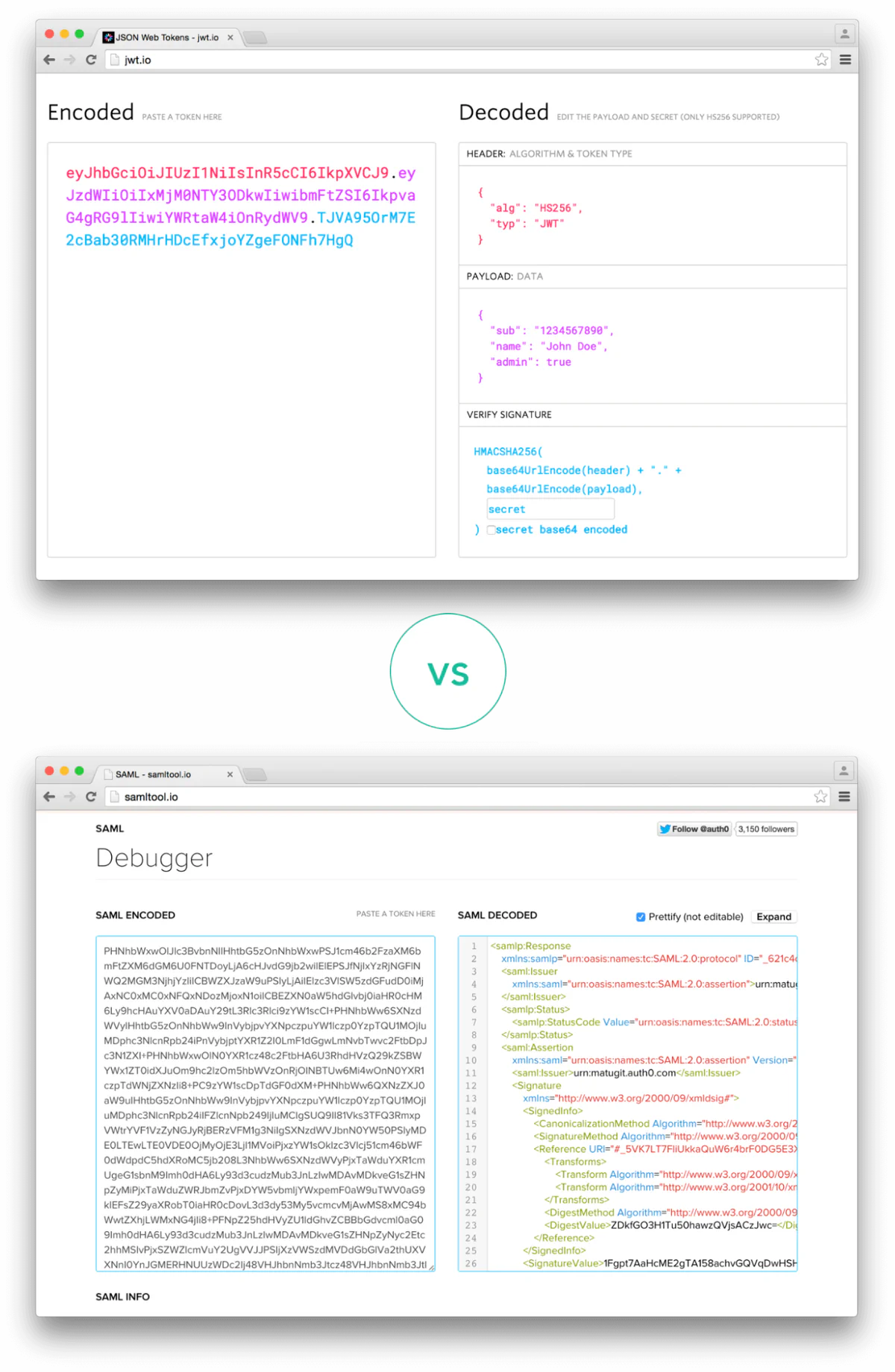
JWT detaches the signature; SAML embeds it inside the payload it signs. Diagram: Trail of Bits

Trail of Bits security engineer Matt Schwager traces SAML’s design failures from its 2002 committee origins through present-day exploits. Core problems: XML canonicalization is deeply cursed (enabling signature wrapping and parser differential attacks that still appear in 2025), enveloped signatures put the signature inside the data being signed (impossible to canonicalize reliably), and kitchen-sink design left 90% of the spec unused but still exploitable. The attack timeline runs from 2005 through PortSwigger’s 2025 “SAML roulette” and “Fragile Lock” papers. Recommendation: migrate to OIDC. Tailscale and Fly.io are holding the line on not implementing SAML at all. SAML emerged from VPN-era network topology assumptions that zero-trust architecture has since obsoleted.

Self-hosting behind CGNAT: WireGuard tunnel via cheap VPS

A clean practical guide to the standard CGNAT workaround: a ~€5/month VPS with a public IP acts as a bridge, tunnelling all traffic to your homelab over WireGuard. The tunnel is initiated by the homelab, so no inbound port is needed. iptables PREROUTING DNAT on the VPS forwards all ports to the homelab box except SSH and the WireGuard port itself, and source IPs are preserved so the homelab sees real client addresses. Resilience: a cronjob at the homelab monitors SSH and reboots if it’s down; the VPS can fail over to Cloudflare Tunnel or Tailscale. Full config included.

Also today

  • Fearless SIMD v1.0: Linebender’s safe SIMD abstractions for Rust reach stability with a 3-year support commitment; kernel! invokes intrinsics without unsafe, and a new #[simd] attribute handles multiversioning — Linebender · Lobsters
  • Raspberry Pi 5 firmware blocks RAM chip swaps to stop resellers passing off upgraded boards as official; Jeff Geerling proposes a “warranty bit” opt-out — Jeff Geerling · Lobsters
  • WordPress unauthenticated path traversal with conditional RCE; patch immediately — GitHub Advisory · HN

AI & Automation

Claude Opus 5.5: Fable-class performance at 40% lower cost, 30% faster

Anthropic’s first release since Dario’s “pacing the frontier” essay. Opus 5.5 matches Fable 5.1 on most benchmarks while costing 40% less ($4/$20 per million input/output tokens) and running 30% faster than Opus 5; cache reads drop from $0.50 to $0.20/M tokens, the dominant cost in agentic work. Standout numbers: 66.4% on Terminal-Bench 4.0 (vs Opus 5’s 52.3%), 81.8% on OSWorld 2.0 computer use, and 1846 Elo on GDPval-AA v2.1. New capabilities include a five-level effort system (low → max, with max at 6× usage consumption), a “responsive mode” that emits a brief acknowledgement before thinking or calling tools, significantly improved prompt-injection resistance, and “preserved thinking” anti-distillation inherited from Fable 5.1. Anthropic calls it its highest-scoring model to date on behavioural auditing, with 85% fewer boundary circumvention attempts than Opus 5. Community reception is strongly positive — complaints of token-guzzling and over-cautious refusals from recent models appear resolved. A tester completed a 680k-line code migration in under a day. Sonnet 5.5 and Haiku 5.5 are to follow.

A developer also launched LiveNerf, an open-source harness that runs against Opus 5.5 every hour to detect post-release degradation, using a private frozen test panel (only hashes published) across four procedurally generated task families tuned to the 30–70% accuracy band.

OpenAI ships GPT-6 Sol and Luna on the same day — Sol at half Opus 5.5’s price

OpenAI’s visual for the GPT-6 Sol and Luna announcement. Image: OpenAI

Companion models to GPT-6 Astra, released September 22 in direct competition with Opus 5.5: Sol ($2/$10 per M tokens) targets professional work and coding, Luna ($0.10/$0.50) is the cheap/fast tier aimed at high-volume and free-tier use. Pricing is cut 50% vs GPT-5.6 promotional rates, and new caching delivers 90% discounts on cached input with higher hit rates by default — GitHub reports a 50%+ reduction in non-cached tokens across billions of Copilot requests. Sol makes roughly half the mistakes of GPT-5.6 Sol and matches Fable 5.1 xhigh on FrontierCode v1.1, but community-compiled head-to-heads show Opus 5.5 leads across the full suite, including a meaningful gap on GDPval real-office work, where Sol regressed ~100 Elo from its predecessor.

Xiaomi MiMo-V2.6 tops the open-weight index as Chinese labs pull ahead

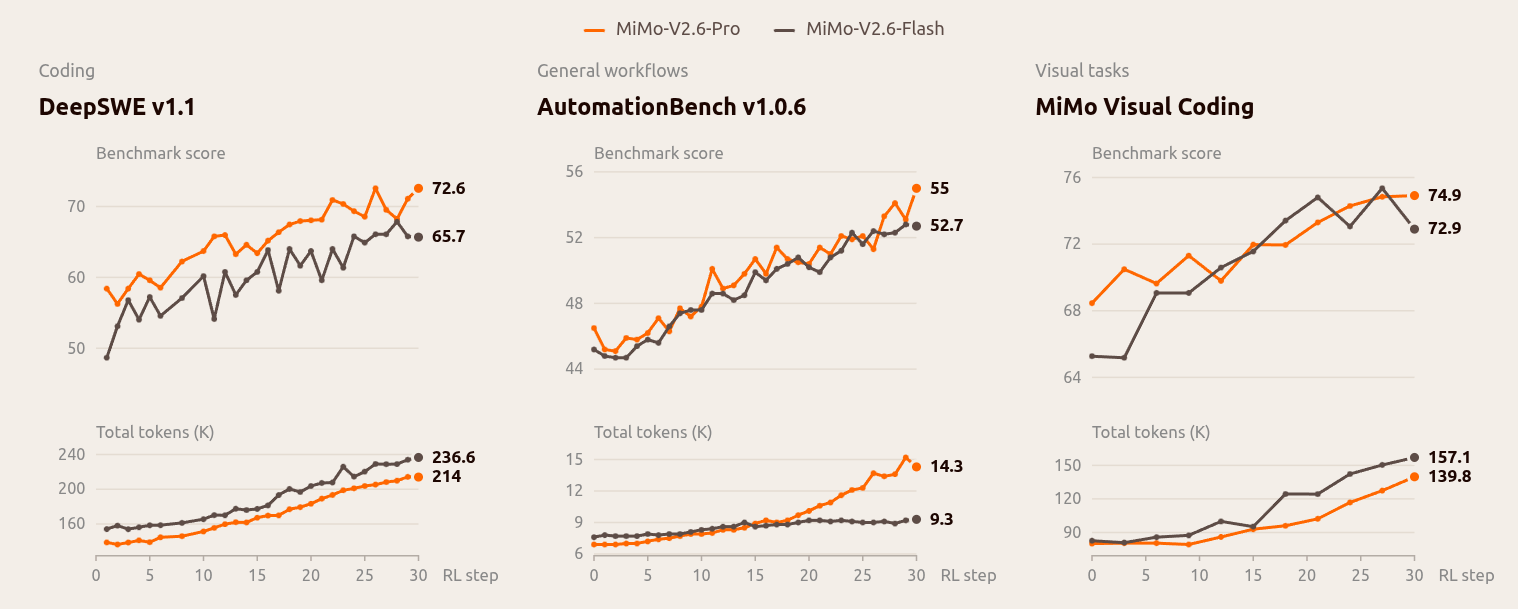
MiMo-V2.6 live benchmarking dashboard. Image: r/MachineLearning

Xiaomi released the MiMo-V2.6 series on September 22 — a 1T-parameter sparse MoE (42B active) that tops all open-weight models on the Artificial Analysis Intelligence Index (score 46, level with Grok 4.7), natively omnimodal with a 1M-token context window. Total RL training cost across the whole series: $3.5M. MIT license. On AutomationBench it scores 53.1, beating Claude Opus 5’s 50.3. API pricing: Flash at $0.14/$0.28 per M tokens, Pro at $0.43/$0.87, available on OpenRouter.

The release lands alongside Nathan Lambert’s expanded Congressional testimony: Chinese open-weight models lead on every major benchmark — the top three score 42–45 on the AI Analysis Index against 23–26 for leading American open models. Chinese models appear in 40% of ML arXiv papers vs 28% for the US, with Qwen dominant in academia. Chinese labs sit 2–5 months behind US closed models; US open models are 6–9 months behind. Distillation explains only 1–2 months of the Chinese advantage. Harvey, Cursor, Airbnb, and DoorDash are all building on Chinese models.

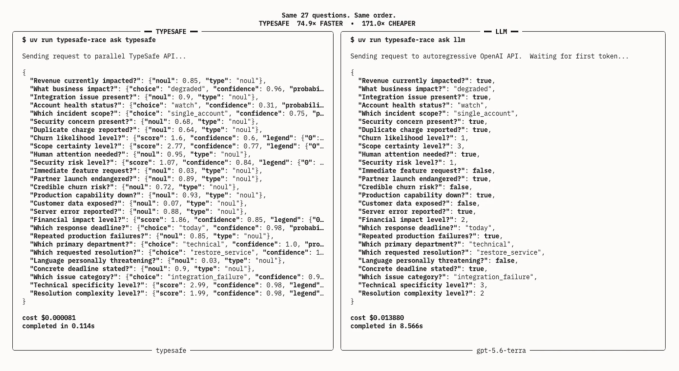
Jev: a model that outputs probabilities, not text — and can’t hallucinate by construction

Jev and a frontier LLM responding to the same structured decision requests. Image: TechCrunch

TypeSafe AI (founded by Diogo Almeida, RLHF and ChatGPT co-inventor) released Jev alongside a $40M seed round. Fine-tuned via RLCD (Reinforcement Learning for Calibrated Decisions), Jev returns probability distributions over user-defined output classes in a single forward pass instead of generating text — “Is this email spam? 88.5%.” Since outputs must be defined in advance, hallucination is impossible by construction. On its target workload — high-volume, repeated binary or multi-class decisions (routing, classification, agent eval scoring, trading signals) — TypeSafe claims 193× faster and 445× cheaper than frontier LLMs, priced at $0.042/M input tokens with free output. Vercel reports it was “adopted faster than any other model in AI Gateway history,” and practitioners are migrating deterministic decision nodes in agentic pipelines to Jev while keeping reasoning-heavy steps on frontier models — a System 1 / System 2 split with a cost tier for each.

The mechanism is straightforward: read logprobs for choice tokens, normalize — NobodyWho’s parody post shows it in 25 lines of Python against any GGUF model, and open clones (OpenJev, openjev-sglang) appeared immediately. Arcturus Labs argues OpenAI can fast-follow by folding this into GPT-6, since it’s essentially how tool-calling already works internally. TypeSafe’s claimed moat is its synthetic calibration data pipeline: “we consider ourselves a data research lab.”

OpenAI won the Navier-Stokes Millennium Prize by solving the wrong problem

Water flowing along a cascading path. Photo: Scientific American

GPT-6 Astra’s solution to the Clay Institute Navier-Stokes problem exploited option C of the 2000 problem statement, which allows an external force to trigger a blowup in the equations. Most mathematicians were pursuing the “pure” version without external forcing, which is what physically meaningful fluids do. A new proof posted Friday shows OpenAI’s approach can never be extended to the force-free case — the blowup disappears when the contrived force is removed. Luis Silvestre (UChicago): “The most important problem is unsolved. The Clay problem is settled, but the main problem for the Navier-Stokes equations is not.”

In a cleaner win for the same model, Carter Leffer directed GPT-6 Astra at unbroken Enigma messages on cryptocellar.org. It selected MVUEH (July 10, 1941, SS-Totenkopf), hypothesized its plaintext matched a nearby message, wrote its own Enigma simulator and Bombe, identified “ROSENOW ROSENOW” as a crib, and recovered the key — a wheel order unlike every other message that day. It also found the correct Bundesarchiv files the page’s author had spent weeks researching. Frode Weierud: “What it has achieved in two days would take a human researcher weeks or even months.”
Also today

  • Claude Code 2.1.277 adopts AGENTS.md as a fallback when no CLAUDE.md exists — the last major AI coding tool to do so; AGENTS.md now sits in 6.2% of GitHub repos — DevOps.com · The Register · DEV.to
  • ICLR 2027 hits 51k+ submissions as AI-accelerated research outpaces reviewer supply; anyone with 3+ author credits must now review, and the new LLM review feedback is mostly nitpicks — r/ML: submissions · r/ML: review infrastructure · r/ML: LLM feedback
cd ~/repos/josse-posten && claude --resume 132edb7b-05d4-4131-93d3-6c8f6f7655df