Josse-posten

The drone is the day’s through-line — jet-powered over Kyiv, explosive-laden at Leipzig and now formally pinned on Moscow — while America’s war with Iran claims a wedding party and Anthropic ships Fable 5.1.

US-Iran war escalates: new strikes, region-wide retaliation, wedding party killed

People gather at the site in the aftermath of a US strike in Kuhestak, near Sirik, Iran, September 1. Photo: Iranian Red Crescent Society/Reuters

The US launched a new “large and powerful” wave of strikes on Iranian targets Tuesday, hitting the southern coast and port facilities. Iran retaliated with missiles and drones against US interests in Bahrain, Kuwait, Jordan, and Iraq, pledging “severe punishment.” The most charged development: a US strike near the port city of Sirik hit a wedding ceremony in Kuhestak, killing at least five people including a child and wounding 63. Iran’s Red Crescent confirmed civilian casualties; the US military denied targeting civilians. Trump vowed further strikes. Hopes of a limited flare-up have been extinguished — and the pressure is now visibly fracturing Tehran’s leadership (see World).

Germany formally names Russia for the Leipzig drone attack; sabotage hits German substation and two Polish defence plants

Ukrainian Antonov cargo planes at Leipzig-Halle airport, near where German authorities found an explosive-laden drone in August. Photo: Reuters

The German government has formally attributed the explosive-laden drone found at Leipzig-Halle airport in August — positioned next to Ukrainian cargo aircraft — to Russian intelligence, calling it part of a “systematic and concerted” hybrid campaign; drone configuration, ignition technology, and explosive payload matched known Russian methods, and EU Commission President von der Leyen concurred. Within 24 hours the pattern widened: police found a “double-digit” number of explosive devices at the Jänschwalde coal plant in Brandenburg, and two fires — both suspected arson — struck Polish defence sites: drone maker WB Electronics in Skarżysko-Kamienna and JFG Composites in Lublin. ISW frames it as Russia’s escalating “Phase Zero” campaign targeting European defence industry to test NATO red lines.

Russia turns its air war round-the-clock with jet-powered drones; Putin orders energy strikes

Ukrainian air defence firing at a Russian drone above Kyiv, August 30. Photo: United24 Media

Russia has sharply pivoted to faster, harder-to-intercept jet-powered drones: over 2,800 were launched in August (up 5× from June), now ~56% of strike packages, against which Ukraine’s interception rate is ~60% versus 90–95% for piston types. Since August 27 the overnight-only pattern is gone — Kyiv has faced 57 air alerts over five days, with shopping centres, food warehouses, and civilian infrastructure deliberately targeted. Putin has ordered mass strikes on Ukrainian energy infrastructure; Kyiv is planning contingency relocation of 200,000 residents and has asked to buy Patriot interceptors via €2B in EU loan funds. Zelensky in turn warned airlines still routing through Russia — including Chinese and Gulf carriers — that “Russian sky will be closed”; Putin called the warning “state terrorism.” The Economist’s read: the war is simultaneously intensifying, expanding, and stuck, with allies privately planning for up to 50 years of confrontation.

Anthropic releases Claude Fable 5.1 and Mythos 5.1: agentic coding up 14pp, 25–45% cheaper

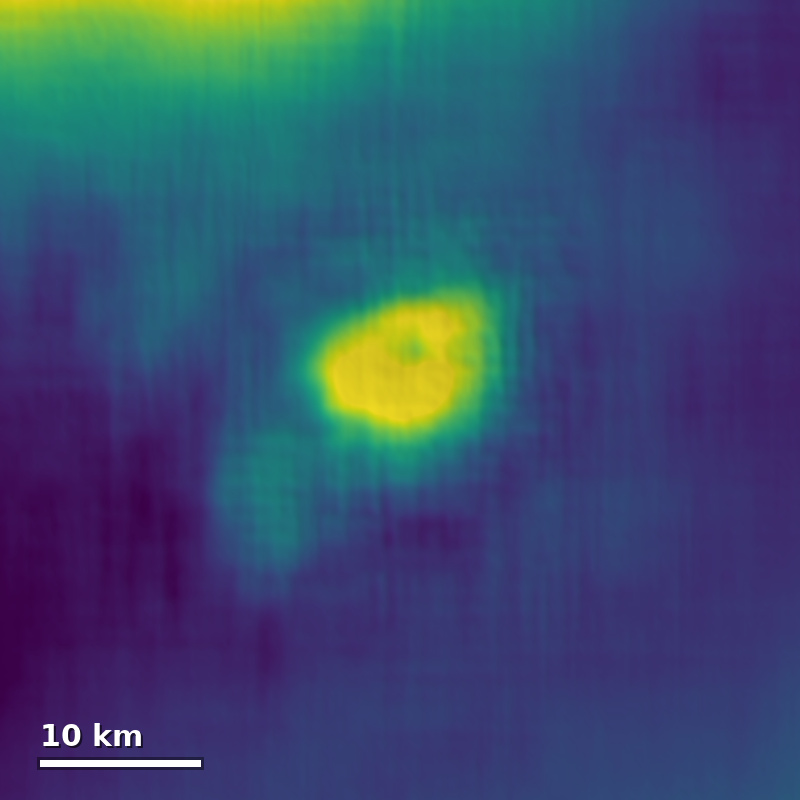
New 300m-resolution DEM of a Venusian volcano created by Claude Mythos 5.1 from 30-year-old Magellan radar altimetry data. Image: Anthropic

Anthropic launched Fable 5.1 and Mythos 5.1 today. Fable 5.1 jumps from 42.0% to 55.8% on Terminal-Bench 4.0 (agentic coding) and nearly doubles scientific research performance (24.7% → 52.6% on Terminal-Bench-Science). Cache read prices drop 75% to $0.25/M tokens; typical workloads run 25% cheaper, highly agentic ones up to 45%. Safeguards move in both directions: 60% fewer false positives in cybersecurity contexts and 85% fewer refusals on benign biology queries, while Mythos 5.1 stays gated to vetted cybersecurity and life sciences professionals — its demo: a 300m-resolution Venus elevation map from 30-year-old Magellan radar data. Community reception is strongly positive on capability, particularly coding and writing, and the release came with a weekly limit reset. The fine print — a statistical text watermark, sealed thinking blocks — matters too (see AI & Automation).

Indicator Value Change
S&P 500 (f) 7,640.75 -0.03%
Dow 30 (f) 52,848 +0.04%
Nasdaq (f) 29,077 -0.17%
Russell 2000 (f) 2,926.20 +0.05%
VIX 16.41 +0.43%
Gold 4,372.40 -0.55%
BTC $77,549.88 -1.35%
EUR/USD 1.1578 -0.12%
USD/NOK 9.3295 +0.01%
  • Muted reaction to the Iran war escalation: VIX still low near 16, gold down -0.55% — no safe-haven bid despite the new strikes and wedding-party casualties (see World).

World

Bishkek SCO summit: Putin’s non-Western counterweight play — and Modi’s public rebuke

Kyrgyzstan welcomes leaders from 10 SCO member nations for the organization’s 25th anniversary summit in Bishkek. Photo: RFE/RL

At the Shanghai Cooperation Organization’s 25th anniversary summit in Bishkek, Putin held at least nine bilateral meetings — Xi Jinping, Narendra Modi, Iran’s Pezeshkian, Turkey’s Erdogan — projecting Russia as an indispensable pillar of a non-Western order. Putin and Xi declared their ties “more solid” while Trump separately warned Moscow and Beijing against arming Iran. The discordant note: Modi, on the sidelines, told Putin directly to stop the “endless war” in Ukraine — a notable public rebuke from one of Russia’s few remaining major non-aligned relationships. The summit serves Russian domestic and diplomatic needs: geopolitical relevance and warm bilateral optics amid battlefield setbacks.

Ratcliffe’s surprise Moscow visit: CIA told Russia it’s getting weaker; Putin reportedly canceled the meeting

CIA Director John Ratcliffe, whose unannounced Moscow visit in late August prompted questions about a Russian threat to NATO’s eastern flank. Photo: RFE/RL

CIA Director John Ratcliffe’s unannounced late-August trip to Moscow — the first by a sitting CIA chief in years — keeps generating competing readings a week on: a back-channel warning, an intelligence-sharing overture, or managed theater ahead of a settlement push in Ukraine. What has since emerged: Ratcliffe reportedly delivered a direct message that Russia is weakening under the cumulative strain of the war — after which Putin canceled what would have been a meeting with him, widely read as an indignant response to the assessment. The secrecy and timing, amid Putin’s SCO summit maneuvering, make the ambiguity itself significant.

Russia secretly helping Iran develop supersonic cruise missiles

The Financial Times, citing leaked documents, reports that Russia has been covertly helping Iran develop supersonic cruise missile technology since 2023 — one of the most significant military technology transfers between the two countries. The program deepens the Moscow–Tehran defence-industrial axis that began with Iran supplying Shahed drones to Russia, and means Moscow is actively enabling Tehran’s weapons program even while publicly maintaining distance from the US-Iran hostilities. Supersonic missiles would substantially increase Iran’s regional strike capability.

Iran oil blockade succeeds where years of sanctions failed — and Tehran answers with rocket-launched mines

Iran’s oil exports have been largely halted by an active US naval blockade — achieving in weeks what successive rounds of sanctions could not — while a “tanker for tanker” policy has seen US strikes target Iranian oil tankers through the Strait of Hormuz. Iran’s counter: days after the US declared Hormuz clear of mines, CENTCOM struck two IRGC rocket launchers positioned to fire artillery rockets modified to release free-floating naval mines on impact with the sea — a modified Fajr-5 capability demonstrated in exercises in January 2025 that would let Iran threaten shipping without exposing mine-laying vessels. The structural shift: from financial to physical coercion as Washington’s primary tool against Tehran.

Iran’s leadership is fracturing over war, sanctions, and nuclear policy

US military pressure has triggered a visible rupture inside Tehran’s leadership. President Pezeshkian and moderate officials have spoken publicly about economic constraints and the need for honesty with the Iranian public about the costs of the war — language that hardline media and factions close to the IRGC are framing as preparation for “surrender.” Supreme Leader Khamenei has called for “cohesion,” but the gap between pragmatists and hardliners now maps onto concrete disagreements: whether to negotiate sanctions relief, what to concede on nuclear posture, and how long to sustain military posture in the Gulf. The internal fight is intensifying exactly when strategic coherence matters most.

Joshua Wong pleads guilty in second Hong Kong national security case

Joshua Wong speaking before the US Congressional-Executive Commission on China on Capitol Hill in Washington, DC. Photo: AFP (file)

Hong Kong pro-democracy activist Joshua Wong, 29 and already imprisoned on subversion charges, pleaded guilty Wednesday to conspiring to urge foreign governments to impose sanctions, blockades, and other hostile measures against Hong Kong and China. The charge carries a potential life sentence under Beijing’s National Security Law. Wong’s guilty plea is the latest development in China’s systematic legal dismantling of the city’s democracy movement.

Keir Starmer announces he is standing down as MP

UK Prime Minister Keir Starmer has announced he is standing down as the Member of Parliament for Holborn and St Pancras, triggering a byelection. The move is an unusual step for a sitting Prime Minister — it may be connected to a broader political transition or internal party decision, though details are still emerging. It raises immediate questions about succession and the Liberal-Labour balance in Parliament.

Canada rebukes Trump, sweeps byelections, and reverses US brain drain

Prime Minister Mark Carney publicly told the Trump administration to “start being serious” amid escalating tariffs, after Trump claimed the US wants to “wipe out Canadian industries or make them subsidiaries.” The Liberal Party swept all three byelections held Tuesday — a strong vote of confidence for Carney’s defiant posture. Separately, Canada has recruited 48 top academics from US universities through a new research fund, capitalizing on anxiety among researchers under Trump — a deliberate policy of attracting talent the US is driving away.

Nepal-Tibet floods: death toll exceeds 1,000; DNA collection begins as 4,000 remain missing

Nepal’s death toll from the flash floods has now passed 1,000, with authorities beginning DNA collection from relatives to identify victims. Over 4,000 people remain missing, including 36 British nationals. Temporary bridges have been built to reach remote areas, and rescue efforts for trapped hydropower tunnel workers continue — a BBC survivor interview this week described floodwater chasing workers for 20 minutes through the tunnel. 119 additional survivors were rescued over the past 24 hours.

IAEA formally confirms Syria secretly built a nuclear reactor under Assad

Syrian Foreign Minister Asaad Al-Shaibani and IAEA Director General Rafael Grossi at a joint news conference in Damascus, August 18. Photo: Mohamed Al Rifai/EPA

The UN nuclear watchdog has concluded that Syria constructed a nuclear reactor at Deir az-Zor under Bashar al-Assad and “failed to report nuclear material, facilities and activities” as required under non-proliferation obligations. The reactor, widely reported to have been destroyed by Israeli airstrikes in 2007, is now formally attributed to the Assad government in IAEA findings following cooperation from Syria’s new post-Assad administration. The confirmation has implications for the NPT regime and for accountability of the former Syrian government.

Also today

Middle East
USS Abraham Lincoln arrives off Pattaya, Thailand after 270+ days at sea — a record deployment marked by grim crew conditions, now emblematic of the human cost of the Iran campaign — Guardian · Guardian: Pattaya · BBC
UK resets Israel policy — Miliband pledges to stop British firms aiding settlement construction, as BDS co-founder Barghouti argues for a full trade embargo — Guardian: Miliband · Guardian: BDS · BBC: occupied Lebanon
Europe
Turkish F-16s on NATO air policing scramble after drones cross into Estonian airspace — AeroTime · r/worldnews
Russia’s Starlink rival suffers major satellite launch failure, deepening the sanctions-era damage to its aerospace sector — Kyiv Post · r/worldnews
Americas
MapQuest defies Trump’s “Lake America” rename of Lake Ontario — after Google and Apple complied — and surges to #1 in the US App Store; Quebec scrubs the label from government sites — Guardian · Al Jazeera · Montreal Gazette · r/worldnews
Economy & environment
Solar overtakes coal as China’s largest installed power capacity source — ahead of most projections — Reuters · r/worldnews
Japan’s 10-year bond yield hits 3% — highest since October 1996, with global carry-trade implications — Kyodo News · r/worldnews
Nearly half of the world’s 1.3 billion farmers are poisoned by pesticides each year, killing ~11,000 annually; India accounts for nearly 60% of fatalities — Guardian

Ukraine

Russia’s summer offensive stalls at a fraction of 2025 pace; Ukraine gains in Lyman

ISW’s August monthly assessment finds Russia seized only ~90 sq km last month — versus 505 sq km in August 2025 — while Ukrainian counteroffensive operations liberated at least 130 sq km, primarily in the Lyman direction where the full extent of gains is still being documented. Russian forces suffered 42,020 casualties in August, the second consecutive month above 40,000: 465 casualties per square kilometer seized. In Donetsk, Russian forces remain stalled at Kostyantynivka while bringing Slovyansk within tube-artillery range. Ukraine is formalizing two new operational commands: Brig. Gen. Biletsky takes the Lyman–Kramatorsk area, Brig. Gen. Prokopenko the Dobropillya sector.

Putin denies mobilization, expands personal guard, reshuffles law enforcement in at-risk oblasts

Putin publicly dismissed post-Duma-election mobilization reports as “absolute nonsense,” but simultaneously expanded his FSO personal security service for the fourth time since 2022 — a response to five assassination attempts against senior Russian military officials since December 2025, including an IED targeting the VKS commander in August. A substantial law enforcement reshuffle on August 31 prominently touched Kursk and Penza oblasts, where coercive recruitment has already been documented. ISW assesses that conditions for compulsory mobilization are being laid regardless of Putin’s public stance; the decision remains his alone. Putin also declared peace negotiations “frozen.”

Ukraine’s ground robots: 100,000 missions, mostly logistics

A Ukrainian self-propelled ground robot of the kind used for frontline logistics and evacuation in the 3rd Assault Brigade’s dedicated robot battalion. Photo: War on the Rocks

By August 20, Ukrainian ground robots had completed over 100,000 frontline missions since the start of 2026 — one sortie every 3.5 minutes, around the clock. The headline vignette (an uncrewed surface vessel delivered a combat robot to Kinburn Spit — possibly the world’s first robot-delivers-robot combat mission) obscures the actual scale shift: in the 3rd Assault Brigade’s dedicated ground-robot battalion, 19 of every 20 missions are logistics or evacuation, not combat. The economic logic is explicit: robots absorb the labor of the most lethal supply-chain miles, reducing human attrition in a war where manpower is existential. Ground robot command also flattens hierarchy — junior officers act on commander intent in real time rather than waiting for approval chains.

Investigations

Germany is not resetting with Russia — but it is leaving the Atlantic

Zelensky and German Chancellor Merz discussing military assistance — the Kyiv–Berlin relationship at the center of the German Russia-reset debate. Photo: War on the Rocks

Speculation about a German rapprochement with Moscow — stoked by a drone attack on German soil, Schröder peace-broker rumors, and nostalgia for Merkel-era Ostpolitik — is premature, War on the Rocks argues. All mainstream parties remain deeply distrustful of Russia; the AfD faces significant structural hurdles to power. What is actually happening is different: a post-Atlantic German security posture is taking shape, distinct from both Ostpolitik and Biden-era alignment with Washington. Germany is rearming, funding European strategic autonomy, and distancing itself from US foreign policy leadership — not toward Moscow, but toward a European-centered framework that doesn’t depend on either partner. Today’s formal attribution of the Leipzig attack fits the same picture (see Leader).

Prominent Europeans call for accelerating toward EU pre-federation

An “Action Committee for the United States of Europe” — signatories include Slavoj Žižek and other prominent European intellectuals and former officials — published a declaration on August 30 calling on the EU Council to take up the Parliament’s treaty reform proposal and accelerate Draghi’s competitiveness agenda toward a “pre-federation” structure. The framing is explicitly crisis-driven: the EU’s institutional architecture cannot respond to geopolitical threats at the required speed. The declaration is notable less for its likelihood of immediate political effect and more as a signal of where influential European federalists have landed after years of US unpredictability, Russian aggression, and internal EU paralysis.

Venezuela as the new American protectorate

After US forces removed Nicolás Maduro in January 2026, the Trump administration has openly stated its intention to “run the country” until a “safe and judicious transition.” Karl’s Notes draws the pointed historical parallel: the setup replicates Cuba’s Platt Amendment (1901–1934), which enshrined US rights to intervene in Cuban governance, ultimately delegitimizing local institutions and contributing to radicalization and Castro’s revolution. The analogy isn’t decorative — the structural conditions are present: military enforcement, US oil companies managing infrastructure, Rubio negotiating political structure, and restrictions on Venezuelan ties with Iran and China. The known failure mode of the Platt model is that imposed stability without legitimacy produces the instability it was meant to prevent.

China is flatlining behind the stability facade

The Atlantic’s Michael Schuman argues that Beijing’s global image as a “stable anchor” relative to chaotic America is propaganda successfully masking deep dysfunction. Real GDP growth is likely 2–3%, not the official 5%, per Rhodium Group estimates. Youth unemployment sits at 18%; the property crisis hasn’t bottomed out; retail sales grew 0.6% in July. Xi has blocked structural reform because it threatens political control, leaving the economy trapped in oversupply and weak domestic demand. A new Pew survey showing higher global confidence in Xi than Trump measures the collapse of US credibility, not Chinese strength — a distinction the article insists on.

Serbia opens Europe’s first Chinese humanoid robot factory — weeks after US ban

A humanoid robot bartender at the opening ceremony of the Šabac factory — the first Chinese-designed humanoid robot mass-production facility in Europe. Photo: RFE/RL

A joint venture between Serbia, Minth Group, and Chinese robotics firm AGIBOT opened a humanoid robot assembly plant in Šabac on August 29 — the first such facility in Europe, and conspicuously timed three weeks after Washington banned Chinese humanoid robot imports on national security grounds. President Vučić announced the Serbian military will deploy armed versions within 15 days. The strategic read from Berlin’s MERICS: the plant could let China circumvent future EU import bans or tariffs by re-labeling Chinese-designed robots as European-assembled. Whether Serbia, an EU candidate state with close ties to both Beijing and Brussels, becomes a durable loophole depends on whether Brussels acts — and how quickly.

Bellingcat uncovers new leads in a 30-year-old Chinatown murder

In June 1996, Fu Chun Wang — a 26-year-old undocumented Chinese immigrant — was executed in a Boston Chinatown basement by members of the Fukienese Flying Dragons gang. His body wasn’t identified until 1998. Bellingcat’s investigation, built from 27 public records requests to 18 agencies, FBI files, court records, and 24+ interviews, names the likely perpetrator: the Boston faction’s gang leader. Despite ballistics, DNA identification, witness testimony, and informant corroboration, no prosecution ever followed. The case documents a failure mode: organized crime violence against undocumented victims that authorities knew about and declined to pursue — the gang, in investigators’ words, “blatantly got away with it.”

Also today

  • Honduran court drops corruption case against ex-president Hernández after Trump’s pardon — a precedent-setting use of presidential clemency to intervene in a foreign country’s courts — Al Jazeera
  • Moldova condemns “unacceptable” Russian plans for 16 new polling stations in breakaway Transnistria — a deliberate escalation of the influence contest as Chișinău pursues EU accession — TVP World · r/geopolitics
  • France imposes fast fashion levy targeting Shein and Temu, up to €20 per item by 2030 — Europe’s most aggressive intervention against the sector to date — BBC
  • Q-Day and the quantum cryptography race: War on the Rocks convenes IonQ, Booz Allen, and GDIT on post-quantum migration and the “harvest now, decrypt later” threat — War on the Rocks

Norway

King Haakon takes oath as Harald V lies in state

Norway’s new King Haakon has formally taken the constitutional oath of office as the country mourns his father, the late King Harald V, who is lying in state at the Royal Palace in Oslo. The ceremony marks the first major step of the new reign and opens an official mourning period for a monarch who reigned for over three decades.

BBC

Tech

FBI investigates dark web service with 153M+ US driver’s license scans — traced to identity verification firm

The Nexus dark web service showing a driver’s license record for Defense Secretary Pete Hegseth — illustrating the scope and audacity of the data. Image: Krebs on Security

The FBI is investigating Nexus, a dark web service that launched in late August claiming possession of 153M+ US/Canadian driver’s licenses, 10M+ ID cards, and 3M+ travel documents. Forensic analysis by Krebs traces the breach to idscan.net, a Louisiana identity verification company: the stolen images include infrared and UV scans matching idscan.net’s documented capabilities, and timestamps correlate precisely to victim encounters with ID-scan kiosks at Hertz car rentals and Planet13 cannabis dispensaries — both confirmed idscan.net clients. The breach illustrates systemic risk in the identity verification supply chain, where biometric scans are routinely aggregated by third-party vendors without adequate security. Nexus went dark shortly after publication.

Local MoE inference comes of age: 125B parameters from SSD, and an always-on Mac Mini server

Two complementary write-ups show how mixture-of-experts architectures are making frontier-class local inference practical. SlotStream, a Mac-native MLX+Swift tool, runs Qwen3.8-Flash-Next (4-bit, 125B total parameters) on Macs from 16GB RAM by streaming inactive expert layers from SSD — ~12 tokens/second on a 48GB machine; the technique only works because most MoE parameters are dormant in any given forward pass. Meanwhile a practical guide to an always-on M4 Pro Mac Mini (48GB) inference server running oMLX makes the same point from the deployment side: Qwen3.6-35B-A3B activates only ~3B parameters per token, fitting in 20GB where a dense equivalent wouldn’t, served across devices via Tailscale. The author routes the “80% of requests that don’t need frontier models” locally, keeping API access for edge cases.

44% on ARC-AGI-1 for 67 cents: test-time training a small transformer from scratch

Mithil Vakde achieved 44% on ARC-AGI-1 by training a small transformer from scratch at test time — 1.5 hours on a rented RTX 5090, total cost $0.67 for training plus inference. Key design choices: per-task additive embeddings enable cross-task learning; 3D RoPE encodes both spatial dimensions of the 2D grids; dihedral augmentation; modern architecture (SwiGLU, RMSNorm, NorMuon optimizer, flash attention). Ablations show the representation choices are the critical lever. The result suggests cheap test-time compute paired with good structural priors can compete with much larger inference budgets on abstract pattern reasoning.

Wasmi 2.0: engineering the fastest portable WebAssembly interpreter

Wasmi 2.0 achieves a 2.2× speedup over v1.0 and now ranks among the fastest portable Wasm interpreters (alongside Wasm3 and Stitch). Key engineering choices: direct-threaded dispatch embeds function pointers directly in the IR; accumulator registers eliminate stack roundtrips; fixed 64-bit stack cells cut 5–10% overhead versus variable-width; contiguous instance object layout removes multi-step pointer chasing. One finding stands out: a Rust 1.92 compiler regression silently degraded branch prediction efficiency — a targeted workaround improved CoreMark scores by ~50%, showing how invisible compiler behavior can dominate interpreter performance.

A RISC-V interpreter that executes at Rust compile time, using ~30 nightly features

A new Rust project implements a spec-compliant RV64IMAC interpreter as a const fn, exploiting ~30 unstable nightly features to execute RISC-V code during compilation — with only the result included in the final binary. Beyond that, it auto-generates both a compact match-loop and an indirect-threaded version with platform-specific ABI optimizations, supports composable ISA extension generics, and includes compile-time panic-absence verification via a forked no-panic crate. The “from the future” label is literal: this is a preview of where Rust’s const execution capabilities are heading, built on features that aren’t stable yet.

Bluefin: why Haskell’s “effect system” is better understood as a capability system

Bluefin is a Haskell library built on effectful that passes capabilities as values rather than type-level constraints — to throw an exception you must hold a Throw value; to modify state, a Modify value. The post argues “effect system” is misleading terminology: Haskell’s real advantage isn’t enabling effects but circumscribing which effects are permitted, which is exactly what capability systems do. Value-level authority passing makes architectural enforcement explicit in ways type constraints can obscure — which the author notes matters increasingly as AI-generated code scales up. A clean PL theory reframing that clarifies a real design question.

Dan Luu audits Ed Zitron’s AI predictions: consistently wrong, gish-gallop technique

Dan Luu reviewed 30+ of Ed Zitron’s AI skeptic predictions from 2024–2025 — claims that major tech companies were dying, that AI had peaked, that training data was exhausted — and found them nearly all wrong. More damaging than the track record: Luu documents statistical sleight-of-hand (citing dubious third-party metrics while ignoring contrary financial data) and a gish gallop structure where claims are generated cheaply but expensive to refute individually. Worth reading as a case study in how confident, anger-driven punditry survives despite poor prediction accuracy in a domain that rewards confidence over calibration.

Also today

  • The flat-vs-segmented memory debate misses that programmers always recursively subdivide — Stephen Kell on what x86 segmentation’s decline cost us, and liballocs’ attempt to capture the full allocation tree — humprog.org · Lobsters
  • Jujutsu creator Martin von Zweigbergk joins East River Source Control as CTO — “the remote server is still Git, which has a ceiling that comes fast at scale”; ERSC Storage entered private beta this month — ERSC blog · HN

AI & Automation

Fable 5.1’s fine print: a statistical watermark, sealed thinking blocks, and a prompting guide

Beyond the benchmarks (see Leader), three details of the Fable 5.1 release deserve attention. First, Fable 5.1 and Mythos 5.1 are the first Claude models to carry Anthropic’s statistical text watermark — an imperceptible provenance signal in generated text, with a public verification tool live at claude.com/check-content. Second, thinking blocks in the Messages API are now sealed against distillation: reasoning traces can no longer be passed as training signal, which matters for anyone using extended thinking outputs in fine-tuning pipelines. Third, Anthropic published model-specific prompting documentation covering updated guidance for agentic workflows and extended thinking — worth checking for divergences from prior Claude conventions.

45% of GitHub PRs now carry Claude’s fingerprint vocabulary — “load-bearing” up 123×

A project scraping 47,000+ GitHub pull requests daily found that a distinctive vocabulary cluster emerged in 2026 and now accounts for 45% of all human-attributed PRs. The most representative word is “load-bearing” — appearing 123× more often than baseline. The wider cluster reads like a Claude fingerprint: quiet, survives, genuinely, wall-clock, fan-out, deliberate, verbatim, surfaced, shipped, untouched, structurally, verdict, honestly, baked. The methodology uses KL-divergence k-means clustering on rolling PR text. The result is a striking empirical signal of how model-specific phrasing is propagating into codebases via AI coding tools.

ChatGPT desktop app silently ships a 1.7GB bundle: full LibreOffice, Python, Node.js, git

Simon Willison found the ChatGPT desktop app (formerly Codex) stores ~1.7GB in its cache folder including a full Python installation, full Node.js, Poppler PDF tools, git, and a complete LibreOffice suite. The app ships “skills” — configuration files that instruct it how to find and invoke these binaries — confirming the bundle is actively used for document processing, not incidental. The discovery illustrates how AI desktop applications are quietly evolving into self-contained computation environments that ship their own open-source software stacks rather than depending on system tools.

Also today

Research
Sliding-window attention with sinks matches or beats linear attention on long-context reasoning — expensive architectural bets on linear attention may be unnecessary — arXiv · r/MachineLearning
Neural networks implicitly realize symbolic structures — closed-form symbolic equations preserve behavior and support targeted interventions on internal representations — arXiv · HN
EvoUndo: recoverability constraints for self-modifying LLM agent harnesses — tracks and gates runtime mutations so rollback remains possible — arXiv · r/MachineLearning
Claude Code
~300-agent ultracode swarm burns a 5-hour Max window in about one minute — multi-agent orchestration with premium models needs per-agent model-tier controls — r/ClaudeAI
Anthropic redesigns the Claude Code chat panel in VSCode, to positive reception — r/ClaudeAI
Policy & people
Matt Clifford, architect of the UK’s AI strategy and adviser to both Starmer and Sunak, joins Anthropic — the highest-profile revolving-door transition yet in AI governance — Guardian
US pushes AI deregulation at G20 as the EU advances stricter law — a widening transatlantic split that could fragment the global regulatory environment — Al Jazeera
cd ~/repos/josse-posten && claude --resume 613981b0-b22a-4373-b401-4491b7162896