Trump reaches for the map — vowing to make Hormuz US territory
“pretty soon” — while Ukraine’s drones choke Russia’s fuel and grain,
and a 7.7-magnitude quake strikes Flores.
Trump
threatens to declare Strait of Hormuz US territory; Iran refuses to
resume talks
Speaking at a New York police academy, Trump said he would “pretty
soon” designate the Strait of Hormuz — through which roughly a fifth of
the world’s seaborne oil passes — as US territory, as the US-Iran war
enters its seventh month with peace talks at an impasse. Iran’s Foreign
Minister Araghchi responded that Tehran has “not yet made a decision to
restart negotiations,” and that Hormuz shipping will remain contingent
on the US meeting conditions. Trump simultaneously told Americans to
accept higher petrol prices as a consequence of the standoff. Mediators
from Qatar and Pakistan are exchanging messages with Iran, but Araghchi
said this “does not mean negotiations.”
Ukraine’s
deep-strike campaign enters a new phase — Samara rocket plant hit, fuel
rationing spreads
Ukraine has informed Washington that its deep-strike campaign is
entering a new phase of significantly increased scale and intensity.
Overnight, Ukraine launched over 500 attack drones into Russian airspace
— among the largest raids of the war — and a Flamingo cruise missile
reportedly struck TsSKB-Progress in Samara, Russia’s sole builder of the
Soyuz launch vehicle. The hit is notable because Russia had been
intercepting 10 of every 11 Flamingos since July using scarce A-50U
airborne radar aircraft. Since early August Ukraine has targeted 11 of
Russia’s 34 major refineries — the Syzran strike is now confirmed to
have destroyed six major production units across the entire refining
chain — and five Russian regions have reintroduced fuel rationing, with
fights breaking out in Moscow petrol queues. (More in Ukraine)
7.7-magnitude
earthquake kills at least 20 in eastern Indonesia
A powerful shallow quake struck off Flores Island in East Nusa
Tenggara province at 5:58am local time on Saturday, collapsing buildings
and homes across the Flores region. The death toll has climbed to at
least 20, with authorities warning it will rise further as
search-and-rescue teams reach remote areas. Indonesia’s meteorology
agency issued a tsunami warning and ordered coastal residents to higher
ground; two aftershocks followed the main quake. The epicentre was 68km
north-northwest of the city of Ende, at a depth of 10km. (Colombia’s
own quake aftermath in World)
| Indicator |
Value |
Change |
| S&P 500 |
7,786 |
-0.17% |
| Dow 30 |
53,732 |
-0.20% |
| Nasdaq |
26,729 |
-0.28% |
| Russell 2000 |
3,068 |
+0.51% |
| VIX |
14.3 |
-2.60% |
| Gold |
4,437 |
+0.38% |
| BTC |
$63,017 |
+0.27% |
| EUR/USD |
1.1567 |
+0.04% |
| USD/NOK |
9.44 |
0.00% |
- A quiet close — VIX down to 14.3 even as Trump tells Americans
to accept higher petrol prices (see Leader)
World
Trump
dismisses USS Abraham Lincoln crisis; relief carrier deployed, Congress
demands answers
Trump said the 250-day deployment of the USS Abraham Lincoln — a
record — was “not nearly long enough,” brushing aside reports that
sailors have faced food shortages, broken plumbing, and a mental health
crisis serious enough for some to consider jumping overboard. A second
carrier is now en route to the Middle East to relieve the Lincoln, and
Democratic senators including Ruben Gallego have called for a Pentagon
investigation, describing the handling as “not proper leadership.”
Israeli
strikes kill seven in south Lebanon — deadliest since June
ceasefire
An Israeli air strike on a house in Ansar, Nabatieh district, killed
seven people and wounded three in what Lebanon’s National News Agency
described as the deadliest Israeli attack since a US-brokered framework
agreement in June significantly reduced hostilities. Overnight strikes
also hit areas near Nabatieh al-Fawqa and the Kounine-Saf al-Hawa road,
reaching further into southern Lebanon than at any point since the
ceasefire. Lebanon’s prime minister has urged a formal timetable for
Israeli military withdrawal, while Hezbollah criticises the Beirut
government’s approach as exposing the Lebanese army to Israeli
pressure.
Israel
moves to transfer West Bank law enforcement to police — Palestine VP
calls it annexation
Israel’s defence minister has proposed shifting law-enforcement
powers over Israelis in the occupied West Bank from the military to
civilian police, a step Palestine’s vice-president describes as “a
flagrant violation of international law” and a move toward full
annexation. The announcement comes amid the ongoing settler siege in
Beit Sahour, where a Catholic bishop and journalists covering a peaceful
attempt to reclaim seized land were fired on by Israeli gunmen. Settlers
also diverted a Palestinian freshwater spring in Fasayil, cutting
irrigation pipes and converting it into a tourist attraction. The US has
asked Netanyahu to condemn the settler siege; the IDF has so far failed
to remove the settlers, instead forcing a Palestinian family out of
their home to use as a military base.
European
wildfires: Croatia’s worst-ever blaze; nearly 500 arrested for arson in
France
One person has been killed and dozens injured as wildfires swept
through Croatia near the port town of Omiš, with officials describing it
as one of the worst in the country’s history and thousands evacuated. In
France, authorities have arrested nearly 500 people on suspicion of
arson since the start of summer — more than 180 of them minors.
Emergency alerts were sent to millions of mobiles across England and
Wales as tinder-dry conditions triggered wildfire risk warnings; England
has received just 4mm of rain in August, 6% of the monthly average.
Blazes are also burning in Germany, Greece, and Spain as Europe
experiences its fifth heatwave of the summer.
Five
years of Taliban rule: women’s lives unrecognizable, world quietly
re-engaging
Saturday marks the fifth anniversary of the Taliban’s return to
power. BBC interviews with Afghan women describe public floggings, loss
of employment, and healthcare barriers that are costing lives; the UN
warns that more than half of women’s organisations operating in
Afghanistan could cease within a year due to funding shortfalls.
Meanwhile, major regional and international powers — including China,
Russia, Gulf states, and some Central Asian governments — are showing
increased readiness to engage diplomatically with the Taliban despite
its record, a shift campaigners warn is undermining pressure for human
rights improvements. The Taliban itself faces growing pressure from
domestic insurgents, including remnants of the Islamic State Khorasan
Province.
Colombia
earthquake: state neglect compounding disaster in Buenaventura and
Cali
Five days after a 7.4-magnitude earthquake struck Colombia on August
10, killing at least 287 people nationally, residents of the
impoverished port city of Buenaventura — where 540 homes collapsed and
19 died — are criticising the government’s response as insufficient and
reflecting chronic under-investment in poorer regions. In Cali, families
are demanding faster search efforts for loved ones still buried under
rubble. Locals fear aid and resources will disproportionately flow to
larger, wealthier provincial capitals.
Venezuela
frees 131 political prisoners; BP secures offshore gas deal under
Trump’s blessing
Emotional scenes outside El Rodeo I prison in Guatire as 131
political detainees were released in post-Maduro reconciliation talks,
including 17 women — one accused of plotting against Maduro. Human
rights group Foro Penal says 391 political prisoners remain. The US
welcomed the release as “a crucial step for Venezuela’s reconciliation
process.” Separately, BP announced plans to develop a large offshore
gasfield in Venezuela in partnership with firms linked to the Trump
administration — one of the first major foreign investments in the
country since Maduro’s removal in January.
Mangione
pleads guilty to federal charges in UnitedHealthcare CEO killing
Luigi Mangione entered a guilty plea to federal stalking resulting in
death, telling the court “I shot Mr Thompson in Manhattan and he died.”
The 28-year-old’s plea leaves uncertain the fate of a separate New York
state capital murder trial, which a judge will need to rule on
independently. Mangione became a polarising public figure after the
December 2024 killing of Brian Thompson outside a Manhattan hotel, with
some viewing him as a symbol of rage against the US health insurance
industry.
President Lee Jae Myung used South Korea’s Liberation Day — the 81st
anniversary of the end of Japanese colonial rule — to propose direct
talks with North Korea aimed at formally concluding the Korean War,
which has existed in legal limbo under a 1953 armistice for over 70
years. The proposal represents a significant diplomatic shift from his
predecessor’s approach and comes as the peninsula remains one of the
world’s most militarised flashpoints.
Also today
- Middle East
-
Six Houthi ballistic missiles struck the government-held port of
al-Makha, killing at least four and eroding the fragile truce with
Yemen’s government — Al
Jazeera
- Americas
-
Bulldozers plough through Big Bend national park’s Santa Elena Canyon
for Trump’s “smart wall” — The
Guardian
-
BBC subpoenas Kushner, Ivanka Trump and Trump Jr in the January 6
defamation suit — they “have personal knowledge” of the president’s
intentions — The
Guardian · BBC
-
HRW documents sharp cuts to US civil rights enforcement as agency
staffing falls — Al
Jazeera
-
American missionary Kevin Rideout freed after nine months’ captivity in
Niger — The
Guardian · NPR
- Europe
-
BBC investigation: Instagram networks sell Ceuta crossing tips to
migrants; Morocco adds barbed wire — BBC · Al
Jazeera
-
France’s Constitutional Council strikes down Macron’s social media ban
for under-15s; new draft legislation promised — The
Guardian · BBC
-
Nero’s Bridge surfaces from a drying Tiber; BBC Verify satellite imagery
shows Europe’s scorched summer from space — AP
/ Reddit · BBC
- Asia-Pacific
-
Taiwan ends record budget deadlock, securing drone development funding
amid China tensions — Al
Jazeera
-
US to formally demand partner countries choose sides in the AI race with
China — Reuters
/ Reddit
Ukraine
Russia
rejects every diplomatic opening as Duma elections loom
Lavrov reiterated Russia will accept no ceasefire that freezes the
current frontline — and stated publicly that Russia will not stop at the
current line of contact — while Medvedev said the war will end
“exclusively” on Russia’s terms. Russia also formally rejected both
Turkey’s and Ukraine’s proposal for a bilateral moratorium on strikes
against Black Sea merchant shipping, with Kremlin spokesperson Zakharova
dismissing it as a “half measure” that would give Ukraine a “temporary
respite.” ISW assesses the Kremlin is deliberately hardening its public
stance ahead of the September 18–20 State Duma elections. Ukraine, for
its part, has been quietly telling Washington that Russia may not even
capture the remainder of Donbas by 2027.
Novorossiysk
paralyzed: oil and grain exports halted as economic strikes bite
The Sheskharis oil terminal at Novorossiysk — Russia’s primary Black
Sea crude export hub, handling around 700,000 barrels per day — has
suspended crude loading after drone strikes filled its storage tanks and
forced ships to depart unladen. Three grain terminals with 26 million
tons of annual capacity have also shut down, and Russian Railways
restricted all cargo to the port through August 22. With over 80% of
Russian grain exports moving through the Azov–Black Sea basin, the
disruption compounds an already severe logistics squeeze; grain purchase
prices have fallen 18–20% year-on-year. The economic campaign extends
inland: Ukrainian strikes on Wildberries warehouses near St. Petersburg
and Voronezh have pushed cumulative losses at Russia’s largest
e-commerce platform close to $12 billion. To Russian threats to “freeze”
Ukrainians this winter, Kyiv’s defence ministry replied: “We’ll warm
ourselves with the fire of Russian oil refineries.”
Crimea’s
land bridges crumbling — Chonhar railway bridge collapsed, Syvash
damaged
The Chonhar railway bridge — one of the main supply arteries between
occupied Kherson Oblast and Crimea — has reportedly collapsed following
Ukrainian strikes, confirmed by local Telegram channels. Satellite
imagery from August 8 and 13 confirms serious damage to the Syvash road
bridge as well, and a new Ukrainian munition rendered the Tokmak railway
bridge, 27 km from the front, unusable with just four strikes. Russia is
responding by adding mobile air-defense groups to convoys on the M-14
Crimea highway — but Ukrainian operators have adapted by targeting the
escorts first to stop convoys before destroying the vehicles.
Frontline:
233 clashes, no breakthroughs — reserves strain as Kremlin dodges a
second mobilization
Fighting continued at high intensity on August 15 with 233 combat
clashes, heaviest on the Kostiantynivka front (34 attacks) and Pokrovsk
(29). Russian forces made no confirmed advances; Russian milblogger
sources claimed units withdrew from the Dnipropetrovsk axis due to
exhausted reserves, with reserves diverted to Donetsk while contract
recruitment slows. The Guardian reports Putin’s recruiters are resorting
to expanded financial incentives and targeting increasingly remote
regions to maintain troop numbers without triggering a politically
costly second mass mobilisation. On the technology front, Russia has
begun fielding FPV drones with frequency-hopping spread spectrum that
can evade Ukrainian electronic warfare at up to 40 km range, while
jet-powered drones — faster and harder to intercept — now constitute up
to two-thirds of Russian nightly strike packages, a fivefold increase
since June.
Investigations
NYT:
Putin ordered Kremlin to “destroy NATO and EU from within”
The New York Times reports on an internal Kremlin directive in which
Putin ordered operatives to work toward dismantling NATO and the
European Union through subversion rather than direct confrontation — a
document that, if authentic, formalises what Western intelligence
agencies have long alleged. In a separate report, the NYT details how
Russia ran an active disinformation and funding campaign specifically
aimed at derailing Moldova’s pro-Western government, providing new
specifics on tactics and scale.
Military
news sites’ ad supply chains trace to sanctioned Russian banks
DecryptAds is a new service that aggregates publicly required ad
disclosure files (ads.txt, app-ads.txt, sellers.json) to map the hidden
tracking ecosystem behind any site. Krebs highlights a notable finding:
military news websites were found working with adtech partners connected
to sanctioned Russian banks. The service also flagged ESPN.com with 143
ad partners including 19 data broker domains, nearly half collecting
geolocation data — and surfaces “quiet removals” when ad networks ban
suspicious partners without public notice, a transparency gap that
previously went undetected.
Tech
AI
will patch every exploit — so governments will demand backdoors
instead
Matthew Green (Johns Hopkins cryptographer) traces a coming
collision: AI vulnerability detection is closing the window law
enforcement relied on for surveillance. Agencies coped with encryption
by buying commercial exploit tools (Pegasus, GrayKey) targeting
unpatched bugs — but AI defenders are now patching bugs at scale, and
Green estimates “major pieces of software are likely to run out of
remotely-exploitable bugs” within two years. His argument: rather than
accepting the security windfall, governments will pressure companies to
build intentional backdoors, “weakening systems precisely when they’re
finally becoming secure” — and those backdoors will be available to
foreign adversaries too. He has no solution, calling it an inevitable
“greasy slide.”
When AI wins at
math, academic mathematics loses
Mathematician Daniel Litt’s argument isn’t “AI replaces
mathematicians” — it’s subtler: the real danger is incentive collapse.
When AI can resolve conjectures cheaply, paper quantity decouples from
quality, creating a mispricing crisis. Multiple groups independently
solve identical problems; researchers stop sharing work-in-progress
because AI can replicate and scoop it. Ultimately “it’s not clear that
our current institutions continue to produce high-quality
mathematicians” if deep engagement is no longer the dominant strategy
for career success. Litt remains broadly optimistic but calls this a
structural fragility that needs attention now, before the capability
jump arrives.
The ghost in
America’s export control database
In 2009, an Irish aviation company invented fake employees —
including a “Sean Byrne” — to look larger to business partners. U.S.
prosecutors charged the scheme and added the fabricated name to
export-control screening lists. Sixteen years later the entry persists
with no date of birth or disambiguating details. The real Sean Byrne has
been denied App Store access by Apple, had a Nasdaq stock sale halted,
and faced repeated shipping demands for passport verification. The
article’s sharper point: a new industry of automated remote-hiring fraud
detection now cross-checks these databases early in hiring pipelines,
creating invisible barriers across employer networks with no resolution
mechanism for false positives.
Implementing IPv8 to
prove it’s broken
Rather than dismiss a proposed IPv8 Internet-Draft as obviously bad,
the GoonHost team actually built it: AF_INET8 support in the Linux
kernel, Musl libc socket functions, BGP8 extensions in FRRouting, and a
10-node QEMU testbed across 4 autonomous systems with 112,000+ routes.
The exercise documented specific failure modes: the expanded 28-byte
header causes MTU collapse requiring MSS clamping worldwide;
multi-homing creates asymmetric routing where “Provider B’s ingress
filters drop all outbound traffic as spoofed packets”; legacy switch
ASICs drop to CPU-path routing, cutting throughput from 400Gbps to under
10Gbps; and the unified “Zone Server” (DHCP8 + DNS8 + NTP + OAuth2) is a
catastrophic single point of failure. Sometimes the most effective
criticism is just building the thing.
RISC-V:
fragmented by design — a detailed technical teardown
Dmitry Grachev’s long-form critique lands specific punches: interrupt
handling requires 44+ cycles versus ARM Cortex-M0’s 27 (the CLIC “fix”
remains non-standard, driving vendors to proprietary solutions);
immediates are scattered across instruction bits with “no
immediately-clear reason,” complicating decoders; compressed
instructions have half ARM’s address offset range; and the RVA23 profile
was essentially created to mandate “mandatory optional extensions” — an
admission that the original spec failed. The core charge: RISC-V tried
to serve microcontrollers to high-performance servers through one ISA,
which is architecturally impossible, and chose optionality to paper over
the contradiction — each optional feature splitting the ecosystem into
two incompatible groups.
Google’s
HEIR: open-source compiler for AI on encrypted data
Google released HEIR (Homomorphic Encryption Intermediate
Representation), an open-source compiler that converts standard AI
models to run on homomorphically encrypted data — the server performs
inference without ever decrypting user inputs. Four production use cases
are demonstrated: private content recommendations, credit card fraud
detection, network anomaly detection without exposing packet contents,
and audio hotword detection. The key practical advance is automation:
HEIR handles the cryptography conversion, so organizations without HE
expertise can deploy encrypted inference. Computational costs are
“rapidly decreasing” but remain non-trivial.
Anthropic:
how to get more from Claude Code sessions
Anthropic published their own guide to maximizing Claude Code
sessions — covering context management, when to start fresh
vs. continue, how to structure tasks for better results, and patterns
that work well for longer agentic sessions. Worth reading both for the
practical tips and for what it reveals about how the team thinks about
the tool’s design constraints.
RustDesk
now supports true unattended remote access on Wayland
RustDesk has shipped headless unattended access for Wayland —
previously, remote sessions required the user to be logged into an
active desktop session. This is a meaningful gap closed for anyone
running Hyprland or other Wayland compositors who wants to manage
machines remotely without a monitor attached. Self-hosted RustDesk
(using your own relay/signaling server) gets this too.
Firefox
is now the last major browser that runs uBlock Origin
Chrome’s Manifest V3 transition has stripped the extension APIs
uBlock Origin depends on from Chrome, Edge, Brave, and Opera. Firefox,
which has retained the older extension API support, is now the only
major browser where full uBlock Origin still works. For
privacy-conscious Linux users, this makes the choice straightforward —
Firefox or degrade to inferior ad blocking.
A developer built a system that pulls RSS feeds, renders them in
newspaper layout, and pushes the result to a small e-ink display —
replacing phone browsing with a physical morning read. The
implementation uses a Boyue Likebook X4 reader, a custom rendering
pipeline, and a scheduled push over WiFi. A kindred spirit to this very
paper: the same editorial instinct — curated RSS, newspaper format, calm
reading — with a different delivery mechanism.
Also today
- SlopScan: a Firefox extension that displays an AI-slop score when
browsing public GitHub/GitLab repositories — Firefox
Add-ons · Lobsters
- Qwen3.8-27B: Alibaba’s new 27B multimodal model with 262K–1M
context, released in FP8 for local deployment; 61.7 on SWE-bench Pro
(self-reported) — HuggingFace · HN
- Computing graph dominators: Evan Martin explains the compiler
fundamental, from the naive O(n²) approach to Lengauer-Tarjan — neugierig.org
· Lobsters
- Demystifying Type: un-paradoxing type theory — why “Type : Type” is
inconsistent and what the universe hierarchy buys you — Sifter · Lobsters
- Unexpected subtype behaviour in Common Lisp: what
subtypep’s technically-correct answers reveal about
syntactic vs. semantic type reasoning — Simon
Dobson · Lobsters
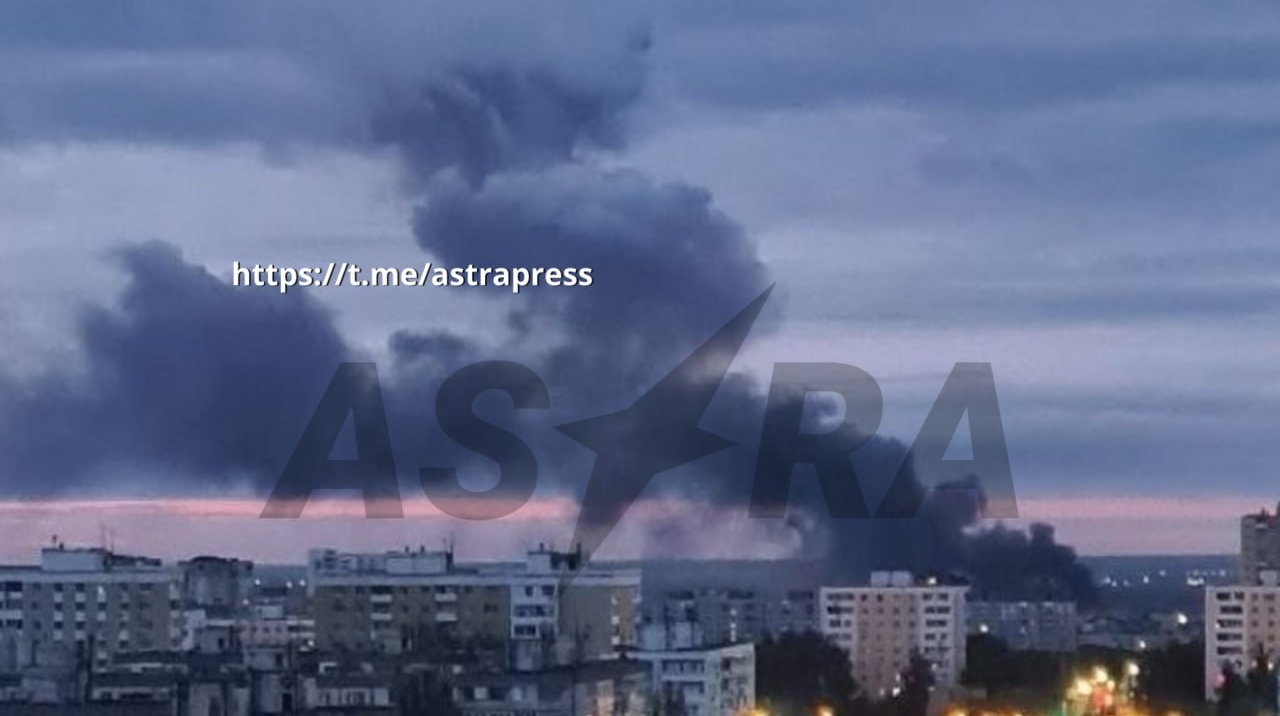 Fire at an industrial facility in
Samara after the overnight Ukrainian strike on what appears to be
Russia’s sole Soyuz rocket plant. Photo: Ukrainska Pravda
Fire at an industrial facility in
Samara after the overnight Ukrainian strike on what appears to be
Russia’s sole Soyuz rocket plant. Photo: Ukrainska Pravda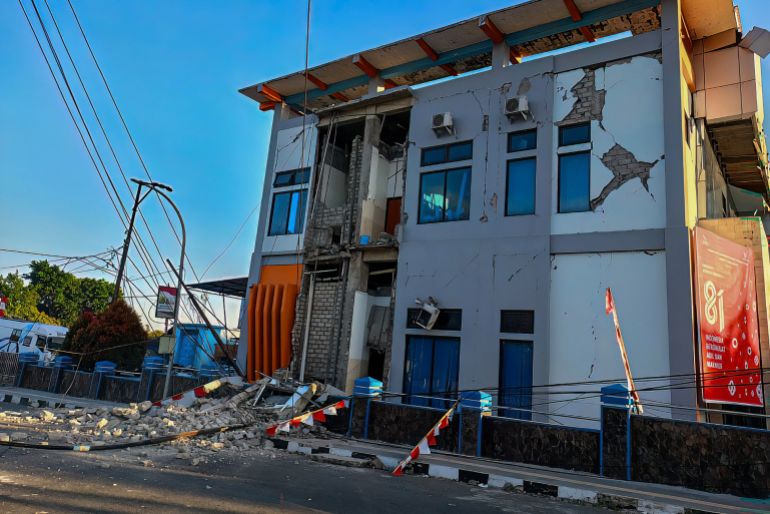 A damaged building in Ruteng, East
Nusa Tenggara, following the 7.7-magnitude earthquake on August 15.
Photo: AFP
A damaged building in Ruteng, East
Nusa Tenggara, following the 7.7-magnitude earthquake on August 15.
Photo: AFP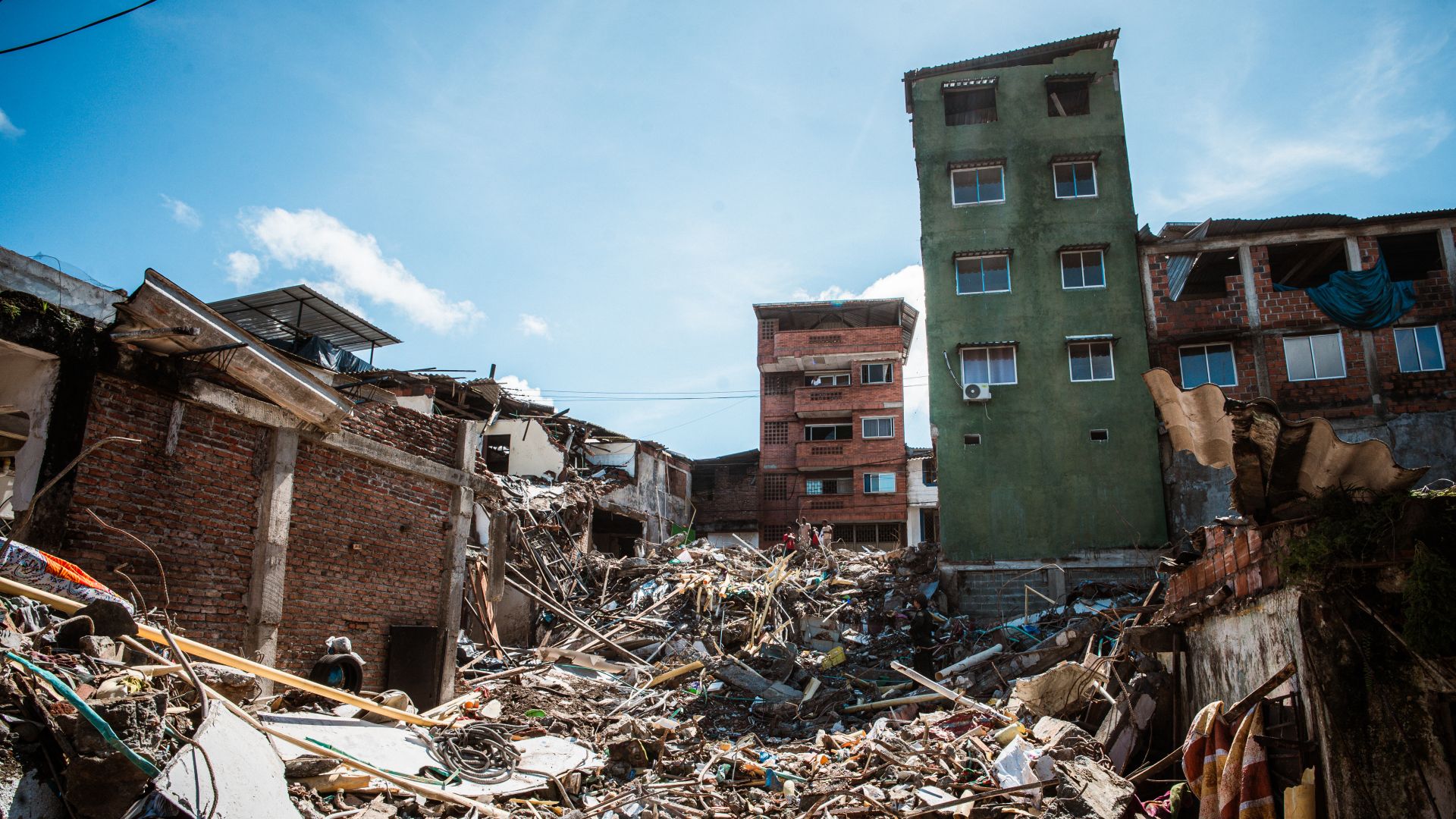 Little remains of the five-storey
building that collapsed onto Lorena Hipis’s home during the August 10
earthquake in Buenaventura, Colombia. Photo: Euan Wallace/Al Jazeera
Little remains of the five-storey
building that collapsed onto Lorena Hipis’s home during the August 10
earthquake in Buenaventura, Colombia. Photo: Euan Wallace/Al Jazeera Former political prisoner Angela
Vasquez embraces her brother after her release outside El Rodeo I prison
in Guatire, Venezuela, August 14. Photo: AFP
Former political prisoner Angela
Vasquez embraces her brother after her release outside El Rodeo I prison
in Guatire, Venezuela, August 14. Photo: AFP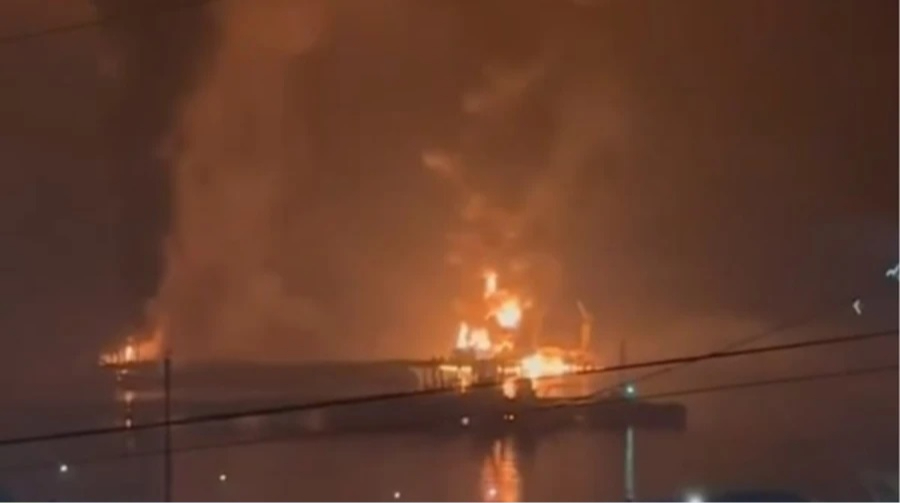 The Sheskharis crude oil loading
terminal at Novorossiysk, which has suspended operations following
Ukrainian drone strikes. Photo: Ukrainska Pravda
The Sheskharis crude oil loading
terminal at Novorossiysk, which has suspended operations following
Ukrainian drone strikes. Photo: Ukrainska Pravda The Chonhar railway bridge between
occupied Kherson Oblast and Crimea, showing strike damage that
reportedly rendered it unusable. Photo: Militarnyi
The Chonhar railway bridge between
occupied Kherson Oblast and Crimea, showing strike damage that
reportedly rendered it unusable. Photo: Militarnyi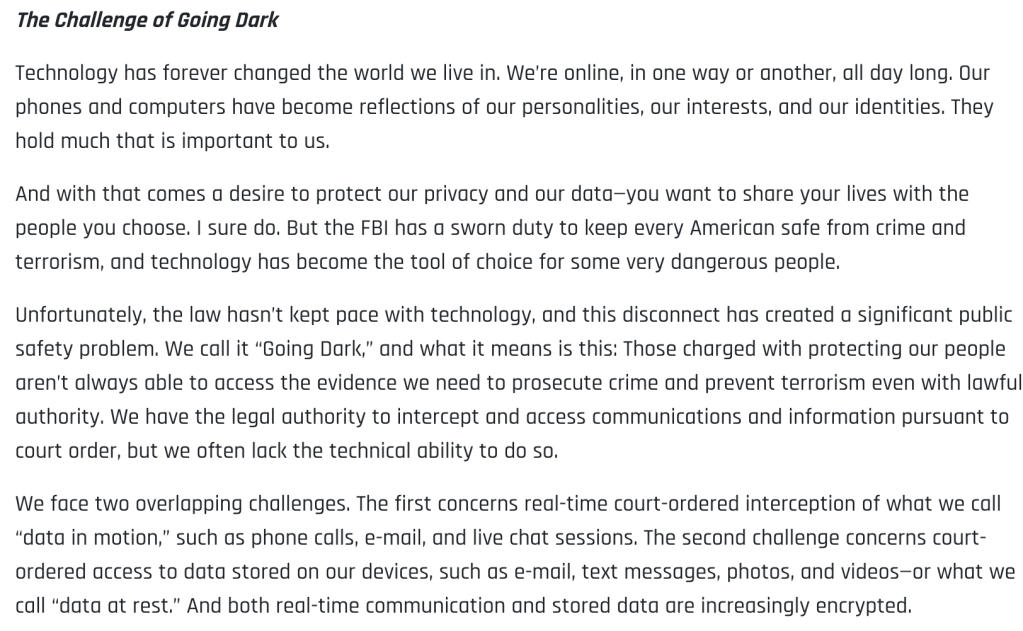 The FBI’s “Going Dark” initiative:
the historical relationship between encryption adoption and law
enforcement access demands. Chart: Matthew Green
The FBI’s “Going Dark” initiative:
the historical relationship between encryption adoption and law
enforcement access demands. Chart: Matthew Green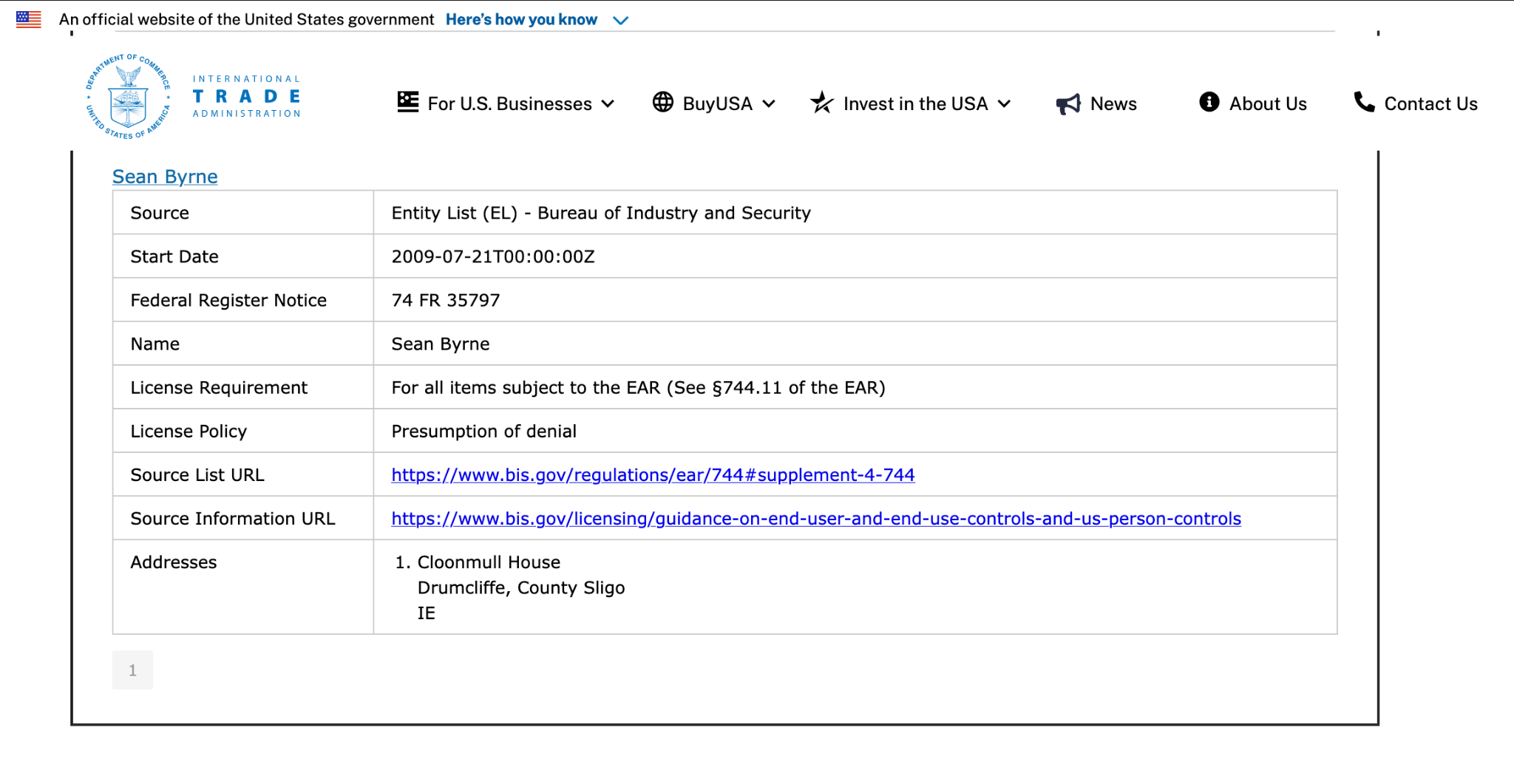 The U.S. Consolidated Screening List
entry for “Sean Byrne” on the BIS Entity List — a person who never
existed. Screenshot: Conic.al
The U.S. Consolidated Screening List
entry for “Sean Byrne” on the BIS Entity List — a person who never
existed. Screenshot: Conic.al A rendered blog post in newspaper
style on a small e-ink reader, coffee within reach. Photo:
heyjonny.dev
A rendered blog post in newspaper
style on a small e-ink reader, coffee within reach. Photo:
heyjonny.dev