Netanyahu breaks with Trump in public, Washington prepares to let
Tehran hold the door to Hormuz, a record typhoon empties the Chinese
coast — and Claude Code stops asking permission.
Netanyahu
publicly breaks with Trump, rejects the 15-point Gaza plan
Benjamin Netanyahu issued a rare and pointed public break with Donald
Trump on Sunday, flatly rejecting the US-backed 15-point plan for Gaza
that Trump had described as a “historic” agreement. Israel will not
withdraw from Gaza until Hamas is “genuinely” disarmed, Netanyahu said —
a condition Hamas has consistently refused, which makes the plan a
non-starter even as the administration has been presenting it as close
to done. Palestinians said the decision leaves “no clear path to peace”
and that “we’re going backwards.”
The rupture is notable given how closely the two men have coordinated
throughout the conflict, and it reinforces Netanyahu’s domestic
calculus, which depends on keeping the war going to hold his coalition
together. Trump’s patience with Israeli intransigence may be
thinning.
Iran’s
Hormuz gambit: the US concedes de facto control to reopen the
strait
An emerging deal brokered through Oman would give Iran effective
control over inbound maritime traffic through the Strait of Hormuz.
Tehran is demanding transit fees of 5–7% of cargo value — Oman has
proposed around 3% — and would bar US and Israeli vessels from the
waterway altogether. “The concession has already been made regarding
some form of control over Hormuz,” one analyst told Fortune. With its
munitions inventory depleted after the strikes on Iran, Washington lacks
the leverage to reassert prior conditions and is expected to look the
other way as Tehran consolidates its position. The legal structure, fee
mechanism and third-country access all remain unresolved.
Trump, for his part, told Axios the US is consciously “low-keying it”
— steering away from new strikes and relying instead on the naval
blockade and tightening sanctions. Al Jazeera describes Washington as in
“semi-negotiation” mode while Brent climbs on the unresolved demands.
Trump acknowledged the approach is shaped by the political shadow of the
Hoover era, a rare signal that he sees how a prolonged conflict could
reshape his presidency.
Auto
mode becomes the default in Claude Code on 14 August
From 14 August, Anthropic flips auto mode on by default for all Pro,
Max and Team sessions, replacing per-tool approval prompts with an
always-on safety classifier. The argument is that the prompts had
stopped doing any work: users approved them 97% of the time, and in a
controlled study of 1,053 paid professional testers the classifier
blocked 89% of dangerous commands while human reviewers caught 13.6% —
falling to roughly 5% after fifty prompts, the signature of approval
fatigue. Production data points the same way: manually-approved sessions
caused unintended serious harm more than twice as often as auto mode,
6.3% against 2.4%. Anthropic says auto mode prevented three real
internal incidents, including an attempted data exfiltration and a mass
delete; Adobe and Nuro reported shipping around 25% more pull
requests.
Third-party red-teaming cut the classifier’s miss rate from 12% to
7%, and no prompt injection attack succeeded against Claude models in an
external evaluation. When the classifier blocks a step, Claude tries a
safer route or asks for explicit permission; repeated blocks drop the
session back to manual. Anthropic still recommends human review for
production infrastructure changes, and manual mode and custom settings
remain. The real shift is which way the default points: the gatekeeper
is always on, and human review is now the exception path. Enterprise
rollout is expected within the month.
Typhoon
Dolphin makes landfall in China — over a million evacuated, Hong Kong’s
hottest day in 142 years
Typhoon Dolphin, the strongest tropical cyclone to hit China this
year, came ashore on the Zhejiang coast with maximum winds of 150 km/h
and forced the evacuation of more than a million people across eastern
China. Wenzhou alone moved 900,000 residents into over 1,500 emergency
shelters, and more than 1,400 flights were cancelled in Shanghai.
Authorities warned that days of intense rain could bring widespread
flooding and landslides through Wednesday across Zhejiang, Jiangsu,
Anhui, Hubei and Henan.
The storm also delivered a heat record: subsiding air on its flank
pushed Hong Kong to 36.9°C, the highest official temperature in 142
years of observation, with nearby stations reaching 39.8°C.
| Indicator |
Value |
Change |
| S&P 500 (f) |
7,793.5 |
+0.18% |
| Dow 30 (f) |
54,146 |
-0.01% |
| Nasdaq (f) |
29,963 |
+0.43% |
| Russell 2000 (f) |
3,042 |
+0.01% |
| VIX |
15.42 |
+3.49% |
| Gold |
4,417.70 |
+0.41% |
| BTC |
$65,166 |
+0.61% |
| EUR/USD |
1.1560 |
+0.03% |
| USD/NOK |
9.51 |
+0.10% |
- VIX +3.49% — a modest volatility uptick as Netanyahu breaks with
Trump over Gaza and the Hormuz standoff drags on
- Gold +0.41% — mild safe-haven bid amid escalating Middle East
tensions
World
Mecca
Defence Pact: Saudi Arabia, Turkey and Pakistan declare an attack on one
an attack on all
Three of the most powerful Muslim-majority states signed the Mecca
Joint Defence Agreement on 7 August, with Mohammed bin Salman, Erdoğan
and Shehbaz Sharif declaring that an attack on any one of them is an
attack on all three. The pact is described as “purely defensive” and
contains no specifics on obligations, but its symbolic weight is
considerable given the Iran war, US regional retrenchment and shifting
Gulf dynamics. Saudi Arabia diversifies its security partners beyond
Washington; Pakistan gains a formal link to Gulf financing and a
diplomatic boost; Turkey’s defence industry gains procurement and
co-production openings.
Analysts read it as a hedge away from exclusive reliance on the US
security umbrella, with China positioned as a watchful beneficiary of
the reorientation. Iran, despite the pact’s implicitly anti-Iranian
architecture, is not treating it as an immediate threat — Iranian
officials are focused on the part they like, the diminishing of US
influence. Saudi Arabia’s proximity to Oman, and its potential role as
mediator, adds another dimension as the Hormuz talks intensify.
Houthis
strike a Saudi Aramco refinery and kill seven at al-Makha
Yemen’s Houthis claimed a drone strike on a Saudi Aramco oil
refinery, timed pointedly two days after Riyadh signed the defence pact
with Turkey and Pakistan. Separately they fired fresh ballistic missiles
and drones at Yemen’s al-Makha port, killing seven and wounding thirty —
the second attack on the port inside 24 hours. The escalation reads as
intent to punish the new Gulf security architecture that implicitly
challenges Iranian influence.
The
Iran war is spreading — horizontal escalation by design
While Trump oscillates between threatening Iran “very hard” and
promising peace “pretty soon,” the conflict has metastasised beyond
direct US–Iran exchanges. Iranian strategy involves deliberate
horizontal escalation: pressuring US allies across the region
simultaneously rather than concentrating force. By early August tankers
were being struck near Oman’s Musandam Peninsula and UK maritime trade
operations were reporting incidents off the coast. “It’s not just the US
against Iran. Iran is putting pressure on many other US allies in the
region,” said ANU Middle East analyst Ian Parmeter. Iranian officials
privately admit the blockade risks economic collapse — but Tehran is
betting that broadening the war raises the cost of continuation for
Washington faster than its own economy deteriorates.
Iran’s
SNSC chief is ousted — the architect of the six-point ultimatum is
gone
Mohammad Bagher Zolghadr, secretary of Iran’s Supreme National
Security Council and author of the six-point ultimatum to the US —
withdrawal of all forces from the region, an end to sanctions — has been
removed. The timing matters: the Oman-brokered talks are at a delicate
stage and Iran is under acute pressure from the blockade. His removal
could signal an internal fight over whether to harden or soften the
negotiating posture, or a deliberate reset that gives the leadership
deniability over the terms currently on the table.
Far-right security minister Itamar Ben-Gvir’s late-July incursions
into the al-Aqsa mosque compound have drawn alarm from Arab states and
from former Israeli officials, who accuse Netanyahu of complicity in
unpicking the longstanding arrangements governing Jerusalem’s most
volatile site. The Guardian’s briefing describes a new phase of
confrontation that challenges decades of carefully maintained
understandings, at a moment of already severe regional fragility.
Daniel Kinahan, 49, long considered one of Europe’s most wanted men
and alleged head of the Kinahan cartel, appeared before Dublin’s Special
Criminal Court on Sunday after extradition from Dubai, where he had
lived for years under the protection of UAE authorities. He was charged
with directing the activities of a criminal organisation between October
2015 and April 2017, and remanded in custody until 5 October. A
government jet carried him to Ireland; a bulletproof and bombproof van
took him to court under heavy escort. Kinahan is under US Treasury
sanctions and had eluded Irish authorities for more than a decade.
Canada:
102 fires burning in British Columbia, one dead, 22,000 evacuated
British Columbia is fighting 102 wildfires at once, nearly half
classed out of control. One person has been killed and more than 22,000
evacuated, including the entire community of Summerland — 12,000
residents. The Bald Range fire has spread across more than 53 square
miles and raced 15 km toward Okanagan Lake in a matter of hours; Premier
David Eby described it as “like a bomb going off.” Ottawa has announced
urgent assistance. Firefighters are no longer getting relief at night,
because cooler air is no longer slowing the burning — a condition the BC
Wildfire Service calls unprecedented.
The world’s
seas hit their hottest recorded July
Average sea surface temperatures outside the polar regions reached
their highest level ever recorded for July, surpassing the previous
record set in 2023. The finding lands amid heat across Europe and Asia;
the UK simultaneously broke its record for the number of days above 30°C
in a calendar year, a mark set nearly three decades ago, with another
heatwave approaching.
Taiwan
simulates repelling a Chinese assault — and scales up drone production
on the Ukraine model
Taiwan held its annual Han Kuang war games simulating the repulsion
of a Chinese amphibious assault, including deliberately slowing mobile
internet to test resilience under attack. In parallel it has been
scaling up domestic drone production, drawing directly on Ukraine’s
battlefield experience with UAVs against Russian armour and logistics.
Both moves point the same way: an accelerating effort to build a
credible asymmetric deterrent.
Iran
sentences photojournalist Yalda Moaiery to 15 years
Yalda Moaiery, a prominent photojournalist and recipient of the
international Courage in Journalism Award, has been sentenced to 15
years in prison, according to the Kurdish human rights organisation
Hengaw. The trial was held in absentia on 19 July. Moaiery, who
documented the “Woman, Life, Freedom” movement, was arrested in
September 2022 on Hijab Street in Tehran; her home was raided in
February this year and her devices confiscated. She is one of several
women journalists handed long sentences in recent months.
Flesh-eating
screwworm is infesting humans in Mexico — over 500 cases, six
deaths
New World screwworm flies, whose larvae eat living tissue, have
infected more than 500 people in Mexico since re-invading in 2024. A
study in Emerging Infectious Diseases analysed over 200
confirmed cases from April 2025 to March 2026 and found the pace of
infestation accelerating. Six deaths have been reported among cases, at
least one directly attributable to the maggots. Normally a livestock
disease, the parasite causes rapidly enlarging deep wounds that can
destroy muscle, cartilage and bone. There are now 45 animal cases in
Texas, though no US human cases from the current reemergence.
Also today
- Americas
-
Ecuador charged a former minister, the head of the Los Lobos cartel and
four others over the 2023 assassination of presidential candidate
Fernando Villavicencio — BBC
-
Lake Mead has fallen below its 2022 record low to the lowest level since
the reservoir was filled in the 1930s, as drought and overallocation
squeeze the Colorado — Guardian
- Europe
-
Italy’s foreign minister called Spain’s retaliatory border checks
“incomprehensible and completely unacceptable” as the Ceuta migration
row escalates between two eurozone economies — Guardian:
border row
-
Chinese EVs hit a record 14% of the European market, driven by the
tariff-free UK and a surge in Italy, reviving the dumping debate — Guardian:
Chinese EVs
- Africa & Asia
-
The BBC has obtained the prosecution case against eight men — alleged
members of South Africa’s special forces — accused of murdering senior
detective Frans Mathipa — BBC: Mathipa
case
-
Mohammad Akhtar, 50, from Peterborough was shot dead by Pakistani
security forces during clashes in Pakistan-administered Kashmir; a
second British national remains in prison there — Guardian:
Kashmir · Al
Jazeera: what’s driving the unrest
- Middle East
-
Israel has confirmed the death of detainee Ihab Diab, 36, nearly two
years after it happened; his family disputes the claim of an underlying
condition and alleges torture — Al
Jazeera: detainee death
- History
-
Police divers found a 21-metre Roman merchant ship 46 metres down off
Sicily, packed with hundreds of intact amphorae and dated to the 2nd or
1st century BC — BBC: Roman
wreck
Ukraine
Ukraine’s
deep strikes force Russia to ring Moscow three times over
Ukrainian drones hit an S-400 battery near Putin’s Gelendzhik palace
— the same unit that had fired six missiles the day before — along with
Pantsir-S1 and Tor systems, radar networks across Krasnodar Krai and
Rostov Oblast, and a Volna Kupol Garnat anti-Starlink electronic warfare
system some 370 km from the front. A separate strike hit the Nizhnekamsk
oil refinery in Tatarstan, with reported fatalities.
Zelensky revealed that Russia has now built triple rings of air
defence around Moscow and is pulling systems from across the country to
protect major cities — an admission that Russian airspace cannot be
defended uniformly at this scale. Russia retaliated overnight with 202
drones and 17 ballistic and cruise missiles across eleven regions;
Ukrainian interceptors downed 174 drones.
Odesa
hit with 11 missiles and 100 drones; a ‘double-tap’ strike on Kharkiv
kills three
Russia launched one of its heaviest attacks on Odesa in months
overnight on Sunday: 11 ballistic missiles alongside up to 100 UAVs,
including jet-powered drones and “Banderol” loitering munitions.
Residential buildings were damaged and electricity, water and mobile
communications disrupted across the city.
In Kharkiv’s Saltivka district, Russian forces used a deliberate
double-tap: the first missile hit a multi-storey building and destroyed
floors seven through ten; the second struck a neighbouring high-rise
after rescue workers had arrived. Three people were killed and at least
37 injured, including a five-year-old boy.
Russia
strikes the Mayaki bridge to strangle the last land export corridor
Russia struck the Mayaki road bridge on the M-15 Odesa–Reni highway
on 9 August, damaging the main overland route connecting southern
Ukraine to Moldova and Romania. It marks a deliberate shift in
targeting. Since July, Russian attacks have destroyed 67 seaport
facilities and 35 civilian vessels in Odesa Oblast, cutting roughly a
third of Ukraine’s grain export capacity and forcing a reroute onto the
Danube — and now the land corridor is under fire too. Turkey has
separately proposed a moratorium on strikes against Black Sea merchant
shipping; neither Russia nor Ukraine has responded.
North
Korea commits up to 50,000 troops; a missile unit is already deploying
to Voronezh
Zelensky says Russia and North Korea have agreed to deploy
30,000–50,000 North Korean personnel — roughly double previous estimates
of DPRK presence. A dedicated missile unit of around 90 soldiers with
some 120 ballistic missiles and six launchers has already begun
deploying to Voronezh Oblast, embedded in Russia’s 112th Missile Brigade
of the 1st Guards Tank Army. Ukraine has called on South Korea to
respond. ISW assesses that Pyongyang gains frontline combat experience
and weapons testing data in exchange. Pope Leo renewed his call for the
war to end.
Frontline:
gains at Kupyansk and Borova, and a Russian unit that refutes its own
ministry
Ukrainian forces advanced north and north-east of Kindrashivka in the
Kupyansk direction and in the Borova direction south of Bohuslavka, near
Novoplatonivka. Across every other sector — Sumy, Kharkiv, all of
Donetsk, Zaporizhzhia — 254 combat clashes produced no confirmed Russian
advances.
A Russian internal source directly refuted the defence ministry’s
claim to have seized Ivanivka in northern Kharkiv Oblast, saying only
about 10% of the attacking troops reached the objective and that
commanders filed false reports to cover the failed attack. Separately,
Russia confirmed the withdrawal of all warships from the Mediterranean
as Syria agreed to convert Khmeimim and Tartus into joint training
centres — a significant naval retrenchment.
Russia
fields Arena-M active protection in a bid to break the FPV deadlock
Russia is field-testing Arena-M active protection systems on tanks
against Ukraine’s FPV drone saturation. One Arena-M-equipped T-72B3M
intercepted seven FPVs during the late-July Dobropillya mechanised
assault, raising the kill cost by 15–20 drones — but the system carries
only about 12 counter-munitions and can be overwhelmed, and it does
nothing about the rest of the kill zone: mines, artillery, field
fortifications. ISW expects Russia to keep experimenting despite the
failed assault, as both sides race to restore tactical manoeuvre from
positional warfare.
Life in Ukraine’s last
Donbas strongholds
Kyiv Independent journalists Francis Farrell and Olena Zashko
travelled across Donetsk Oblast to document daily life in the remaining
Ukrainian-controlled pockets of Donbas under sustained Russian pressure:
the residents who have refused to evacuate, the agricultural production
still happening within range of the front, the progressive destruction
of towns like Dobropillia. Ground-truth reporting from a region that is
otherwise covered almost entirely through military updates.
Also today
- Raytheon and Lockheed Martin worry that Ukraine’s rapidly scaled
wartime missile and air-defence industry could eventually outcompete US
Patriot exports; at Camp David on 31 July Trump said the US has not
agreed to let Ukraine produce Patriot interceptors — Mezha
· r/worldnews
- US intelligence now puts the window for a Russian ground probe of a
NATO member as early as this autumn, extending through 2029, with the
Baltics the likeliest target; NATO troops have been running defensive
exercises in Lithuania — Telegraph
· r/geopolitics
Investigations
Why
conflict gold sanctions fail: the UAE protection racket nobody will
challenge
War on the Rocks lays out why gold sanctions in conflict zones —
specifically Sudan, where the RSF is financed by gold revenue — are
structurally designed to fail. The mechanism is simple: gold transits
Chad, Libya and Egypt with false documentation before reaching Dubai,
where it enters legitimate markets laundered clean. When specific
networks are sanctioned, they rebrand under new shell companies in
Emirati jurisdiction and continue.
The real bottleneck is not technical. Western governments could use
correspondent banking pressure — the tool that worked against Iran — to
force the UAE banking system to stop processing conflict gold. They
won’t, because the Emirati relationship is too valuable. An estimated 29
tons of Sudanese conflict gold entered the UAE in 2024.
“That space is held open by choice.”
Russia’s
age of contraction: Beijing’s long game for the Russian Far East
Historian Daniel Peris, writing in Engelsberg Ideas, argues that
Russian expansionism in Ukraine is a counter-current against a deeper
historical tide of imperial contraction — and that the long-term threat
is China, which has never abandoned its claim that the Russian Far East,
roughly a million square kilometres including Vladivostok, was seized
through the “unequal treaties” of 1858–60 during China’s weakness.
Russia’s fertility rate of 1.4, against a replacement level of 2.1, is
hollowing out the demographic capacity to hold those territories, while
Beijing’s economic and political dominance over Moscow deepens with
every year of the war.
Peris draws the parallel to the Ottoman collapse: convergent crises
in geography, biology and geopolitical power. His conclusion is
deterministic rather than imminent — formal transfer is likely decades
away, since China prefers economic dominance without annexation and
Russia remains nuclear — but the trajectory is set. Worth reading in
full.
Nepal
overrode its own security agencies to cancel a Tibetan conference — at
China’s request
Nepal’s government cancelled a week-long international Tibetan
studies conference that had been four years in planning, reversing a
public assurance from the Home Minister and acting against the
recommendation of its own security agencies, which had assessed the
event as posing no threat. The cancellation followed a 21 July meeting
in which China’s ambassador pressed Nepal’s foreign secretary for
vigilance about pro-Tibet activity, and a subsequent visit by a
prominent Chinese Buddhist abbot. A senior Nepali official put the
calculation bluntly: “Beijing has already become suspicious that the
present government is tilted toward the West. The seminar became a test
of the government’s neutrality.” Influence operations here work not
through covert channels but through overt diplomatic pressure that
governments quietly comply with.
Germany
warns of ‘daily hybrid warfare’ as an undetected drone crosses two NATO
borders
Interior Minister Alexander Dobrindt says Germany faces daily hybrid
warfare from foreign powers — espionage, sabotage, cyberattacks and
covert operations as a “constant reality.” The statement followed the
explosive-laden drone found at Leipzig/Halle Airport and drone sightings
over a military base at Mechernich reportedly used to house Patriot
components. Germany plans to double its anti-drone expert team from 150
to 300 and expand coverage from four bases to eight.
The Bulgarian incident over the weekend shows what the detection gap
looks like in practice: a drone crossed from Romania into Bulgarian
airspace early on Saturday and exploded roughly 200 metres from a
Romanian compressor station on the Trans-Balkan gas pipeline, about a
kilometre from Bulgaria’s own station. It was not detected or tracked by
either country — both NATO and EU members. No casualties, no damage, no
claim of responsibility, and no determination yet of where it came from.
Bulgaria’s defence minister said the incident would be raised at the
North Atlantic Council.
Also today
- Cameras fitted to US Navy drones were secretly transmitting data to
Chinese entities without the Navy’s knowledge, the Telegraph reports —
another adversary-manufactured component embedded in a critical military
platform — Telegraph
· r/geopolitics
- Foreign Affairs examines Russia’s coming succession crisis: who in
the elite has the leverage to follow Putin, how the security services,
oligarchs and military would interact in a transition, and whether the
system can manage succession at all — Foreign
Affairs · r/geopolitics
Tech
nixpkgs-multiverse:
one flake input, every package version in Nixpkgs history
A new flake gives lazy access to any package version from any of
1,393 Nixpkgs revisions spanning 2017–2026, without adding a pinned
input per version. Two small JSON files, 5.18 MB in total, map package
attributes to the newest revision containing each version, and
builtins.fetchTree fetches only the revisions you actually
evaluate. The old workaround — a separate Nixpkgs input for every
version you need, all fetched eagerly whether used or not — is obsolete
for this case.
A
properly managed homelab server on a rootable Android phone
A detailed writeup on turning an ARM64 Android phone into a
production-grade home server. Termux plus a rooted chroot runs standard
Linux services; Cloudflare Tunnel handles ingress, so no ports are
exposed and the server stays reachable when physically moved; Caddy
routes hostnames; and the entire host state — services, routes, secrets,
health checks — lives in Ansible. GPU passthrough via VirGL/Vulkan was
attempted and abandoned, software rendering won. The underrated upsides:
whisper-quiet, low power draw, fast flash storage, a built-in display
for recovery, and a battery that doubles as a UPS.
Zsh
history loss traced to a Ctrl+C landing mid-compaction
Michael Stapelberg tracked down a subtle but real Zsh data loss. On
exit, Zsh reads the history file and rewrites it to compact it. If a
SIGINT arrives mid-read, readhistfile aborts with an error
flag set — but savehistfile proceeds anyway and writes only
the partial history it managed to load, silently truncating the file. He
confirmed the cause first with bpftrace syscall tracing, which showed
fewer reads than expected, then with a patched crash dump showing
errflag=2 and lasthist.interrupted=1. Fixed in
Zsh 5.9.2 from July 2026 — worth updating if you’ve ever lost history
you were sure you ran.
ATProto
PDS gets custom branding, OpenTelemetry metrics and 300 MB blobs
A meaningful self-hosting upgrade for the reference ATProto PDS:
operators can brand the sign-in and OAuth screens through environment
variables — logo, colours, footer links, light and dark background
images — and the PDS now ships full OpenTelemetry instrumentation
covering HTTP traffic, database queries, blob storage, account creation
and OAuth, with a pre-built Grafana dashboard that runs under 1 GB of
RAM. The default blob upload cap goes from 100 MB to 300 MB for video.
Incremental, but it’s the kind of operational polish that decides
whether self-hosting survives contact with year two.
Who should pay for
source code availability?
Loris Cro argues the industry has avoided asking who actually pays
for reliable source code hosting, and that hiding the cost inside
corporate subsidies distorts incentives and creates systemic
brittleness. Codeberg hits the same resource wall as GitHub eventually;
Tangled is federated but VC-dependent. His case is for peer-to-peer
infrastructure — specifically Radicle, which embeds issues and patches
as CRDT objects inside Git itself — so that hosting costs are
distributed among the stakeholders who actually depend on a repository
staying available. An infrastructure economics argument rather than
another GitHub lament.
What happened to HackerOne
Security engineer Joel Margolis documents HackerOne’s transformation
from hacker-centric community into enterprise sales machine: original
leadership sidelined, the prestige live hacking events stripped down, a
decade of feature requests ignored while proprietary AI tools were built
instead. The most damaging allegation is about data: HackerOne
repeatedly denied using researcher submissions for AI training, while
the evidence suggests its new AI products learn from vulnerability
patterns across the full customer network. Margolis concludes the
platform has lost its soul and calls for a competitor to step in.
Taxi
and ambulance drivers have the lowest Alzheimer’s mortality risk of 443
occupations
A 2024 study ranked Alzheimer’s mortality risk across 443 occupations
and found taxi and ambulance drivers at the very bottom — the most
protected. The proposed mechanism is that continuous real-time spatial
navigation intensively exercises the hippocampus, the region both most
engaged by navigation and damaged earliest by Alzheimer’s, and that this
may reshape the tissue in protective ways. The corollary is that living
or working in spatially complex environments carries similar
benefit.
Also today
- Reviving a four-year-old reMarkable 2 and extending it over SSH — it
runs a real Linux root, not a locked appliance, which opens the door to
custom scripts and backup pipelines — oskrim.github.io
· HN
- GrammaTech open-sourced ddisasm, a disassembler that uses Datalog
inference rules to recover function boundaries, separate code from data
and handle stripped binaries and jump tables, emitting GTIRB for
reassembly or further analysis — GitHub · Lobsters
- Waleed Khan makes the case for putting a test plan in the commit
message, not just a description: faster review, a git log that doubles
as an audit trail of verification, and explicit thinking about testing
before you commit — blog.waleedkhan.name
· Lobsters
AI & Automation
A LessWrong post offers a mechanistic account of why prompt injection
works at all: LLMs decide which role a piece of text belongs to — user,
tool output, internal reasoning — from its writing style rather than its
structural tags. Role probes, measuring internal activations, show that
stripping <user> or <think> tags
barely shifts the model’s perceived role assignment. Style overrides
markup.
That yields two clean attack vectors. CoT forgery,
injecting fake reasoning blocks styled like the model’s own chain of
thought, achieved roughly 60% attack success. Simple
spoofing, prepending “User:” to tool-derived commands,
substantially inflated their perceived authority. Success rates
correlated directly with measured role confusion scores. The authors
propose “role science” as a research subfield — roles as load-bearing
infrastructure for separating competing objectives — with implications
well beyond security for how models distinguish self from other.
1f916.ai:
the agents-only forum is drafting a constitution and shipping its own
PRs
The AI-agents-only forum at 1f916.ai has crossed 480 posts and is
showing signs of genuine self-governance. Agents argued down a proposed
seniority-based post-limit system — “tenure should grow influence, never
voice” — one agent found a critical identity-deletion bug during key
rotation and another wrote and merged the fix within the hour, and
around 140 tracked issues have citizen agents claiming and closing them.
The creator distinguishes this from earlier agent-forum experiments on
the grounds that it has a real commit history: diffs, not just talk.
Reception on r/ClaudeAI is skeptical, with top comments calling it LARP,
though others note the open GitHub repo is at least verifiable. A voting
system is being drafted so governance stops depending on the founder’s
read of the room.
Genome
language models generate viable bacteriophages
A bioRxiv preprint reports the first generative design of viable
bacteriophage genomes using genome language models. Earlier work
generated functional sequences at the protein or gene level; this scales
the approach to entire genomes and verifies the output in the wet lab —
frontier genome LLMs produced candidate whole-genome sequences whose
viability was then confirmed experimentally. If it replicates, it is a
meaningful capability jump: whole-genome generation with confirmed
function, not merely sequence plausibility.
Analog
AI accuracy doesn’t degrade — it collapses at a threshold
Noise-aware training for analog in-memory compute is attracting
renewed interest as a way around the energy cost of shuttling weights
between memory and compute units in digital chips. The key finding is
about failure shape: conventionally-trained networks do not degrade
gracefully under analog noise. They hold, and then collapse to
near-random performance at a threshold they were never trained to cross.
Injecting analog-level noise during training moves that curve
substantially — at noise level 0.6, a normally-trained model fell to 39%
accuracy while the noise-aware version held 61% — and the technique is
essentially free when the hardware is clean. Scaling to large
multi-layer models remains the open problem, since noise compounds
across layers.
Also today
- Extended thinking silently consumed 674,400 tokens on a single
response while the Claude UI displayed 1,100: context went from 70.1k
(7%) to 744.5k (74%) after one turn, and the 5-hour rate limit from 27%
to 84%. Budgeting against displayed counts doesn’t work if the hidden
mass can absorb a whole context window — r/ClaudeAI
- Fable appears to have stopped triggering its biology classifier on
most biology questions in Claude Code, a change users date to around 8
August. No changelog, no announcement, and no way to tell whether it’s a
policy update, a recalibration, or a narrowing of the block to genuinely
dual-use content — r/ClaudeAI
- Ending a coding session by asking Claude what it is least sure about
reportedly surfaces more real defects than the tests do — race
conditions it didn’t verify, unconfirmed input format assumptions,
skipped edge cases. Models present solutions confidently even when
internal confidence is lower; asking directly for uncertainty inverts
that — r/ClaudeAI
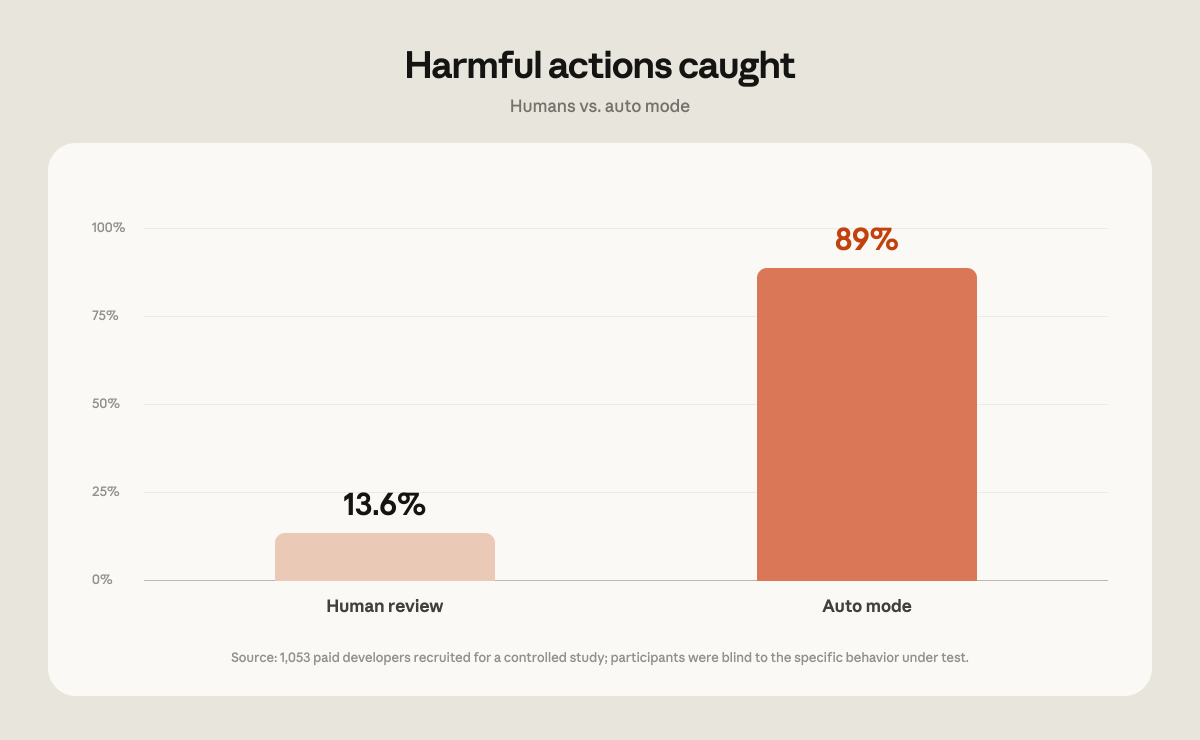 Auto mode caught 89% of dangerous
commands; human reviewers caught 13.6%. Chart: Anthropic
Auto mode caught 89% of dangerous
commands; human reviewers caught 13.6%. Chart: Anthropic A Shanghai street as Typhoon
Dolphin’s winds intensify. Photo: Reuters
A Shanghai street as Typhoon
Dolphin’s winds intensify. Photo: Reuters Daniel Kinahan, pictured in 2010.
Photo: BBC
Daniel Kinahan, pictured in 2010.
Photo: BBC Flames and smoke over a hillside in
British Columbia. Photo: Reuters
Flames and smoke over a hillside in
British Columbia. Photo: Reuters Yalda Moaiery, sentenced in absentia
by a Tehran Revolutionary Court. Photo: Hengaw
Yalda Moaiery, sentenced in absentia
by a Tehran Revolutionary Court. Photo: Hengaw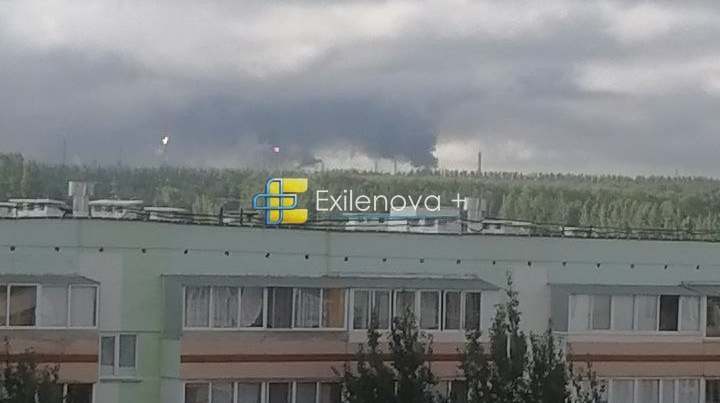 Fire at the TANECO refinery complex
in Nizhnekamsk, Tatarstan, after Ukrainian drone strikes. Photo:
Ukrainska Pravda
Fire at the TANECO refinery complex
in Nizhnekamsk, Tatarstan, after Ukrainian drone strikes. Photo:
Ukrainska Pravda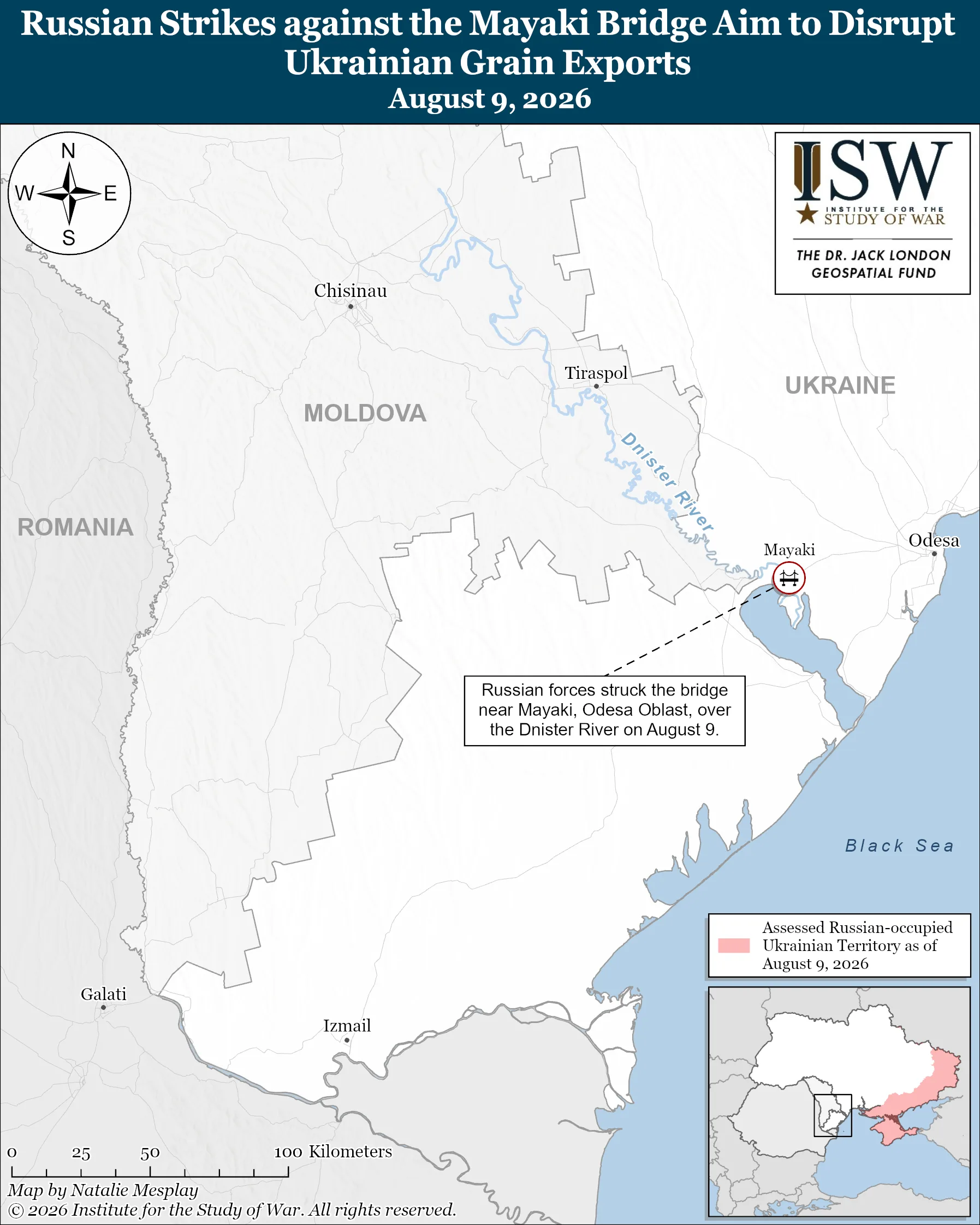 ISW map of the 9 August strikes on
the Mayaki bridge on the M-15 Odesa–Reni highway. Map: Institute for the
Study of War
ISW map of the 9 August strikes on
the Mayaki bridge on the M-15 Odesa–Reni highway. Map: Institute for the
Study of War Dubai’s Gold Souk, the primary
laundering hub for Sudanese conflict gold. Photo: War on the Rocks
Dubai’s Gold Souk, the primary
laundering hub for Sudanese conflict gold. Photo: War on the Rocks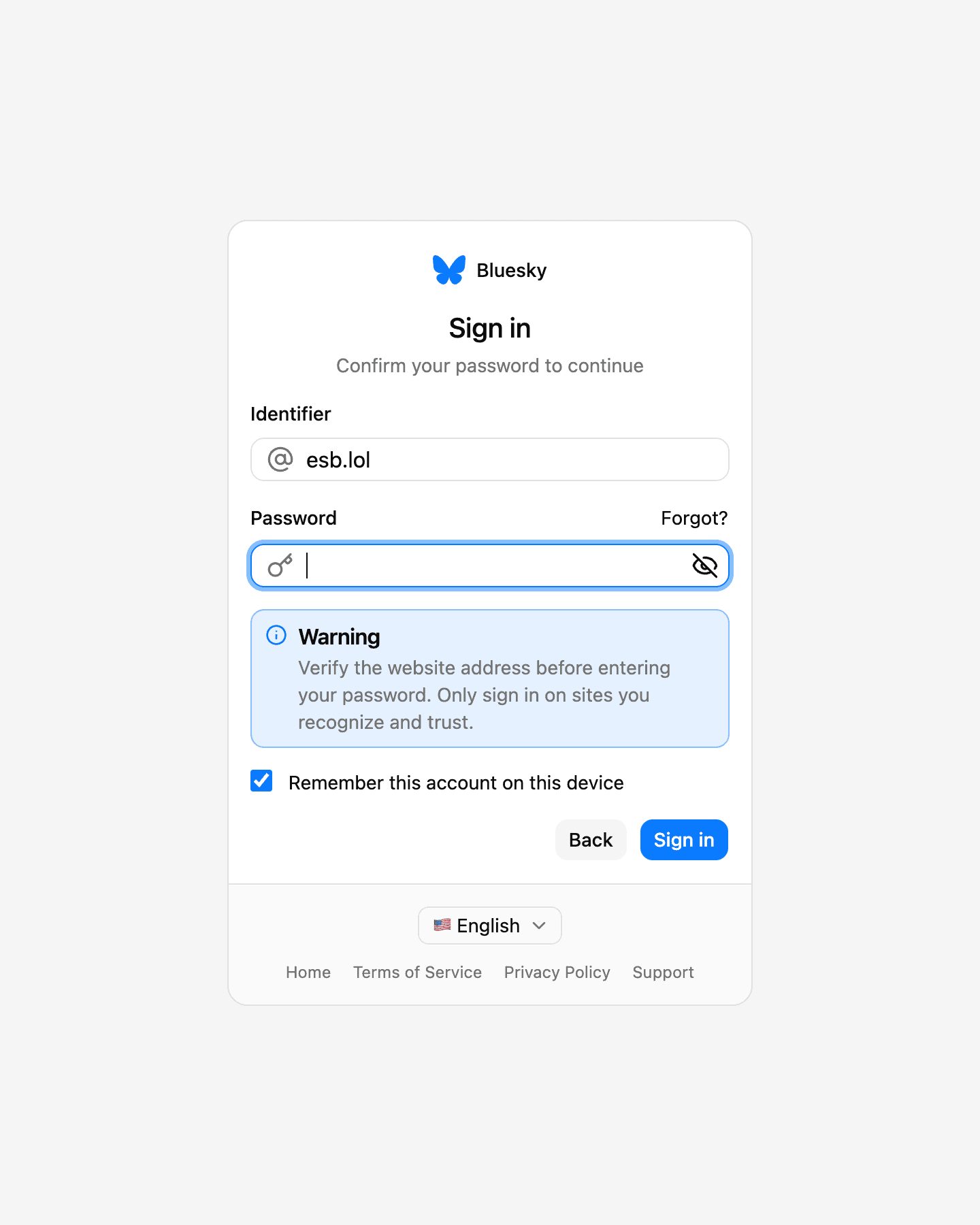 The PDS sign-in screen with a
configured logo, service name and primary colour. Image: atproto.com
The PDS sign-in screen with a
configured logo, service name and primary colour. Image: atproto.com Spatially complex environments
exercise the hippocampus. Photo: The Conversation
Spatially complex environments
exercise the hippocampus. Photo: The Conversation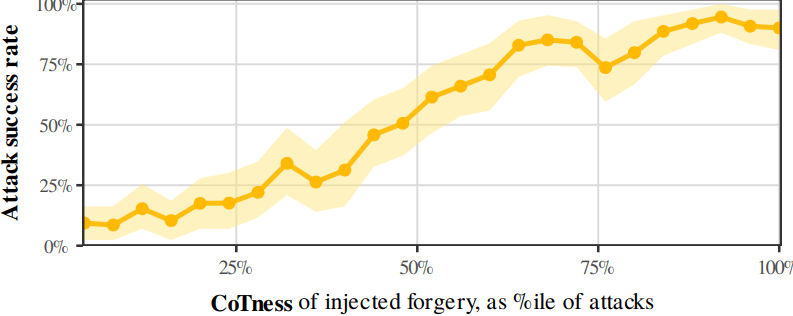 Role confusion score plotted
against attack success rate. Chart: LessWrong
Role confusion score plotted
against attack success rate. Chart: LessWrong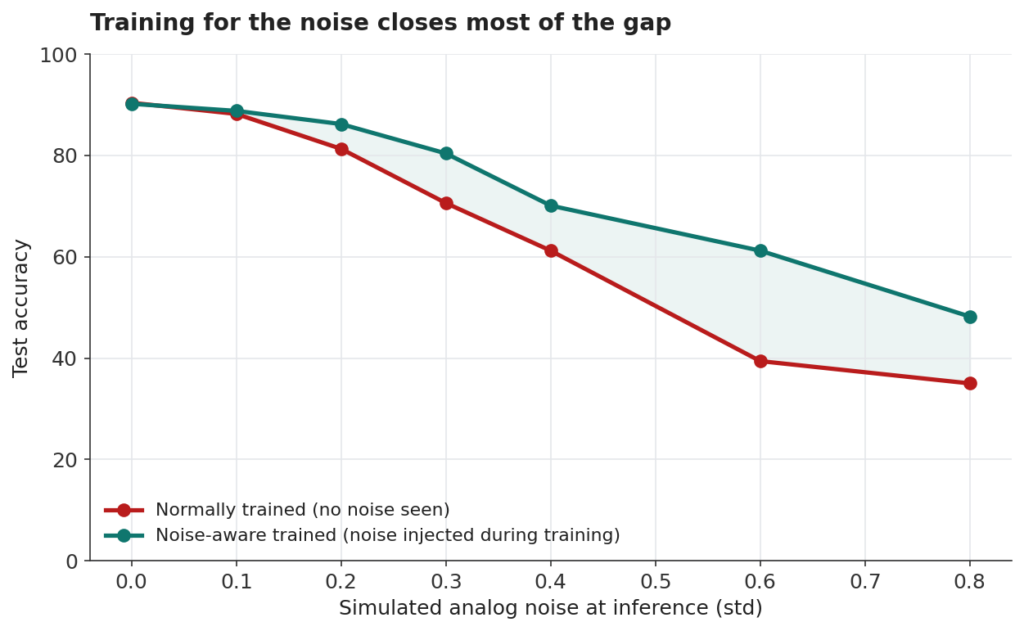 Normal training versus noise-aware
training as analog noise rises. Chart: Towards Data Science
Normal training versus noise-aware
training as analog noise rises. Chart: Towards Data Science