Iran sets its price for reopening Hormuz, a drone lands 200
metres from the pipeline that feeds Ukraine, and Kyiv finally gets
missiles — just as Moscow prepares the strike that will test
them.
Iran
issues sweeping Hormuz demands as Vance claims the nuclear programme is
‘destroyed’
The IRGC has issued far-reaching conditions for reopening the Strait
of Hormuz, including a demand that the US “correct its behaviour” and
meet broader political commitments — dampening hopes of a near-term deal
despite the Oman-brokered talks. Complicating the picture: the UAE
reported that one of its ships was targeted by an Iranian missile.
Vice-President Vance meanwhile claimed the US has “destroyed” Iran’s
nuclear programme and degraded its military, a claim analysts dispute,
while the Guardian characterised the standoff as an “impotent cycle of
empty threats.” Tanker crews remain in limbo; transiting the strait is
still dangerous.
A
drone with explosives lands 200 metres from the Trans-Balkan
pipeline
The drone that detonated in a Bulgarian field close to the Romanian
border was initially unidentified — and read, in the first hours, as
another entry in the pattern of suspected Russian-linked incursions into
European airspace. It turned out to be a Ukrainian “Maya” decoy,
carrying a significant explosive load, that came down roughly 200 metres
from a Romanian gas compressor station on the Trans-Balkan pipeline, the
route that supplies Ukraine. Bulgaria’s defence ministry called it
likely unintentional and Ukraine denied deliberate targeting, though it
remains unclear why a decoy was carrying explosives at all. The pressure
on European infrastructure is not one-directional: a likely Russian VTOL
surveillance drone made six overflights of the Bundeswehr’s Mechernich
base, where US Patriot systems are housed and repaired.
Ukraine
buys 70 ATACMS from Turkey and secures monthly Patriot deliveries
Turkey will supply 70 M39 ATACMS missiles and 12 M270 MLRS launchers,
along with tens of thousands of cluster munitions — a significant boost
to long-range strike capacity, and one the US Congress has been formally
notified of. Separately, Zelensky announced that the US has agreed to
monthly Patriot interceptor deliveries. He said he is “satisfied” with
the results of a 40-day operation against Russian logistics and
signalled more to come: “We understand all their weak points.” Ukraine’s
domestically produced ballistic missile is on track for first combat use
this autumn, and the startup Fire Point says mass production of its
FP-7X interceptor could begin this month. None of it closes the gap yet
— Ukraine is receiving nearly three times fewer anti-ballistic
interceptors than at the start of 2026, and Russia intends to exploit
that in the coming weeks.
The Senate narrowly confirmed Todd Blanche — who represented Trump in
his federal criminal cases — as the nation’s top law enforcement
official, with rare Republican dissent. Senate Minority Leader Schumer
condemned the vote as enabling Trump’s “pervasive, breathtaking
corruption.” The immediate question is DOJ independence on cases
involving Trump’s allies and his opponents.
| Indicator |
Value |
Change |
| S&P 500 |
7,758 |
+0.62% |
| Dow 30 |
54,037 |
+0.28% |
| Nasdaq |
26,691 |
+1.30% |
| Russell 2000 |
3,034 |
+1.10% |
| VIX |
14.9 |
−1.65% |
| Gold |
4,400 |
+2.33% |
| BTC |
$64,793 |
−0.21% |
| EUR/USD |
1.1557 |
−0.02% |
| USD/NOK |
9.51 |
−0.01% |
- Gold +2.3% as safe-haven demand builds on Ukraine escalation,
Iran and Hormuz, and the Bulgaria pipeline drone (see World)
World
Israel
accused of weaponising archaeology to seize West Bank land
Israel is advancing plans for large-scale land expropriations at
historic, Palestinian-populated areas of the West Bank under the guise
of archaeological preservation — heritage law used as a displacement
tool. At the same time, Palestinians near Bethlehem describe daily
settler attacks with little or no intervention from Israeli security
forces, as settler violence reaches record levels across the
territory.
Gaza:
8,000 remain under the rubble as recovery collapses for want of
machinery
Crews pulled 19 more bodies from the ruins of a destroyed Gaza
building, while officials estimate that more than 8,000 people remain
entombed across the strip. Heavy machinery has been destroyed or blocked
from entry, so the search proceeds at a fraction of the necessary pace —
and thousands of families still cannot confirm whether the missing are
dead or alive.
Netanyahu’s
ex-chief of staff says he blocked a loyalty pledge to the ‘Netanyahu
family’
Israel’s former prime ministerial chief of staff has disclosed that
the entire staff at the PM’s office was instructed to sign a personal
loyalty pledge — not to the state, nor to the office, but to the
Netanyahu family. He says he blocked the directive. It adds to a
widening picture of personalised authority at the apex of Israeli
government during wartime.
Israeli
troops intrude on southern Lebanon town; Lebanese soldiers injured
Israeli forces entered Zawtar al-Gharbiyah, where Lebanese Army
soldiers were disarming unexploded ordnance. Lebanese soldiers were
injured in the incursion, and Israeli forces reportedly built an earth
barrier in the area — a marker of continued de facto occupation beyond
the ceasefire line.
Yemen:
government forces counterattack as Marib shelling resumes
Yemen’s government forces have launched counterattacks against Houthi
positions as the group resumed shelling of Marib province, and the
Houthis claimed a missile strike on a site inside Saudi Arabia. Analysts
warn that “all the warning signs” of a wider escalation are present,
with the conflict threatening to spill beyond Yemen’s borders while
Houthi attacks in the Red Sea corridor continue.
Colombia:
ELN detonates a car bomb on day two of the hardline presidency
A car bomb destroyed a toll booth on the Pan-American Highway in
southwest Colombia, one day after President Abelardo de la Espriella was
sworn in and pledged “all-out war” on narco-terrorism. The attack,
attributed to the ELN, is a direct signal that the guerrilla group will
answer the end of the Petro-era peace process with violence. The
government has promised a harsh response.
Orbán
nominates the judge he had sacked as Hungary’s next president
Fidesz has nominated András Baka — the former president of Hungary’s
Supreme Court, removed from his post by Orbán’s government in 2012 in a
case that went to the European Court of Human Rights — to become
Hungary’s next president. Baka has been a vocal advocate of judicial
independence. The nomination is being read as a carefully calculated
gesture, perhaps toward EU normalisation; critics remain deeply
sceptical.
Canada
wildfire doubles in size; British Columbia declares a state of
emergency
A fast-moving fire in BC’s Okanagan region has grown past 95 sq km,
forcing the entire community of Summerland and tens of thousands of
surrounding residents to evacuate. The Bald Range fire remains out of
control. It belongs to the same summer as the fires that swept France
last month — where authorities have now arrested hundreds of people,
even as the role of extreme heat and drought complicates any attempt to
attribute criminal responsibility.
178,000 immigrants
have suddenly left South Africa
More than 178,000 immigrants have departed South Africa — deported or
self-driven — in a rapid exodus prompted by stepped-up enforcement,
anti-immigrant political pressure and worsening economic conditions. The
scale and speed make it one of the largest migration reversals on the
continent in recent memory.
Private
prisons report $1.4bn in revenue as immigration detention surges
GEO Group and CoreCivic, the two dominant US private prison
companies, have reported $1.4 billion in combined revenue driven by the
expansion of immigration detention. CoreCivic separately took $1.6
billion in net proceeds from selling four facilities directly to the
Department of Homeland Security, which is building out detention
capacity to meet deportation targets.
European
drought exposes Nazi-era shipwrecks in the Danube
Record-low water levels from this summer’s heat have exposed dozens
of WWII-era German warships along the Danube riverbed, along with
unexploded ordnance and a military motorcycle. Europe’s wartime past
surfacing by way of a contemporary climate catastrophe has drawn
historians and bomb disposal teams to the same stretch of river.
Also today
- Americas
-
Hunter Biden says his father’s prostate cancer has “metastasised into
his bones and further” and is debilitating — Al
Jazeera · Guardian
-
Federal grants can no longer fund fentanyl test strips; harm reduction
groups say the ban will cost lives — NPR
- Europe
-
The Royal Navy spent 21 days in July shadowing Russian ships in the
Dover Strait and North Sea, a 25% increase in patrol time — The
Guardian
-
Wednesday’s near-total solar eclipse is the first this century visible
across the whole UK; a partial version reaches parts of the US — Guardian
· NPR
- Asia-Pacific
-
The State Department condemned China’s designation of contested South
China Sea waters as a marine nature reserve, calling it a device to deny
Filipino fishermen their traditional grounds — Al
Jazeera
-
Typhoon Dolphin cut power to 44,000 buildings on Okinawa and injured
five, and is now tracking toward mainland China — BBC
Ukraine
US
intelligence: Russia is preparing a mass ballistic strike on Kyiv’s grid
before Independence Day
US intelligence cited by Ukraine’s Strategic Communications Center
reports that Russia is planning a large-scale campaign against Kyiv
City’s energy grid in the weeks before Independence Day on 24 August,
potentially drawing on its strategic ballistic missile reserves. The
timing exploits the interceptor crisis directly, and would front-load
the winter energy campaign while Ukraine’s repair work is still under
way. Last winter’s strikes caused an estimated $64–70 billion in damage
and left a 6-gigawatt generation shortfall; Moscow appears to want to
inflict that again before Ukraine can fortify. Overnight strikes had
already killed civilians in Kyiv Oblast, including a child.
Twin
refinery strikes and a Black Sea insurance collapse deepen the economic
squeeze
Ukrainian drones struck the Ilsky refinery in Krasnodar Krai (6.6
Mt/year) and the Syzran refinery in Samara Oblast (8.5 Mt/year, some 700
km from the border) simultaneously, igniting fires at both; a shadow
fleet tanker was hit near Gelendzhik. The cumulative effect is now
measurable: Russian fuel exports are down 59% since 2024, and Russian
insurers have effectively stopped covering Black Sea cargo vessels for
military risk. The campaign cuts both ways — Ukraine’s ministry
forecasts wheat exports could fall 53% in the 2026–27 marketing year,
with grain storage nearing capacity by November, and Turkey has called
for a moratorium on strikes against vessels.
Infiltration
pressure at Kupyansk and Orikhiv — and a flag-raising exposed as
staged
Russian forces are escalating coordinated small-group infiltration
across several axes rather than massed assaults: north and east of
Kupyansk simultaneously, aiming to cut off Ukrainian bridgeheads and
flank the town, and into southern Orikhiv, where a FAB-3000 struck a key
logistics road ahead of a likely future push. A captured Russian POW
confirmed he had been ordered to record a flag-raising video in
Zirnytsya, on the Hulyaipole direction, for MoD propaganda claiming a
settlement Russia does not control — corroborating ISW’s assessment that
several recent Russian “advances” in that sector are fabricated.
Ukrainian forces made confirmed gains on the Borova direction.
Zelensky
warns of a covert mobilisation, then goes to Belgrade
Zelensky accused Putin of planning an unannounced mobilisation to
pressure Ukraine and Europe while avoiding the domestic political cost
of another declared call-up, and said Russia intends to deploy a further
30,000–50,000 North Korean troops on Russian territory. He then made a
diplomatically notable visit to Serbia, a country that has refused to
sanction Russia — an attempt to peel away a fence-sitter, made while
Russian missile attacks on the Kyiv region killed four people in his
absence.
Ukraine
mourns Oleksiy Yukov, the ‘collector of souls’
For two decades Oleksiy Yukov recovered the bodies of fallen soldiers
from Ukrainian battlefields — including many Russian dead — on the
conviction that every soldier deserves to be identified and returned to
a family. He was killed on a recovery mission after stepping on a
landmine. He was, by the end, a singular humanitarian figure of this
war, and he is being mourned across the country.
Also today
- Kim Jong Un has earned an estimated $22 billion from the Russian
alliance — troop deployments, arms transfers and economic concessions —
a substantial revenue stream for a sanctions-strangled regime — Kyiv Post · Reddit
Tech
Claude Code ships
cross-session messaging
Version 2.1.224 adds ListAgents and
SendMessage, letting sessions discover and message each
other — for coordinating parallel worktrees, handing off findings when
one session’s change breaks another, or pulling status out of a
long-running migration. Same-machine delivery goes over a per-session
Unix socket and never touches Anthropic servers. Permission boundaries
stay per-session: a received message cannot approve anything, change
configuration, or run slash commands. Cross-machine replies flow through
Remote Control but are reply-only. macOS and Linux only for now;
unavailable on Bedrock and Foundry, and disabled when
DISABLE_TELEMETRY or DO_NOT_TRACK is set.
Illinois
mandates OS-level age verification — with no open-source exemption
HB5511, effective 2028, requires OS providers, device manufacturers
and app stores to collect birth dates at account setup and expose an
age-bracket API (under 13 / 13–15 / 16–17 / 18+), which apps must then
query to activate safety restrictions for minors. Unlike the comparable
Colorado and California laws, Illinois carves out nothing for open
source: Linux distributions and open-licensed platforms carry the same
compliance burden as proprietary systems. Receiving an age signal counts
as “actual knowledge” of minor status, and violations run to $50,000
enforced by the state AG.
Shopify
swapped Redis for MySQL on inventory reservations — and it scaled
The counter-intuitive move: flash-sale inventory reservations
migrated from Redis to MySQL 8, trading a specialised cache for a
general database. The design turns on SKIP LOCKED and one
row per sellable unit — up to 1,000 rows per item and location, rather
than a single quantity counter — which buys ACID across
reserve-and-claim and eliminates a whole class of oversell and undersell
bugs inherent to the previous dual-system approach. The real bottleneck
turned out not to be the database at all: SQL comment tags at the proxy
layer revealed connection exhaustion in unrelated checkout code, and
fixing that cut reads by 50% and transactions by a third. The system
carried Black Friday 2025 at a $5.1M/minute peak with writer CPU under
50%.
A repo cataloguing the slowest single-instruction sequences its
contributors could find on consumer x86. Gold medal goes to
fxrstor64 loading 512 bytes of FPU/MMX/XMM state from a
high-latency MMIO deadspace discovered by mapping the PCIe fabric: 74
billion cycles, roughly 23 seconds for one instruction. Runner-up is
vmovdqu from high-latency PCIe address space at 4.4 billion
cycles. Other entries exploit I/O ports mapped to ACPI PM blocks,
subnormal FP divisors that trigger microcode assists, cache invalidation
sequences and wbinvd. Each entry documents the strategy,
the hardware, and the measurement.
FastLanes
Unified Transport Layout: SIMD-parallel delta decoding
Delta decoding is inherently sequential — each value depends on its
predecessor — which is exactly what UTL breaks. It conceptually
reorganises 1,024 values into a matrix whose rows become 16 independent
delta streams, processable simultaneously, and a single permutation
scheme covers 8, 16, 32 and 64-bit values without separate layouts,
running at L1 cache throughput. The cost is a layout no human can read
and a separate SIMD routine per data width. Worth attention if you care
about columnar databases or compressed data pipelines.
Livelymerge:
JavaScript closures that persist inside an Automerge document
An Ink & Switch lab note on an object model where ordinary
JavaScript programs use an Automerge document as their heap instead of
the JS heap. A transpiler rewrites literals and global references;
proxies handle serialisation at property access time. The payoff is that
closure-captured variables live in scope objects inside the shared
document, so incrementing a counter on one machine is visible to a
collaborator on another. Fresh temporaries — bounding boxes and the like
— are kept in a shadow heap and promoted into the Automerge document
only if they survive GC, which keeps render-time garbage out of the
operation history permanently. Anything that does make it into the
document is never collected, since an offline collaborator might still
reference it.
Multistack
concatenative programming languages
A survey of a niche but active corner of language design:
concatenative, point-free languages extended with multiple named stacks
rather than a single data stack. Single-stack concatenative code becomes
opaque and hard to refactor at scale; named stacks give you scoped state
without giving up concatenative composition, and with static
stack-effect checking they can be optimised away entirely at compile
time. Active projects include Mirth (linear resource types), Nova,
StackTalk and Kit, which builds prototype-based objects out of named
stacks. A good entry point into the design space.
UTM ships Triton, a guest DirectX 11 driver that routes D3D11 calls
to real GPU backends on the host. On macOS it supports two: D3DMetal for
x86_64 guests under Rosetta, and DXMT, a native arm64 Vulkan-based D3D11
implementation. Transport is virgl with a Neptune host module. It also
fixes something fundamental about the old host-side swapchain handling,
which was largely bypassed anyway since DXGI operates on shared textures
and the desktop compositor. The practical result: real GPU acceleration
for DirectX 11 Windows guests on Apple Silicon.
Running a homelab on a
jailbroken iPhone
An old iPhone running a Debian environment as a production homelab
server, managed entirely through Ansible: versions, service definitions,
routes, power settings, secrets and health checks all in one private
repo. Releases are pinned by digest or checksum and installed into
versioned directories behind an atomic current symlink,
with a failed checksum or health check halting the deployment. Services
include a personal finance tracker on SQLite with automated off-device
backups, and Surf, a backend that streams a full arm64 Chromium desktop
to old iPads over H.264 and takes touch, keyboard and navigation
commands back. The author tried bridging the Mali GPU via VirGL and
Android Vulkan for hardware acceleration; the software-rendered path
turned out to be faster.
DeepMind
loses its research independence as Hassabis steps back
Nobel laureate Demis Hassabis is shifting his role at Google DeepMind
as the division is integrated more tightly into Google’s commercial
product pipeline. The concern voiced inside the AI research community is
that the lab is losing the independence that made it distinctive —
corporate reality displacing the long-term AGI research mission that
defined DeepMind’s identity.
Free on the Internet Archive: a 1978 documentary following the final
night of hot-metal Linotype typesetting at the New York Times, the
evening before the paper moved entirely to computer-based
phototypesetting. Typographers who had spent decades mastering the craft
watch their skills become obsolete over the course of one shift. The
Lobsters commenter who surfaced it noted that it feels “very relevant to
the current software zeitgeist.” The title is the test string operators
used — the left-hand keyboard column, in frequency order.
Also today
- TheoremDB, a public workspace for machine-checked mathematics in
Lean 4, tracking claims and conjectures with explicit evidence status
(draft / supported / conjectured / proved), linked proof code and an
audit trail — TheoremDB · HN
- Melatonin impaired morning cognition without improving sleep in a
double-blind, polysomnography-controlled study of 120 undergraduates:
significantly more procedural placekeeping errors an hour after waking,
and no differences on any sleep measure — SLEEP
· HN
 Vessels in the Strait of Hormuz seen
from Musandam, Oman — the contested waterway at the centre of the
US-Iran negotiations. Photo: Reuters
Vessels in the Strait of Hormuz seen
from Musandam, Oman — the contested waterway at the centre of the
US-Iran negotiations. Photo: Reuters Bulgarian police securing the area
near the Kardam border crossing after the explosion beside the
Trans-Balkan gas compressor station, 8 August. Photo: Pavlina
Zhivkova/BTA
Bulgarian police securing the area
near the Kardam border crossing after the explosion beside the
Trans-Balkan gas compressor station, 8 August. Photo: Pavlina
Zhivkova/BTA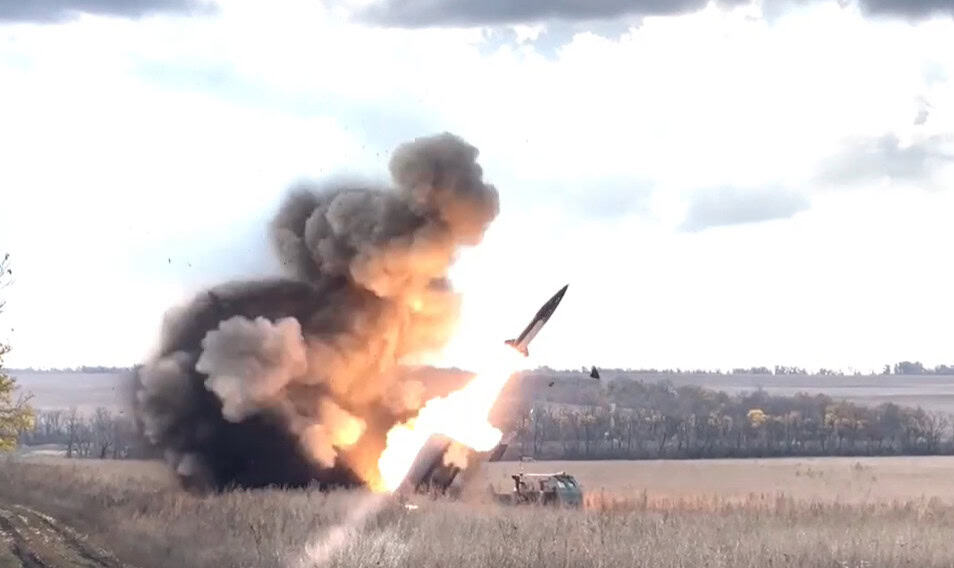 Launch of an ATACMS ballistic
missile. Ukraine has purchased 70 M39 rounds from Turkey in a deal
notified to the US Congress. Photo: Ukrainian General Staff
Launch of an ATACMS ballistic
missile. Ukraine has purchased 70 M39 rounds from Turkey in a deal
notified to the US Congress. Photo: Ukrainian General Staff Mourners gather around the shrouded
bodies of Palestinians killed in Israeli air strikes. Photo: Anadolu
Mourners gather around the shrouded
bodies of Palestinians killed in Israeli air strikes. Photo: Anadolu OSINT imagery of the fire at the
Syzran oil refinery in Samara Oblast after the drone strike of 7–8
August.
OSINT imagery of the fire at the
Syzran oil refinery in Samara Oblast after the drone strike of 7–8
August. Shopify’s write-up on moving
flash-sale reservations off a specialised cache and onto a general
database.
Shopify’s write-up on moving
flash-sale reservations off a specialised cache and onto a general
database.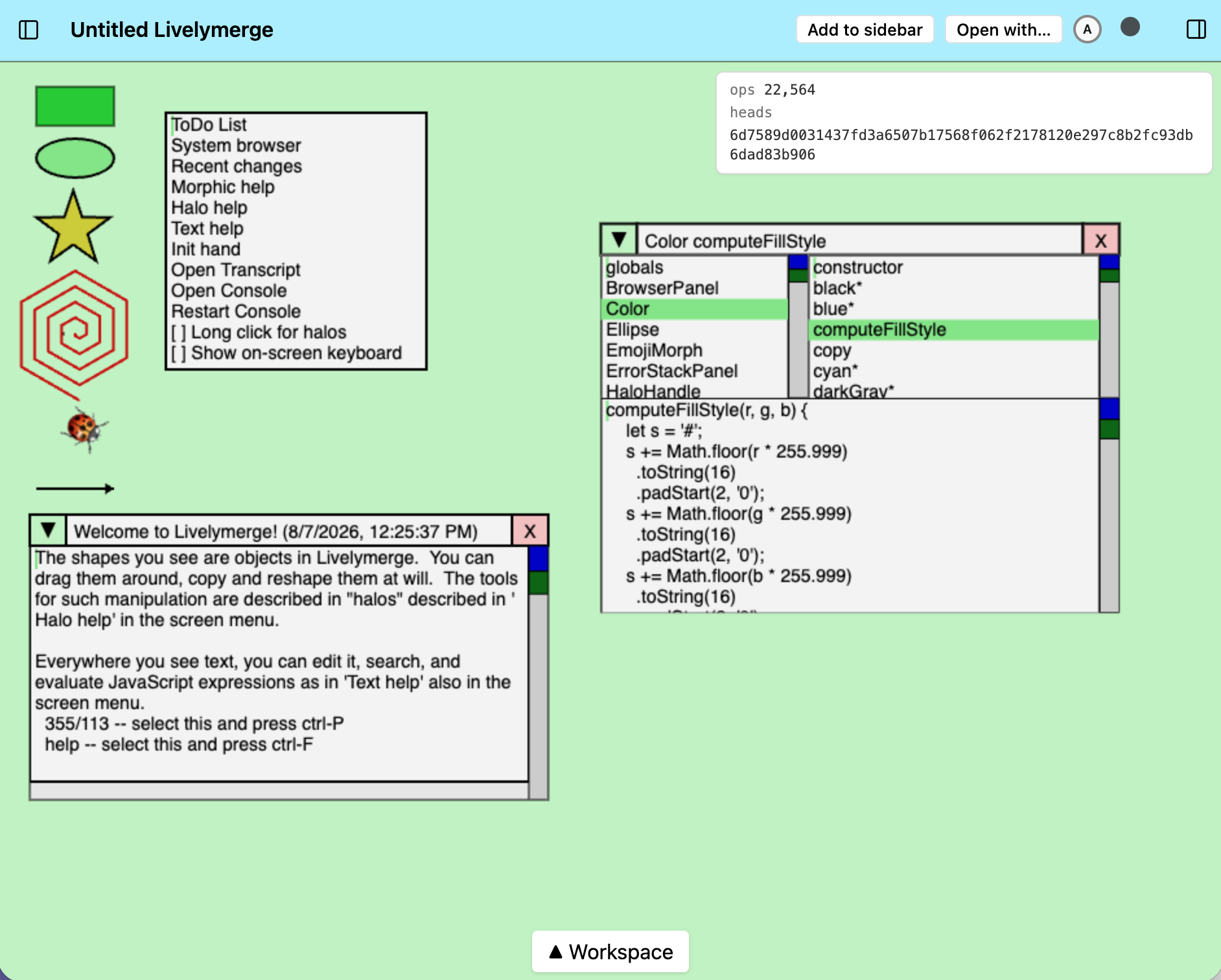 Livelymerge running a Morphic GUI
world — draggable shapes, world menu and a Smalltalk-style browser, all
stored as objects in an Automerge document.
Livelymerge running a Morphic GUI
world — draggable shapes, world menu and a Smalltalk-style browser, all
stored as objects in an Automerge document.