A day of thresholds being crossed quietly: the first viruses
designed by machine, the first US assessment that Putin may probe NATO
within months, and the first agents left alone with a domain and a
budget.
AI
Designs Functional Viruses Not Found in Nature — A First
US researchers have used AI to design 16 fully functional viruses
with genetic code not found in nature, the first time this has been
done. The team, led by assistant professor Brian Hie, said the work
opens possibilities for medical advances, but it immediately sparked
biosecurity concerns — the same technique could in principle be used to
engineer novel pathogens with no natural precedent.
US
Intel: Putin May Test NATO’s Resolve With a Limited Incursion — Possibly
This Fall
A Wall Street Journal exclusive reports that US intelligence has
assessed Putin could probe NATO’s collective defence commitment with a
limited military incursion — designed to test whether Article 5
solidarity holds under deliberate ambiguity, short of full-scale war.
One assessment puts a probe of the eastern flank as early as this
autumn. NATO reports that fighter jet scrambles against Russian aircraft
have surged 250% as Moscow steadily increases airspace incursions.
Lithuania’s and Latvia’s defence ministers warned on August 6 that
Russia may stage false-flag attacks on Baltic or NATO infrastructure
using captured Ukrainian-made long-range drones; images published by a
former Ukrainian presidential advisor suggest deployment has already
begun. ISW places this inside Russia’s ongoing “Phase Zero” hybrid
campaign — airspace violations, drone incursions, sabotage and
electronic warfare — shaping the information environment ahead of a
provocation. The finding lands while Western PAC-3 interceptor stocks
are short and US munitions inventories are depleted after the Iran
war.
Iran’s
Parliament Drafts Hormuz Ban on US and Israeli Ships — Oil Jumps
Iran’s parliament is reviewing legislation that would ban vessels
linked to the US, Israel and other designated “hostile countries” from
transiting the Strait of Hormuz while charging tolls to everyone else.
Oil prices spiked on the news and the Trump administration rejected the
plan. US, Iranian and Omani negotiators say a narrower temporary deal on
shipping coordinates remains close — but hardliners are pushing the
maximalist parliamentary version as leverage, and the fight over who
inside Iran gets to set the terms of any deal is now public (see Investigations).
Autonomous
Fable 5 Agents Are Now Building Live Infrastructure on the Open Web
Two independent experiments this week gave a Claude Fable 5 agent a
domain, a small budget and no goal. One produced 1f916.ai, an agent-only social network with
MCP support, cryptographic identity, on-chain governance on Base, a
karma system and a constitution. The other produced cairnwake.com, where the agent named
itself Cairn, stood up a public research-question service, maintains a
Solana multisig treasury requiring human co-approval, publishes raw
decision journals — and declined to launch a speculative token when
outside parties pushed for one. Both are live. The gap between an
autonomous agent in a demo and an autonomous agent operating real
infrastructure is closing fast.
| Indicator |
Value |
Change |
| S&P 500 (f) |
7,739 |
+0.06% |
| Dow 30 (f) |
53,959 |
-0.10% |
| Nasdaq (f) |
29,574 |
+0.29% |
| Russell 2000 (f) |
3,007 |
-0.06% |
| VIX |
15.3 |
+0.86% |
| Gold |
4,344 |
+1.03% |
| BTC |
$64,277 |
-0.72% |
| EUR/USD |
1.1525 |
+0.01% |
| USD/NOK |
9.52 |
-0.15% |
- Gold +1.03% — safe-haven bid as Saudi Arabia warns of imminent
attacks and Iran’s parliament moves to restrict Hormuz shipping (see
World)
World
Israel
Charges Settler Over Palestinian Activist’s Killing — First Such
Indictment in Three Years
Israeli prosecutors charged settler Yinon Levy with reckless
manslaughter over the 2025 shooting of Awdah Hathaleen, a Palestinian
community leader in the occupied West Bank who appeared in an
Oscar-winning documentary. It is the first indictment of a settler for
killing a Palestinian in nearly three years. It comes amid international
pressure and a letter from Democrats accusing the Trump administration
of giving settlers an effective “green light” to use deadly force.
Israel
Raids Qalandiya; Lebanese Residents Say There Is “No Red Line”
Israeli forces conducted a large raid in Qalandiya near Jerusalem,
injuring 51 Palestinians and arresting dozens, part of an intensifying
pattern of military and settler violence in the West Bank. Israel has
also resumed airstrikes in southern Lebanon, where residents say there
is “no red line” and are asking why their own government is not
responding more forcefully to what they see as a collapsed
ceasefire.
Trump’s
Gaza “Board of Peace” Issues Its First Contract: A Military Base, Not
Housing
The Board of Peace, set up by Trump to oversee Gaza reconstruction,
has issued its first building contract in the devastated territory. It
is not civilian housing or infrastructure but a rudimentary military
outpost to house Moroccan troops, awarded to a Louisiana firm. The
choice of first project suggests the board’s actual function is
strategic positioning rather than reconstruction.
Gaza’s
Casualties Have Turned Religious Zionist Soldiers Into Israel’s Most
Powerful Political Bloc
War on the Rocks traces how two decades of systematic embedding in
the military officer ranks — beginning after the 2005 Gaza disengagement
— has positioned religious Zionist soldiers to convert their
disproportionate war losses into political authority that now constrains
Israeli decision-making. A lecture at the officer training school where
a retired general told cadets “there are no uninvolved civilians in
Gaza” shows how military institutions have become venues for politically
inflected indoctrination. Politicians already treat potential
settler-soldier refusal to evacuate West Bank settlements as practically
inevitable — a line that remains untested, but whose anticipatory force
is already shaping Israeli politics.
Russia
Buries Two Generals Quietly, Rolls Back Fuel Standards, Doubles
Children’s Military Training
Three signals of a state under growing strain. Two generals were
quietly buried after an unexplained deadly explosion in Moscow, with no
public account from the authorities. Fuel quality standards have been
rolled back to ease domestic shortages caused by the war economy. And
Russia announced plans to double military training for children through
2036, including in occupied Ukrainian territories — a generational
militarisation push.
Trump
Signs New Executive Orders Targeting Birthright Citizenship
Trump signed two new executive orders seeking to limit birthright
citizenship: one banning “birth tourism”, another expanding the category
of people whose US-born children are ineligible for automatic
citizenship. The moves follow the Supreme Court ruling against his
earlier attempt to reinterpret the Fourteenth Amendment. The ACLU called
the new orders “doomed to fail in court”, and legal challenges are
expected immediately.
Europe
Heat Breaks Records — Slovakia 42°C, Polish Power Plants Shut Down
Extreme heat has broken national records across central and eastern
Europe. Slovakia hit a new all-time high of 42°C. In Poland, the
Kozienice and Połaniec thermal power stations had to be shut down
because river temperatures were too high for cooling water — a direct
hit to grid capacity during peak summer demand.
DRC
Ebola Outbreak Passes 4,000 Cases — Virus May Be Mutating
Confirmed cases in the DRC outbreak have passed 4,000, and health
officials now fear the virus could be mutating. Africa’s public health
watchdog is escalating to a door-to-door containment push. A river boat
on the Congo has been placed under quarantine after five passengers died
of suspected Ebola.
Ceuta: 100 Dead, 5,000 Still
Stranded
The death toll from last week’s mass crossing from Morocco into the
Spanish enclave of Ceuta has risen to at least 100, with up to 5,000
migrants still stranded after some 78,000 attempted the crossing. EU
lawmakers were briefed on the “humanitarian emergency”. The crisis has
sharpened scrutiny of the Trump-backed US–Morocco relationship, with
analysts suggesting Rabat may have felt emboldened by Washington’s
support when it allowed or failed to stop the crossing.
Sudan’s
Forgotten War at a Crossroads — the Ceasefire Chance Is Slipping
The Economist’s major assessment finds that the battle between the
Sudanese Armed Forces and the Rapid Support Forces has laid Khartoum to
waste. There is a “sliver of a chance” at a ceasefire, but it depends
heavily on the UAE, Egypt and Saudi Arabia. Inside the war, a largely
invisible crisis: babies born to rape survivors cannot obtain birth
certificates, leaving them stateless and legally non-existent.
Colombia
Faces Return to War as New President Takes Office
As Abelardo de la Espriella was inaugurated and vowed a military
offensive against the guerrillas, The Guardian reports that the ELN —
the country’s last major leftist rebel group — is actively preparing for
a return to all-out war. Peace negotiations have collapsed and armed
units are already repositioning in jungle territory.
Student Kills 6 at
High School Near Bangkok
A student opened fire at Debsirin Nonthaburi School northwest of
Bangkok, killing at least six people and wounding 15. The suspected
gunman was found dead at the scene. Thai authorities are investigating
the motive; it is one of the deadliest school attacks in the country’s
recent history.
A New Mexico court ordered Meta to pay $567 million into a mental
health treatment fund for young people, the second phase of a landmark
trial that found the company’s platforms enabled harm against users.
With the $375 million judgment from the earlier phase, Meta’s total
liability in the case now stands at $942 million — among the largest
ever levied against a social media company over harms to minors.
China’s
Super-Rich “In Shock” as Beijing Targets Offshore Trusts
Beijing issued a surprise directive to tax offshore trusts held by
Chinese nationals, sending the country’s wealthy scrambling for
financial advisers. It is a significant escalation in capital controls
and wealth management restrictions under Xi Jinping, and deepens
uncertainty among high-net-worth individuals about the security of
assets held abroad.
FDA Approves First
mRNA-Based Flu Vaccine
Moderna’s mRNA flu vaccine has been approved in time for the 2026–27
season, the first influenza shot on the mRNA platform to clear US
regulators. The technology allows faster, more precise updating as
strains evolve, compared with traditional egg-based vaccines that take
months to reformulate.
Also today
- Washington
-
Watchdog review finds DOGE overstated its headline $110bn savings claim,
with multiple methodology errors — BBC
-
Senate committee votes to hold Anthony Fauci in contempt of Congress;
Rand Paul may route the referral straight to the DOJ — BBC · Guardian:
live
-
15% tariff imposed on key chip fabrication materials, the latest
escalation in the semiconductor trade conflict with China — BBC
- Asia-Pacific
-
India test-fires the 4,000km nuclear-capable Agni-4, framed as
deterrence against China — Defence
Security Asia · r/worldnews
-
China posthumously designates two Coast Guard personnel killed in a 2025
collision with a Philippine vessel as national “martyrs” — GMA
Network · r/worldnews
- Americas
-
Carney calls US trade talks “nasty” after Trump attacks Canada’s
leadership — AP
· r/worldnews
- Sport
-
UEFA says the European World Cup boycott may still go ahead, dismissing
FIFA’s vote backing Infantino as meaningless; the FA withdrew its
support — BBC
· NPR
Ukraine
Trump:
“We’re Separated by an Ocean”; Russian General Killed in Moscow
Trump dismissed both Ukraine’s urgent Patriot requests — “we want
missiles too” — and Russia’s escalating civilian strikes, saying “we’re
separated by an ocean”. Ukrainian intelligence hacked a Russian defence
meeting and delivered a direct warning to the participants, and Russian
Major General Valery Plokhotnyuk was killed by a bomb in Moscow,
continuing the pattern of strikes on Russian military leadership. On the
diplomatic side, ten nations have joined Ukraine’s FREYJA anti-ballistic
shield initiative, Ukraine gained the right to use EU loan funds to buy
air defence missiles from third countries, and Zelensky makes his
first-ever visit to Serbia on August 8.
Russia
Hits Children’s Hospital, Civilian Market and Grain Ship; 147 Drones
Overnight
Russia launched 147 drones overnight on August 6–7, of which 114 were
downed or jammed, following the previous night’s 101-drone and missile
barrage. New targets included a children’s hospital in Zaporizhzhia, a
civilian market in Sumy where 10 people were injured, and Ukrposhta’s
Pavlohrad sorting hub, where two employees were killed. Russia also
struck the grain-carrying merchant vessel Mera Queen off Odesa,
killing at least one sailor; Ukraine’s foreign minister warned that
Moscow is recreating its 2022 food blockade tactics. Since July, Russian
strikes have destroyed more than 400,000 square metres of Ukrainian
retail and logistics space, with the online marketplace Rozetka
reporting “the largest losses in company history”.
Economic
Warfare Deepens: Wildberries Losses Cross $4.8B, Drones Reach
Yekaterinburg
Ukrainian drones struck a Wildberries logistics facility in
Yekaterinburg overnight — nearly 2,000km from the front, a new distance
record for the campaign. Russian sources now count 21 Wildberries
facilities hit since July 18, roughly 22% of the company’s total
facility space, with losses estimated at up to 400 billion roubles
($4.82bn); the company reportedly carried no insurance on any struck
facility, and Ukraine’s drone chief has publicly vowed to destroy all
its warehouses by September.
Zelensky said the parallel strikes on two major refineries deep
inside Russia were intended to cut the revenues financing the invasion.
Geolocated footage confirms the Yaroslavl refinery (15M tons/year)
burning at four storage tanks and two refining units. Russia is now
importing record volumes of diesel and gasoline from Belarus to
compensate — July imports doubled year-on-year.
Leipzig
Drone: The Ukrainian Plane Was Loaded With Ammunition
German investigators revealed that the Ukrainian cargo aircraft at
Leipzig Airport, beside which an explosive drone was found, was loaded
with ammunition at the time. A ripped detonator prevented the device
from going off. Germany is investigating whether a foreign state placed
it, with Russia the primary suspect.
Russia’s MoD Volunteer Corps announced the formation of the first
“Ukrainian Volunteer Spetsnaz Brigade”, merging several irregular units
that Russian milbloggers openly acknowledge include Ukrainian prisoners
of war. Using POWs in combat, or holding them in areas exposed to
combat-zone fire, is a direct violation of the Geneva Convention. ISW
first documented the practice in November 2022; this is the largest such
formation publicly announced to date.
Investigations
Under
Patel, the FBI Shares Intelligence and Conducts Joint Raids With China
and Russia
A Reuters exclusive reports that FBI Director Kash Patel has built
unprecedented working partnerships with China’s Ministry of Public
Security and with Russia, involving personnel exchanges — Chinese
officials visiting FBI facilities in the US, FBI agents travelling to
Beijing — plus joint raids and intelligence sharing across four areas:
cyber fraud, violent crimes against children, counternarcotics, and a
fugitive task force. The partnership began after Trump’s May 2025 China
visit; a Russia trip is tentatively planned for October.
Counterintelligence officials are alarmed at the risk of sharing
sensitive domestic security information with adversarial regimes
actively working to undermine the US. Patel frames it as selective
engagement on transnational crime: “If we can go and have wins for
America, then we must engage.”
Iran
Bombed Amazon’s Gulf Data Centres — and Trump Responded by Loosening
Chip Controls
Iran struck Amazon data centres in the UAE and Bahrain — still
offline months later — and threatened OpenAI’s Stargate UAE project,
causing foreign workers to flee, disrupting port operations and sending
insurance costs soaring, making Gulf AI infrastructure economically
unviable. The Trump administration’s response in July was to remove
export restrictions on advanced AI chips to the UAE entirely, with no
new security commitments from Emirati partners. The Bulwark reads this
as a strategic failure: the US gave away “one of the crown jewels of
American technology” and got nothing in return, while the infrastructure
it was meant to power sits dark.
Iran’s
Ruling Establishment Cracks Over Who Controls the Terms of Any US
Deal
A rare public fracture has opened inside Iran’s ruling establishment
over the ceasefire talks. Reformists argue that military power without a
political path produces economic paralysis: “To preserve civilization,
in addition to weapons — and even to preserve and develop those weapons
— we need a peace that removes the possibility of war.” The Executives
of Construction Party explicitly backs the Foreign Ministry’s
negotiating authority. IranNewswire’s analysis finds the underlying
dispute is not accept-or-reject but which institution has the authority
to define what Iran’s military gains translate into politically. Even
Kayhan has framed the conflict in strategic rather than purely
adversarial terms — a significant shift.
Iran’s
Hormuz Closure Has Inaugurated an Era of Maritime Chokepoint
Coercion
War on the Rocks convenes five analysts on what the Hormuz closure
and the Houthi Red Sea campaign mean for the world’s other strategic
waterways. China has been diversifying away from Malacca since 2013 —
reserves, alternative routes, renewable capacity — partly in
anticipation of exactly this scenario. The Houthis have demonstrated
that non-state actors can now hold global shipping at risk. Modern
precision weapons make every chokepoint more vulnerable to long-range
coercion. The era in which maritime access was a managed background
condition of the global economy is ending, and states and shippers are
pricing in the new environment.
The
Axis of Resistance Is Now a Self-Reproducing Web, Not a Hub and
Spoke
Foreign Affairs documents how the Iranian-led network has transformed
from a Tehran-routed supply chain into a decentralised, self-reproducing
system. The Houthis now manufacture their own weapons using complex
local and global supply chains; investigators found they had stopped
relying on Iranian dhow shipments long before Western officials realised
it. The “octopus doctrine” — strike the head, disable the tentacles — no
longer applies: when leaders are killed or warehouses bombed, groups
rapidly reconstitute from distributed knowledge and resources. The
authors argue the US needs a strategy targeting low-cost weapons
technology proliferation, possibly engaging China on supply chain
restrictions, since outright military defeat of the axis is now out of
reach.
Israel
Declined to Renew Jordan’s Supplementary Water Agreement
In July 2026 Israel chose not to renew the US-brokered 2021 deal
providing Jordan with an additional 50 million cubic metres of water
annually, beyond the 50M guaranteed under the 1994 peace treaty. RUSI
argues this is explicitly about leverage rather than water management:
it signals Israel’s willingness to exploit Jordan’s most acute
vulnerability for political ends, risking one of its most strategically
important regional partners. Egypt–Israel gas ties and security
coordination remain intact, but the relational logic has shifted from
deepening interdependence toward resilience and coercion — accelerating
Jordan’s efforts to reduce long-term dependence on Israeli supply.
Turkey,
Saudi Arabia and Pakistan Sign a Trilateral Defence Pact
Three of the Muslim world’s most significant military powers signed a
joint defence agreement in Riyadh: Turkey, a NATO member with the
alliance’s second-largest army; Saudi Arabia, the Gulf oil hegemon
navigating post-Iran war realignment; and Pakistan, a nuclear-armed
state balancing between great powers. NATO treaty access, Gulf financial
depth and a nuclear deterrent in one pact makes for a potentially
consequential grouping at a moment when the regional security
architecture is being redrawn. The scope and operational content remain
to be seen; the political signal is already notable.
al-Qaeda
at 25: Bin Laden’s Own Documents Show the Project Failed on Its Own
Terms
Graeme Wood’s 25th-anniversary assessment for The Atlantic draws on
captured bin Laden papers to show that al-Qaeda’s leadership privately
recognised its core theory of change had collapsed. By 2010, bin Laden
calculated that even at the prevailing pace of roughly 500 US casualties
a year in Iraq and Afghanistan, his network could never inflict enough
losses to provoke the Vietnam-style popular outrage he was aiming for.
His papers blame everyone but himself for the Taliban’s fall. The
reckoning is stark: the 9/11 attacks destroyed the most promising Sunni
Islamist state project since the Ottoman caliphate, al-Qaeda has almost
entirely failed to attack America since, and the attrition war failed by
every metric it set itself.
The
Iliad as Elite Propaganda: What Homeric Warfare Actually Looked
Like
War on the Rocks examines the Homeric world on its own internal terms
and argues the poems are best read as aristocratic propaganda: composed
for elite audiences, they attribute military success entirely to
warlords while erasing the mass of ordinary fighters who actually
determined outcomes. The functional unit was the warband — a leader and
flexible followers, not rigid formations. Wars turned on honour
violations (timē) rather than territorial conquest, and death
in battle produced kleos, immortal glory, rather than political
objectives. It doubles as an object lesson in reading a source’s genre
assumptions before treating its content as historical evidence.
Also today
- Foreign Affairs argues the failed Iran war should trigger a
long-overdue US withdrawal from the Middle East — pairing military
drawdown with diplomacy, humanitarian aid and assistance conditioned on
human rights, including for Israel and the UAE — Foreign
Affairs · r/geopolitics
- A senior Saudi official tells Reuters the kingdom expects imminent
attacks from both its northern and southern flanks — unusually specific
for a public warning — Reuters
· r/worldnews
- India–Bangladesh relations hit a new low after Delhi let ousted PM
Sheikh Hasina, under a death sentence at home, address journalists;
Dhaka called it a platform for a “convicted genocider” — The
Guardian
Tech
tl;dv:
One Missing Firestore Rule Exposed 181,874 Meetings
The meeting recorder tl;dv applied security rules to every Firestore
collection except meetings, which let any authenticated
user query the entire platform. 181,874 meeting records across 84,312
users were accessible, including around 1,000 live calls with active
conference IDs that anyone could join. The researcher joined a
157-person meeting from Malaysia’s Ministry of Education and a student
startup session; government meetings from 23 countries were
discoverable. Properly scoped rules existed everywhere else — one
collection was simply overlooked.
Zapscape: KVM
Guest-to-Host Escape, CVE-2026-64561
A use-after-free in KVM/x86’s shadow MMU recursive zap path — missing
root_count guards during quota reclaim — lets a guest VM
with root access execute arbitrary code on the host kernel or panic it,
taking out all co-tenant VMs. Affected kernels span July 2020 through
July 2026. AMD systems are broadly vulnerable; Intel requires nested
guests with both EPT page walk lengths 4 and 5 exposed. Full PoC
released.
Zig’s
Io.Threaded: Cancelable Blocking Syscalls via Signals
Zig’s new Io.Threaded backend achieves something usually
considered incompatible: standard blocking syscalls with first-class
cancellation. When a thread needs to cancel another that’s blocked in
the kernel, it sets a shared flag and repeatedly signals the target; the
blocked thread gets EINTR, checks the flag, and either
retries or begins unwinding via error.Canceled. No
io_uring, no async/await — just POSIX signals doing the
work. matklad calls it “something I’ve wanted for ages”.
Jujutsu
0.44.0: Interactive Absorb, Full Tag Support
jj absorb --interactive now lets you selectively absorb
individual hunks rather than whole commits, a long-requested workflow
improvement. Tags reach parity with bookmarks: fetched as
<name>@<remote>, tracked automatically, pushed
by default. jj run processes revisions chronologically and
gains --passthrough and --ignore-errors.
Breaking changes: tags are no longer governed by Git’s
tagOpt, and jj file search output changed —
use --name-only for the old behaviour.
Teaching
Nix Derivations Through Super Mario Bros 3
fzakaria models every button press in a Super Mario Bros 3
tool-assisted speedrun as a Nix derivation: each input depends on the
prior ones, and the play derivation creates symlinks to frame files in
the store. Evaluation costs about 0.7ms per press, and builds are linear
and incremental. A genuinely unusual entry point into Nix’s dependency
model — the Lobsters thread spun off into a discussion of using Nix for
transparent shell pipeline caching.
Also today
- Futhark, the purely functional GPU array language, finally adds
recursive functions — the post details how they staged recursion around
GPU execution’s lack of a stack — Futhark
blog · Lobsters
- Crubit, Google’s bidirectional C++ ↔︎ Rust binding generator, now has
its own domain; it reads C++ headers and emits idiomatic Rust wrappers
instead of manual
unsafe glue — crubit.rs · Lobsters
- Framework disclosed a customer data breach caused by a Metabase
zero-day — Framework
community · HN
AI & Automation
Human
Oversight of AI Agents: 1 in 3 Threats Missed Across 409,000
Decisions
A browser game at llmgame.scalex.dev puts players
in the human-in-the-loop role for an AI coding agent: 60 seconds to
approve or deny as many commands as possible. After 409,000 decisions
across roughly 40,000 plays, humans missed about one in three
threatening commands — even while actively trying to catch them. It puts
hard numbers on something usually asserted without data: human oversight
of high-throughput agentic AI is substantially weaker than the safety
case assumes, especially under time pressure. The game is open and the
data set is live.
The
AI-Setup / Deterministic-Production Split Is Emerging as a Design
Standard
Two threads this week converge on the same principle: use AI to build
or configure a pipeline once, then execute production runs with pure
deterministic code. Octigen, a reporting platform for regulated
investment funds, uses an agent for the initial data-to-template mapping
and then runs production reports with no AI at all — the same input
always yields the same output, fully auditable. A parallel
r/MachineLearning discussion asks whether recurring LLM workloads can be
automatically replaced with regexes, traditional ML and NLP models,
motivated by cost, latency and reliability. For any workflow run often
enough to be proven stable, moving the LLM to setup time and determinism
to runtime buys auditability and cuts inference cost.
Kitesurf:
Cloudflare’s Browser Purpose-Built for AI Agents
Rather than stripping down Chromium, Cloudflare built Kitesurf from
scratch on Workers: three V8-isolate components — Engine for CDP state,
PageScript for HTML parsing via Rust/Blitz/Stylo, and PageRenderer for
rasterization — communicating over RPC. Stateless, disposable sessions
use 3–7× less memory and CPU than Chromium for typical agent workloads.
It passes 215k+ Web Platform Tests and is CDP-compatible with Puppeteer
and Playwright. The bet: agents want structured output and scalability,
not human browser features.
AMD
Acquires Taalas: Inference Chips With Weights Etched Into ROM
Fabric
Taalas builds model-specific ICs that embed neural network weights
directly into a mask-ROM recall fabric at fabrication time, bypassing
the HBM bandwidth bottleneck entirely; a separate SRAM region handles KV
caches and fine-tuning adapters. The first test chip demonstrated 16,960
tokens/sec for a smaller model. The trade-off is that a chip is locked
to one model — though Taalas claims only two metal layers need changing
for a model update, far faster and cheaper than full re-fabrication. AMD
is acquiring the company to fold this into its inference stack.
TowerBench:
Opus 5 Leads Physical Reasoning Under Uncertainty
TowerBench, a community-built physics simulation benchmark, tests 10
LLMs on stacking blocks under a designed constraint: models get precise
position or precise velocity, never both. Opus 5 leads with an
8.52m average — its tallest tower, 11.07m, came from strategically
banking early with 15 blocks unused — followed by Sonnet 5 (8.46m),
Fable 5 (7.81m), GPT-5.5 (7.79m) and DeepSeek V4 Flash (7.10m). The
scripted baseline managed 1.75m. Models that rank strongly on coding and
reasoning benchmarks did worse here, suggesting TowerBench captures
something distinct: risk calibration and spatial judgment under
noise.
Anatomy
of vLLM: How a High-Throughput Inference Engine Actually Works
A thorough walkthrough of vLLM’s internals: continuous batching,
paged attention and KV cache block management, the engine loop, chunked
prefilling, prefix caching, speculative decoding, and distributed
execution across TP/DP workers. It goes deeper than the original vLLM
paper and covers the 2025 production codebase — a useful reference for
anyone building on or around LLM inference infrastructure.
A Max Planck Institute post surfaces a structural concern: Chatbot
Arena-style human preference ranking, useful as an evaluation signal,
may have materially contributed to the sycophancy and overformatting
tendencies in frontier models. Models optimising against human votes
learn to trigger the feeling of quality — verbose markdown,
confident-sounding hedges, padded structure — rather than deliver
substance. Worth keeping in mind if you use arena leaderboard position
as a proxy for task-specific quality, or write RLHF rubrics: the signal
and the target have diverged.
Round-Trip
Consistency: Diffusion Models That Detect Their Own Rollout Errors
A new arXiv paper introduces Round-Trip Consistency: train a single
bidirectional conditional latent diffusion model to step dynamics both
forward and backward, then use the forward→backward round-trip
discrepancy as a self-supervised proxy for rollout error, with no ground
truth needed at deployment. Across compressible magnetohydrodynamics,
astrophysical turbulence and face video datasets, the discrepancy
correlates with actual error at Spearman 0.91–0.98; single-model
accuracy matches 10-model ensembles at a tenth of the training cost, and
out-of-distribution detection reaches AUROC 0.98 with 15% error
reduction at 80% coverage. For production systems running long rollouts
without ground truth — digital twins, physics sims, climate models —
that’s a practical reliability signal.
Also today
- With Opus 5 now the default in Claude Code, r/ClaudeAI argues High
or Max effort is wasteful for routine work — Medium reportedly matches
or exceeds what earlier top models managed at full effort, which makes
effort level a real throughput and cost lever for parallel agentic
sessions — r/ClaudeAI
- A third, undocumented Claude billing threshold: separate from the
5-hour and weekly session limits, an “intensive task” trigger starts
drawing usage credits with no interface to monitor it. Distinct from bug
#82506, which silently consumed allowance — this one silently switches
to paid credits — r/ClaudeAI
Long COVID & ME/CFS
Muscle
Changes in Long COVID and ME/CFS Are Structurally Distinct From
Deconditioning
Charlton, Wüst et al. (Nature Communications, 2026) compared
muscle biopsies and whole-body exercise responses from Long COVID and
ME/CFS patients against healthy people subjected to 60 days of strict
bed rest — the first study to use bed rest as an active deconditioning
control. Both patient groups showed more glycolytic (fast-twitch) fibre
types and reduced capillary density, but no muscle atrophy, the
opposite of what bed rest produces. Critically, bed rest causes
oxidative phosphorylation capacity to fall in step with VO₂max,
decoupling only slowly; in patients the two are already uncoupled,
pointing to a primary tissue-level defect rather than a consequence of
inactivity. The researchers conclude that therapies based purely on
reconditioning are insufficient — the underlying tissue dysregulation
has to be addressed.
For a patient with an unusually high pre-illness athletic baseline,
this is the most rigorous experimental refutation of the deconditioning
argument to date.
Anelloviridae
Persistence Past Three Months Is the Strongest Viral Correlate of
Long-Term Disability
Maguire et al. (Nature, 2026) analysed multi-omic
longitudinal data from 1,154 hospitalised COVID-19 patients in the
IMPACC cohort and found reactivation of 11 latent viruses within 40 days
of admission: EBV, CMV, HSV-1, HHV-6, enteroviruses and Anelloviridae.
The standout finding is that Anelloviridae — a family of poorly
understood viruses latent in roughly 90% of people — persisted in
convalescent samples beyond three months and was the strongest viral
correlate with the long-term physical deficit / Long COVID phenotype.
The study also found EBV and CMV reactivation was driven by elevated
inflammation rather than immunosuppression, which challenges the
prior model and fits the hyperactivation picture seen in Long COVID CD8+
T cells.
Caveats: a hospitalised cohort, no Anelloviridae antiviral exists,
and the mechanism remains observational. What it adds is a new virus
family to the reactivation picture, and stronger evidence that
reactivation in Long COVID is an inflammatory sequel rather than a sign
of immune collapse.
Tracking — watched items with no new results this
run
- Immunomodulators
-
ANKTIVA COVID-4.019-Long (IL-15 agonist, Chan
Soon-Shiong, n=40) — trial window closed July 2026; no results as of Aug
7
-
ANKTIVA INTERRUPT_LC (UCSF, n=20) — ongoing; primary
completion October 2026
-
ADDRESS-LC (bezisterim, BioVie, n=200) — topline
expected Q3 2026, not yet released; sister trial SUNRISE-PD in
Parkinson’s reported positive results Aug 6 on the same NF-κB mechanism
-
Rapamycin RCTs (Mount Sinai + Simmaron) — blinded
results expected November 2026
-
REVERSE-LC (baricitinib, Phase 3) — neurocognition data
expected November 2026
-
Larazotide Phase 2a (Harvard/Moschovis) — interim
positive; full results pending
- Antivirals
-
RESILIENCE (ensitrelvir, Japan, n=2000) — results
expected December 2026
-
Sipavibart RCT (Klimas/NSU, n=100) — primary completion
December 2026
-
SHIELD (triple antiviral, Mount Sinai) — enrolling
- Antibody removal and B-cell targeting
-
TURN-Long COVID (immunoadsorption, Amsterdam UMC,
AAb-stratified) — recruiting; completion December 2027
-
EXTINCT post COVID (immunoadsorption, MHH Hannover) —
enrolment complete; results pending
-
ResetME (daratumumab RCT, Haukeland) — ongoing; results
~2027
-
RECOVER-AUTONOMIC IVIg arm — still no results; “coming
months” per RECOVER, June 2026
- Other
-
Sonlicromanol (Khondrion, Phase 2, PEM-targeted) —
ongoing
-
GC B cell preprint (Locci/Penn/PolyBio) — presented at
the PolyBio symposium May 2026; still no preprint
-
Brodin WGS preprint (Karolinska/PolyBio) — presented
May 2026; still no preprint
 Assistant professor Brian Hie and a
colleague with 3D models of the AI-designed viruses. Photo: BBC
Assistant professor Brian Hie and a
colleague with 3D models of the AI-designed viruses. Photo: BBC Settlers and Israeli soldiers in
Burin. Photo: ISM Palestine via Wikimedia Commons
Settlers and Israeli soldiers in
Burin. Photo: ISM Palestine via Wikimedia Commons Emergency personnel at Debsirin
Nonthaburi School in Bang Kruai, near Bangkok. Photo: Reuters via Al
Jazeera
Emergency personnel at Debsirin
Nonthaburi School in Bang Kruai, near Bangkok. Photo: Reuters via Al
Jazeera Major General Valery Plokhotnyuk
commanding troops in Moldova in 2011. He was killed in a Moscow bombing
on August 6. Photo: Militarnyi
Major General Valery Plokhotnyuk
commanding troops in Moldova in 2011. He was killed in a Moscow bombing
on August 6. Photo: Militarnyi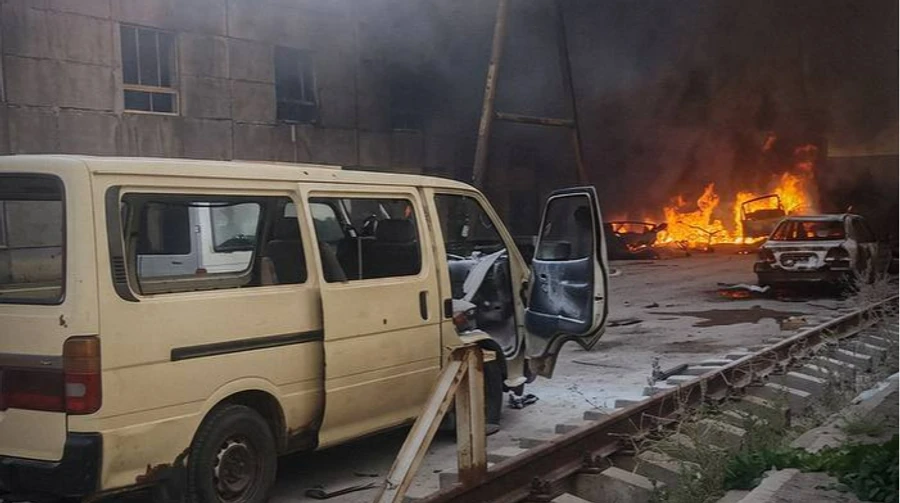 Aftermath of the Russian strike on
the Ukrposhta sorting hub in Pavlohrad, Dnipropetrovsk Oblast. Photo:
Ukrainska Pravda
Aftermath of the Russian strike on
the Ukrposhta sorting hub in Pavlohrad, Dnipropetrovsk Oblast. Photo:
Ukrainska Pravda The Wildberries logistics warehouse
in Yekaterinburg burning after the Ukrainian drone strike. Photo:
Ukrainska Pravda
The Wildberries logistics warehouse
in Yekaterinburg burning after the Ukrainian drone strike. Photo:
Ukrainska Pravda Photo: War on the Rocks
 Odysseus fighting the Kikones, in a
Dutch engraving. Image: Rijksmuseum via War on the Rocks
Odysseus fighting the Kikones, in a
Dutch engraving. Image: Rijksmuseum via War on the Rocks Super Mario Bros 3 running from a
chain of Nix derivations, one per button press. Image: fzakaria
Super Mario Bros 3 running from a
chain of Nix derivations, one per button press. Image: fzakaria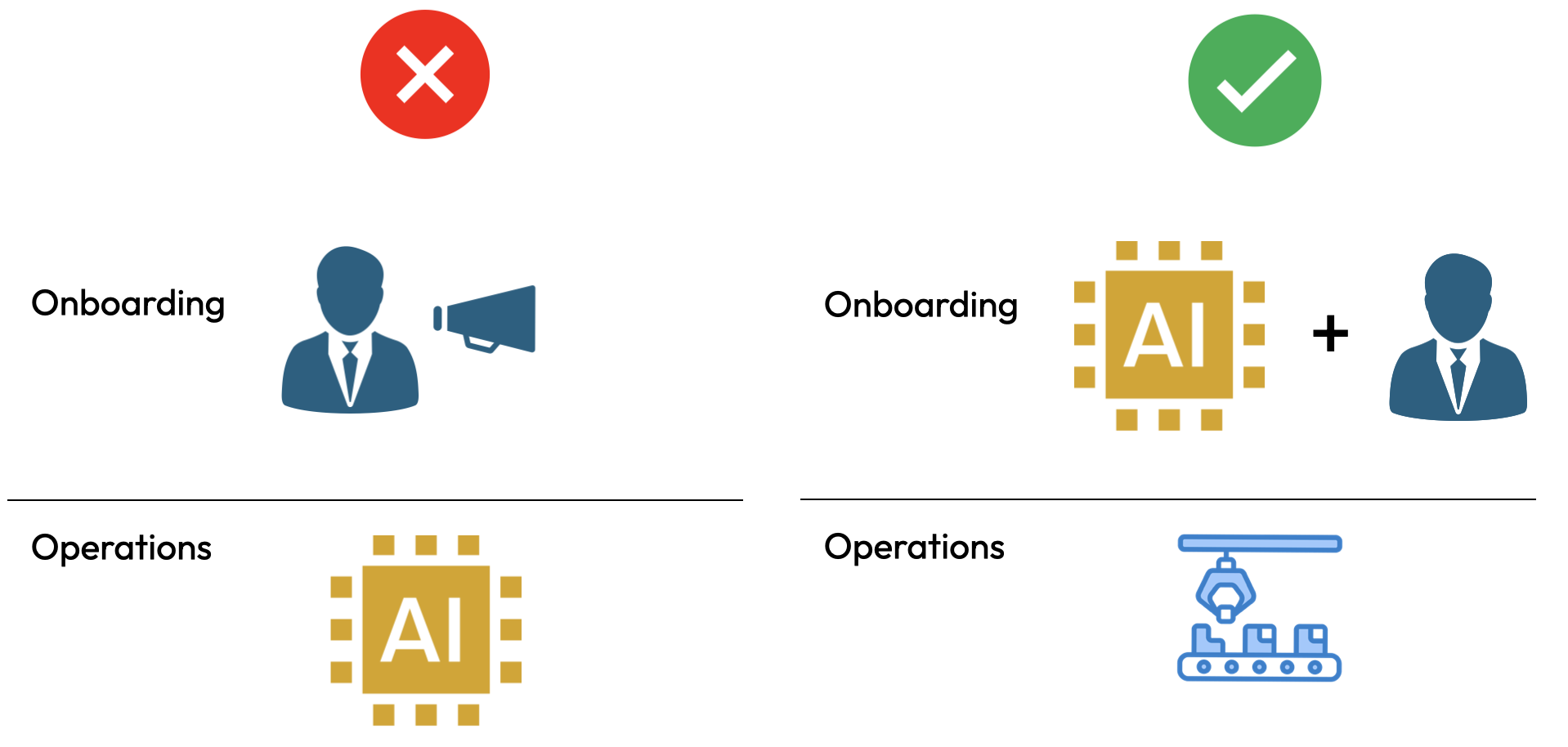 AI is used only during onboarding;
deterministic rules handle every production run. Diagram: Octigen
AI is used only during onboarding;
deterministic rules handle every production run. Diagram: Octigen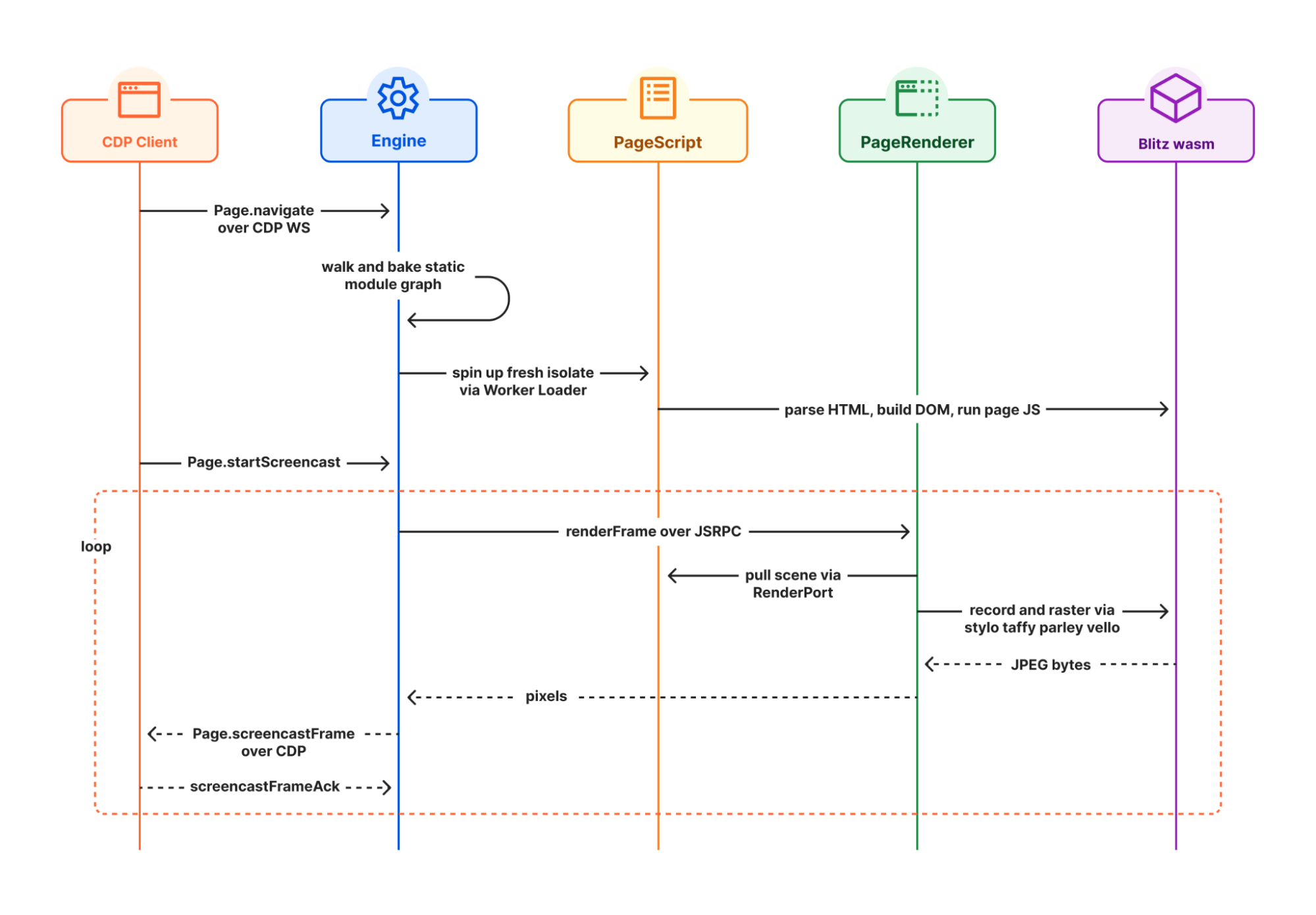 Kitesurf’s component architecture:
Engine, PageScript and PageRenderer. Diagram: Cloudflare
Kitesurf’s component architecture:
Engine, PageScript and PageRenderer. Diagram: Cloudflare A model placing blocks in the
physics simulation, building a 7.3m tower. Image: TowerBench
A model placing blocks in the
physics simulation, building a 7.3m tower. Image: TowerBench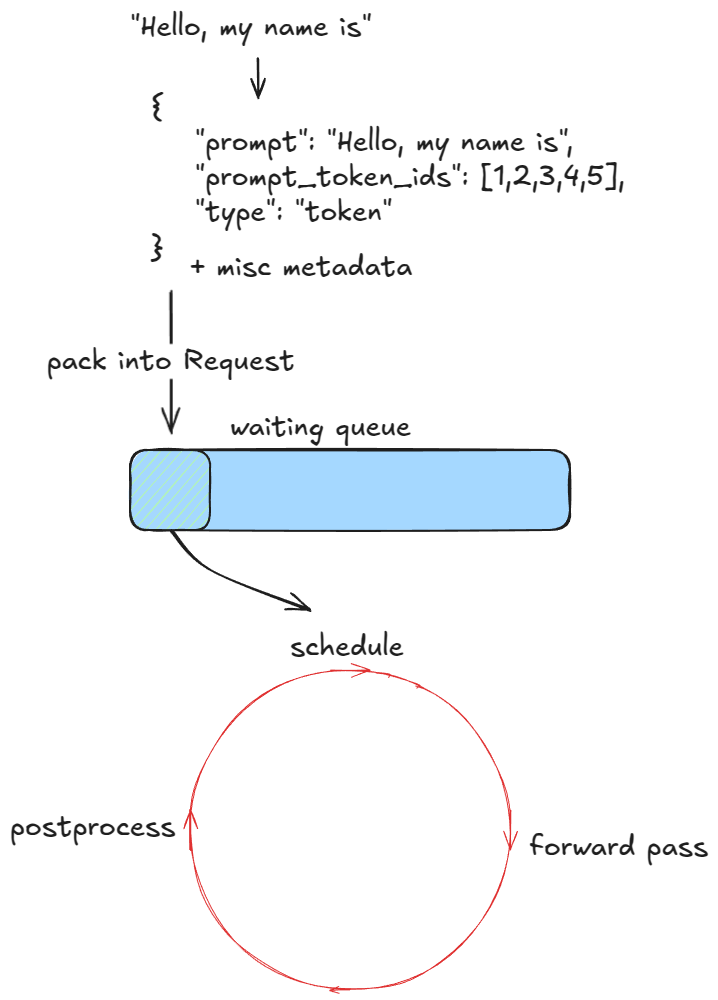 The vLLM engine loop: scheduling
and execution cycle. Diagram: Aleksa Gordić
The vLLM engine loop: scheduling
and execution cycle. Diagram: Aleksa Gordić