Josse-posten

Russia answers Ukraine’s deep-strike campaign with its heaviest barrage on Kyiv in months, Hormuz diplomacy inches toward reopening the strait — and the day’s best analysis is all about China.

Russia strikes Kyiv with heaviest ballistic barrage in months — at least 17 killed

A fire breaks out following massive Russian ballistic missile strikes in Kyiv on August 5, 2026. Photo: Evgen Kotenko / AFP / Getty Images

Russia launched roughly 30 ballistic missiles — Iskander-M, S-400 surface-to-surface, Zircon hypersonics, and North Korean KN-23s — plus 115 drones at Kyiv and the surrounding oblast overnight, killing at least 17 people and injuring dozens. Major fires engulfed the capital; an Epicentr logistics hub was destroyed, and eight people died at Kvitneva railway station in Brovary district. The use of cluster-warhead ballistic missiles marks a notable escalation in strike composition, and the attack is widely read as retaliation for Ukraine’s intensifying deep-strike campaign. (Full war coverage in Ukraine)

Iran-Hormuz talks show concrete progress; US stocks hit record high

US and Qatari officials report meaningful progress toward reopening the Strait of Hormuz, with Iran and Oman holding what Tehran calls ‘positive’ talks. Iran’s president Pezeshkian denied reports that he threatened to resign amid pressure from hardline factions who call the negotiations ‘futile.’ Oil prices fell on the optimism, driving US stocks to record highs. Trump warned Iran would be ‘hit very hard’ if the strait isn’t open soon; Secretary of State Rubio said a deal could come ‘very shortly.’ Iran continues to insist all contact runs through Oman. (Analysis of Iran’s leverage and the reopening plans in Investigations)

Ceuta: 70,000 returned to Morocco as death toll nears 100 — and Europe’s hybrid warfare blind spot is exposed

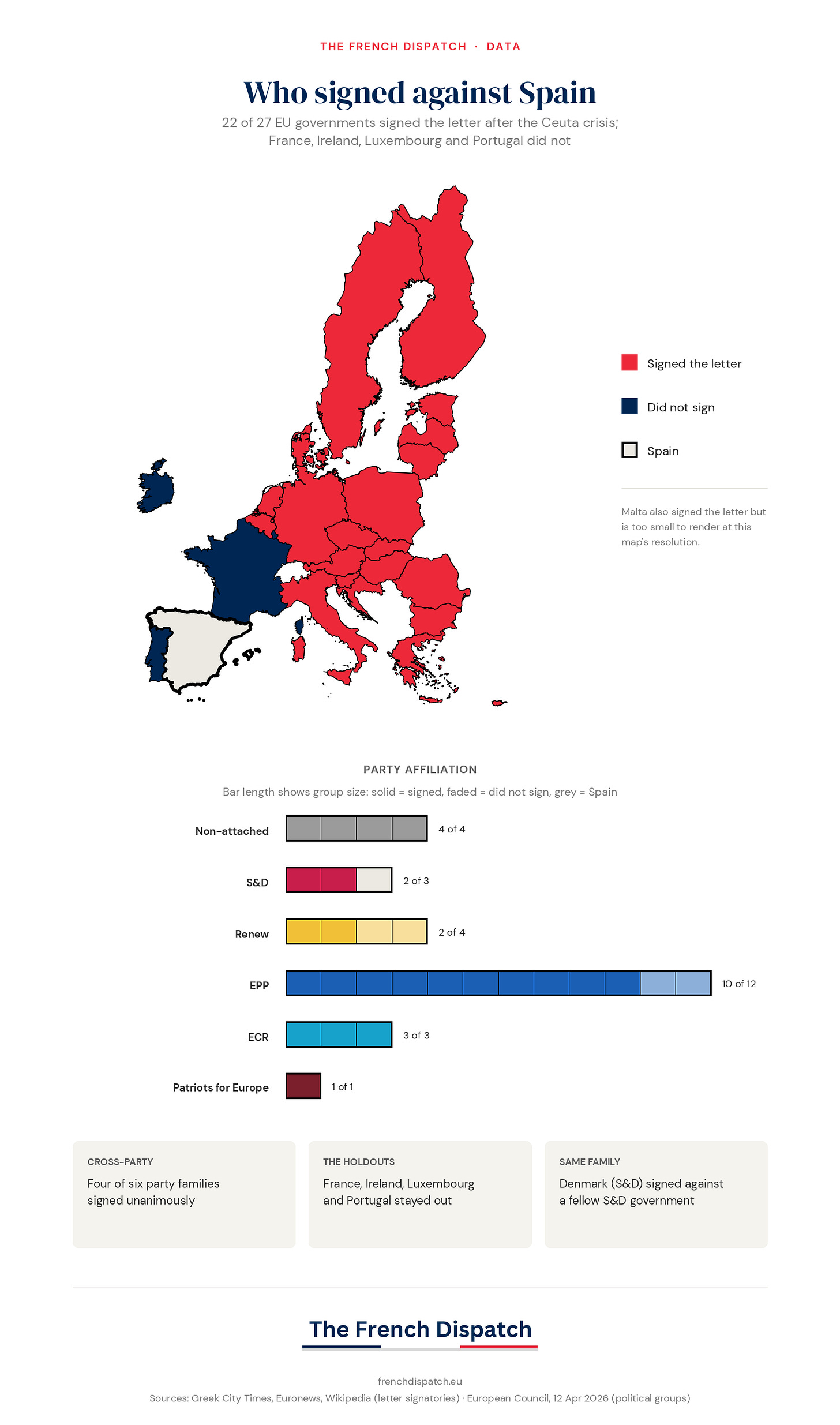
Which EU member states signed the letter condemning Spain over the Ceuta crisis — and which did not. Chart: The French Dispatch

About 70,000 of the roughly 72,000 people who crossed into Spain’s Ceuta enclave last week have been returned to Morocco, leaving around 2,000 still in Ceuta and a death toll approaching 100. Hundreds of Moroccan families are gathered at the border town of Fnideq, showing photos of missing relatives to returnees. The EU’s migration commissioner criticized Spain’s plan to regularize undocumented immigrants as ‘not a good signal for Europe’ — while The French Dispatch documents how EU leaders first condemned Spain, threatened Schengen suspension, and imposed border checks, before reversing within four days to praise Spain’s ‘swift and effective’ response. Von der Leyen offered Morocco financial support without addressing its alleged role in orchestrating the crossing — a pattern analysts characterize as Europe failing to recognize deliberate hybrid warfare when it sees it.

Indicator Value Change
S&P 500 (f) 7,791 +0.33%
Dow 30 (f) 54,378 +0.20%
Nasdaq (f) 29,908.25 +0.15%
Russell 2000 (f) 3,051.20 +0.21%
VIX 16.07 -2.61%
Gold 4,223.40 +1.70%
BTC $64,010.77 +0.62%
EUR/USD 1.1536 +0.03%
USD/NOK 9.5228 -0.16%
  • Futures up and VIX down on Iran-Hormuz optimism — US/Qatari officials report progress toward reopening the strait, easing oil-supply fears (see leader)
  • Gold +1.7% as safe-haven demand persists amid the Kyiv missile strike and fragile Iran talks

World

Ebola kills 1,700 in eastern Congo — the fastest-growing outbreak in history

The Ebola outbreak in Congo’s Ituri province — declared May 15 and linked to the Bundibugyo virus, for which there are no approved vaccines or treatments — has recorded 1,707 deaths and 3,802 cases, making it the second-largest Ebola outbreak ever recorded. Africa CDC Director-General Jean Kaseya called the trajectory alarming: 60–70% of new cases are spreading in communities rather than through contact tracing, which ‘is not working.’ The response is hampered by unpaid healthcare workers on strike, attacks on health centers, a funding gap, and ongoing armed conflict in eastern Congo. The WHO director-general was visiting the region this week.

Iran executing more teenagers arrested during the 2022 Woman, Life, Freedom uprising

Iranian rights organizations warn that an increasing number of teenagers arrested during the 2022 protests face imminent execution. Iran International reports several detailed cases, including Nobakht Pardasti — arrested at 16 and found dead in the Kahrizak detention facility with signs of severe torture: broken jaw, nose and shoulders, strangulation marks, and skin removed from his arm where nationalist tattoos had been. Families are being pressured to attribute deaths to fellow protesters rather than security forces.

Gaza holds mass funeral for 112 people killed in a single 2023 Israeli airstrike

Mourners gathered in central Gaza for a mass funeral for 112 people — including 40 children — killed in a single Israeli airstrike that destroyed a residential block in Gaza City in 2023. Their remains were only recently recovered from the rubble more than two years after the attack; the victims belonged to two extended families. The funerals underscore the scale of casualties still being accounted for across the territory.

Abdul El-Sayed wins Michigan Senate primary despite $60m AIPAC campaign against him

Progressive advocate and former Detroit Health Department director Abdul El-Sayed won Michigan’s Democratic Senate primary over incumbent Congresswoman Haley Stevens, despite AIPAC spending more than $60 million backing Stevens — one of the most expensive US primary campaigns ever. The result is a significant blow to pro-Israel political spending and signals that the Israel-Palestine issue is reshaping Democratic primary politics heading into the midterms.

Electronic Arts sold to Saudi Arabia and Kushner’s firm for $55bn

Electronic Arts — maker of The Sims, Madden NFL, Battlefield, and EA Sports FC — has been acquired for $55 billion by a consortium of Saudi Arabia’s Public Investment Fund, Jared Kushner’s private equity firm Affinity Partners, and Silver Lake. The deal, completed after EU regulatory approval, is one of the largest leveraged buyouts on record and takes EA private after 36 years as a publicly traded company.

US revokes Brazilian ambassador’s visa as Trump-Lula feud escalates

The Trump administration revoked the visa of Brazil’s ambassador to the US in retaliation for President Lula’s refusal to approve Trump’s choice for US ambassador in Brasília — the sharpest escalation yet in a sustained feud between the two governments, though officials indicated it falls short of formal expulsion. Separately, Brazil also cut its diplomatic presence in Argentina after President Milei made personal attacks on Lula.

Also today

Americas
Guatemala’s Fuego volcano erupted for 23 hours straight, streaming lava over villages; hundreds evacuated — Guardian · BBC
A US federal judge begrudgingly dismissed the last remaining January 6 prosecutions, ending the federal accountability effort — Al Jazeera
Second man dies at ICE’s Delaney Hall — 41-year-old Salvadoran Edwin Lopez-Cornejo, at least the 23rd death in ICE custody this year — Al Jazeera
Platforms & power
X joins Facebook and Snapchat in blocking 60+ Saudi dissident accounts inside the kingdom — The Guardian
Trump Media sells Wall Street firms early access to Trump’s market-moving Truth Social posts — BBC
Middle East
Israel approves $37m to seize over 70 historical landmarks in the occupied West Bank — Al Jazeera
Indian-flagged cargo ship sunk off Yemen by projectile strike; all 14 crew rescued — BBC · Indian Express
Climate & energy
Major oil firms collectively earned $93bn in profits as war and climate crisis raged — The Guardian
South Korea issues first-ever highest heat alert for Seoul as heatwave kills 16 — TRT World
400+ live WWII shells found in French wildfire zone, with explosions already heard as fires reach the munitions — CNN
Russia
Russia’s sole domestic TV manufacturer Kvant declared bankrupt over an $8m debt — The Moscow Times

Ukraine

Wildberries campaign reaches Tula and Vladimir; oligarch Mordashov’s Lenta chain struck

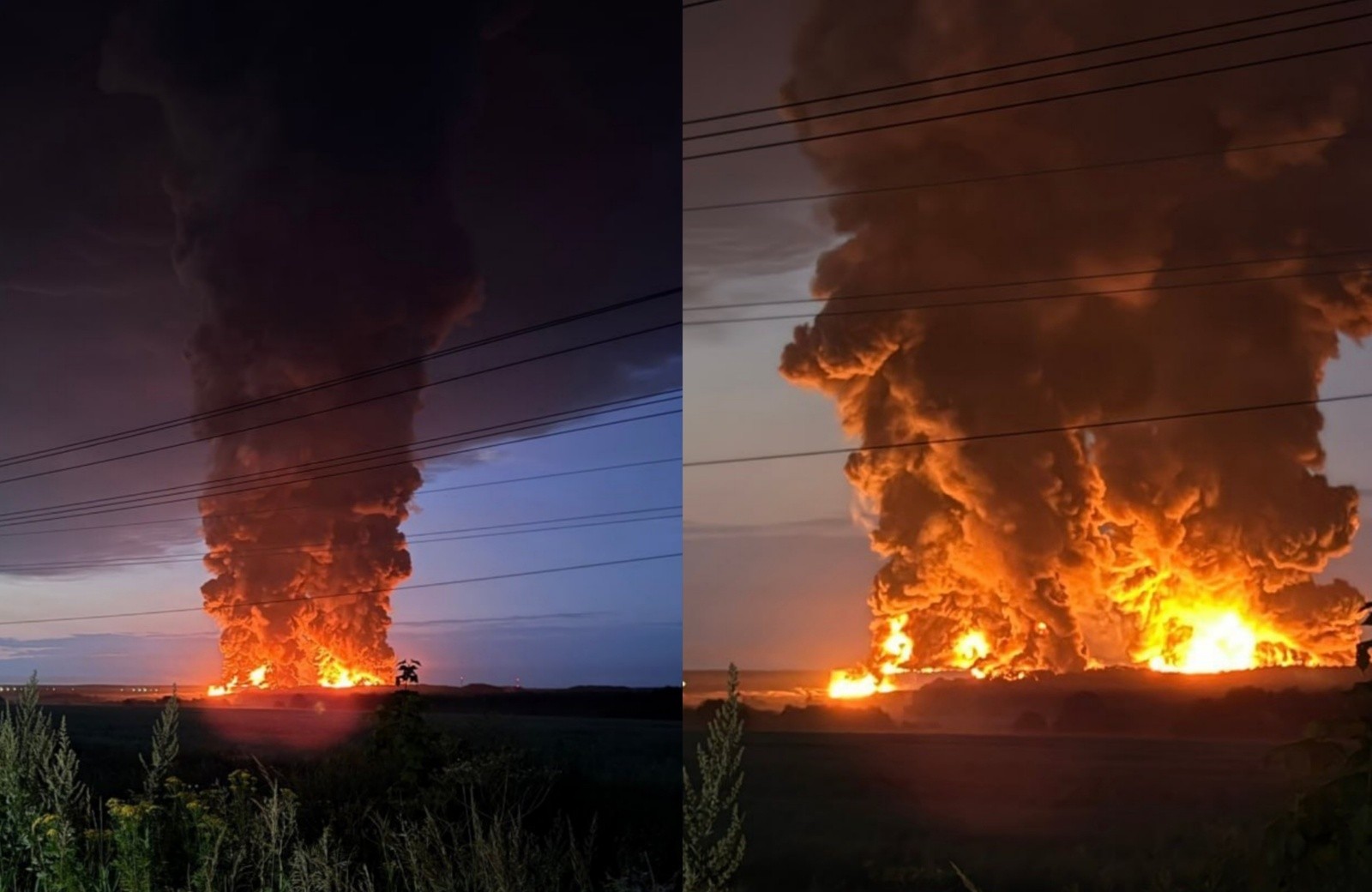
Fire at the Wildberries logistics hub in Aleksin, Tula region, August 5, 2026. Photo: Exilenova+
Ukrainian drones hit at least three more Wildberries hubs overnight: a massive complex in Aleksin, Tula Oblast (catastrophic fire, one of the largest in the campaign), a 175,000 m² facility in Vladimir Oblast, and a follow-up strike on the Krasny Bor hub near St. Petersburg. A separate strike hit a Lenta grocery distribution center owned by sanctioned oligarch Mordashov — the first strike on his assets. The campaign now counts at least 19 Wildberries warehouses struck; Belarusian businesses with goods in Russian warehouses are lobbying Minsk for relief, putting political pressure on Lukashenko.

SBU 40-day operation concludes; Russia’s oil refining hits 24-year low

The SBU closed out its 40-day strike operation having hit 100+ strategic targets: airbases in Crimea and deep Russia, a Tu-95MS strategic bomber, two Su-35 fighters, and 14 oil refineries. Combined with broader campaign effects, Russia’s crude processing fell to 3.6M barrels/day in July — the lowest since May 2002 and roughly a third below seasonal norms. Russian insurers have effectively stopped covering military risks for cargo ships in the Black and Azov seas, and SEAD/DEAD operations have pushed Russian AWACS assets into active duty over rear areas. Zelensky announced approval of a follow-on SBU operation of undisclosed scope.

Crimean S-400 defending the Bridge destroyed; peninsula fuel runs dry

A Ukrainian medium-range strike drone destroyed an S-400 launcher in occupied Kerch — a system actively protecting the Crimean Bridge and ferry crossings. The ‘Crimean Switch: OFF’ campaign struck 10 more energy facilities overnight, including 750 kV and 110 kV substations in Mariupol and across Crimea. Meanwhile the peninsula’s gasoline shortage has turned acute: despite Russian authorities imposing a price cap of 100 rubles/litre on August 4, TES and ATAN stations had already run out of AI-92 fuel the same day.

Russian advance at slowest pace in a year; tactical shifts at Dobropillya and Kostyantynivka

Russian net territorial gains in July totalled ~106 km² — the fastest since January but roughly one-fifth the pace of July 2025, confirming a sustained deceleration of the offensive. The day’s 259 combat clashes were heaviest at Pokrovsk. Russia is abandoning frontal attacks on Dobropillya after mechanized assaults failed, shifting to outflanking attempts north and south. In Kostyantynivka, small Russian infiltration groups — now including officers — probe 500 metres into the city daily on flag-raising missions staged for propaganda footage rather than holding ground. The Russian MoD falsely claimed the capture of Baksheivka in Kharkiv Oblast; ISW assessed this as part of a pattern of fabricated advance reports fed to the Kremlin.

The West’s missile magazines run dry: US exhausted precision stockpiles in Iran war as Patriot demand outpaces production

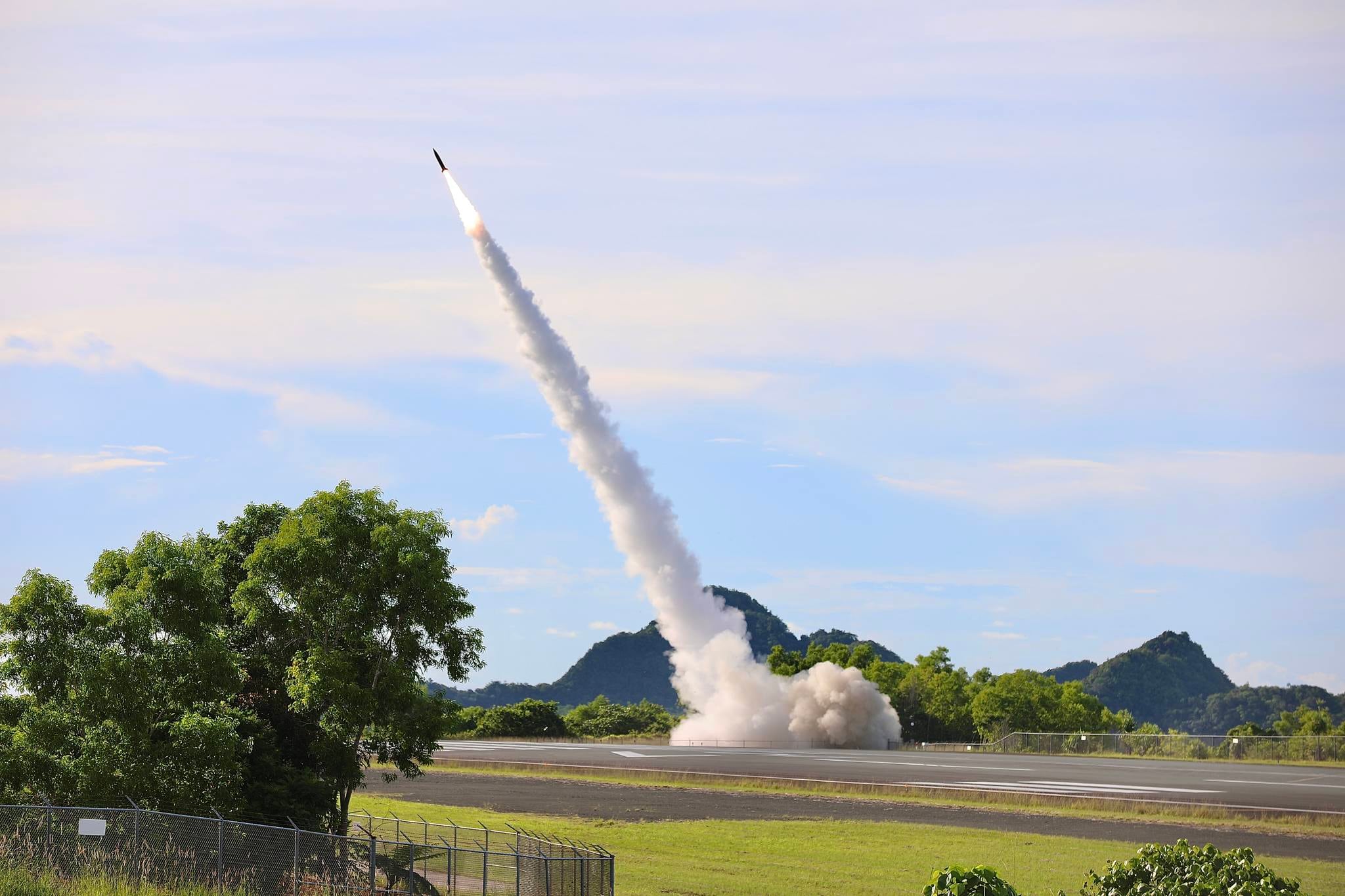
The Army’s Precision Strike Missile launches during exercise Valiant Shield in Palau. Photo: U.S. Army
Reuters sources report the US has used ‘virtually all’ of its ATACMS and Precision Strike Missile stockpile during five months of war with Iran — a depletion not previously reported. The drawdown extends broadly: roughly 65% of Patriot interceptors, 38% of THAAD interceptors, and nearly half of global Tomahawk supplies. At the same time, Russia and Iran are sustaining ballistic missile launch rates the defense industry cannot match — Ukraine faces particular risk this winter, when Russia is expected to again target the power grid with mass strikes. Analysts warn the depletion directly limits US ability to deter China or Russia; Trump responded that the US had ‘far more munitions than anyone in the world,’ but insiders describe active internal debate about how much longer strikes can continue.

North Korea deploys missile unit to Russia; Kim Yo Jong threatens Japan

Ukraine’s military intelligence says North Korea has deployed a dedicated missile unit to Russian territory in support of the war — a step beyond the 14,000 troops already sent to Kursk and the millions of artillery shells supplied since 2022. Separately, Kim Yo Jong issued a military threat against Japan following Tokyo’s missile test, accusing Japan of moving beyond a purely defensive posture and vowing North Korea would ‘teach’ it a lesson.

Russia hunts Ukrainian market vendor with drone in filmed ‘human safari’

Video released by Ukrainian police shows a Russian drone pursuing a vegetable seller around his market van in Kherson, detonating and sending shrapnel into the man, who survived with shock and shrapnel injuries. Ukraine’s foreign minister accused Russia of a deliberate war crime, saying the pilot ‘was clearly aware they were targeting a civilian.’ Reuters verified the location against satellite imagery. Ukraine says thousands of similar incidents never surface publicly.

Also today

  • NATO’s air defense gap: why Poland — its biggest spender at 4% of GDP — couldn’t stop one Russian missile from reaching Tarnawa — TVP World · r/geopolitics
  • India declines Russia’s offer to purchase advanced Su-57 stealth fighters — another signal of eroding India-Russia military ties — Kyiv Post · r/worldnews
  • Ukraine runs its war like a corporate efficiency operation — RAND documents the ‘epoints’ KPI doctrine that treats drone strikes as portfolio optimization — Fortune / RAND · r/geopolitics

Investigations

Future Made in China: Evan Osnos’s portrait of a rising power and its contradictions

A sweeping New Yorker letter from Beijing. China now produces 70%+ of the world’s EVs, drones, batteries, and solar cells; deploys more industrial robots than the rest of the world combined; has surpassed the US in clinical trial volume; and saw a Chinese cancer drug (Akeso) outperform Merck’s gold-standard Keytruda. Trump’s science cuts and the China Initiative’s targeting of Chinese-American researchers have dramatically accelerated the return of scientific talent to China. But Osnos is clear-eyed about the contradictions: 90 million empty homes, a fertility rate of 1.0, rampant youth pessimism, and a political system that bars entrepreneurs from leaving the country and makes engineers disappear. He frames the contest not as a clash of systems but a race between two oligarchic groups — Xi bending technology toward obedience, Trump and Silicon Valley pushing AI ‘to let that baby thrive’ — and asks which system can face its problems most candidly.

China’s biotech offensive: 75% of US pharma now depends on Chinese suppliers

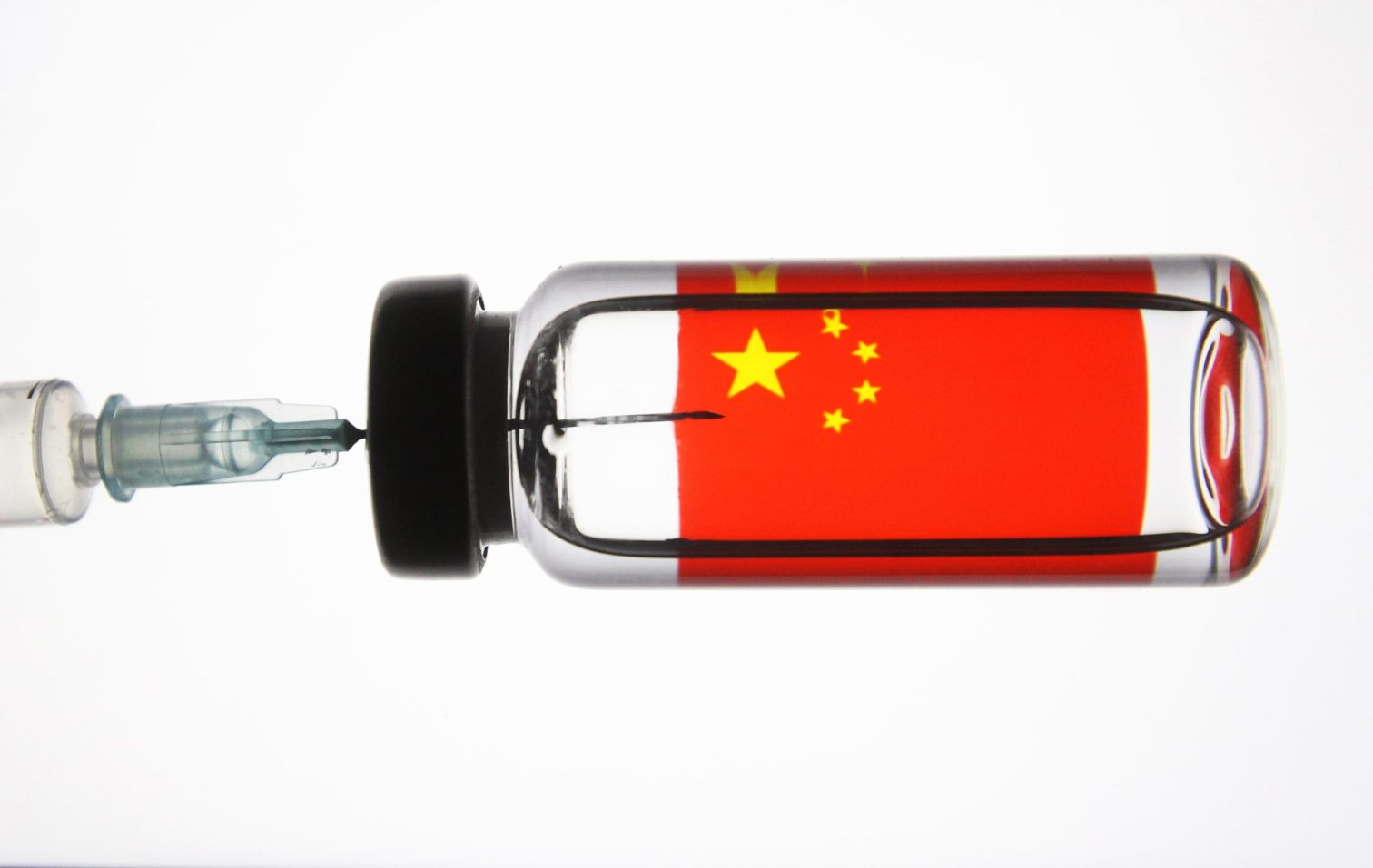
China’s biotech expansion and western supply chain exposure. Photo: Pavlo Gonchar/SOPA Images via ZUMA Wire

CEPA analysis by Samantha Hoffman: Chinese biotech out-licensing to western pharma grew from $13.9B (2021) to $137.7B (2025) — nearly tenfold in four years. More than 75% of US pharmaceutical companies now depend on Chinese suppliers for at least some drug manufacturing components. The piece argues this creates a strategic exposure comparable to rare earths: China has already demonstrated willingness to weaponize export controls on gallium, germanium, and rare earths, and holds the same legal tools over biotech. China’s 15th Five-Year Plan explicitly lists biomanufacturing as a ‘new quality productive forces’ priority alongside quantum computing and brain-computer interfaces.

China’s fourth option against Taiwan: a “blockade by fire” that avoids direct third-party attacks

Foreign Affairs analysis argues the conventional three-option taxonomy (invasion, firepower strike, maritime blockade) misses a variant China may prefer: a ‘blockade by fire’ that destroys only Taiwanese assets while avoiding direct attacks on foreign ships — letting Beijing frame the operation as an internal matter and undermining the case for international intervention. The trap is escalatory: China would ultimately need to fire on determined civilian vessels to actually stop them, giving it ‘the last clear chance to back down’ — the position Thomas Schelling identified as the strategically weakest in a crisis.

China built Kimi K3 on Anthropic’s Fable model; US weighs AI export sanctions

White House AI advisor Michael Kratsios confirmed that Moonshot AI built its Kimi K3 model by systematically copying Anthropic’s Fable, evading watermark detection. Treasury Secretary Bessent threatened sanctions against Chinese labs that built on ‘stolen’ US models, citing government findings of US LLM watermarks across Chinese AI. War on the Rocks argues sanctions alone can’t solve the structural problem: open-weight models enable freeriding by design, and the only durable fix is funding a genuine, permissively-licensed American open-weight commons — making Chinese copying less strategically valuable by ensuring the free version is good enough.

Senate Democrats: major banks ignored Epstein’s suspicious transactions for years

A Senate Democratic report accuses JPMorgan, Bank of America, and Deutsche Bank of failing to file mandatory Suspicious Activity Reports on Jeffrey Epstein’s unusual financial transfers — despite years of red flags — until after his arrest in 2019. The report accuses the banks of ‘turning a blind eye’ to transactions that should have triggered regulatory scrutiny under anti-money-laundering law.

NPR

Iran’s Hormuz leverage: a data dashboard and a UN-backed reopening plan

The Economist built a ‘Hormuz dependency dashboard’ and draws three conclusions: Iran’s leverage varies significantly by commodity and country; its ability to cash in on the strait will diminish but not quickly; and the strategic picture is more asymmetric than the headline threat suggests. Meanwhile Fortune reports on an ICC-backed reopening plan modeled on the Black Sea Grain Initiative — deconfliction zones, neutral governance, inspection at scale. The plan faces a critical ambiguity: Article 5 of the US-Iran MOU allows Iran to read itself as having an administrative mandate over the strait’s shipping, which the US disputes.

Trump’s Israel normalization demand may have doomed the Saudi nuclear deal

Days after the administration celebrated a landmark civilian nuclear agreement with Saudi Arabia, Trump posted that the deal was ‘totally subject’ to Saudi-Israel normalization — which Riyadh has consistently conditioned on Palestinian statehood. War on the Rocks argues this linkage gives Saudi Arabia a domestic political escape from the deal’s substantive terms, muddies US credibility with other nuclear partners, and creates a nearly impossible diplomatic knot. A parallel Foreign Affairs piece proposes a structural fix: reframe uranium enrichment as a regional, IAEA-supervised service rather than a national sovereign right — nuclear legitimacy in exchange for transparency, decoupled from immediate normalization.

Also today

  • China’s quiet capture of Latin America: a pivot from Belt and Road mega-projects to small, hard-to-detect subnational investments — surveillance systems, payment infrastructure, ‘smart cities’ — Foreign Affairs · r/geopolitics
  • US military asks troops for ‘creative and unconventional’ ideas to punish Iran as missile stockpiles run low — CNN · r/geopolitics
  • Putin signs law imposing sweeping restrictions on Russians convicted in absentia — targeting exiled opposition, deserters, and draft evaders with loss of banking, property, and travel documents — Kyiv Independent · r/geopolitics
  • MI6 ranked Europe’s most powerful foreign intelligence service in peer review, praised for ‘playing the long game’ and ‘a taste for dirty tricks’ — The Guardian
  • AI now drives more than half of all cybercrime in Africa, Interpol reports — African News · HN

Tech

The Nix sandbox is a hidden build input, undermining reproducibility

A careful analysis shows that Nix’s sandbox-paths configuration — what gets mounted into the build sandbox — affects build outputs but is not recorded in the derivation, creating a reproducibility gap. The sandbox contents are a compile-time property of your Nix binary, so two users with identical Nix version numbers can produce different build results. The author identifies a genuine design tension: including sandbox paths in the output hash would break binary cache sharing across machines; excluding them permits silent non-determinism. Required reading for anyone building on Nix’s reproducibility guarantees.

Rust project formalizes LLM policy: use to analyze, not to create

The rust-lang/rust monorepo has adopted an explicit LLM policy. The central rule: LLMs are fine for analysis, review, answering questions, and refining existing work — but not for generating code or documentation that goes into public contributions. LLM-generated code is held to a higher bar than human-written code: it must include tests, be pre-arranged with reviewers, and is restricted from soundness-critical changes unless the author is a domain expert. All LLM involvement must be disclosed. The policy names three motivations: polished submissions no longer signal genuine effort, easy generation increases review burden, and mechanical LLM usage erodes reviewer trust.

Why hobby programming communities reject LLM usage

An essay by Michael Fogus examines why many hobby and enthusiast programming communities are aggressively anti-LLM: when the obstacle is the reward — the craft, the struggle, the genuine understanding built through difficulty — a tool that removes the obstacle also removes the point. Not technophobia but a coherent value system about what programming is for in those contexts. A sharp frame for understanding the Rust LLM policy debate and similar friction across communities.

IntelliJ IDEA ships LSP server: Java and Kotlin intelligence comes to VS Code and agentic tools

The Java and Kotlin extension powered by IntelliJ’s LSP server running inside VS Code. Image: JetBrains

JetBrains has released an LSP server that exposes IntelliJ IDEA’s deep Java and Kotlin analysis to any LSP-capable editor — VS Code, Cursor, Neovim, and agentic coding flows. This is significant: IntelliJ’s static analysis, refactoring, and type inference have historically been locked to JetBrains IDEs. Opening it via LSP means non-JetBrains workflows get class-leading Java/Kotlin tooling without vendor lock-in.

Polonius alpha lands on Rust nightly: more programs compile, fewer false rejections

The next-generation Rust borrow checker, Polonius, is now alpha-available on nightly behind a flag. Polonius replaces Non-Lexical Lifetimes with a Datalog-based location-aware model that tracks borrows more precisely — accepting programs that NLL rejects as false positives while maintaining soundness. A significant step toward stabilization of a long-standing correctness improvement that resolves real friction in Rust ergonomics.

Case-folding source code at >45 GiB/s: the branch-free vectorization insight

A GitHub engineering post demonstrates how eliminating a single early-exit branch from a tight case-folding loop unlocks full auto-vectorization by LLVM, jumping from 3 GiB/s to over 45 GiB/s on ASCII. The counterintuitive finding: a break statement prevents the compiler from emitting any vector instructions at all. Unicode is handled via byte-space arithmetic rather than decode-encode cycles, backed by a 1,776-byte lookup table. A practical systems post on how vectorization heuristics interact with control flow in non-obvious ways.

WebKit leaks real IPs through three vectors, breaking proxies and iCloud Private Relay

Proof-of-concept page showing IP and DNS leaks triggered through WebKit’s DNS prefetching, WebAuthn, and WebTransport vectors. Image: Mysk

Researchers at Mysk have identified three WebKit vulnerabilities that expose users’ real IP addresses and DNS servers despite proxy or privacy relay configuration: DNS prefetching via <link rel="dns-prefetch"> resolves hostnames through the device’s actual DNS; WebAuthn related-origin requests trigger OS-level fetches that bypass proxies; and WebTransport HTTP/3 connections open directly from the device. All iOS proxy browsers (including Tor Browser for iOS) and Apple iCloud Private Relay are affected. Traditional VPNs that tunnel all traffic at the OS level are unaffected.

Bugtraq revived: full disclosure, no corporate filter

Jonathan Brossard has acquired securityfocus.com and revived the legendary Bugtraq mailing list, which originated in 1993 as the canonical venue for unrestricted vulnerability disclosure. The mission statement is unchanged: ‘full disclosure, researcher-first, no corporate filter.’ Brossard frames the timing around disappearing security history — crucial exploit documentation scattered across defunct sites — and the need for authoritative records in an era when AI can spread misinformation about what actually worked and who actually did the work.

Gwern retires from pseudonymous writing to build a personal AI project

The Guardian Angel ambigram logo: a serif G and A flank a vertical split quill with inverted red-and-black feather halves.

Gwern Branwen, who has written some of the most substantive long-form analysis of AI and adjacent topics under pseudonymity for years, is leaving fulltime writing to launch Guardian Angel — a research project on highly personalized LLMs. The core concept: instead of generic assistants optimized for broad audiences, a ‘Guardian Angel’ is trained on one person’s full corpus (writing, logs, archives) to function as a genuine digital extension aligned to that principal’s values and thinking style. Gwern is building a prototype called GBT (Gwern Branwen Transformer) using his own extensive text history, targeting meaningful productivity gains in essay production.

Also today

Rust
BorrowSanitizer — an LLVM sanitizer catching aliasing violations in unsafe Rust/C/C++ FFI code, fast enough for fuzzing where Miri can’t reach — borrowsanitizer.com · Lobsters
SIMD Viterbi decoder in Rust — libcorrect ported to std::simd with runtime dispatch — GitHub · HN
Releases & standards
FFmpeg 9.0 released — Release notes · Changelog · Lobsters
The Haskell 2010 language report gets its first revision in 16 years — errata, clarifications, and alignment with GHC behavior — Haskell blog · Lobsters
Open source & web
libexpat’s maintainer gets a six-month funded sabbatical from the City of Munich — a notable public-sector sustainability model — Hartwork blog · HN
EU citizen initiative to kill cookie consent banners by reforming ePrivacy in favor of browser-level preference signals — killthecookiebanner.eu · Lobsters
Home automation
Zigbee vs. Matter over Thread — empirical benchmarks of latency, reliability, and delivery under load, rather than vendor marketing — arXiv · HN

AI & Automation

Claude Code bug #82506: session limits consumed silently, with billing fallout

An open bug in Claude Code is eating session usage limits without any user activity. At least one user reports waking to unexpected Max 20x subscription charges and auto-recharge fees after the phantom consumption. Separately, users hit by the bug report a perceived quality regression in Opus 5, Opus 4.8, and Fable 5 output — models drifting off task mid-run, half-finished code, and ignored constraints — though the causal link is unconfirmed. The bug remains open as of August 5.

“Claude Mythos 5” appears in Anthropic incident report — new model tier revealed

An August 5 service incident publicly named ‘Claude Mythos 5’ for the first time, listing it alongside Fable 5 and Opus 5 as affected models. The degraded-performance incident hit claude.ai, the API, Claude Code, and Cowork; cause identified at 07:05 UTC with a fix in progress. Mythos had not appeared in prior announcements — its placement at the head of the affected-models list suggests a new tier at or above Opus.

Cross-model code review: the reviewer must outrank the coder, or it backfires

Illustration: LeadDev

Researchers tested Claude and Codex on 116 medium/hard Python tasks from LiveCodeBench. Claude solo: 91.4%; Codex solo: 71.6%. Claude reviewing Codex lifted the pass rate to 89.7% — fixing 26 failures while breaking only 5 correct solutions. The reverse (Codex reviewing Claude) degraded to 82.8% — fixing 3, breaking 13. Reviewer capability relative to the coder determines whether code review helps or hurts. Adding a reviewer doubles cost ($0.19 → $0.44/task) and triples latency.

Zero-Mem: LLM agent memory without spending tokens on memory ops

A new memory architecture for LLM agents eliminates all LLM calls from memory operations — no tokens consumed except at final answer generation. Zero-Mem uses a dual structure: an entity-context graph for cross-session relationships, plus a temporal hierarchy for conversational order. Retrieval uses deterministic calibration rather than LLM summarization, preserving original traces. Results: 57.6% reduction in memory-operation time versus the fastest baseline, with competitive accuracy. For agentic workflows requiring persistent memory across long sessions, a meaningful engineering advance.

arXiv · HN

Also today

  • VelaTerm: a Tauri 2 (Rust, no Electron) multi-agent dev environment running terminals and nine coding agents as first-class sessions in one native tree — VelaTerm · r/ClaudeAI
  • Claude Code Opus 5 workflow report: skills became a liability at scale; a hierarchical system of markdown files worked better — r/ClaudeAI
  • ARPL: chip-aware llama.cpp runtime optimization for ARM — detects ISA capabilities and core topology at runtime, tested on Snapdragon 8 Elite — GitHub · r/MachineLearning
  • Bad Apple compressed to a 3.2MB MLP — 2.7 billion pixels as a coordinate function: a 790k-parameter network maps (frame, y, x) to grayscale — GitHub · r/MachineLearning
cd ~/repos/josse-posten && claude --resume 2ff2125a-cb07-44e4-a140-6ff5eba39fd5