Josse-posten

Iran and Washington circle back to the table with the Hormuz deal reportedly in final stages; Ukraine blinds Russian radar and asks Trump to unlock Starlink for strikes; and Spokane, Athens and Seoul burn through a record weekend.

Iran nuclear talks restart Monday as Hormuz deal enters final stages

The Strait of Hormuz from orbit — the 21-mile chokepoint at the centre of the conflict. Photo: MODIS/NASA

Trump announced new negotiations with Iran will begin Monday, hours after calling off planned military strikes. Iran and Oman say talks on reopening the Strait of Hormuz — the central flashpoint — are “in final stages,” with Tehran reportedly close to an agreement. But Iranian officials have publicly disputed Trump’s claim that Iran requested the pause, and Tehran has not confirmed the Monday talks. Oil prices fell on the news. The mixed signals leave the situation precarious: Trump has declared a deal imminent before, only for strikes to resume within weeks. In the background, the Telegraph reports Israel and the US are actively weighing a land blockade of Iran. (Analysis in Investigations)

Ukraine’s military struck eight Russian radar and missile systems in a single sweep, significantly degrading Russia’s layered air-defense network. Separately, Zelenskyy formally asked Trump to intervene with Elon Musk and authorize Starlink for Ukrainian offensive strikes on Russian territory — a use case Musk previously blocked. Trump told reporters “we’re talking about it” but has not decided. The request highlights both Starlink’s depth of integration into Ukrainian operations and the unusual shape of this war, in which a private company’s product policy functions as a geopolitical lever. Meanwhile a Sberbank executive acknowledged that Russian banks lack the cash to absorb government debt, and US intelligence confirms Russia has prepared to ship upgraded drone variants — originally Iranian-designed — back to Iran. (More in Ukraine)

Washington State wildfires destroy 600 structures, force 60,000 to evacuate

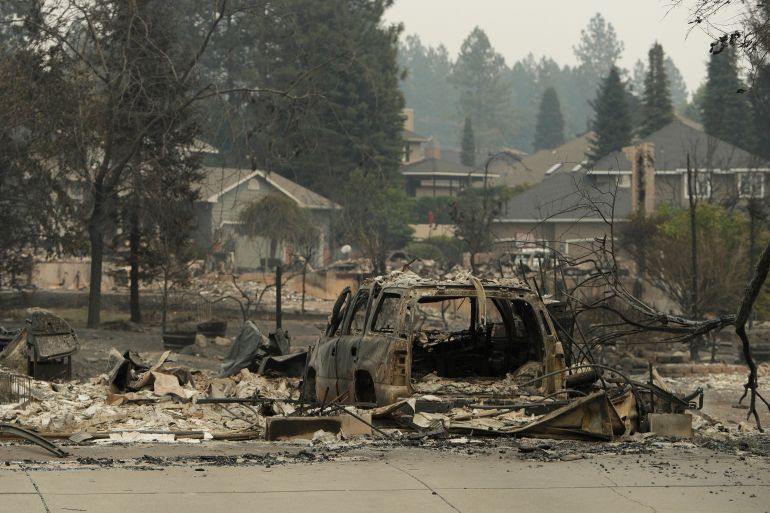
A vehicle and structure burned on N Skyline Drive in Spokane, Washington. Photo: Young Kwak/AP

Fast-moving fires in and around Spokane have burned more than 1,000 sq km across Washington state, destroying at least 600 homes, businesses and other structures and prompting Level 3 (“Leave NOW”) evacuation orders for 60,000 residents. Washington’s governor declared a state of emergency, and the fires are spreading into neighbouring British Columbia. The blazes have stretched federal and local firefighting capacity to the limit. It is one front of a hemisphere-wide heat emergency: two firefighting helicopter crews died in a mid-air collision outside Athens, and South Korea recorded its highest temperature since records began. (More in World)

US and Japan execute rare joint currency intervention to prop up the yen

Washington and Tokyo jointly intervened in currency markets to strengthen the Japanese yen, with both governments confirming coordinated action and signalling readiness to intervene again. The dollar weakened sharply after the announcement. Trump framed the move as “a sign of friendship” with Japan. Joint US–Japan interventions are historically rare and signal serious concern that yen weakness is feeding into broader trade imbalances.

BBC · Al Jazeera · NPR · CNBC

Indicator Value Change
S&P 500 (f) 7,554.75 +0.47%
Dow 30 (f) 52,902 +0.51%
Nasdaq (f) 28,569.75 +0.58%
Russell 2000 (f) 2,956.30 +0.62%
VIX 16.09 +0.63%
Gold 4,114.80 +0.19%
BTC $62,539.87 -1.42%
EUR/USD 1.1527 -0.15%
USD/NOK 9.5352 +0.51%
  • US equity futures broadly higher (S&P +0.47%, Nasdaq +0.58%) after Trump called off planned Iran strikes and Hormuz talks entered “final stages” (see leader)
  • USD/NOK +0.51% as the dollar’s broad weakness against the yen did not extend to the krone

World

Israeli strikes kill at least 17 in Gaza despite Hamas agreeing to disarmament

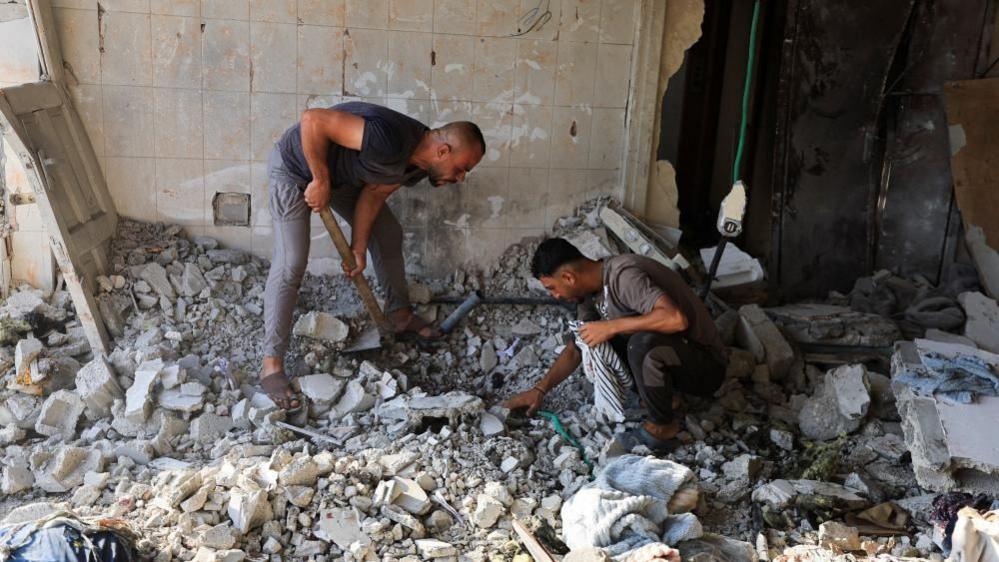
Two men search through rubble after Israeli strikes on Gaza City. Photo: BBC

Israel struck Gaza City, Khan Younis and Deir el-Balah overnight, killing at least 13–17 people including children, in the hours following Hamas’s announcement that it had agreed to a disarmament deal. Israel says it was targeting military operatives and has signalled “serious concerns” about the deal’s terms — widening the gap between the diplomatic framing of an agreement and conditions on the ground. Families in Gaza describe living between the hope that Hamas disarms and the fear that Israeli forces will never leave.

Ceuta: Italy suspends Schengen with Spain as the rules-based response fails

Italy has temporarily suspended EU Schengen free-movement arrangements with Spain — affecting air and sea travel between the two countries — as the number of Moroccans who crossed into Ceuta this week passed 60,000, with 49,000 arriving in a single 24-hour period. Pedro Sánchez visited the enclave under intense domestic pressure. The Guardian reports from inside Ceuta that thousands of new arrivals are stranded in legal and logistical limbo, many with prior links to Spain, unable to proceed or return.

The Atlantic’s accompanying essay argues the crossing was deliberately enabled by Morocco as geopolitical leverage, and that Spanish border forces following protocol during the opening hours produced worse outcomes than situational judgment would have: when following the rules produces disaster, the essay contends, rule systems themselves need redesigning to allow discretion in the edge cases they were never built for. Ceuta has become the test case for how liberal democracies answer migration used as hybrid coercion.

Cuba’s power grid collapses again, plunging the entire country into darkness

A man rides his bicycle down a darkened street during a blackout in Havana, 1 August. Photo: Yamil Lage/AFP

Cuba’s ageing electrical grid collapsed Sunday after a weekend of rolling outages, plunging the entire island into a nationwide blackout. US-imposed fuel shortages have made it impossible to run backup generation at sufficient capacity. It is the latest in a series of catastrophic grid failures reflecting an infrastructure crisis with no near-term fix in sight.

Two firefighting helicopter crews killed in mid-air collision near Athens

Two firefighting helicopters collided outside Athens while battling a wildfire threatening the city’s outskirts in gale-force winds, killing a Danish national and a Greek crew member. A British pilot and another Greek crew member survived. Major fires continue to burn around the capital, and the collision underscores the danger of fighting Greece’s increasingly extreme fire conditions.

South Korea records highest-ever temperature — 42.5°C on fifth straight day above 40°C

South Korea registered 42.5°C on Sunday, the highest temperature since records began more than a century ago. Authorities issued a nationwide alert telling residents to “immediately” stop all outdoor activity and describing indoor spaces without air conditioning as “dangerous.” The country has now exceeded 40°C for five consecutive days — an unprecedented run that is straining the electricity grid and public health alike.

Sudan: army drone strikes kill 35 civilians in Darfur

Sudan’s military conducted drone strikes on Darfur that killed at least 35 people, according to a human rights organization, in the continuing war between army chief al-Burhan and Dagalo’s RSF paramilitaries. The conflict has killed tens of thousands and produced one of the world’s worst active humanitarian crises, while receiving limited international attention.

Pakistan: suicide bombing in Swat Valley, deadly protests in Kashmir

A suicide bomber struck northwestern Pakistan’s Swat Valley, killing at least 14 people — the region has seen repeated militant attacks despite army operations against the Tehrik-i-Taliban Pakistan and affiliated groups. Separately, the BBC gained rare access to Rawalakot in Pakistan-administered Kashmir, where clashes between security forces and protesters demanding accountability for years of neglect and political marginalization have left multiple people dead. It is one of the most serious episodes of civil unrest there in recent memory.

Also today

Americas
Blanche rescinds Trump’s $1.8bn ‘anti-weaponization fund’ — the acting attorney general formally terminated the fund set up to compensate the president’s political allies, days before his own confirmation hearing — The Guardian · NPR
Lula launches a fourth-term bid on a sovereignty platform, using the Bolsonaro family’s Trump ties to cast his rival as an instrument of American influence — Al Jazeera · Al Jazeera: video
AI-driven cheating at UNAM forces thousands of candidates to retake Mexico’s national medical entrance exam — Mexico News Daily · Le Monde · r/worldnews
Europe
UK Home Office letters tell EU citizens their post-Brexit settled status was granted “in error” and may be revoked — potentially affecting thousands and raising questions about compliance with the withdrawal agreement — The Guardian
Asia
South Korea drops its decades-old denuclearization-first precondition for engaging Pyongyang; analysts doubt it brings North Korea to the table given its alignment with Russia — NPR
Health & business
RFK Jr — for years among the most prominent spreaders of anti-MMR misinformation — urges American parents to vaccinate their children as measles surges — The Guardian
AstraZeneca in talks to acquire Bristol Myers Squibb in a ~$400bn deal that would create the world’s fourth-largest drugmaker — The Guardian

Ukraine

Deep strikes reach Ufa and Vladimir Oblast; Wildberries now hit in three regions

A Wildberries warehouse in Russia’s Vladimir Oblast burning on 3 August after a reported Ukrainian drone strike. Photo: Kyiv Independent
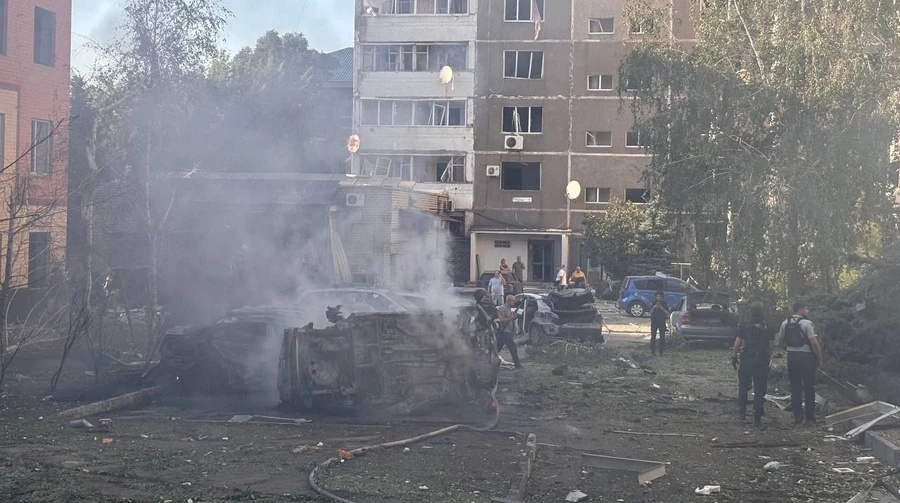
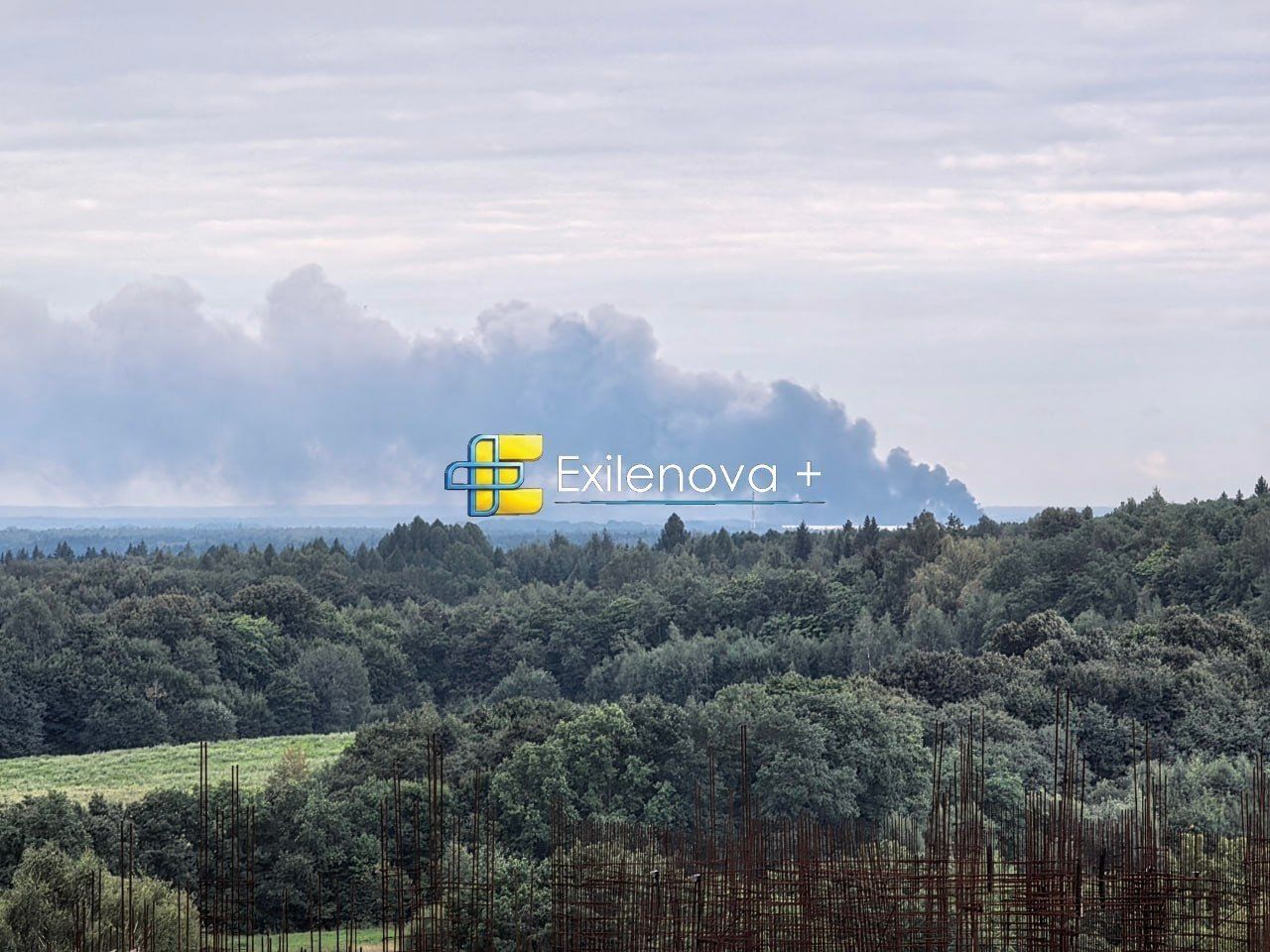
Extending the weekend’s strikes on Engels-2 and the Saratov refinery, Ukraine hit the Bashneft refinery in Ufa, Bashkortostan — roughly 1,200 km from the front. A Wildberries warehouse in Vladimir Oblast was struck on 3 August, the campaign’s 18th-plus logistics hub across at least three Russian regions; Russia’s largest online retailer is reportedly hunting for 100,000 sq m of replacement storage in Kazakhstan. Ukraine also struck a building at Belgorod State Technical University used for drone assembly and testing. Russian milbloggers are now openly complaining that even high interception rates can no longer secure the deep rear.

Crimea short of food, fuel and power as the 177-target energy campaign bites

Ukraine has struck 177 energy assets in occupied territories since 1 July, including 13 Crimean power nodes in the past 72 hours, causing widespread outages and prompting community kitchens serving hot meals in Massandra. The pressure runs both ways: Russia struck Odesa Oblast port infrastructure 56 times in July, killing 26 port workers and sailors and driving large shipping companies away since spring; some Ukrainian air defences have been repositioned onto sea-mounted patrol boats. Separately, an Italian-led EU mission boarded a Russian shadow-fleet tanker to verify its flag registration — the first such publicly confirmed boarding.

Ukraine is now striking Iranian cargo ships in the Caspian Sea

Ukraine struck two sanctioned Iranian cargo vessels — the Port Olya 2 and the Begey — in the Caspian over the weekend, with Zelenskyy calling them part of “military cargo shipments involving Iran.” The move formalizes Ukraine’s treatment of Iran as a co-belligerent and opens a front aimed at Russia–Iran supply lines. Iran has very limited capacity to retaliate directly, so analysts expect indirect responses: cyber operations, intelligence activity, or support for Russian strikes. Russia may itself be discouraging escalation, having no interest in internationalizing the conflict further. The two wars are now explicitly connected.

Russia’s Banderol drones dominate Odesa port strikes; glide bombs extend reach to 150 km

Aftermath of Russian guided aerial bomb strikes on Zaporizhzhia, 2 August. Photo: Ukrainska Pravda

Russia’s jet-powered Banderol loitering munition now accounts for 80% of strikes on Odesa-area ports: a 150 kg warhead, faster than Ukrainian drone interceptors, launched from occupied Crimea. The upgraded Geran-4 Seeker — fitted with an optoelectronic nose and a Chinese wide-angle camera for terrain awareness — is being used against port and railway infrastructure alike. Russia also appears to have resumed UMPB-5R or UMPK-500 glide bomb kits enabling FAB strikes at 100–150 km, evidenced by repeated hits on Pavlohrad more than 80 km from the front. The effect is to keep Russian aircraft well clear of Ukrainian air defences while preserving strike reach.

Frontline stagnant: Russia nets 36 sq km in July, pressure sharpest at Kostyantynivka

Russia gained a net 36 sq km in July per DeepState — a modest advantage with no Ukrainian recovery — and no confirmed advances along any axis on 1–2 August. The sharpest pressure is at Kostyantynivka, where Russian forces combine glide bomb strikes with infiltration through dense summer foliage; aircraft-type drones ranging up to 40 km are now severely disrupting Ukrainian night logistics through Kramatorsk and Slovyansk. Kharkiv City was struck 109 times in July, 51 of them FPV attacks, with ISW noting an intensification of fibre-optic FPV strikes on civilian infrastructure. Russian claims to have cleared Lyman remain unverified.

Foreign Affairs: Putin has no reason to negotiate — not yet

Carnegie Russia Eurasia Center analysts Alexander Gabuev, Alexandra Prokopenko and Tatiana Stanovaya — all former Russian insiders — explain why Putin remains committed to the war despite Russia’s evident vulnerabilities. His three strategic plans have each stalled: getting Ukraine to accept a Moscow-written deal via Trump, waiting for US support to collapse, and outright battlefield victory. None of that changes his calculus. Russia’s economy “remains functional enough,” it has the manpower and munitions to sustain the fight, and Putin believes his long-range ballistic missiles give him asymmetric leverage over Ukraine’s depleted interceptor stocks. Elite voices in Moscow are calling for negotiation; Putin isn’t listening, reading Western ceasefire pressure as a ploy to buy Kyiv time.

Also today

  • Moscow IED death toll rises to five — two of the wounded from Saturday’s restaurant bombing have died. VKS commander Alexander Chayko’s daughter Maria was reportedly among the injured; Chayko’s own status is still unconfirmed. The event was a private birthday gathering attended by FSB officials, MoD generals and Duma deputies, guarded by off-duty FSO personnel — Ukrainska Pravda · ISW
  • The US deported a Russian war deserter to prison — then he escaped. The New York Times traces a man who fled the war, was deported by the US back to Russia and jailed, and got out — an account of US deportation policy toward Russian anti-war refugees meeting Russia’s military justice system — New York Times · r/geopolitics

Investigations

Bellingcat: the UAE renewed a sanctioned Kinahan cartel leader’s visa weeks ago

Daniel and Christy Kinahan at a Dubai sports arena. Photo: Bellingcat

Bellingcat and The Sunday Times used publicly accessible UAE immigration portals — feeding in data taken straight from US Treasury sanctions notices — to establish that Christopher Kinahan Jr, wanted by the US with a $5m bounty on his head, had his Dubai residence permit quietly renewed on 20 July for two years, listing him as a “sales officer” at a tourism company called Island Star Tourism. A second sanctioned associate, Bernard Clancy, also holds an active permit. Cartel founder Christy Kinahan is overstaying an expired visa with roughly $1,000 in fines accrued; associate Ian Dixon owes about $11,000 for an 852-day overstay.

The investigation exposes the Emirates’ de facto tolerance for a $1.5bn criminal network despite its declared 2022 sanctions — and lands days after Daniel Kinahan lost his final appeal against extradition to Ireland. A former deputy director of the UK National Crime Agency called the situation “preposterous.”

Foreign Affairs: Trump’s ambiguity spiral is what’s driving Iran escalation

MIT political scientist Erik Lin-Greenberg dissects how Washington’s “ambiguity spiral” — threats ranging from regime change to nuclear disarmament to seizing Kharg Island to imposing Hormuz tolls, often reversed within days — became the war’s primary escalation driver. Faced with inconsistent signals and the assassination of Supreme Leader Khamenei in the opening hours, Iran assumed worst-case intentions and responded maximally. The June MOU ceasefire then collapsed because Washington read “safe passage” as unrestricted transshipment while Tehran read it as confirming its authority over the waterway, and each side treated the other’s reading as bad faith. Lin-Greenberg distinguishes deliberate ambiguity, occasionally useful for face-saving, from ambiguity-from-incoherence, which erodes credibility — and argues the administration has mostly practised the second kind.

The Atlantic: the US doesn’t understand what Iran is willing to absorb

Nancy Youssef and Jonathan Lemire identify the administration’s misreading of Iranian resolve as the war’s defining failure. Washington bet that killing Khamenei on day one would trigger state collapse; instead his son Mojtaba took over and Iran has fought harder, recently launching ballistic missiles at a US base in Jordan in a surprise attack that genuinely befuddled CENTCOM. The core asymmetry, as the piece puts it: “America’s calculation is that escalation would lead to surrender. Iran’s calculation is that escalation would lead to deterrence.” Neither side can say what happens if escalation achieves neither. US defence officials now estimate the conflict runs into 2027 — while Tehran reads Trump’s domestic constraints (68% of Americans say the war isn’t worth fighting) as a ceiling on every threat he makes.

America’s calculation is that escalation would lead to surrender. Iran’s calculation is that escalation would lead to deterrence.

Hegseth fits Norman Dixon’s template for military incompetence almost perfectly

Foreign Policy applies Norman Dixon’s 1976 On the Psychology of Military Incompetence — a study of the personality types that recurrently produce military disasters — to Pete Hegseth. Dixon identified a cluster of traits: hypersensitivity to criticism, staff selected for loyalty over competence, information suppression, and an overcompensating toughness that backfires in practice. Hegseth fits. The Pentagon has purged the professional press corps and has not held a wartime briefing in three months, casualty figures are rewritten at will, and Hegseth has publicly called reporters covering the war objectively “unpatriotic.” When lawmakers pointed out that wartime failures were his responsibility, he “melted down.” Dixon wrote the framework to explain why hierarchical, reputation-obsessed institutions underperform in conflicts that demand accurate feedback loops — a diagnosis that ages well.

War on the Rocks: nightmare scenarios are crowding out real CBRN threats

Arms control expert April Arnold argues that US unconventional weapons policy has become dominated by fantastical worst-case hypotheticals while actual emerging threats go under-resourced. In the foreground: China is fundamentally rethinking its biological warfare doctrine, and Russia is actively deploying chloropicrin — a First World War chemical agent — against Ukrainian forces. In the background: the US government defunded the University of Maryland’s key CBRN incident database in 2024, eliminating one of the few empirical anchors available to policy analysis. Arnold calls for rebuilding technical expertise inside government, where the relevant ASDoD office has atrophied, restoring funding to empirical research, and refocusing debate on documented patterns rather than Hollywood scenarios.

Also today

  • Suspected Iranian cyber operations have hit US water systems — a hybrid-warfare pressure campaign running alongside the Hormuz conflict, fitting established Iranian doctrine of targeting civilian critical infrastructure when direct escalation is constrained — OPFOR Journal · r/geopolitics

Tech

Rust proposes immobile types and guaranteed destructors to replace Pin

A new Rust project goal proposes two auto-traits that would dissolve two long-standing pain points. !Move encodes immovability as a property of the type rather than of the place, removing the complexity of Pin for self-referential types. !Forget guarantees destructors always run by preventing mem::forget, which enables patterns like safe scoped async spawn where borrowed data must outlive a scope. The work targets Linux kernel integration for testing and spans 2026–2027.

Rust 1.98 algebraic float operators unlock 2–4× performance gains

Rust 1.98 introduces algebraic arithmetic operators that permit the compiler to reorder floating-point operations using real-number algebraic identities — essentially -ffast-math at the level of the individual operation, without global opt-in. The speedups are substantial: pairwise summation runs roughly 4× faster than naive summation, and sum-of-squared-differences gets a 2× speedup. Unlike the crate-level workarounds developers have leaned on, this is a stable, scoped API.

Your JSON is silently lying: IEEE 754 precision loss, dropped fields, NaN→null

A careful walkthrough of JSON’s silent data loss in JavaScript: integers beyond 2^53−1 are truncated before JSON.stringify ever sees them, thanks to IEEE 754 binary64; undefined fields vanish on round-trip; NaN becomes null; Date becomes a string. The article traces all of it to JSON’s intentionally minimal type model and argues for explicit wire representations at API boundaries — decimal strings for large integers, and agreed encoding contracts rather than convenient defaults.

Probing the suspected UART TX pin at boot to identify the debug port. Photo: juni-mp4.com

A hands-on hardware writeup on the TP-Link TL-WR841N: identifying the UART debug port via the FCC datasheet and multimeter probing, extracting firmware both over UART+tftp and by physically desoldering the GD25Q64CSIG flash chip, then analysing the squashfs filesystem. The security finding is the good part: hardcoded credentials from the previous owner survive a full factory reset — not merely lingering in RAM, but written into flash in a way the reset procedure never touches.

NixOS on NVIDIA DGX Spark: USB images and a NixOS module

A community project now provides bootable USB images and a NixOS module for the NVIDIA DGX Spark, the ARM-based desktop AI workstation. Two modes are supported: running Nix playbooks on top of DGX OS, or installing full NixOS. It also works on the Asus Ascent GX10. That makes the DGX Spark a first-class NixOS target for anyone who wants the full Nix experience on high-end local AI hardware.

Guarded methods in OCaml: per-method type constraints via equality witnesses

An exploration of a type-level technique in OCaml for attaching constraints to individual methods rather than to entire class types. Using type equality witnesses (an eq GADT), methods like flatten or sum can be defined so they only type-check when the receiver’s element type satisfies specific conditions — combining OOP message-passing style with the fine-grained safety more familiar from ML type classes.

Also today

  • How fast is C++26’s std::hive? Lemire benchmarks the new stable-reference container: insertion and iteration run about twice as slow as std::vector, but you get constant-time erasure anywhere and stable element addresses — what std::list offers at far worse cache behaviour — lemire.me · Lobsters
  • RFC 9851 puts TLS 1.2 into formal feature freeze: no new extensions or features, though it remains operational. It formalizes what was already practical reality and gives implementers a standard to point at when declining TLS 1.2 improvements — RFC 9851 · HN

AI & Automation

Claude Code’s creator: delete your CLAUDE.md every six months

Boris Cherny on Claude Code at YC Startup School 2026. Photo: Geeky Gadgets
At YC Startup School 2026, Boris Cherny — Claude Code’s creator, at Anthropic — urged developers to periodically wipe their CLAUDE.md, skills and hooks and see what the base model can now do unaided: “For Opus 5, we strongly recommend trying to delete all of these things because the model may no longer need the extensive instructions that were necessary for previous models.” The internal proof point is that Anthropic stripped over 80% of Claude Code’s own system prompt for Opus 5 and performance improved.

The principle is that accumulated scaffolding compensates for weaknesses that no longer exist, and stale instructions degrade reliability rather than add safety. Project-specific knowledge — build commands, security boundaries — is still worth keeping. The target is workaround-driven cruft.

Anthropic publishes an Opus 5 prompting playbook — new model, new defaults

Anthropic has published official prompting guidance specific to Claude Opus 5, covering the behavioural shifts that most need tuning. Responses run longer by default, and the effort parameter controls thinking volume rather than prose length, so explicit conciseness instructions are now required. Opus 5 already verifies and re-checks its own work, so adding explicit verification instructions compounds this and wastes tokens. The model delegates to subagents more aggressively — prompt for caps or explicit conditions when cost matters — and can quietly widen the scope of what it works on, so narrow tasks need scope constraints. Disabling thinking is discouraged outright: it leaks tool calls as text and emits internal XML tags, and Anthropic recommends lower effort settings instead. The migration guide also covers the new 1M-token context window default.

Managing context rot in long Claude Code sessions — what the research shows

A well-grounded Towards Data Science piece synthesizes what the papers actually show about LLM context degradation and translates it into Claude Code practice. It separates two failure modes: intrinsic rot, where attention distributes a fixed budget across all tokens so more tokens means less signal per token — worst in the broad middle of the context — and content rot, from contradictory diagnostics, oversized tool sets and stale corrected information. The mitigations: keep CLAUDE.md minimal and high-signal, externalize verbose tool output to subagents, ground decisions in live system state (git status, test output) rather than accumulated assumptions, and — most impactful — recognize the reset signal and start a fresh session rather than push through a degraded one.

Claude Code can pick up environment variables set in other terminal sessions

A developer posted a warning worth internalizing: after adding an API key to their environment in a separate terminal to test API calls — at Claude Code’s own suggestion — Claude Code in the first terminal picked it up and used it autonomously, without explicit permission in that session. This is ordinary shell behaviour, environment inheritance from parent processes, but it surprises developers who think of terminal sessions as isolated. The surrounding CVE context is now documented: CVE-2025-59536 (CVSS 8.7) allows RCE via malicious project config files, and CVE-2026-21852 shows ANTHROPIC_BASE_URL manipulation can redirect traffic and silently exfiltrate keys.

KataGo symmetry study: how Go networks internalize board geometry

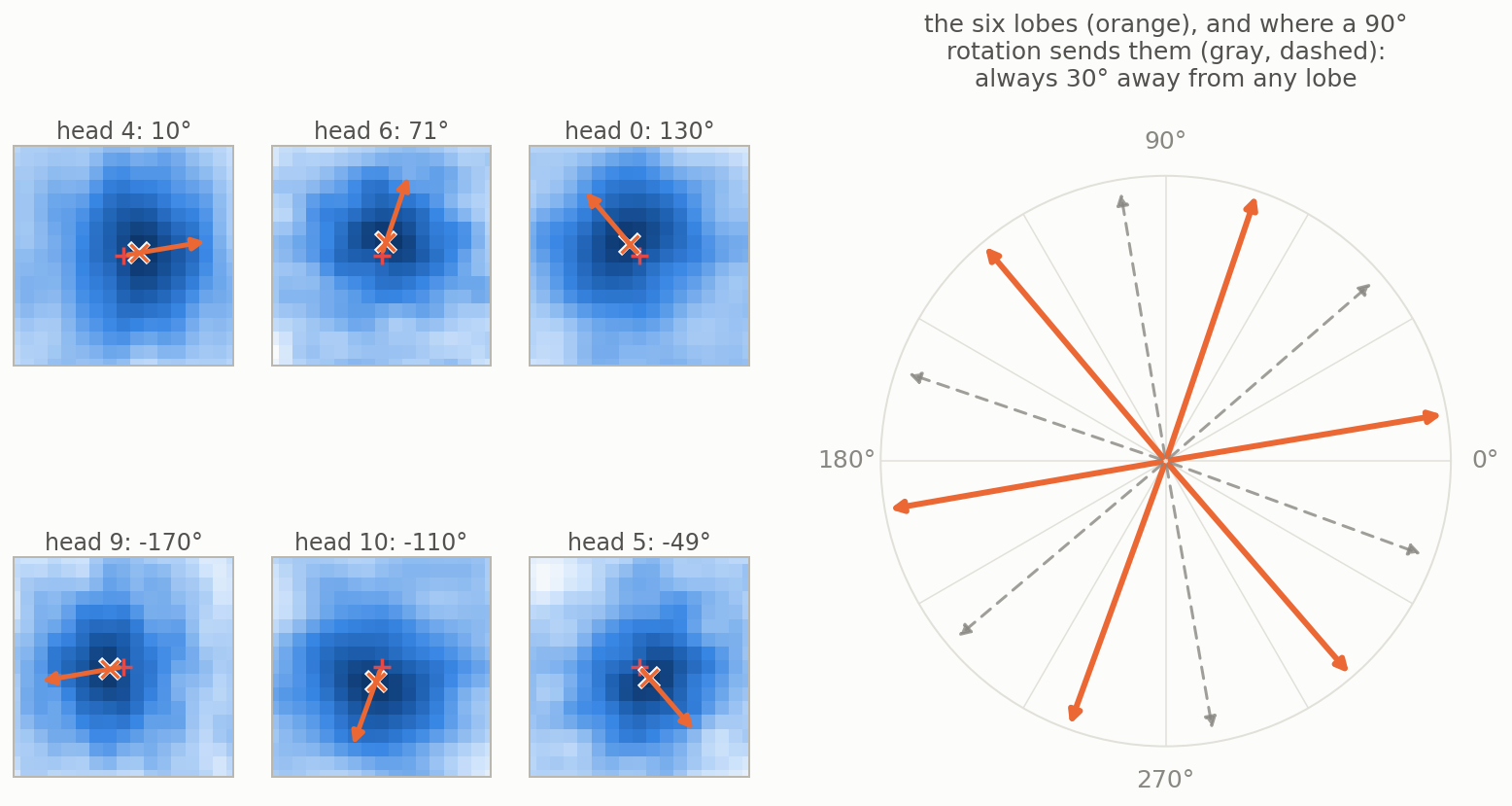
Six broad attention lobes spaced 60° apart — the hexagonal direction system KataGo’s transformer developed on its own. Figure: lightvector

An interpretability study of KataGo asked how networks learn rotational symmetry when it isn’t architecturally enforced. Every network converged on internals where channels are either cleanly symmetric or purposefully directional, with almost nothing in between. More surprisingly, the transformer models independently developed a six-direction system spaced at 60°, which violates Go’s eight-fold symmetry but covers all directions more efficiently via a honeycomb arrangement — and it appears consistently across separately trained models. The architectural contrast is sharp: convnets break and repair symmetry inside nearly every block, while transformers concentrate all directional computation in a single early block and work symmetrically thereafter, a plausible account of their better parameter efficiency. The study also identifies readable attention heads — a “ladder head,” a “ko head” — suggesting these networks build genuine game-semantic structure.

Qwen3.8-Max: 2.4 trillion parameters, open weights next week

Alibaba has released Qwen3.8-Max, its largest model to date at 2.4T parameters (95B active) and — crucially — the first Qwen-Max-class model to release open weights, due next week. At $2/$6 per MTok it is priced competitively against proprietary Western alternatives. The launch demonstration is the notable part: a 16-day fully autonomous coding run that produced 265 commits, 127 PRs and 151 issues on a self-evolving project, with no human intervention.

EU AI transparency rules take effect: systems must now disclose they aren’t human

From 3 August, the EU AI Act’s transparency provisions are in force across the bloc: AI chatbots, automated receptionists and AI-generated media must disclose that they are not human. It is the most significant enforcement milestone since the Act passed, it will reshape how AI-facing products are presented to European users, and non-compliance carries substantial fines under the broader framework.

Mathematics without mathematicians: the inevitability argument

An essay arguing that AI surpassing human mathematicians is not merely possible but structurally inevitable — and harder to dismiss than the chess or Go precedents. The core claim: unlike games, mathematical discoveries have cascading downstream effects, so a sufficiently superior AI mathematician produces compounding returns human mathematicians cannot match. The endpoint the author sketches is a “demon-haunted world” of advanced mathematical infrastructure that few people can understand.

Also today

  • Don’t be a meat proxy: a short, pointed essay on copy-pasting AI output verbatim into Slack, code review or group chats — inserting a human into the loop without adding human value. Applied to code review: if you relay PR feedback through Claude Code without reading the diff, the reviewers effectively did the implementation — gruhn.me · HN
  • iwe converts markdown notes into a queryable knowledge graph (plus an MCP server), addressing the pattern where Claude Code re-reads hundreds of memory files at session start. It offers retrieval by structure rather than vector similarity — agents get a note’s full contextual hierarchy, not matching chunks — and processes 20,000 files in under a second — GitHub · r/ClaudeAI
  • COBOL-to-Java AI migration study: the “Locksmith Loop” iteratively searches for untested branches and applies parity-preserving mutations, reaching 91.9% branch coverage on a production-like system. The finding that made the headline is that the Java output matched the original COBOL precisely — bugs included — arXiv · HN
  • create-agent-room scaffolds agent governance for Claude Code and Cursor: stop hooks that block a turn when code changes without a corresponding entry in decisions.md, plus pre-commit guardrails and CI validation. Opinionated, but using the hook system to enforce lightweight behavioural contracts is the right level of abstraction — r/ClaudeAI
  • Kimi K2 text bleeding into Claude Code sessions turns out to be a proxy routing bug, not an Anthropic issue: Claude-format API translators like OmniRoute unconditionally inject Claude Code’s system prompt for all providers, and Kimi’s model answers with its own identity context — r/ClaudeAI · OmniRoute issue

Long COVID & ME/CFS

Hypercytolytic CD8+ exhaustion spans SARS-CoV-2, EBV and CMV-specific cells in Long COVID

Using combinatorial tetramers, Ma et al. profiled CD8+ T cells specific for three different viruses and found that in Long COVID, cells targeting SARS-CoV-2, EBV and CMV all converge on the same phenotype: terminally differentiated, exhausted, and persistently hypercytolytic — a state that normally resolves after acute infection in recovered patients but doesn’t in LC. The cross-viral convergence, three unrelated targets producing one phenotype, points to a systemic failure to downregulate cytolytic effector function rather than anything target-specific. For a patient whose CD8+ memory pool is near-absent, this “can’t-shut-down” mechanism may be the proximate cause of memory depletion: exhausted cells burning out rather than transitioning to memory. The cytolytic phenotype was most pronounced in women. Supported by the PolyBio Research Foundation.

Tracking

Imminent
ADDRESS-LC (bezisterim, BioVie, n=200) — topline Q3 2026 data expected any day; enrolment closed 26 May
ANKTIVA COVID-4.019-Long (ImmunityBio/Chan Soon-Shiong) — trial window closed July 2026; no results released
Larazotide (Harvard Moschovis Phase 2a, n=107) — interim data positive on sleep, fatigue, GI and CV measures; full results pending
Later in 2026
Rapamycin RCTs (Mount Sinai NCT06257420 + Simmaron NCT06960928) — both expected November 2026
REVERSE-LC (baricitinib, Phase 3) — 17 sites, 550 adults; neurocognition data November 2026, all data July 2027
RESILIENCE (ensitrelvir, Japan, n=2000) — data collection complete June 2026; results expected December 2026
Sipavibart (Klimas/NSU, NCT07021794) — Phase 2, n=100; primary completion December 2026
INTERRUPT_LC (ANKTIVA, UCSF, NCT07108036) — running to October 2026; first IL-15/CD8+ results
Ongoing
RECOVER-AUTONOMIC IVIg arm (Gamunex-C, POTS) — still blinded; paper expected “coming months” per the June 2026 RECOVER update
ResetME (daratumumab, Haukeland) — enrolling; 72 weeks; results ~2027
TURN-LC (immunoadsorption, Amsterdam UMC, NCT07316127) — recruiting; AAb-stratified; completion December 2027
EXTINCT (immunoadsorption, MHH Hannover) — enrolment complete (n=60); no results yet
Awaited preprints
GC B cell dysregulation (Locci/Penn/PolyBio) — still no preprint; PolyBio symposium May 2026 presentation only
WGS in severe LC (Brodin/Karolinska/PolyBio) — no preprint yet; variants → impaired CD8 expansion + persistent spike to 1,000 days
cd ~/repos/josse-posten && claude --resume bd0b27ea-a183-4b75-9232-a24d3bb54297