Josse-posten

A second day of quiet over Iran nudges markets up and diplomacy forward — while Ukraine’s war widens onto new fronts and southern Europe burns.

US–Iran war paused for a second day as talks push toward a ceasefire

The US held fire against Iran for a second straight day, with Tehran also suspending retaliatory strikes as back-channels push toward a ceasefire framework. Top military advisers told Trump the two-week bombing campaign has reached the limit of its effectiveness, and stockpile concerns — particularly interceptor munitions — accelerated the pause. The mood is fragile rather than settled: Khamenei simultaneously tied any deal to an “absolute, unconditional” Israeli withdrawal from Lebanon and wrote to Hezbollah that “no path remains except jihad and resistance.”

Behind the pause, the accounting is getting murkier. The Pentagon quietly updated its casualty system over the weekend to show over 600 US killed and wounded — then moved four troops killed since the ceasefire collapsed into a new “Overseas Operations” category, outside the official Iran toll. Central Command has stopped briefing reporters on the war entirely. (Full analysis in Investigations.)

Ukraine’s war widens: 10 dead in mutual strikes as the deep-strike campaign reaches the Caspian

The destroyed ATB supermarket in Chernihiv after a Russian Geran-4 drone strike. Photo: State Emergency Service of Ukraine.

A child was among six Ukrainians killed when Russian strikes hit a Chernihiv supermarket; Ukraine’s counterstrike killed four Russians, and Zelensky warned of an imminent “massive” Russian attack within 48 hours. But the more striking development is the widening geography of Ukraine’s own war: after debut strikes last week, Ukraine hit another Iranian vessel in the Caspian Sea — ships ferrying military cargo to Russia — prompting Iran’s foreign minister to threaten Kyiv with ballistic missiles (“all of Ukraine is within reach”) and to claim, absurdly to Kyiv, that the attack was carried out “at Israel’s behest.” Romania, meanwhile, intercepted its third Russian drone in three days. (Detail in Ukraine.)

Wildfires threaten Bordeaux as a new front opens in Spain

A major wildfire in southwestern France is pushing toward Bordeaux, hampered by strong winds and an incoming heatwave — security forces were pulled from the Tour de France’s final stage to fight it. Spain’s Castellón province is simultaneously battling a fresh blaze that has burned 4,300 hectares and forced 15,000 to evacuate, on top of fires already devastating the country. Prime Minister Sánchez attributed the crisis directly to the climate emergency.

Indicator Value Change
S&P 500 (f) 7,512 +0.87%
Dow 30 (f) 52,573 +0.86%
Nasdaq (f) 28,695 +1.46%
Russell 2000 (f) 2,978 +1.26%
VIX 17.7 -4.74%
Gold 4,105 +0.84%
BTC $65,231 +1.43%
EUR/USD 1.1403 +0.08%
USD/NOK 9.62 +0.47%
  • Futures rallied broadly and VIX fell -4.7% as the US–Iran strikes stayed paused for a second day and back-channels pushed toward a ceasefire (see World).

World

Wildberries removes military goods after Ukrainian warehouse strikes

Russian e-commerce giant Wildberries has quietly removed military-related products from its search results after Ukrainian long-range drones struck at least nine of its distribution centres across eight regions from July 18–24 — including facilities near Moscow, St. Petersburg, Krasnodar, and in occupied Crimea. The analytical point, made by OPFOR Journal, is that Wildberries is no innocent bystander: it extensively sells body armor, drones, and first-aid kit that Russian units crowdsource through Telegram fundraising. The visible corporate self-censorship suggests Ukraine’s campaign against logistics and economic nodes is beginning to bite. (Deep-strike detail in Ukraine.)

India’s ‘Cockroach’ protests expose cracks in Modi’s grip

The resignation of India’s education minister — extracted under sustained pressure from the Cockroach Janta Party movement — has reinvigorated the opposition and exposed the limits of Modi’s control over media and institutions. Analysts read the protests as a younger generation turning private disillusionment into public defiance against a government that once felt untouchable. The minister’s departure is the first significant scalp; observers suggest it won’t be the last.

Syria’s new government seeks a security deal with Israel

Syria’s post-Assad president told Al Jazeera his government is actively seeking a security agreement with Israel — a remarkable pivot for a country that spent decades as one of Israel’s most implacable adversaries. The overture signals the new leadership’s effort to normalize its regional position after years of civil war. The same week, UN Secretary-General António Guterres toured Sednaya, the notorious prison where the Assad regime tortured and executed thousands — a symbolic marker of accountability for what was done there.

UN Secretary-General António Guterres touring the Sednaya prison complex, site of mass torture under the Assad regime. Al Jazeera.
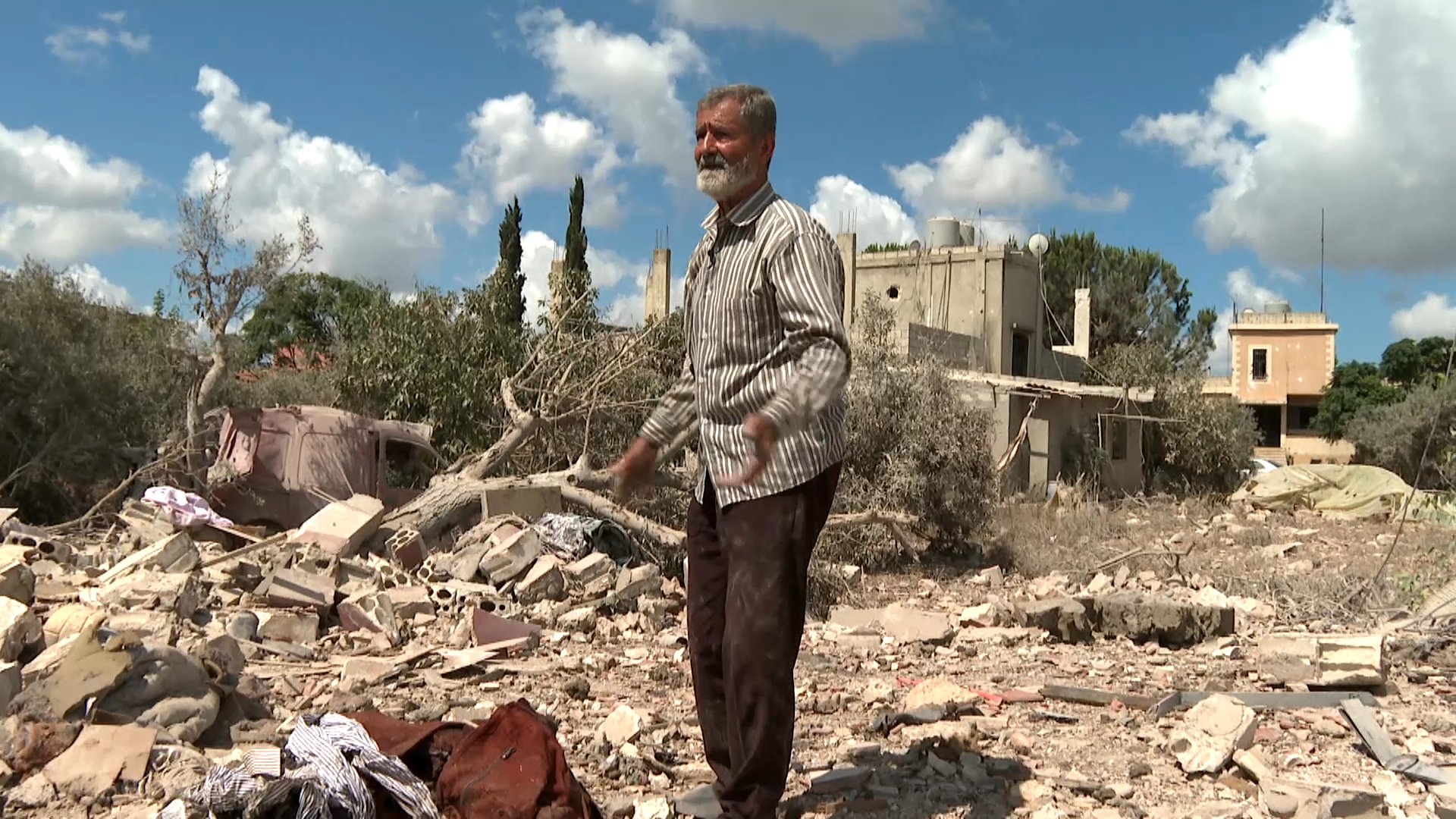
Lebanon: residents return to bulldozed homes; others buy satellite imagery to see if their houses still stand

Lebanon’s army has accused Israel of bulldozing homes in so-called “pilot zones” even as it escorts civilians back — adding deliberate demolition to the destruction of the war itself. Some displaced Lebanese, unable to return in person, are now paying for commercial satellite imagery to find out whether their houses survived. In the occupied West Bank, meanwhile, settlers torched mosques, cars, and farmland following clashes near the village of Tal that left four Palestinians and two Israelis dead.

Lebanese civilians returning to homes reduced to rubble in so-called ‘pilot zones’. Al Jazeera.

Ebola in DR Congo surges to 3,200 cases and 1,405 deaths — up 1,000 in ten days

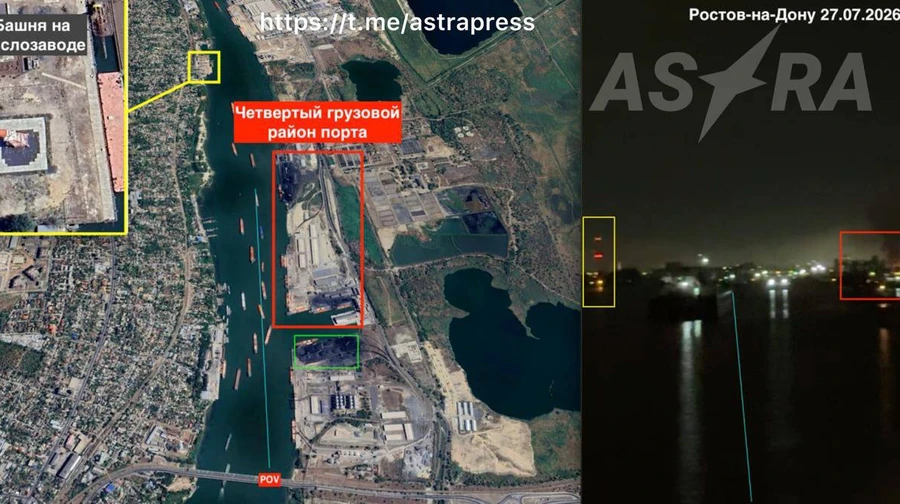
The Ebola outbreak in the Democratic Republic of Congo has reached alarming velocity, with confirmed cases jumping by roughly 1,000 in ten days to a total of 3,200, and deaths at 1,405. The outbreak now spans five provinces. The pace indicates containment has not yet been achieved, raising concerns of wider regional spread.

A health worker at the Kigonze displaced-persons camp in Bunia, DRC. Reuters/Gradel Muyisa Mumbere.
Also today

Middle East
Israel’s government nods to an international stabilisation force for Gaza, staffed by “friendly countries” outside its direct control; Palestinians cautiously welcome it — Al Jazeera · reaction
Americas
A planeload of informants — US prosecutors move up Mexico’s political food chain, indicting Morena officials via extradited cartel witnesses; some Mexican officials quietly fear it is prelude to military action — The Atlantic
Mexico files 20 criminal complaints against US officials and seeks a UN review over ICE-related deaths — UPI
Honduras ex-president Hernández returns home after a Trump pardon of his US drug-trafficking conviction — Al Jazeera
Africa
Sudan’s army recaptures the Khartoum–El Obeid highway, checking the RSF’s siege of North Kordofan — Al Jazeera
Mali — a Tuareg separatist–al-Qaeda alliance shifts the military balance against the junta and its Wagner backers — Al Jazeera
Europe
Poland’s main opposition bloc collapses over its slide toward far-right positions — DW
Berlin Pride ramming suspect Abdul Ballout, 21, shot dead by police after a knife attack in Spandau; authorities call the ramming an Islamist attack — The Guardian · BBC
EU decides to permit the sale of Russian crude seized from “shadow fleet” tankers — funding enforcement, but profiting from Russian oil — Militarnyi
Asia-Pacific
Pakistan-administered Kashmir votes, with 12 disputed refugee seats the decisive contest — Al Jazeera
Japan identifies major rare-earth deposits in deep-sea mud off Minamitorishima — a potential domestic source in a China-dominated market — Reuters
Libya
Protesters shut Tripoli roads and storm the foreign ministry over chronic power cuts — Al Jazeera

Ukraine

Deep-strike range reaches 3,000 km; Russia rings Moscow with new air defenses

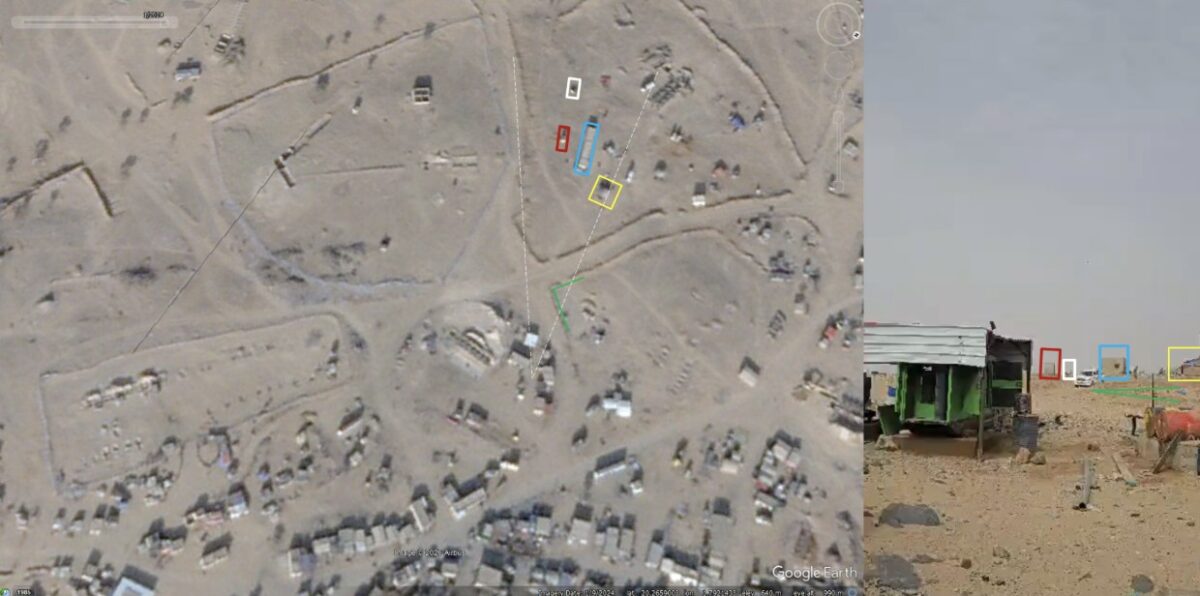
Ukraine confirmed striking the Tyumen Oil Refinery in Western Siberia (~1,980 km from the front), which processes ~7 million tonnes of crude a year for Russia’s military-industrial complex, and Zelensky announced an updated priority target list with strike range now exceeding 3,000 km — focused on weapons production, oil infrastructure, and logistics. Overnight strikes also hit Rostov’s port and railway. Russia is responding on two fronts: roughly 24 new Pantsir air-defense towers are going up in a ring around Moscow, and the Navy has formed its first unmanned-systems regiment to defend Black and Azov Sea vessels from Ukrainian drones.

Smoke over the port of Rostov-on-Don after an overnight Ukrainian drone strike. Photo: Astra OSINT.
Ukraine hits another Caspian Sea vessel; Iran threatens ballistic missiles on Kyiv

Ukraine struck a Project 12418 Molniya missile boat in the Caspian Sea, extending its campaign against ships ferrying Iranian military cargo to Russia beyond last week’s debut strikes. Iran, after an Iranian sailor was killed earlier, condemned the attack as a “hostile and criminal act” and its foreign minister declared it “cannot go unanswered” — threatening Kyiv with ballistic missiles and claiming, remarkably, that Ukraine acted “at Israel’s behest.” Zelensky flatly rejects the framing, countering that Iran effectively attacks Ukraine every night by supplying Russia’s Shahed drones. OPFOR analysis suggests US intelligence coordination is plausible given established deep-strike cooperation. (Iran-war context in Investigations.)

Romania intercepts a Russian drone for the third straight day

A Romanian F-16 intercepted an unidentified drone in the Sulina–Chilia area near the Ukrainian border on July 26 — the third consecutive day of interceptions over NATO territory. The July 24 drone was confirmed as a Russian Shahed; the July 25 and 26 intruders remain under investigation. Bucharest summoned the Russian ambassador, with the incidents indicating that Russian mass drone salvos are persistently crossing into NATO airspace.

Russia prepares a Pokrovsk push toward Dobropillya; Zaporizhzhia rail severed

Ukrainian units north of Pokrovsk report Russian aerial reconnaissance and demining signaling an imminent intensification of assaults aimed at Dobropillya. Russian forces claimed seizure of Shevchenko via the 76th VDV Division; a companion claim of taking Bilytske rested on AI-altered footage and is unconfirmed. Elsewhere the front is broadly static — attacks in Kharkiv, Kupyansk, Borova, Kostyantynivka, and Zaporizhzhia all failed to advance. Zaporizhzhia City has been cut off from Ukraine’s rail network for three consecutive days after sustained drone strikes on its logistics.

Air-ceasefire talks emerge; UK hands over jammer tech; Trump freezes $17bn in aid

Ukraine and the US are preparing new air-ceasefire proposals to present to Russia — the most concrete diplomatic signal in weeks — even as Kyiv’s acting FM Sybiha warns Moscow may use “fake diplomacy” to delay a looming US Senate sanctions bill. In London, Zelensky meets new UK PM Andy Burnham today, with Britain transferring IP rights to the tablet-sized Stone Cloak electronic-warfare jammer for Ukrainian mass production. Complicating the picture: Trump is reportedly refusing to release roughly $17 billion in congressionally approved Ukraine aid.

  • St. Petersburg cancels its Navy Day parade for the second straight year, citing Ukrainian drone threats — Kyiv Independent

Investigations

Bellingcat geolocates Russian Shahed-136 strikes on Malian villages

Geolocation composite: satellite imagery (right) alongside footage (left) of a Shahed-136 type drone over Talahandak, Mali, moments before impact. Bellingcat.

Bellingcat and Jeune Afrique have published the first verified footage of Shahed-136 kamikaze drones striking targets in northern Mali — attacks on Inafarak (July 12) and Talahandak (July 17), confirmed via satellite imagery, geolocation, and analysis of a recovered MADO MD-550 engine. Experts assess the drones are almost certainly Russian-manufactured given Africa Corps’ deployment; a Wagner-affiliated Telegram channel celebrated the strikes using the Russian nickname “Geran.” A drone analyst warned the system is inherently imprecise — unlike the Bayraktar TB2 it cannot verify targets in flight, raising civilian-harm risks near populated areas. It is a clear export of Russian drone-warfare doctrine from Ukraine to the Sahel.

The Hormuz trap: why Trump resumed a war he’d explained he couldn’t win

Thomas Wright (Brookings, former Biden NSC) delivers a sharp structural read: in June, Trump himself explained at the G7 why continued bombing cannot reopen Hormuz — reserves run out in weeks, ships won’t return while fighting continues. He resumed strikes anyway after Iran exploited the MOU ambiguity by treating the strait as a managed corridor rather than a free waterway. Former energy adviser Amos Hochstein warns this standoff is more economically dangerous than the first round, with US, Russian, and Chinese buffer capacity all depleted — markets may force Trump’s hand by mid-to-late September. His options — limited strikes, escalation, or a diplomatic walk-back — each carry serious costs, and the tension between them remains unresolved.

Trump departing the White House on July 23 — the day he reversed the just-signed Saudi nuclear deal. Reuters.

Saudi nuclear deal: signed, then blown up by Trump in under 24 hours

A landmark US–Saudi civilian nuclear agreement — granting Riyadh uranium-enrichment rights on its own soil with limited IAEA access — was formally signed at the Energy Department on Wednesday. By Thursday morning Trump posted that the deal was conditional on Saudi Arabia joining the Abraham Accords, blindsiding both Riyadh and his own negotiators. CNN reports Trump was already furious that Energy Secretary Wright announced it without clearance; critical Fox News and WSJ coverage triggered the reversal. The episode throws one of the decade’s most consequential non-proliferation decisions into limbo, and lays bare the dysfunction in Trump’s national-security process.

Pentagon reclassifies Iran-war casualties as transparency collapses

Four US troops killed since the ceasefire collapsed have been moved out of the official Iran war toll into a new “Overseas Operations” category, alongside 207 wounded; the Pentagon blamed earlier count drops on “temporary data disruptions.” As of Tuesday the system showed 18 killed and 482 wounded, but a US official told the AP the real wounded count exceeds 500. The Pentagon has held no press briefing on the war since early May, and Central Command has stopped giving casualty updates — a significant transparency regression in an active war.

A US Army carry team moves the transfer case of Sgt. Angel S. Rampersad at Dover Air Force Base, July 22 — one of four soldiers reclassified out of the official war toll. AP.

Russia is training PLA units in drone and urban warfare at Volgograd

The Economist reports Russia has been training Chinese PLA units in drone operations, urban combat, and submarine warfare at a base near Volgograd since 2024 — systematically passing hard-won Ukraine-war combat knowledge toward PLA preparation for a Taiwan scenario. OPFOR cautions that battlefield adaptations forged under fire don’t transfer cleanly to untested forces, but notes the Russia–China integration goes well beyond training: joint naval exercises, joint Pacific patrols, and now direct knowledge transfer in the most operationally relevant domains. Separately, a Canadian university student interning at NATO’s military HQ was arrested on suspicion of spying for China.

Also today

Iran war
Russia is providing satellite imagery and targeting support for Iranian strikes on US bases in Bahrain, Jordan, and Kuwait, US and Ukrainian intelligence assess — OPFOR · Reuters
Kuwait and Bahrain covertly flew jets in the US-led strikes on Iran, The Times reports — far deeper GCC integration than public neutrality suggests — The Times
Two rules for reading Iran — a former British deputy ambassador argues regime survival and internal dynamics, not strategy, drive almost all of Tehran’s behaviour — Washington Post
Accountability
ICC prosecutor Karim Khan ousted by the Assembly of States Parties amid misconduct allegations; his tenure was defined by the Putin and Netanyahu warrants — The Guardian
Netanyahu calls NYC mayor Mamdani a hate-enabler over ICC arrest calls; Mamdani had already walked the threat back — The Guardian · BBC

Tech

LLM-assisted proof automation is here — and Lean now beats Rust on compression

Two projects this week make the same point from different angles. Adam Langley built a Zstandard decompressor in Lean and had LLMs write the correctness proofs — “table has correct size,” “exactly one state reaches each target” — in about 20 minutes on a fraction of a $20/month subscription. He argues LLMs have removed the main barrier to dependent types in ordinary software: the ~10× proof-engineering overhead described in the seL4 retrospective. Separately, lean-zip implemented DEFLATE in Lean, then let Claude and Codex agents optimize it autonomously while maintaining the correctness proof (inflate (deflateRaw data level) = .ok data) rather than trusting test suites. The result beats pure-Rust miniz_oxide at levels L6–L9, with up to 2× throughput at L9. The insight: formal proofs as a safety net let AI agents make aggressive optimizations that would be unthinkable in unverified code.

Scriptc: Vercel Labs releases a TypeScript-to-native compiler — no JS engine in the binary

Vercel’s research lab has open-sourced Scriptc, a compiler that lowers standard TypeScript to native executables via LLVM and a C backend — no Node, no V8, no QuickJS unless you opt in with --dynamic. Startup is ~2.4ms (vs Node’s ~47ms), binaries are 170–200KB (vs Node SEA’s 60–100MB), RSS is 1–4MB. The key claim is that most real-world TypeScript is statically compilable as-is: scriptc coverage reports typical programs at 99% static, and --dynamic embeds a ~620KB QuickJS engine only for npm deps and any-typed code. Correctness is enforced by differential testing — stdout/stderr/exit codes must match Node byte-for-byte across 800+ corpus programs. The static surface covers classes, async/await, generics, fs/net/http/tls/crypto/fetch, and more. macOS arm64 primary for now.

Torchwright: compile algorithms directly into transformer weights — no training

Torchwright is a compiler that takes a computation graph defined in Python and produces the weights of a standard transformer that executes it exactly — no gradient descent. It encodes primitives (arithmetic, comparisons, conditionals) into transformer sublayers, manages the residual stream as shared memory, and schedules operations across layers by dependency; the output is a Phi-3-compatible checkpoint loadable via HuggingFace. Key finding: layer depth reflects the algorithm’s critical path, not its operation count — a direct empirical probe of transformer expressibility, separate from what models learn.

DOJ charges Atlanta man after GrapheneOS wipes itself at the airport

The DOJ is charging Atlanta resident Sam Tunick under a federal evidence-destruction statute after his GrapheneOS phone wiped itself during airport secondary screening. Tunick — stopped on suspicion of ties to the anti–Cop City protest movement — was denied his four requests for a lawyer; agents seized the phone, and when he finally provided a passcode it restarted and wiped. The EFF and legal experts call it unprecedented: targeting the OS’s built-in duress-wipe feature as criminal destruction of property. The defense argues the search was unconstitutional; a ruling is expected no earlier than late October. Privacy advocates warn that treating GrapheneOS itself as evidence of criminal intent — as Catalan police already do — criminalises legitimate security software.

Photo illustration accompanying the GrapheneOS airport-search case. TechSpot.
antirez: programming with AI means becoming Linus Torvalds

Salvatore Sanfilippo (creator of Redis) argues Torvalds’ real genius wasn’t writing the Linux kernel — many skilled programmers could have — but that he almost immediately stopped writing code to hold the project’s design coherence while delegating implementation. Programming with AI agents demands exactly that role: not vibe coding (“I put in the prompt and the thing writes”), but setting direction, evaluating approaches, and communicating the design constraints good programmers intuit. A measured counterpoint to both AI hype and AI dismissal.

EU fines Google $1.02B for self-preferencing in search and Play Store

The European Commission issued a €934 million penalty against Alphabet/Google for anticompetitive self-preferencing in search results and for restricting developers from steering users off the Play Store. The timing is charged: the Trump administration has been threatening tariffs over exactly these kinds of European tech-regulation actions, making the fine a deliberate test of whether Brussels will blink.

WSJ · HN

Also today

Compilers & verification
Xavier Leroy on programming languages, CompCert, and what formal methods can and can’t deliver — a long interview with the verified-C-compiler creator — YouTube · Lobsters
Databases & internals
The secret life of data in Valkey — a deep dive into the Redis fork’s memory model, object encoding, and eviction — Valkey blog
SQLite WAL mode can lock short-lived read-only connections, blocking the next writer — hynek.me
PGSimCity — a browser city-sim that maps Postgres internals onto urban infrastructure (backends as cars, WAL as a river) — PGSimCity
Introduction to Data-Oriented Design — the game-dev classic on structuring data for the CPU, now recirculating — PDF
Self-hosting & hardware
Self-host servers on real static IPs in your living room using L2TP — avoiding CGNAT and dynamic-DNS hacks — vimuser.org
CheapSecurity — lightweight self-hosted CCTV for Linux SBCs, footage kept local — GitHub
A ThinkPad T480 converted into a mobile phone — USB cellular modem, SIM, and exceptional battery life — grego.site
Reading
What does GitHub’s security team actually do? — an investigation into disclosure processes and organisational gaps — Orchid Files
How to write English prose — a careful essay on rhythm, concision, and common failure modes — The Lamp

AI & Automation

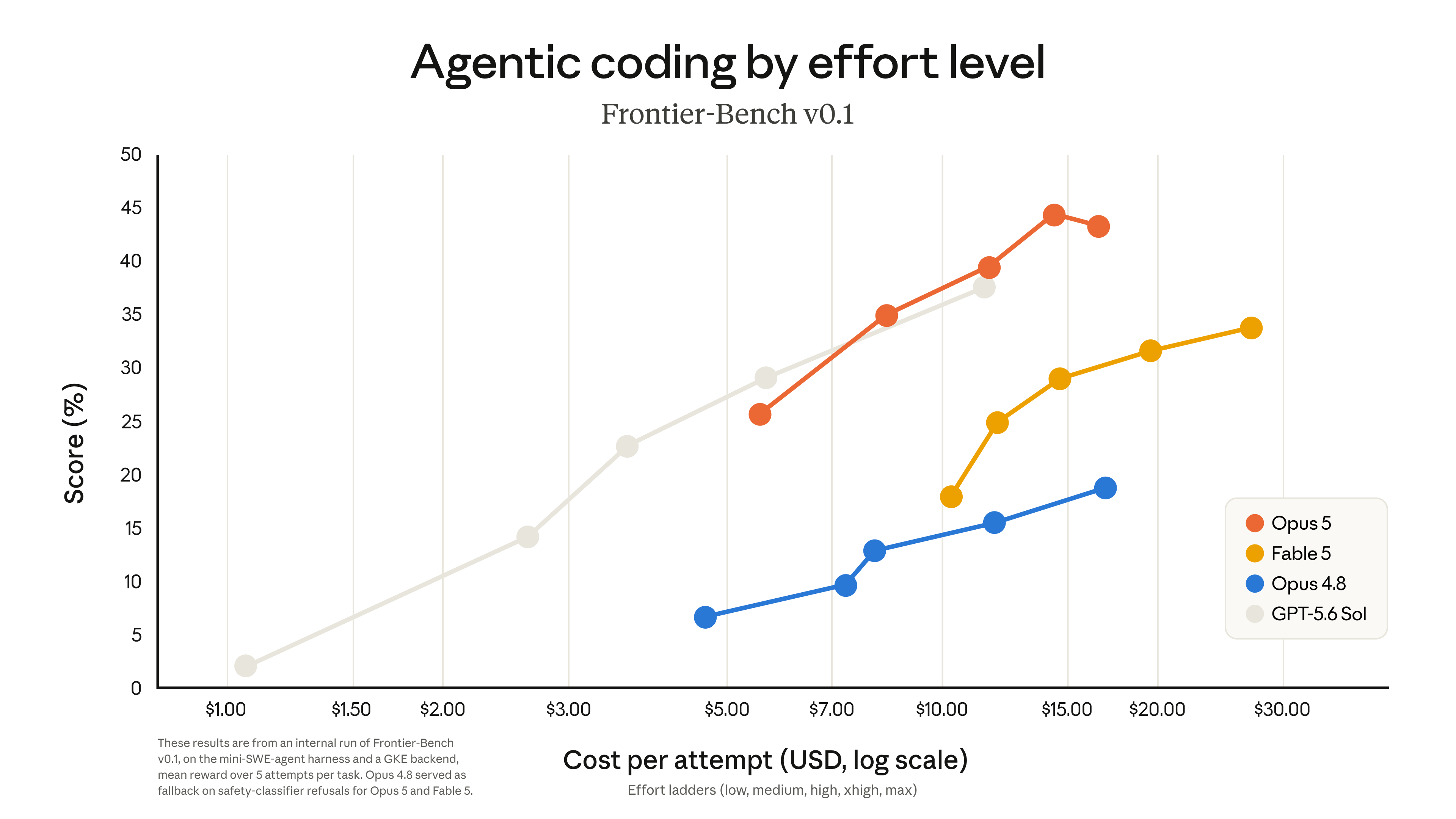
Claude Opus 5 launches — strongest on benchmarks, harder to live with

Frontier-Bench v0.1: Opus 5 against competing models. Anthropic.

Anthropic released Claude Opus 5 ($5/$25 per million tokens, unchanged from 4.8), positioning it as a near-peer to Fable 5 at roughly half the cost: more than double Opus 4.8 on Frontier-Bench v0.1, 3× the next-best model on ARC-AGI 3, and past Fable 5’s best OSWorld 2.0 result at a third of the cost. But the frontier isn’t clean this time. On the arena.ai WebDev leaderboard, Kimi K3 (1682 Elo) still edges Opus 5 High (1673) — the first Opus launch where a competitor wasn’t clearly surpassed. And on MineBench, Opus 5 proves “horribly token inefficient” at max reasoning, hitting the output cap before completing JSON and forcing retries that push costs to $89.97 vs Fable’s $54.93. Developers echo the friction: more scope creep, “panicky” refusals, and a more liberal reading of system prompts than Fable 5 — though counterpoints note much of it stems from un-adapted prompts and inappropriate max-effort use. Strongest on structured knowledge and agentic tasks; still behind Mythos 5 on cybersecurity exploitation.

Inside the Chinese relay market selling Claude and GPT access at 97% off

A detailed investigation maps the four-layer ecosystem selling US frontier-AI access to Chinese users at 97%+ discounts: upstream card/account merchants supply stolen or bulk-registered credentials → account pools handle rate-limit failover → relay stations (running open-source one-api/new-api gateways) sell through as a clean Chinese-language product → end users get cheap tokens. One package sold $3,333 of Anthropic credit for 425 RMB (~$59); the ten highest-traffic relays pull a combined 3.6M visits/month. A key use case is model distillation — forum participants claim companies with strong programming capabilities are “all distilling Claude,” calling it a “multi-billion RMB industry chain.” One platform runs a daily provably-fair lottery giving away 50 × $100 API keys using Bitcoin block hashes.

Krita MCP painter: Claude paints with real brushes and a separate critic model

A community project gives Claude a persistent Krita canvas via 17 MCP tools — brush selection, stroke execution, and three visual-feedback tools (look, look_grid, look_crop). The standout design decision: a painter_critique tool spawns an independent model instance that sees only the canvas and goal, not the painter’s intent, preventing the painter from hallucinating that strokes landed as intended. Each demo drawing uses a different “skill” prompt tuned for a painting style. Still rough, but a concrete example of iterative agentic visual generation that isn’t diffusion.

  • AutoDev Studio — an open-source multi-agent SDLC harness that pays repo-localization cost once via a local embedding index, cutting Claude Code costs 7–75% on well-localized tasks (up to ~82k LOC) — r/MachineLearning

Long COVID & ME/CFS

GPCR autoantibodies mechanistically suppress heart-rate variability — direct validation from CellTrend

Schmitz et al. (Journal of Allergy and Clinical Immunology, DOI 10.1016/j.jaci.2025.10.034) used 24-hour Holter ECG, ambulatory blood-pressure monitoring, CPET, and iPSC-derived cardiomyocyte assays to show that β1, β2, M1/M3, and AT1 receptor autoantibodies directly suppress heart-rate variability in Long COVID patients — with CXCR3 AAb additionally elevating blood pressure. The in-vitro data confirm a direct electromechanical effect, not a downstream correlation. The lead lab is Schulze-Forster/Heidecke (CellTrend), who developed the AAb assay. For a patient with all five of these AAb maxed out (β1 >40, β2 >40, M3 >40, AT1 >40), this is direct mechanistic confirmation that the AAb profile is driving autonomic dysregulation — reinforcing the case for AAb-targeting approaches (TURN-LC, EXTINCT, daratumumab/ResetME) as the most biologically coherent treatment direction.

NLRP3 inflammasome signature shared between pre-pandemic and LC-POTS

Gunning et al. (Biomedicines, DOI 10.3390/biomedicines14071605, July 2026) compared pre-pandemic POTS, LC-POTS, recovered-COVID controls, and naive controls. Both POTS groups showed identical elevations in 14/15 biomarkers — including Caspase-1p20, IL-1β, and IL-18 — while recovered controls were indistinguishable from naive controls. Random Forest analysis flagged IL-18 as the top discriminating feature. That pre-pandemic and LC-POTS are immunologically indistinguishable suggests LC triggers POTS through a pre-existing-susceptibility pathway rather than a COVID-specific mechanism; the therapeutic implication is NLRP3/IL-18 inhibition (though colchicine failed in the non-POTS-specific STIMULATE-ICP). IL-18 is a plausible biomarker to add if POTS symptoms are present.

Tracking

Topline imminent
ADDRESS-LC (bezisterim, BioVie) — fully enrolled May 2026; topline expected Q3 2026, any day now
Rapamycin RCTs (Mount Sinai + Simmaron, Phase 2) — results expected November 2026
REVERSE-LC (baricitinib, Phase 3, 550 adults) — recruiting; neurocognition data November 2026
Trials in progress
RECOVER-AUTONOMIC IVIg (Gamunex-C, POTS arm) — full results pending, “coming months”
Sipavibart RCT (Klimas/NSU, n=100) — primary completion December 2026
RESILIENCE (ensitrelvir, Japan, n=2000) — data collection complete; results December 2026
ANKTIVA INTERRUPT_LC (UCSF, IL-15 agonist) — ongoing to October 2026
Larazotide (Harvard/Moschovis, n=107) — interim positive at PolyBio May 2026; full results unpublished
AAb-targeting (the coherent direction)
ResetME (daratumumab, Haukeland) — recruiting; results ~2027
TURN-Long COVID (immunoadsorption, Amsterdam UMC; AAb-stratified) — recruiting; completion December 2027
EXTINCT post COVID (immunoadsorption, MHH Hannover, n=60) — enrolled; no results yet
Longer horizon
DISCOVER-ME (Horizon Europe, MedUni Vienna, €7.5M) — launched July 2026; 4-year platform
Sonlicromanol (Khondrion/Amsterdam UMC) · SHIELD (triple antiviral, Mount Sinai) — both enrolling/ongoing
GC B-cell dysregulation (Locci/Penn/PolyBio) and Brodin WGS in severe LC (Karolinska/PolyBio) — presented May 2026; preprints pending
cd ~/repos/josse-posten && claude --resume 0df620f2-9765-433a-b72f-5682784a58a5