A
28.9M-parameter LLM runs offline on an $8 ESP32 — 100× the previous
state of the art
A project squeezes ~9.5 tokens/second from a 14.9MB (4-bit quantized)
language model on an ESP32-S3, entirely offline. The enabling trick is
Google’s Per-Layer Embedding architecture from Gemma: the massive
embedding table lives in slow flash, with only ~450 bytes fetched per
token, while the compute core stays in fast SRAM. The model (trained on
TinyStories) generates coherent text but doesn’t follow instructions.
Previous microcontroller LMs topped out around 260K parameters — roughly
100× smaller. In the same vein, Inflect-Micro-v2 packs a full
text-to-speech voice into 9.36M parameters, small enough for fully
offline synthesis on constrained edge hardware.
Anthropic removed over 80% of Claude Code’s system prompt for Opus 5
/ Fable 5-generation models and found no performance loss — better
outcomes, in fact. The insight: verbose, over-constraining prompts cause
the new generation to overthink rather than reason. The new guidance for
builders: keep CLAUDE.md files lightweight (repo-specific gotchas only),
prefer code and mockups over prose specs, design skills as
progressive-disclosure guides, and trust the model’s judgment where you
haven’t spelled things out; a /doctor command helps
auto-optimize context. The shift is conceptual — from “tell the model
everything” to “give it product context and get out of the way.” It
pairs neatly with an essay by jsbarretto framing natural
language as a deliberately constructed latent space, which explains why
LLMs work as powerful symbol manipulators without a world model — and
warns that heavy LLM use could calcify existing conceptual frameworks
(“linguistic and cognitive inertia”).
Open-weight AI
is having its Kubernetes moment
Written by Mesosphere co-founder Tobi Knaup — who watched Kubernetes
disrupt his own company — this argues open-weight models are becoming
the neutral ecosystem substrate the way Kubernetes did for cloud-native:
once the center of gravity forms, no single vendor can outpace combined
ecosystem innovation. The data points: Chinese models now account for
41% of HuggingFace downloads; GLM-5.2 claims 62.1% on SWE-bench Pro
vs. GPT-5.5’s 58.6%; Kimi K3 weights were promised for July 27. His
policy argument: US restrictions on Chinese open-weight models would be
“an own goal,” cutting American developers off from an ecosystem the
rest of the world will keep building regardless. Cloudflare, meanwhile,
is shifting from blanket bot-blocking to credentialed access — separate
toggles for search, agent, and training crawlers, plus a “BotBase”
registry so publishers can negotiate terms with specific verified
operators.
Rust
vs. the “memory-safety absolutists” — Android’s production data is the
argument
A sharp pushback against holding Rust to inconsistent standards.
Android’s production Rust corpus (~5M lines) shows ~0.2 vulnerabilities
per million lines vs. C/C++’s historical ~1,000 — roughly a 5,000×
improvement. The trigger is Fil-C, a new tool that makes C/C++
memory-safe via GC and pointer tracking, which critics wield to argue
Rust developers should just switch if they truly care about safety. The
author rejects the false equivalency: Fil-C has real tradeoffs (ABI
incompatibility, performance cost), and pragmatic engineers should
evaluate tools by outcomes, not ideological purity. Relatedly, an
advocacy essay argues that IOMMUs — standard for a decade — eliminate
the copying bottleneck that made Linus’s 1992 dismissal of microkernels
correct, reopening the case for isolated, crash-contained drivers.
Debian
holds a live vote on whether contributors may use LLMs
Debian is running a General Resolution on LLM usage in contributions,
with four proposals on the ballot: (A) complete ban; (B) allow with six
conditions including DFSG compliance, disclosure and contributor
accountability — currently leading with 9 seconders; (C) discourage but
don’t ban, treating violations as CoC breaches; (D) accept with
contributor-responsibility and transparency requirements. Voting opened
July 24 with no outcome yet. The decision will set precedent for how
major open-source projects govern AI-assisted contribution.
 Flames rise from the Engels-2
airfield overnight, July 25 — Russia’s strategic-bomber base for Tu-95
and Tu-160 aircraft. Photo: Kyiv Independent
Flames rise from the Engels-2
airfield overnight, July 25 — Russia’s strategic-bomber base for Tu-95
and Tu-160 aircraft. Photo: Kyiv Independent Houthi followers rally in Sanaa as
the movement escalates strikes on Saudi Aramco infrastructure. Photo:
Reuters
Houthi followers rally in Sanaa as
the movement escalates strikes on Saudi Aramco infrastructure. Photo:
Reuters Thousands gather in Tunis to demand
the fall of President Kais Saied’s regime, five years after he seized
emergency powers. Photo: AFP
Thousands gather in Tunis to demand
the fall of President Kais Saied’s regime, five years after he seized
emergency powers. Photo: AFP Argentina’s Javier Milei holds a
Brazilian jersey beside right-wing candidate Flavio Bolsonaro at the
Liberal Party convention in São Paulo. Photo: AFP
Argentina’s Javier Milei holds a
Brazilian jersey beside right-wing candidate Flavio Bolsonaro at the
Liberal Party convention in São Paulo. Photo: AFP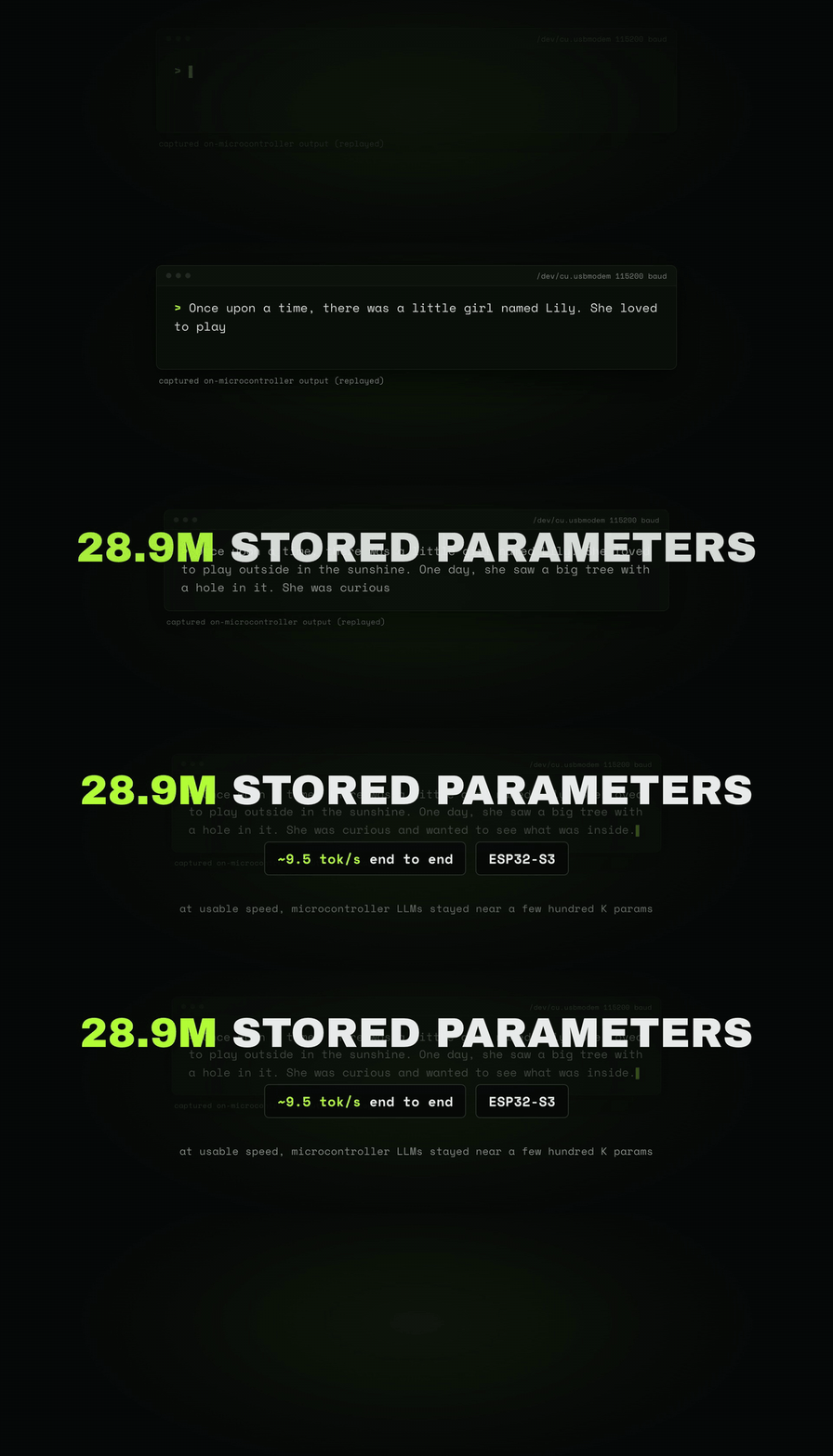 A 28.9M-parameter model generating
text in real time on an ESP32-S3’s display.
A 28.9M-parameter model generating
text in real time on an ESP32-S3’s display.