Josse-posten

Ninth night over Iran, a third American dead and Brent past $90 — while in Moscow Oblast the warehouses burn and in a corner of algebraic geometry an 85-year-old conjecture quietly collapses.

US–Iran War, Day 9: Third US Soldier Killed as Iran Vows “Not a Single Drop” Through Hormuz

A US service member was killed in northern Iraq during a controlled detonation of a downed Iranian drone, bringing American military deaths in the conflict to 17. Trump said the ninth consecutive night of airstrikes — hitting targets as far apart as Tabriz and Chabahar — was carried out “in honour” of the dead. The escalation follows Iranian strikes on a base in Jordan that killed two US soldiers, the first direct American fatalities from Iranian fire since the conflict’s opening days, and retaliatory US strikes that Iran says hit an unfinished nuclear power plant.

Iran has vowed that “not a single drop” of oil or gas will pass through the Strait of Hormuz and has stopped two tankers there. Brent crude crossed $90 a barrel, a level not seen in over a year. Maritime traffic through the strait — which carries roughly 20% of global oil trade — has collapsed from around 30 ships a day to eight. Tehran has instructed the Houthis to prepare to close Bab al-Mandeb if the US targets critical infrastructure, and declared permanent Hormuz control an “invincible red line.” The US has reimposed its naval blockade of Iranian ports and formally notified Congress of renewed war; the April ceasefire is effectively dead.

A Trump administration official conceded the mission has increasingly pivoted toward ensuring oil keeps flowing. Democrats are framing the conflict as a “war of choice” with mounting costs and no credible endgame. Iran’s Revolutionary Guard separately claimed Jordanian troops helped guide an attack on a US base — an allegation that, if confirmed, would mark a serious rupture in Washington’s alliance with Amman. (Tehran’s internal fractures covered in Investigations.)
Drones Reach Moscow Again as Russia Burns Two-Thirds of Its Annual Zircon Output in 19 Days

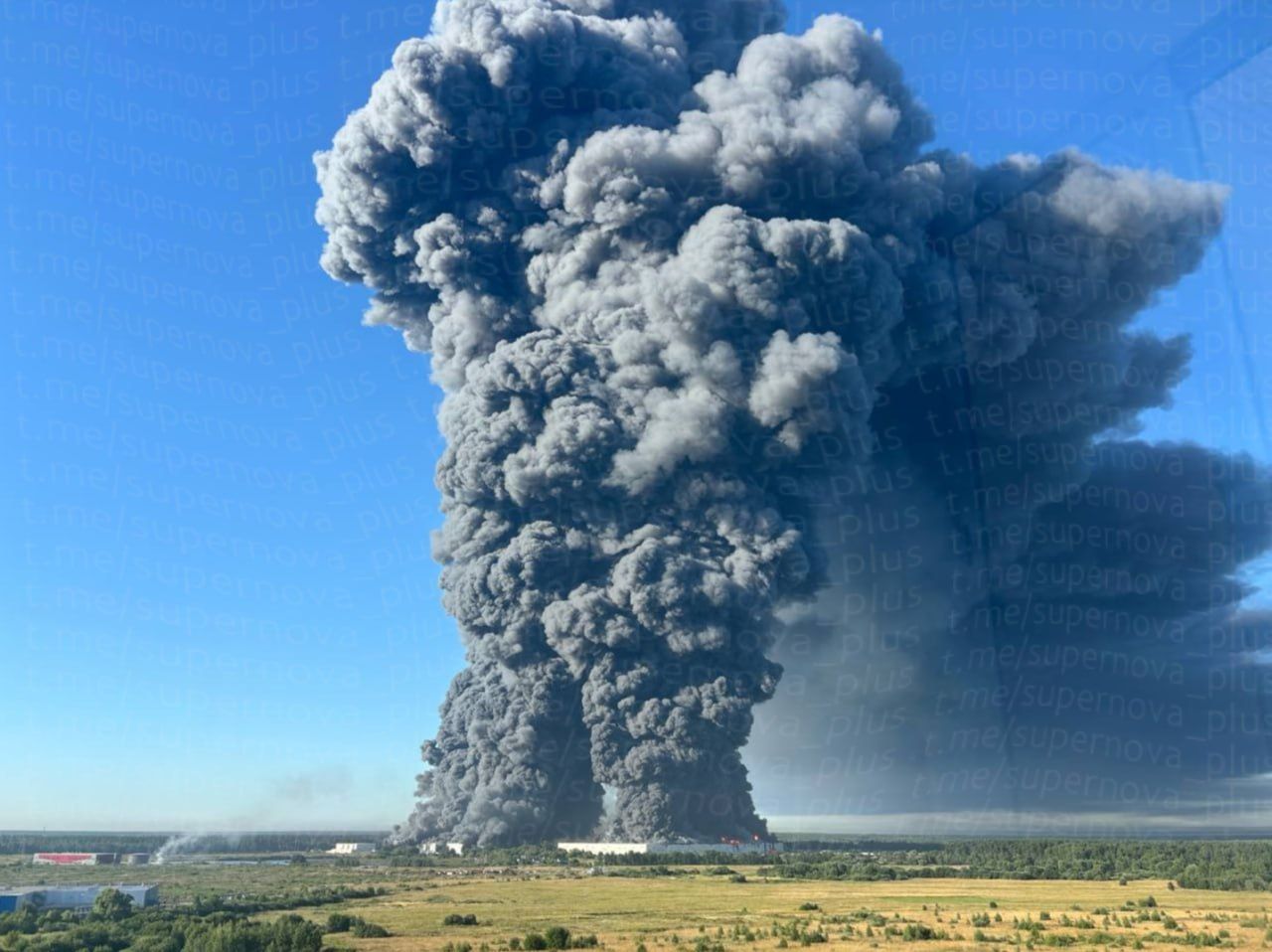
Strike damage at a Wildberries fulfillment centre in Moscow Oblast after a Ukrainian drone attack, 18 July. Photo: Supernova_plus/Telegram

A second consecutive Wildberries logistics centre — this one in Podolsk — burned on the morning of 20 July, as Russian authorities reported over 400 drones targeting Moscow Oblast overnight and fires at oil depots in Noginsk and Podolsk. Ukraine also struck three oil depots in Stavropol Krai, some 600 km from the border, and the Novorossiysk terminal, halting crude loading at the Caspian Pipeline Consortium facility. Le Monde notes Russians are increasingly questioning whether the Kremlin can meet basic needs as the strikes reach further into the country.

The exchange is a stockpile war. Russia’s latest assault — 41 ballistic missiles and 125 attack drones on Kyiv and other cities, killing at least six — is part of a pattern ISW reads as deliberate drawdown: Russia fired more ballistic missiles in July than it produces in a month, and has consumed two-thirds of its estimated annual Zircon production in 19 days, betting on exploiting global Patriot interceptor shortages. Nightly drone volumes have simultaneously halved (2,955 so far in July against 5,749 for all of June) — a shift toward harder-to-intercept ballistic weapons at the cost of reserve depth. Zelenskyy said ballistic missiles are what sustains Putin’s belief in the war.

Andy Burnham Becomes UK’s Sixth Prime Minister in a Decade

Burnham was formally appointed Prime Minister on Monday, visiting the King and beginning cabinet appointments the same afternoon. The former Manchester mayor, long identified with England’s north–south class divide, pledged to “rewire Britain” and promised to move faster than his predecessor Keir Starmer. He immediately dropped the digital ID scheme as a signal of priorities, and will face early pressure on the cost of living. His ascent marks a significant leftward shift inside Labour and a generational break in the party’s leadership.

Fable Produces the First Known Counterexample to the 85-Year-Old Jacobian Conjecture

Claude’s frontier model has produced an explicit counterexample to the Jacobian Conjecture — Smale’s Problem #16 on his 1998 list of challenges for the 21st century, alongside P vs NP and the Riemann Hypothesis. The conjecture, open since 1939, holds that any polynomial map with a constant nonzero Jacobian determinant must have a polynomial inverse. Fable found a degree-7 map ℂ³→ℂ³ — ((1+xy)³z + y²(1+xy)(4+3xy), y + 3x(1+xy)²z + 3xy²(4+3xy), 2x − 3x²y − x³z) — with Jacobian determinant −2 that sends three distinct input points to the same output.

The result came via Princeton’s Levent Alpöge (a student of Fields Medalist Manjul Bhargava), was announced on X during the World Cup final, and has been verified with a formal Lean proof and independently confirmed by multiple frontier models. It is checkable with basic computer algebra. The most striking detail is the degree: computational searches in the 2000s and 2010s targeted degree-100+ polynomials and found nothing, on the estimate that any counterexample would have to be enormous. A 1997 grad student with a three-day computer search could, in principle, have found this one first.

Indicator Value Change
S&P 500 (f) 7,516.25 +0.25%
Dow 30 (f) 52,446 +0.14%
Nasdaq (f) 28,909 +0.47%
Russell 2000 (f) 2,979.5 +0.20%
VIX 18.53 −1.28%
Gold 4,022.10 +0.08%
BTC $64,139 −0.83%
EUR/USD 1.1447 +0.18%
USD/NOK 9.63 −0.15%
  • US equity futures and the VIX show little sign of stress despite the ninth night of Iran strikes and Brent crossing $90 on Hormuz blockade threats — risk gauges are muted rather than pricing the escalation.

World

Ben-Gvir Leads March to Gaza Border Demanding Settlements; Settlers Burn West Bank Mosque

Far-right National Security Minister Itamar Ben-Gvir joined hundreds of pro-settler marchers at the Gaza border under the slogan “After 21 years, we’re returning home” — the most explicit political push yet to resettle Gaza after the 2005 withdrawal. In a separate overnight incident, Israeli settlers were accused of burning and vandalising a mosque in the West Bank. Together the events reflect the accelerating push by far-right factions, including ministers holding cabinet positions, to physically reshape the occupied territories while the war continues.

NYC Mayor Mamdani Explores Whether He Can Arrest Netanyahu

New York City Mayor Zohran Mamdani told the New York Times he is in “active conversation” with the city’s law department about whether his administration can arrest Israeli Prime Minister Benjamin Netanyahu should he visit New York, as expected for UN engagements. Mamdani called Netanyahu a “war criminal.” Any arrest attempt would collide with federal authority and diplomatic immunity, but the statement from the mayor of America’s largest city marks an escalating fracture between the Trump administration’s Israel policy and parts of the domestic Democratic base.

Belgium Bans Imports from Israeli Settlements

Belgium’s parliament approved a ban on goods from Israeli settlements in the occupied West Bank — one of the most concrete unilateral trade measures taken by an EU member state over settlement activity. The move is likely to face legal scrutiny over WTO rules, but signals a hardening political consensus in Western Europe and may encourage similar action elsewhere.

Cuba’s Most Prominent Dissident Arrives in US After Five Years in Prison

Luis Manuel Otero Alcántara, the performance artist and activist who became the symbolic face of Cuba’s July 2021 uprising, arrived in Miami after serving five years in prison — released on condition that he leave Cuba permanently. His exile continues a pattern of Havana emptying its prisons of prominent dissidents through forced departure rather than rehabilitation, hollowing out the domestic opposition ahead of any future political opening.

BBC · NPR

ICE Mandates Body Cameras After Two Killings; Houston Protests Demand Accountability

Trump’s “border czar” Tom Homan announced ICE will require officers to use body cameras during vehicle stops, a response to scrutiny after federal agents fatally shot two men in six days. In Houston, hundreds rallied to demand justice for Lorenzo Salgado Araujo, a 52-year-old Mexican man killed by ICE. The mandate falls well short of the broader accountability and de-escalation measures protesters are demanding, and does not cover all the enforcement contexts in which the recent killings occurred.

Brazil’s Military Takes on Illegal Gold Mining Deep in Amazon Indigenous Lands

Brazilian federal forces are operating against illegal mining settlements embedded in protected indigenous territories in the Amazon, including the Yanomami territory. The Guardian’s on-the-ground reporting describes “total devastation”: networks of jerry-built settlements, supply chains and associated trafficking entrenched over years of impunity. Miners have proved resilient against prior enforcement drives, raising the question of whether the current operations can achieve lasting removal.

Extreme Heat Is Now a Poverty Trap for India’s Outdoor Workers

New research finds India’s outdoor workers are losing up to 9% of their income to heat-induced productivity losses, with extreme temperatures functioning as a “poverty multiplier” that compounds existing deprivation. As extreme heat days multiply, day labourers with no paid sick leave and no cooler alternatives face a structural double bind: work through dangerous conditions, or forfeit income they cannot afford to lose.

Syria Removed from US Terror Blacklist After 47 Years

The US has taken Syria off its state sponsors of terrorism list, a designation held since 1979, removing a major barrier to foreign investment and the international banking access reconstruction requires. The move follows the fall of Bashar al-Assad’s government. Broad US bilateral sanctions remain and Western governments are still cautious about the new administration’s character, but the delisting is a significant step toward economic normalisation.

Spain Win the 2026 World Cup, Beating Argentina 1-0 in Extra Time

Spain claimed their second World Cup, defeating a 10-man Argentina 1-0 in extra time at MetLife Stadium, Ferran Torres scoring the only goal. The tournament co-hosted by the US, Canada and Mexico closed with Trump attending the final alongside FIFA president Gianni Infantino — both booed by the crowd at the trophy presentation. The win makes Spain the first nation to hold the men’s and women’s World Cup titles simultaneously.

Also today

  • Canada barred entry to foreign nationals who have recently visited the DRC over a disease outbreak — against explicit UN advice that travel bans stigmatise affected populations and discourage transparent data sharing — Reuters · r/worldnews
  • A ferry sank off Guyana with 133 aboard; 67 rescued including 15 children, dozens missing. A criminal investigation opened after the passenger list proved inaccurate, complicating the search — The Guardian · BBC
  • The WTA will require all female players to take a one-time test for the SRY gene as a condition of tour eligibility; critics say it reduces the biology of sex to a single marker and raises privacy and medical-ethics questions — Al Jazeera

Ukraine

Frontline: Novopavlivka Liberated; Kerch Ferry Capacity Collapses to 25%

The Russian ferry Maria under drone attack. Photo: Robert Brovdi, commander of Ukraine’s Unmanned Systems Forces

Ukrainian forces have likely liberated Novopavlivka and advanced 9–10 km into the southern Pokrovsk sector, with fighting continuing toward Filiya and along the Dachne road — the most significant confirmed gain in this area in weeks. The two-week maritime drone campaign has simultaneously cut the Kerch ferry crossing to 25% of its prior capacity, after destroying five military ferries that handled 80% of supply runs from Krasnodar to occupied Crimea. Eight Crimean electrical substations were struck overnight, continuing the island-isolation strategy.

Operation Molochka: 172 Shadow Fleet Vessels Struck in Two Weeks

Oil tankers near Novorossiysk, Russia. Photo: Getty Images

Ukraine’s Unmanned Systems Forces have struck 172 Russian vessels in the Black Sea and Sea of Azov in under two weeks as part of Operation Molochka — shadow fleet tankers, cargo ships, ferries and support vessels servicing Crimea. Zelenskyy announced three further shadow fleet tanker strikes alongside hits on oil depots in southwestern Russia. The “Middle Strike” campaign is turning Crimea from a Russian strategic anchor into a logistical liability; Russia has reportedly begun diverting its best drone units from offensive operations in Ukraine to defensive coverage of Crimean shipping.

Russia Kills 10 Sailors on a Civilian Grain Ship near Odesa

The civilian bulk carrier GOLDEN LEO after being attacked in the Black Sea, 19 July. Photo: Ukrainian Navy

Russian forces struck the Guinea-Bissau-flagged bulk carrier GOLDEN LEO with Kh-59/69 missiles as it transited near Odesa on 19 July, killing 10 crew. In parallel, a Russian guided bomb strike on Zaporizhzhia city killed three people — including an 11-year-old girl — and injured 41, while a separate FPV drone strike destroyed a Red Cross vehicle in Vilnyansk. The attacks continue a pattern of targeting civilian and humanitarian infrastructure alongside military objectives.

The Syrskyi Crisis Crystallizes: Commanders Close Ranks, Fedorov Offered a Tech Portfolio

Protesters gather in central Kyiv on 17 July demanding the dismissal of Commander-in-Chief Syrskyi. Photo: Getty Images

Ukraine’s Navy and Air Assault Force commanders publicly endorsed General Syrskyi as nationwide protests calling for his dismissal entered a third day. Zelenskyy’s office is simultaneously exploring a “miltech czar” role for former defence minister Mykhailo Fedorov — coordinating military technology development independently of the defence ministry — a move that would split the weapons portfolio rather than simply replace the commander. Zelenskyy signalled “key conversations” for 20 July after meeting both men, leaving the command structure’s future unresolved but pointing toward restructuring rather than a straight dismissal.

The crisis began with Fedorov’s dismissal after an escalating conflict with Syrskyi, who allegedly demanded he stop pushing institutional reforms or step aside. Fedorov — Ukraine’s youngest-ever defence minister and the architect of its drone and digital warfare capability — refused a ceremonial advisory role and went public, crediting himself with launching sea and long-range drones, the Delta targeting system and the Unmanned Systems Forces, and blaming Syrskyi for blocking reform. Successor Ihor Klymenko brings mobilisation expertise but lacks tech instincts. EU Commissioner Kubilius voiced concern. At risk: competitive procurement reform, Drone Deal partnerships, FREYJA missile defence, and 2027 funding plans.

Investigations

Iran’s Ruling Establishment Fractures: Who Has the Authority to Choose War or Peace?

The renewal of US strikes has exposed fissures inside Iran’s power structure that go beyond the familiar reformist–conservative split. This is now a dispute over who controls the decision between war and diplomacy. Hardline Paydari Front factions treat any concession as treason; even veteran conservatives now back diplomacy as “a continuation of war.” The foreign minister was reportedly pelted with stones at Khamenei Sr.’s funeral, and campaigns have emerged demanding punishment of the president and National Security Council members. The struggle has become an open challenge to the Islamic Republic’s formal decision-making hierarchy — making it harder for any foreign government to know which signals from Tehran represent actual state policy.

The new Supreme Leader, Mojtaba Khamenei, issued his first major statement since succeeding his father, declaring US presidential signatures “valueless and invalid” and demanding strict domestic unity. The aggressive framing signals continuity in Iran’s hardline posture toward the West and the Axis of Resistance — but the call for unity itself reveals anxiety about internal cohesion at a moment of acute crisis. Meanwhile the regime hanged two more protesters, Erfan Esfandiari and Gol Mohammad Mohammadi, bringing the total executed since January to 23.

Trump’s Four Terrible Options with Iran — All of Them Bad

The Atlantic’s Brynn Tannehill lays out the strategic dead ends. One: stay the course with air strikes — which hasn’t moved Iranian demands and mirrors the Vietnam escalation failure. Two: destroy electrical, water and oil infrastructure to make life unlivable — which risks devastating Iranian retaliation on Gulf state infrastructure the US cannot fully defend. Three: declare victory and go home — but Tehran already tore up the last memorandum of understanding. Four: a ground invasion. Iran allegedly plotted to assassinate Trump via the Qatar-gifted 747; Trump floated a 20% Hormuz transit toll before backing down. Infrastructure strikes are the sharpest instrument available and also the one that opens an escalation trap leading to Gulf-wide catastrophe.

Iraq and Syria Sign Deal to Restore Oil Pipeline as Hormuz Bypass

With Hormuz maritime traffic collapsing, Iraq and Syria have agreed to restore an oil pipeline providing an alternative land-based transit route, reducing regional dependence on the increasingly contested strait. The deal marks a shift in regional energy geopolitics as the conflict disrupts Gulf flows and producers scramble for alternatives.

Baltics and Poland: Intelligence Shows Russia Planning Attacks on Critical Infrastructure

Lithuania’s president says intelligence assessments confirm Russia is planning “limited kinetic operations likely targeting critical infrastructure” — electricity and transport systems in Lithuania, Latvia and Poland. Latvia’s president warns Russia may “indirectly test Article 5” as Ukrainian battlefield pressure intensifies, and describes the next 12 months as crucial for Baltic security. Separately, the OPFOR weekly reports the Russian FSB attempted to bring down part of the Polish power grid in December 2025, prompting new EU sanctions.

A Council on Geostrategy analysis details how China’s People’s Armed Forces Maritime Militia has scaled up: in December 2025 and January 2026, more than 2,000 and 1,400 Chinese fishing boats respectively formed barriers in the East China Sea stretching 200–290 miles. The “cabbage strategy” — fishing vessels swarming a target while the PLA Navy and Coast Guard provide outer deterrent layers — deliberately exploits the distinction between combatants and non-combatants under international law, staying below the armed-attack threshold that would trigger Article 51 self-defence rights. Analysts read the scale of the recent mobilisations as rehearsal for future contingencies, particularly around Taiwan.

Trump’s Arctic Territorial Demands Are Fracturing NATO’s Northern Defense

A Foreign Affairs analysis finds Trump’s push to control Greenland and other Arctic territory is causing Canada and Europe to orient their defences against the US rather than alongside it — precisely as Arctic security demands attention. China is actively mapping the Arctic seafloor and expanding its icebreaker fleet; Norway recently arrested a Chinese national on espionage charges near a satellite ground station in the far north. Arctic infrastructure funding risks being crowded out by Iran, Ukraine and the South China Sea, while US scientific and security priorities in the region remain misaligned.

Also today

  • Vadym Yermolaiev, victim of a parcel bomb attack in Monaco, says he has “no doubt” Ukrainian military intelligence officers carried it out — video was released publicly last week — The Times · r/geopolitics
  • Russia is luring citizens of Botswana to Ukraine’s front lines with fraudulent employment contracts, at what Ukrainian monitors call an alarming rate — mirroring documented recruitment of Nepalese, Indian and Central Asian workers — United24 Media · r/worldnews
  • German lobbyists and former politicians are meeting Putin associates in back-channel talks, worrying European allies who see a quiet Russian rehabilitation campaign running outside official channels — The Times · r/geopolitics

Tech

Chat Control 1.0 Passes EU Parliament — Without a Direct Vote

The European Parliament passed Chat Control 1.0, a regulation requiring platforms to scan private messages for child sexual abuse material, by attaching it to a broader vote rather than debating it independently — a procedural manoeuvre critics call a back-door bypass of democratic scrutiny. Cryptographers and civil liberties organisations warn the measure fundamentally undermines end-to-end encryption by mandating client-side scanning, creating infrastructure that could be repurposed for broader surveillance. The regulation creates binding obligations for messaging platforms operating in the EU.

A 1-Million P-Bit Probabilistic Computer, Built Across 18 FPGAs

Eighteen FPGAs wired together in a rack to create the largest p-bit machine built to date. Photo: IEEE Spectrum
Researchers have demonstrated the largest probabilistic computer to date: 18 FPGAs networked together to implement one million probabilistic bits flipping stochastically at over a trillion times per second. Unlike quantum computers, p-bit machines exploit tunable noise to solve optimization problems at room temperature. The key advance is a synchronization scheme that works without global lockstep across chips, removing the main barrier to scaling. The result is a general-purpose programmable machine for stochastic optimization — route planning, combinatorial search — that the team says can be extended to arbitrary size.

AI Data Centers Drive Eminent Domain Land Seizures

US power utilities are invoking eminent domain to force landowners to sell easements for transmission lines serving AI data centers. States including Georgia and Pennsylvania grant utilities broad seizure authority under the Fifth Amendment — even though 70% of Americans oppose building data centers in their communities. With 3,000+ centers operating and 1,500 more planned, consuming over 4% of national electricity, courts in Michigan, Ohio and Oklahoma have begun drawing stricter lines against seizures that primarily benefit private economic development. The legal challenges will hinge on whether AI compute infrastructure qualifies as genuine “public use.”

Fortune · HN

NixOS Home Server Rebuilt Smarter After a microSD Failure

A detailed writeup on surviving the classic Raspberry Pi failure mode: years of constant writes killed a microSD card during a power outage. The rebuild is a solid NixOS homelab pattern — btrfs RAID1 across two external HDDs, zram swap, journald logging to RAM only, atime disabled, and per-service btrfs subvolumes managed by a custom NixOS module. restic backups to S3 cover critical services like Immich. Because the configuration is declarative, the entire rebuild was reproducible from config.

Five CLAUDE.md Patterns That Actually Hold After 18 Months on a 200k-Line Codebase

A developer running Claude Code against a 200k+ line TypeScript monorepo (NestJS + Next.js) for 18 months and roughly 40 CLAUDE.md rewrites reports what survived. One: architectural “never cross” rules stated as explicit prohibitions rather than descriptions — “never import from X in Y” outperforms paragraphs explaining layering. Two: “grep before you write,” a single instruction that stops the model reimplementing existing utilities by defaulting to training data. Three: file references instead of prose — "for error handling, see src/shared/errors/http-error.ts — follow that shape exactly" beats two paragraphs describing the pattern. Four: a short session-start checklist (read package.json, nearest files, existing tests) rather than a 3,000-word wiki the model skims and ignores. Five: a standing instruction to flag uncertainty before coding, which converts confident wrong changes into explicit checkpoints.

Runaway Sub-Agent Cascade: 166 Agents, 5 Layers Deep, on a Simple Code Change

A developer using GPT-5.6 SOL with the official code-review plugin in Claude Code watched 166 sub-agents fan out five levels deep to review a trivial change, burning a week’s usage quota in 15 minutes. The root cause: the plugin was invoked by the main model, which triggered sub-agents, each of which invoked the plugin again recursively. There was no loop-detection guard anywhere in the chain. It is a concrete instance of the failure mode agentic frameworks need to handle — tool calls that are valid at any single level become catastrophic when the tool itself spawns more agents with the same tool available. Rate limiting and call-depth caps are not optional in production agentic setups.

Claude Code Hooks Are Powering a Wave of Physical Ambient Status Lights

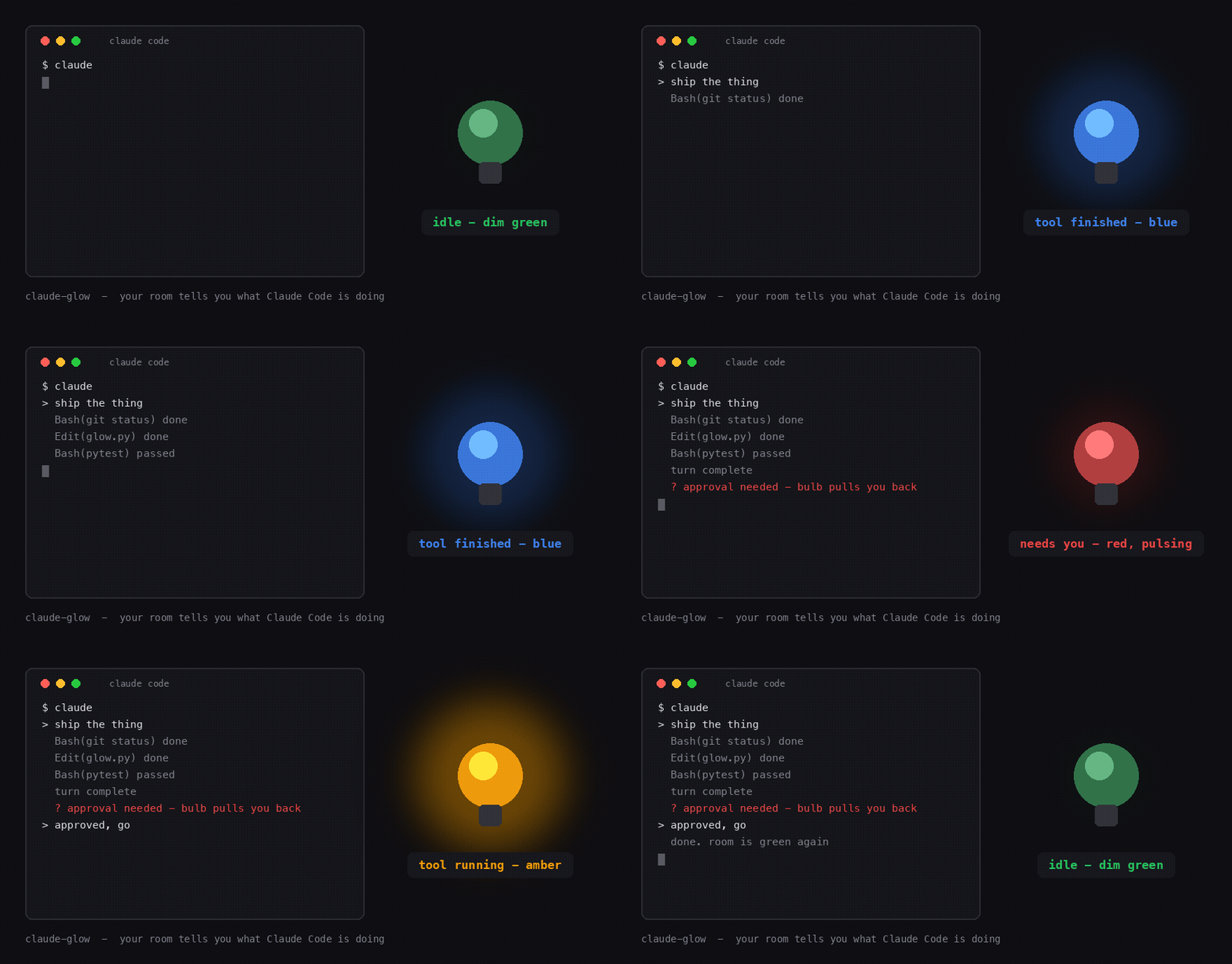
A smart bulb cycling through colour states in sync with Claude Code activity. Demo: claude-glow

The claude-glow project wires Tuya/Halonix smart bulbs to Claude Code hook events over LAN, with no cloud round-trip after setup: amber on PreToolUse, blue on PostToolUse, dim green when idle, pulsing red when awaiting approval. The pulsing red is the practical payoff — you can leave a long agent run and be physically summoned when input is needed. It has become a pattern: XDA Developers covered a broader trend of traffic lights and LED strips wired to PreToolUse, PermissionRequest and Stop hooks, with setups running for as little as $5. The hook system exposes every state transition Claude Code makes, and physical feedback is emerging as a legitimate ambient interface for long-running agentic sessions.

The “Just Review the AI Code” Safety Argument Doesn’t Hold

An essay makes the case that “humans will review AI-generated code” is not a viable safety net: human review doesn’t catch all bugs even for carefully-written code, AI code introduces subtler and less familiar failure modes, and the volume pressure of AI output degrades review quality over time. The argument isn’t against AI coding tools — it’s that the review-as-backstop assumption is unexamined and fragile, and teams should be honest about what they are actually trading off.

Dependable C: A Conservative, Portable Subset for Long-Lived Code

Dependable C documents a practical C subset prioritising cross-compiler portability and long-term reliability over language-feature richness. It covers undefined behaviour clearly, establishes reasonable assumptions (8-bit bytes, ASCII source) without being overly restrictive, and targets the middle of the road — only two implementations support C23 and C2Y. Explicitly modelled on the philosophy of SQLite and curl: code that should still compile and work correctly in decades.

Microsoft Uses Proprietary Document Formats as a Lock-In Weapon

The Document Foundation argues Microsoft’s format strategy is deliberate: OOXML’s complexity and undocumented extensions make third-party interoperability practically impossible, while the cleaner “Strict” OOXML variant that others could implement has been quietly dropped from Office. The result is that a format used by hundreds of millions can only be rendered correctly by Microsoft’s own software — with real consequences when government contracts, legal filings and hospital forms render differently across applications.

Also today

Dev tools
Gleam has mirrored its source repository to Tangled, a Git forge built on the AT Protocol — federation rather than self-hosting as the resilience strategy against GitHub lock-in — Lobsters
bedctl, a CLI for the Sleep.me Chilipad water-cooled mattress topper, written in Zig with zero external dependencies and a ~75ms compile — structured as a library with a thin CLI wrapper for future FFI reuse — tinkering.xyz · Lobsters
Moonshine is a headless Linux game streaming server in Rust for Moonlight clients, running each stream in its own isolated compositor rather than capturing the host desktop — so the host stays usable and no monitor is needed — GitHub · HN
A practical walkthrough of replacing a consumer router with MikroTik — VLAN segmentation, firewall rules, DHCP/DNS and RouterOS tuning — justsomebody.dev · HN
Hardcore IndieWeb: hand-authored HTML over SFTP to NearlyFreeSpeech.net, no CMS, no generator, ~$0.01/day — the case that simplicity is the only reliable form of data sovereignty — neatnik.net · Lobsters
AI
A Kaggle thread presents evidence that the winner of DeepMind’s $25K “Measuring Progress Toward AGI” competition — for designing novel cognitive-science-based benchmarks — was nonsensical AI-generated content, and that the judges rewarded it anyway — Kaggle · r/MachineLearning
A Claude Code skill routes bulk implementation to cheaper LLMs while Claude handles decomposition, interface contracts, acceptance tests and final judgment — tests decide acceptance, each slice runs in an isolated worktree, and slices touching files outside their declared scope are rejected even if tests pass — GitHub · r/ClaudeAI
Physicist Yuji Tachikawa’s team reportedly spent six months stuck on a string theory problem before Fable supplied a key insight and SymPy verification code. Unverified — no preprint, no notebook, no collaborator confirmation — treat as anecdote, though it tracks with the week’s Jacobian result — ExplainX
Hardware & CS
An SRE who owns an 8-lane rural bowling center replaced its $120,000 proprietary scoring system with ESP32s, ESPNow mesh (RS485 fallback), a Raspberry Pi running Redis and a React/WebSocket frontend, at ~$200 per lane pair. After reverse-engineering the pinsetter, the entire commercial complexity reduced to triggering a single relay — HN
Harvey and Hoeven’s 2019 O(n log n) integer multiplication improved on decades of prior work, but nobody knows whether it’s optimal — whether multiplication can be done in linear time remains open, with connections to circuit complexity lower bounds — Scientific American · Lobsters

Long COVID & ME/CFS

Simmaron Rapamycin Phase II: Viral-Onset ME/CFS Responds Better; Purine Metabolism as Mechanism

The Simmaron/multi-center Phase II observational study (Gile, Kaufman, Gottschalk, Roy et al.) is now published in the Journal of Translational Medicine. The key new contribution over the Phase I pilot is a viral-onset subgroup analysis: participants with viral-triggered ME/CFS — explicitly including Long COVID patients meeting ME/CFS criteria — showed superior outcomes compared to non-viral-onset cases.

The mechanistic data is also new. LC-MS/MS metabolomics in responders shows rapamycin inhibits IMPDH, blocking the IMP→XMP branch of purine biosynthesis; elevated purine intermediates are linked to impaired mitochondrial energy metabolism and microglial inflammatory signaling, which rapamycin appears to reverse.

The study remains uncontrolled — no placebo arm — and the title itself says “pilot findings” from Phase II, so the two blinded RCTs (Mount Sinai NCT06257420, Simmaron NCT06960928, both reporting November 2026) remain the definitive tests. The viral-onset finding is the only signal here that directly changes how to read the uncontrolled data.

Tracking

Reporting 2026
ADDRESS-LC (bezisterim, BioVie, n=200) — fully enrolled May 2026; topline still expected Q3 2026; no data yet
RESILIENCE (ensitrelvir prevention, Japan, n=2000) — data collection completed June 2026; results expected Dec 2026
REVERSE-LC (baricitinib Phase 3) — recruiting, 550 adults; cognition data Nov 2026
Rapamycin Phase 2 RCTs (Mount Sinai NCT06257420, Simmaron NCT06960928) — both blinded, results Nov 2026
Sipavibart RCT (Klimas/NSU, n=100) — primary completion Dec 2026
ANKTIVA INTERRUPT_LC (UCSF, n=20) — ongoing to Oct 2026
Overdue or unpublished
ANKTIVA COVID-4.019-Long (Chan Soon-Shiong, n=40) — completion date was July 2026; no results released
RECOVER-AUTONOMIC IVIg arm (Gamunex-C) — full paper “expected in coming months” per the June 2026 RECOVER update; still not published
Larazotide (AT1001, Harvard/Moschovis) — positive interim signals at PolyBio May 2026; data collection ongoing
Locci/Penn GC B cell dysregulation and Brodin/Karolinska WGS in severe LC — both presented at PolyBio May 2026; no preprints yet
Longer horizon
ResetME (daratumumab RCT, Haukeland) — recruiting; facing a funding gap; results ~2027
TURN-Long COVID (IA, Amsterdam UMC) — recruiting; results Dec 2027
EXTINCT post COVID (IA, MHH Hannover) — enrollment complete; results pending
cd ~/repos/josse-posten && claude --resume c0fec352-f072-443c-8620-b7e16b38ce3c