Josse-posten

Day seven of the US–Iran war spreads to Gulf water plants and shipping lanes; Ukraine burns Moscow’s fuel while Russia’s markets buckle; and Nigel Farage, Andy Burnham and a European heatwave round out a heavy Saturday.

US–Iran War, Day 7: Strikes Reach Civilian Infrastructure as Kuwait Is Hit and Tehran Declares Talks Over

The US launched a seventh consecutive night of strikes on Iran, expanding the campaign to bridges, energy facilities and the port of Bandar Khamir — killing at least seven people at bridge strikes in the southern city. Central Command said attacks hit “surveillance sites, military logistics infrastructure, underground weapons storage, and maritime capabilities”; Iranian state media confirmed hits on railway stations and an airport near the Pakistan border, and US strikes reportedly left 10,000 Iranians without water in the south. International law experts warned that deliberately targeting civilian infrastructure may constitute war crimes under the 1949 Geneva Conventions.

Iran answered by firing on Bahrain, Qatar and Kuwait, striking a Kuwaiti power and water desalination plant — the most alarming escalation yet, exposing the Gulf’s water infrastructure as a new front. Senior official Mohsen Rezaee warned that continued bombing would draw Tehran into “full-scale war” and declared that “the policy of negotiating during war is over,” closing off any near-term diplomatic exit. Shipping through the strait fell to a three-week low of eight vessels; Trump told Americans Thursday the US is “winning big.” A leaked US intelligence report concluded Iran still retains 70% of its pre-war missiles and launchers. (Maritime fallout — piracy and a new pipeline — covered in World.)

Ukraine Burns Moscow’s Fuel as Russia’s Markets Hit 2022 Lows

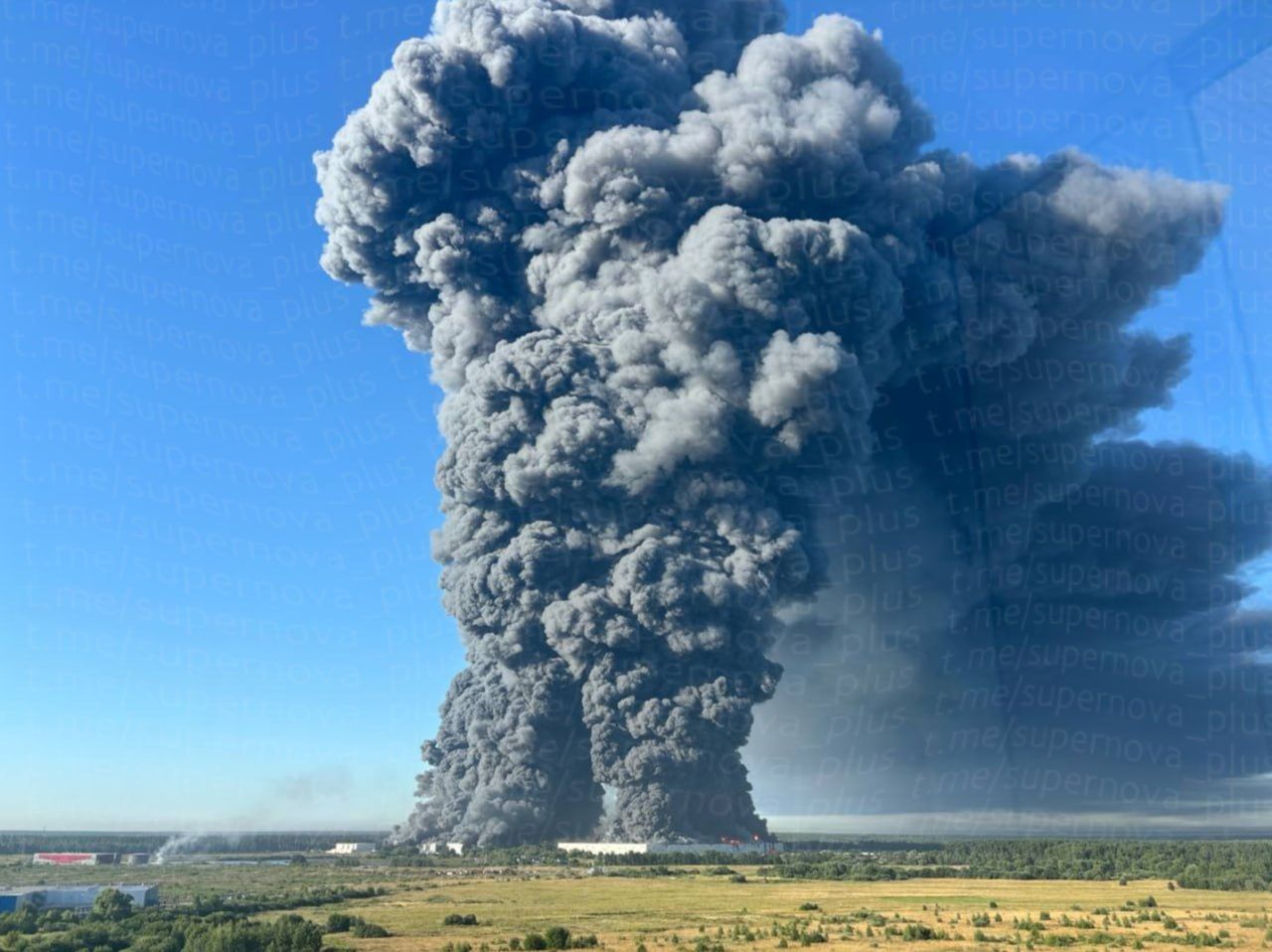
Fires burning at an oil depot in Noginsk, Moscow Oblast, roughly 50 km from the Kremlin. Photo: Kyiv Independent

Overnight July 17–18, Ukraine mounted its largest drone assault yet on the Moscow region — striking an oil depot in Noginsk, 50 km from the Kremlin, and a Wildberries logistics warehouse in Elektrostal, injuring 24. Moscow authorities claimed 370 drones were launched toward the capital, 64 intercepted. Ukraine also confirmed a Tu-95 strategic bomber at Engels airbase — 800 km away — had its tail torn off; analysts estimate Russia now operates only about a dozen Tu-95s regularly and cannot replace them.

The economic reckoning is arriving in parallel. The Moscow exchange fell 4.24% on July 16 — the steepest single-day drop since September 2022 — and sank further to 1,958 points on the 17th; VTB shares hit an all-time low, and reports indicate the Finance Ministry can no longer obtain credit. ISW attributes the deterioration to structural causes — unsustainable war spending, labour shortages, sovereign wealth fund depletion — compounded by the refinery strikes. (Maritime campaign, frontline and protests in Ukraine.)

Indicator Value Change
S&P 500 7,457.69 -1.01%
Dow 30 52,146.42 -0.77%
Nasdaq 25,520.24 -1.40%
Russell 2000 2,962.22 -0.42%
VIX 18.77 +12.19%
Gold 4,018.80 +0.67%
BTC $63,955.60 +1.89%
EUR/USD 1.1440 +0.01%
USD/NOK 9.6472 0.00%
  • VIX +12.2% and equities broadly lower as the US–Iran war escalates — Iran hit a Kuwaiti desalination plant and a senior official declared negotiations “over” (see World)
  • Gold +0.67% — safe-haven bid alongside the selloff and continued Strait of Hormuz shipping disruption

World

Piracy Returns to the Gulf of Aden: Second Tanker Seized Near Yemen in Three Months

Suspected Somali pirates have seized an oil tanker off Yemen and are steering it toward Somalia — the second such hijacking in three months and part of a broader resurgence, with several additional attempts reported. The comeback is notable given the disruption to Red Sea shipping from the US–Iran conflict and Houthi activity, which may be thinning the naval capacity available for counter-piracy patrols.

Iraq and Syria Sign Deal to Restore Oil Pipeline as Hormuz Bypass

Iraq and Syria have agreed to restore an oil pipeline that would route crude exports around the Strait of Hormuz entirely — a significant strategic response to a conflict that has choked traffic through the strait to historic lows. The move could reduce Iran’s leverage over global energy flows and undercut Tehran’s central demand that vessels pay to transit what it considers its waterway.

Israeli Ministers Announce Settlements in Gaza and West Bank, Breaching Trump Ceasefire Terms

Defence Minister Katz announced plans for three military-settler ‘Nahal’ outposts in northern Gaza — areas held by Israeli settlements before 2005 — while the Finance Minister earmarked more than $400m for West Bank settlement expansion. A senior commander confirmed Israel now controls 65% of Gaza, far beyond the 53% ceiling agreed under Trump’s ceasefire deal. Settlers were photographed Friday building a new outpost near the Palestinian village of Azmut. The EU urged Israel to halt, with growing internal pressure to impose sanctions. Separately, an Israeli airstrike hit a Gaza funeral — killing at least seven mourners and injuring 22 — and Lebanon’s education minister says Israeli forces have now completely destroyed 20 schools in the south, with over 100 more damaged. Colombia’s incoming government, meanwhile, announced it will withdraw from the ICJ genocide case against Israel, reversing the outgoing Petro administration.

Trump Threatens Canada Tariff Hike Over Wildfire Smoke Entering US

With smoke from Ontario wildfires affecting 109 million Americans across the Midwest, mid-Atlantic and Northeast — described as equivalent to “smoking half a pack a day” — Trump threatened additional tariffs on Canada, blaming mismanagement for the fires. Prime Minister Carney pushed back, saying both countries share responsibility to fight the climate change that scientists say is driving worsening conditions. The threat adds a new trade flashpoint to an already strained relationship.

Trump Media to Sell Wall Street a Fast Lane to Market-Moving Posts

Trump Media is launching a paid, expedited feed of Truth Social posts for financial traders — effectively monetising the president’s market-moving communications. The move sharpens conflict-of-interest concerns that have already produced a federal investigation into a White House teleprompter operator over prediction-market insider trading. Critics say it turns presidential statements into a subscription product for those who can afford first access.

European Heatwave Turns Violent; Wildfire Destroys Over 100 Homes Near Drammen

Europe’s record heatwave has spawned extreme thunderstorms, with golf-ball-sized hail reported in French villages — the characteristic but intensified pattern of extreme heat fuelling severe convective storms — while monsoon rains in Bangladesh have turned deadly. In Norway, a major wildfire near Drammen has destroyed more than 100 homes and spread into surrounding forest, with helicopters dropping water; it ranks among the most destructive fires in recent Norwegian history.

Epstein Survivor Speaks: Cult-Like Control, Threats, Disfiguring Surgery

A woman identified only as “Anya” has given the BBC a rare first-person account of life inside Jeffrey Epstein’s network — describing systematic control, threats used to enforce compliance, and disfiguring cosmetic surgery performed on victims. She details how Epstein recruited and manipulated what he called his “assistants,” adding to the picture of the coercive structure of his operation beyond what has emerged in court proceedings.

BBC

Also today

UK & Europe
Trump administration to grant $12m to groups founded by UK Conservatives Jacob Rees-Mogg and Toby Young — Guardian
Farage seeks a parliamentary comeback in a by-election with a record 34 candidates, amid a furious clash with the editor of The Times — Al Jazeera · Guardian: Times clash
Germany’s Jens Spahn (CDU) faces resignation calls after fathering a child via a US surrogate — a practice he backed banning — BBC
EU moves to weaken its own carbon market, drawing fierce criticism that it undercuts the price signal — Guardian · BBC
Americas & immigration
ICE arrested Chinese human-rights lawyer Wu Shaoping in Pennsylvania while his asylum claim was pending; supporters fear deportation — Guardian
ICE illegally shared Medicaid patient data with Palantir, revelations in a federal case show — NPR
Cuban dissident artist Luis Manuel Otero Alcántara cleared to travel to the US after imprisonment — Guardian
China signals it may allow the US to restore Hong Kong’s trade privileges ahead of Xi’s expected visit — NPR
Asia & science
K-pop has penetrated North Korea despite extreme censorship, defectors tell the BBC — an alternative idol to Kim Jong Un — BBC
Indian activist Sonam Wangchuk forcibly hospitalised after a 20-day hunger strike; another activist takes up an indefinite fast — BBC
Skyroot’s Vikram-1 reaches orbit — India’s first commercial orbital rocket launch — BBC
A 7.4-magnitude earthquake struck off the Guatemala–Mexico border; small tsunami waves recorded on the Chiapas coast — BBC

Ukraine

Protests Grow on Day Two; Now the Streets Demand Syrskyi’s Head

A large crowd in downtown Kyiv on the second day of protests against Defence Minister Fedorov’s dismissal. Photo: Kyiv Independent
Second-day protests were substantially bigger, with crowds now explicitly chanting for Commander-in-Chief Syrskyi’s removal — not just Fedorov’s reinstatement. Zelensky said he “hears but doesn’t act.” The anger has spread to active military personnel: soldiers told the BBC Fedorov was dismissed “at precisely the moment Kyiv appeared to be gaining advantages in several spheres.” Journalist Hanna Kalyuzhna published claims of direct evidence that officers close to Syrskyi ordered the use of barrier squads, and reports circulate that Zelensky’s office is discussing his replacement. The reshuffle continues amid — not instead of — the pressure: Poklad is confirmed as acting SBU head, Klymenko proposed for NSDC secretary.

Maritime Campaign Scales: 159 Ships in 12 Days, None Left in the Mediterranean

Ukraine’s Unmanned Systems Forces struck 9–12 shadow-fleet vessels in a single day (July 17), bringing the total to 159 Russian vessels hit between July 6–17 — 117 in the Azov Sea, 42 in the Black Sea. For the first time since 2013, Russia has no ships in the Mediterranean. In occupied Crimea, Ukraine hit a patrol ship, an oil terminal and a fuel depot near Kerch; Sevastopol faces worsening outages, and satellite data shows night illumination across the peninsula has fallen to one-fifth of baseline. AI-guided FP-2 mid-range drones are reportedly now being used for autonomous ship targeting.

Frontline: Russia Netting a Slow Loss in July; Dobropillya the Exception

ISW assesses Russian forces are losing roughly 1.6 sq km of territory per day this month — evidence, it argues, that optimized small-unit motorized tactics are failing to deliver meaningful advances. The exception is Dobropillya, where Russian forces claim entry into Hannivka and Novyi Donbas, and may have infiltrated near Zapovidne. In Lyman, Ukrainian forces report Russia losing the initiative; in Pokrovsk, bypass attempts are repelled, with Russian infantry reportedly forced to march up to 50 km on foot under Ukrainian drone coverage. Moscow’s MoD board confirmed continued commitment to positional grinding over maneuver.

Russia Intensifies Crackdown as Putin’s Approval Slides

Putin’s FOM approval fell a sharp five points to 66% — its biggest weekly drop since the 2022 invasion — amid a domestic fuel crisis, now aligning with the separate VTsIOM figure; state-linked pollsters are acknowledging discontent at a rate not seen since the war began. The Kremlin moved simultaneously to suppress dissent: pro-Kremlin blogger Ilya Remeslo, who had turned critical, was arrested and remanded, while opposition figure Boris Nadezhdin was barred from running for parliament the same day — a coordinated tightening.

  • Andy Burnham confirmed as Labour leader and set to become UK Prime Minister, pledging a government free of Starmer-era infighting — “Labour’s last chance to get it right”; anxiety on the party’s left over his chancellor pick — AP · Guardian

Tech

“The Vibe Bobsled”: Why Reviewing LLM Code Is Structurally Impossible at Scale

Christine Lemmer-Webber coins “vibe sickness” — the ambient malaise of living among plausible-but-incomprehensible outputs nobody truly understands — and “the vibe bobsled” for how developers surrender review agency incrementally: they tell themselves they’ll catch problems, but generation is fast while theory-building and review are the actual bottleneck. A voting-machine study she cites found expert programmers missed critical flaws in code they reviewed. The essay argues developers have quietly normalized non-review by reframing it as acceptable, leaving systems nobody comprehends built on towers of abstract, unowned code.

This lands alongside a notable correction: METR now admits its landmark 2025 finding — that AI tools caused a ~20% slowdown among experienced developers — had severe selection bias. Participants increasingly refused to work without AI, and 30–50% avoided submitting tasks they expected AI to accelerate most (“I avoid issues like AI can finish things in just 2 hours, but I have to spend 20 hours”). The study measured a systematically AI-unfriendly subset of work; METR is redesigning around shorter intensive experiments and observational data. Meanwhile Linus Torvalds endorsed LLMs in kernel development where they produce results — drawing pointed Lobsters commentary that he argued from personal conviction while forbidding it as a basis for argument.

Roc Compiler’s Zig Rewrite Complete: 35ms Builds vs Rust’s 3.4s

After 487 days and ~300,000 lines of Zig, Richard Feldman’s Roc team has reached full feature parity with the original Rust compiler. Incremental build time: 35ms in Zig vs 3.4s in Rust 1.97 (and 10s in Rust 1.85) — roughly 100× faster. A bug-classification audit found 21 memory-corruption bugs in the Rust era vs 10 in Zig, with a key difference: Rust’s bugs were miscompilations that corrupted user programs, whereas Zig’s were confined to the compiler itself. New capabilities include hot code loading and zero-heap-allocation HTTP routing via pattern-matching string interpolation.

Enterprise Haskell at H-E-B: Nearly 1M Lines in Production

Texas grocer H-E-B replaced its largest COBOL mainframe application with Haskell, eventually deploying nearly a million lines across multiple production systems. The type system delivered — whole categories of runtime failure eliminated, refactoring made low-risk — and the GHC runtime never caused a production outage. But advanced type-level patterns (GADTs, tagless final, type families) accumulated over time, consuming engineering budget on plumbing and making codebases harder for newcomers. The cultural lesson: establish “boring Haskell” conventions early, permit principled advanced features only when justified, and hire people genuinely excited about the language.

Freya 0.4: Rust GUI Library Drops Dioxus, Builds Its Own Reactive System

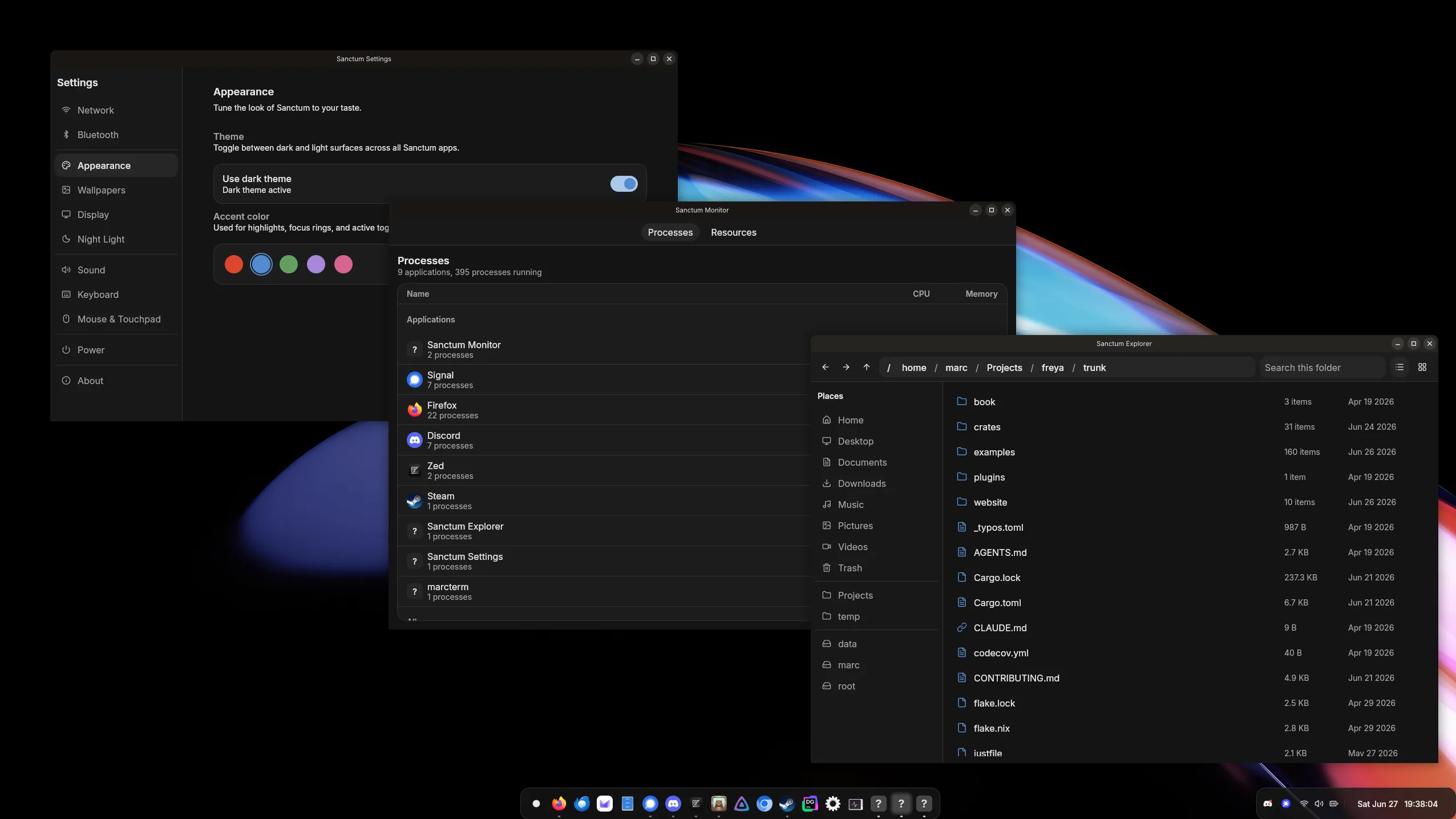
Sanctum, a full Linux desktop environment built entirely with Freya 0.4.

Freya 0.4 is the biggest release yet for this Rust-native GUI library, with a fundamental architectural change: it no longer depends on Dioxus and now has its own reactive and component model. The rsx!() macro is gone, replaced by a typed builder pattern that catches attribute typos at compile time and enables proper IDE autocomplete. The release adds 45+ built-in components, multi-window support, system tray, embedded terminal emulation, experimental WebView and hot-reload, routing, i18n, accessibility and docking panels. Real applications shipping on it include Valin (a code editor) and Sanctum (a full Linux desktop environment).

First Atmosphere Detected on a Habitable-Zone Rocky Planet: LHS 1140 b

Harvard researchers, writing in Science, have detected an atmosphere on LHS 1140 b — a rocky, Earth-sized planet 48 light-years away orbiting a red dwarf in its habitable zone. The gas detected so far is helium (likely the upper atmosphere), which alone wouldn’t support life, but other gases may exist lower down. It’s the first of its kind: prior habitable-zone rocky planets, including TRAPPIST-1 candidates, had no confirmed atmospheres. Lead author Dr Collin Cherubim called it “a big deal” — the first demonstration that rocky worlds in the right zone can hold onto an atmosphere.

BBC · HN

Isomorphic Labs’ Drug Design Engine Doubles AlphaFold 3 on the Hardest Cases

Isomorphic Labs (DeepMind’s drug-discovery spinout) has published IsoDDE, a unified computational drug-design system that surpasses AlphaFold 3 across several dimensions: it more than doubles AF3’s accuracy on the most difficult novel protein–ligand systems, significantly outperforms competitors on antibody–antigen prediction (especially the notoriously hard CDR-H3 loop), predicts binding affinity without experimental crystal structures, and identifies ligandable pockets — including cryptic sites — from amino-acid sequence alone. The system is designed for deployment across real drug-discovery workflows, not just benchmark performance.

Dev tools & systems
Static search trees (S+ trees) hit ~27ns/query vs binary search’s 1150ns on 4GB datasets — cache-line-aligned nodes, SIMD popcount, query batching — curiouscoding.nl · HN
Julia Evans on four years of production SQLite: running ANALYZE dropped a full-text query from 5s to 50ms; the single-writer constraint can cascade into worker timeouts — jvns.ca · HN
AWS publishes the Aurora DSQL architecture — serverless multi-region OLTP whose key idea is deferred coordination: cross-region consistency checks held until commit time — arxiv · Lobsters
Security & curiosities
TP-Link Kasa EC71 cameras broadcast the owner’s precise home GPS over unauthenticated UDP — for roughly six years before disclosure — GitHub · HN
Regressive JPEGs — a single file that renders different images at each scan step as it loads; ~90 DC-only transitions before browsers give up — maurycyz.com · HN
cd ~/repos/josse-posten && claude --resume 2433be16-6921-4b72-b31a-8c0c92686cfd