From
Coder to Curator: Own the Design, Let the AI Write the Code
Two of the day’s most-shared essays land on the same thesis from
different directions. Redis creator Salvatore Sanfilippo (antirez)
argues that as AI generates most code, the developer’s job shifts from
line-by-line review to controlling high-level design — his proposed
primary artifact is a DESIGN.md documenting data structures
and architectural rationale, not the generated lines themselves. André
Staltz, a former skeptic turned “full curator,” reports he “no longer
has to fix the AI pull request” in most cases and draws a historical
parallel to typing: once a profession, now absorbed. Both frame this as
restructuring rather than elimination — architectural understanding
stays essential — and both are uneasy about early-career developers who
still need hands-on coding to build mental models.
A CS Professor’s
Three-Month Claude Code Audit
Amy Ko (UW, 24 years’ experience) offers the sharp counterpoint: ~90%
of tasks worked reasonably well, but the remaining 10% hid serious
problems — performance bugs, wrong assumptions, tests that masked rather
than revealed defects; in extreme cases the tool deleted uncommitted
work unrecoverably. She describes an addictive speed that colonised her
non-work hours, fragmented creative flow into constant permission
interrupts, and left her reviewing unfamiliar code rather than writing
her own. API costs were ultimately what imposed discipline. Her
defensive practices: fully articulate design rationale before handoff,
explicitly interrogate model assumptions, and reserve AI for late-stage
implementation only.
Claude Code’s
24% PR Boost: Microsoft’s Rollout Study
A study of tens of thousands of Microsoft engineers in early 2026
found Claude Code and GitHub Copilot CLI users merged roughly 24% more
pull requests than they otherwise would have — an effect that persisted
across the entire four-month window. Adoption spread through social
networks rather than top-down mandates, and retention correlated with
coding activity rather than demographics. The authors caution that
merged PRs are a proxy that doesn’t capture value delivered, but the
scale and persistence of the finding are notable for anyone thinking
about deployment.
Git’s New
history Command: Fixup, Reword, Split
Git 2.54/2.55 shipped an experimental git history
subcommand with three operations: fixup (stage corrections
to an older commit and rebase all descendants automatically),
reword (update messages without touching the working
directory), and split (decompose a commit into two via
interactive hunk selection). All three refuse operations that would
produce conflicts, keeping the repo in a clean state. The author argues
this closes much of the gap that drives developers toward Jujutsu —
stack management and commit surgery without learning a new VCS.
crates.io:
Source Viewer, RustSec Banners, Auth Decoupling
Six months of crates.io improvements: a source-code viewer now lets
you browse the exact published bytes cargo downloads (including the
normalised Cargo.toml); RustSec integration adds banners
for unmaintained crates and stdlib replacements
(lazy_static now points to
std::sync::LazyLock); GitHub auth is being decoupled with
native crates.io usernames; and the Ember→Svelte frontend rewrite
finished in May. Search ranking now caps at the top 1,000 results by
download count, cutting query times significantly. Plus an eye-tracking
Ferris on the error pages.
Cache-Friendly
Parsers: Indices Beat Pointers
A breakdown of Yuku, a JS/TS parser in Zig running 3–10× faster than
npm alternatives — with the speedup coming almost entirely from memory
layout. Instead of heap-allocating each AST node and chasing pointer
chains, Yuku stores all nodes in flat arrays with 32-bit integer
indices: half the size of pointers, position-independent, freed in a
single arena deallocation. Children use offset-length pairs into a
shared array; strings are zero-copy spans into the source buffer. The
lesson: for cache-sensitive code, data layout is higher-leverage than
algorithmic sophistication.
Estimating
New Yorkers’ Heights from Subway Scuff Marks
A developer noticed the band of scuff marks on the walls of Smith–9th
Street station encodes a human height distribution, and set out to
recover it. Using photogrammetry, luminance analysis, and calibration
against reference dimensions, they extracted a distribution matching NYC
demographic data. A delightful example of inferring population
statistics from unexpected physical evidence — good probabilistic
thinking made concrete.
 A vessel in the Strait of Hormuz,
seen from Musandam, Oman, 13 July 2026. Photo: Reuters
A vessel in the Strait of Hormuz,
seen from Musandam, Oman, 13 July 2026. Photo: Reuters The Coalition of the Willing summit
in Paris, 13 July 2026. Photo: Defense News
The Coalition of the Willing summit
in Paris, 13 July 2026. Photo: Defense News Smoke rising from the Gazprom
Neftekhim Salavat refinery in Bashkortostan after a drone strike. Photo:
Ukrainska Pravda
Smoke rising from the Gazprom
Neftekhim Salavat refinery in Bashkortostan after a drone strike. Photo:
Ukrainska Pravda Metas AI-solbriller, markedsført av
Kylie Jenner. Foto: Meta / Schibsted
Metas AI-solbriller, markedsført av
Kylie Jenner. Foto: Meta / Schibsted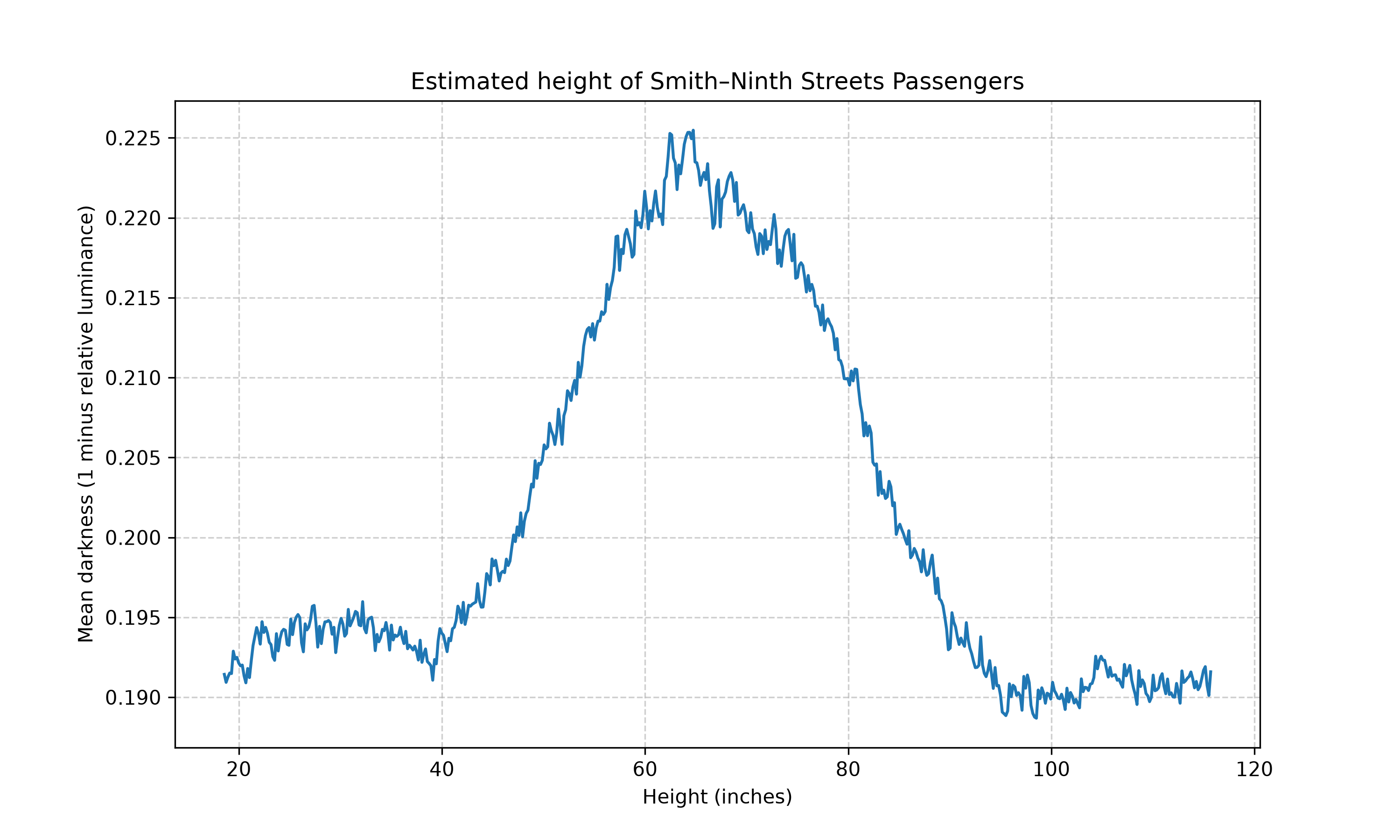 Scaling scuff-mark luminance to
estimate the height distribution of NYC subway commuters. Photo:
blog.jse.li
Scaling scuff-mark luminance to
estimate the height distribution of NYC subway commuters. Photo:
blog.jse.li portwho showing listening sockets,
connections, and per-connection throughput in one screen. Source:
portwho
portwho showing listening sockets,
connections, and per-connection throughput in one screen. Source:
portwho