The Gulf truce breaks and the US strikes Iran again; NATO
convenes in Ankara as Trump renews his claim on Greenland; and Ukraine
leaves no major Russian refinery unstruck — with fuel queues now a daily
fact of Russian life.
US–Iran
ceasefire collapses: strikes escalate into a Gulf-wide crisis
After Iranian forces struck three commercial vessels in the Strait of
Hormuz — which Washington called a “clear violation” of the ceasefire —
the US military launched “powerful” strikes on Iranian missile sites and
command centres. Iran retaliated against what it claimed were “85
military installations” across Bahrain and Kuwait, sending air-raid
sirens across the Gulf, and has since accused the US of itself violating
the peace agreement. A separate report finds one US strike hit an
Iranian school after commanders bypassed warnings that the targeting
intelligence was outdated. The UK and France are deploying a naval
mission to the Strait within days, and the US Treasury has revoked
Iran’s general license to sell oil without sanctions. Brent crude
reversed its recent fall to climb above $76 as shipping risk was raised
to “severe”; Saudi Arabia is in active talks with Gulf neighbours to
expand overland pipeline capacity and bypass the chokepoint
entirely.
At
NATO Ankara, Trump renews the Greenland threat — and lifts Turkey’s
sanctions
Arriving in Ankara, Donald Trump again demanded that Greenland come
under US control, threatening to pull all American forces from Europe if
allies resist: “That’s what hurt my relationship with NATO, because
Greenland doesn’t help Denmark.” The statement at a summit rather than a
rally signals this remains live US policy; Danish PM Mette Frederiksen
replied that Denmark is “ready to defend Greenland.” Trump also lifted
sanctions on Turkey and praised President Erdoğan, with restored F-35
access reportedly on the table — a major concession to the host nation.
Against that backdrop the alliance staged a show of independent
firepower: a new £37bn joint missile programme convened by Keir Starmer,
billions in further arms deals, and a South Korean call for a “defence
industry partnership 2.0.” Canada announced $900M in aid including
significant air defence, the Netherlands said it has exhausted its
direct capacity, and Ukraine’s foreign minister declared Kyiv no longer
seeks outside permission to strike Russian territory. Trump claimed to
have spoken with both Putin and Zelensky on July 6, though neither side
confirmed it.
“No
refinery left unstruck”: Omsk halts as fuel queues spread across
Russia
Russia’s largest oil refinery, at Omsk, formally suspended operations
after Ukraine’s July 5–6 strike knocked out roughly 75% of daily
capacity — both CDU units offline, no fuel clearing the St Petersburg
exchange, and a new world record for the longest one-way drone strike.
Overnight July 7–8, Ukrainian drones hit the Saratov and Nizhnekamsk
refineries, three defence-industry facilities near Moscow, the Kremniy
El microchip plant in Bryansk and a rocket-fuel plant. Zelensky declared
there is now no major Russian refinery Ukraine has not struck; Gazprom
stock fell to a 17-year low. The domestic resonance is the real story:
across Russia, motorists are waiting 12–18 hours to fill up — one widely
shared report featured a mother queuing 18 hours with a baby — the
clearest sign yet of the campaign producing daily-life economic pain
rather than mere attrition at the front. (Military detail in Ukraine.)
| Indicator |
Value |
Change |
| S&P 500 (f) |
7,542 |
−0.12% |
| Dow 30 (f) |
53,027 |
−0.32% |
| Nasdaq (f) |
29,359 |
−0.11% |
| Russell 2000 (f) |
2,990 |
−0.29% |
| VIX |
16.45 |
+1.98% |
| Gold |
4,136 |
−0.51% |
| BTC |
$62,738 |
−0.47% |
| EUR/USD |
1.1429 |
+0.24% |
| USD/NOK |
9.7721 |
−0.40% |
- Oil above $76 — Hormuz shipping risk raised to “severe” after
US–Iran strikes resume; Saudi Arabia in talks to expand an overland
bypass pipeline (see leader).
- Equity futures flat to −0.3%, VIX +2% — a muted risk-off tone
despite Gulf escalation; markets appear to be pricing limited Hormuz
disruption for now.
World
China’s
PLA cyber army directed attacks on ICIJ — Taiwan charges executives
Taiwan’s Ministry of Justice Investigation Bureau has charged
executives at front companies that “acted under the direction of the
Chinese Communist Party’s cyber army unit” to target the International
Consortium of Investigative Journalists. The campaign used phishing from
ICIJ impersonators, fake Chinese whistleblowers, and LinkedIn
recruitment offering paid articles — targeting not just ICIJ reporters
but Uyghur, Tibetan, Taiwanese and Hong Kong diaspora activists. The
charges follow a joint investigation by ICIJ and the University of
Toronto’s Citizen Lab; Western intelligence agencies have linked the
cover companies to China’s military intelligence services.
US
charges Indian crime boss in the assassination of Sikh activist
Nijjar
US authorities have charged Lawrence Bishnoi — leader of an Indian
criminal network, currently imprisoned in India — with orchestrating the
June 2023 killing of Hardeep Singh Nijjar, a prominent Sikh activist
shot dead in British Columbia. It is the first time a named individual
has been publicly charged over the killing, and a significant escalation
in the diplomatic crisis that has strained India–Canada relations to
breaking point.
Lawsuit:
Trump administration shared Iranian asylum seekers’ details with
Tehran
A new lawsuit alleges the Trump administration has disclosed personal
information from Iranian asylum applications — potentially names and
locations — directly to the Iranian government. If accurate, the breach
would expose applicants to persecution, arrest, or reprisals against
family inside Iran, weaponising the asylum process against the very
people it is meant to protect.
Twin bombs
wound 18 in Damascus during Macron’s visit
Explosions rocked Damascus near the hotel housing Emmanuel Macron on
Tuesday, injuring at least 18. The blasts did not disrupt the visit —
Macron met Syrian President Ahmed al-Charaa at the presidential palace
and visited the Umayyad Mosque — but they underscored the fragility of
the post-Assad government’s stability as it tries to project normalcy
and attract Western engagement.
Hungary
halts state TV, airs an on-screen apology for Orbán-era lies
Hungary’s main state television channel broadcast an on-screen
apology for “lying” and then went dark Tuesday, as the new government
moves to dismantle the propaganda apparatus built under Viktor Orbán.
Public news broadcasts have been suspended as part of a sweeping
restructuring of state media — a striking public reckoning with over a
decade of state-directed disinformation.
Farage quits
as MP amid £5m money-laundering probe
Nigel Farage resigned his seat, triggering a Clacton by-election,
after the Guardian revealed he received an undeclared £5m gift now
reported to the National Crime Agency over money-laundering concerns.
Rivals have pledged to boycott what they call a “stunt” by-election; the
only confirmed challenger so far is Count Binface. Farage denies
wrongdoing and is expected to win the seat back — but the financial
questions are unlikely to disappear. Separately, hours after a French
appeals court confirmed her embezzlement conviction and ordered an
electronic ankle tag as a condition of running, Marine Le Pen announced
she will contest the 2027 presidential election and appeal to France’s
highest civil court — a gambit that, if it fails, could end her
candidacy before it formally begins.
DOGE
Ebola cuts caused “significant” DRC deaths — as three new trials
begin
Experts say Musk’s DOGE cuts to USAID Ebola programmes “hindered the
response” to the DRC’s current outbreak and caused “significant numbers”
of preventable deaths. In parallel, three new clinical trials have begun
targeting the specific strain driving the outbreak — a variant with no
approved treatment — the first real therapeutic hope for a crisis badly
under-resourced since the funding cuts.
Also today
- Americas
-
An ICE officer fatally shot motorist Lorenzo Salgado Araujo during a
Houston traffic stop; his son says he was looking to hire day labourers
— Guardian
· Al
Jazeera
-
Bellingcat geolocated a two-hectare trench-burial site near La Guaira,
contradicting Venezuela’s minimised earthquake toll — Bellingcat
- Middle East
-
CCTV caught an Israeli border officer throwing a stun grenade into a
Palestinian car during a West Bank raid; police have opened an
investigation — Guardian
-
Detained Gaza surgeon Dr Hussam Abu Safiya was beaten so severely his
lawyer could barely recognise him in custody — BBC
- Science
-
A cheap homegrown catnip-oil lotion matched DEET at repelling mosquitoes
in a Uganda field trial — Guardian
- Briefly
-
The IOC lifted its neutrality screening of Russian athletes, clearing a
path to the 2028 LA Games — NPR
-
A Pakistan-registered Boeing 737 cargo plane with five crew went missing
off Karachi after a navigational fault — Guardian
-
A nationwide Telstra outage cancelled trains, disabled traffic lights
and interrupted triple-zero calls across Victoria — Guardian
-
Anastasiia Berezovska, wanted over a Monaco bombing, was found dead near
Kyiv — BBC
Ukraine
Ukraine
besieges Crimea: shadow fleet burned, bridges cut, 18 raions dark
Ukraine struck ten shadow-fleet vessels in the Sea of Azov overnight
July 6–7 — eight oil tankers, a cargo ship and a ferry — severing
Crimea’s primary seaborne gasoline route. Forces also destroyed railway
bridges near Rozdolne and Ichki and hit 44 electrical facilities across
occupied Crimea and southern Ukraine over July 1–7, including S-400
positions and major substations. Eighteen raions across Crimea are
without power; Kherson Oblast declared a state of emergency; telecoms
operators activated emergency roaming ahead of a possible full blackout.
ISW assesses Crimea’s air-defence umbrella is degrading and the
peninsula is becoming genuinely difficult to operate from.
Russian
milbloggers demand a unified air defence as the gaps show
Russian military bloggers and commentators publicly demanded on July
6–7 that the Kremlin create a unified air-defence command, warning that
fragmented control among the military, Rosgvardia and private business
lets Ukraine systematically locate and exploit gaps. One noted “there is
no rear in Russia now”; another called the Aerospace Forces a “fifth
wheel” in actual air defence. ISW assesses Russia cannot rapidly fill
these gaps while competing for the same manpower pool needed at a front
where recruitment is falling — making it likely Ukraine can sustain or
escalate its deep-strike campaign in the near term.
No
Russian advances on any axis; Kostyantynivka fight confirmed by Russia’s
own bloggers
Russia launched 271 combat operations over the past day — over 50 on
the Pokrovsk front alone — but confirmed zero territorial advances
anywhere. In Kostyantynivka, where Russia officially claimed seizure, a
Russian milblogger acknowledged Ukrainian forces remain active and
forecast the city won’t be cleared until August; Ukraine’s National
Guard says Russian troops are staging flag-raising stunts during
infiltration attempts. ISW assesses Russian claims of village seizures
in Sumy Oblast rely on likely AI-altered footage. A 114th Motorized
Rifle Brigade commander was arrested mid-theatre on corruption charges —
a pattern the Kremlin uses to mask the real reasons for removing
disfavoured commanders.
Investigations
Iran
was “the most successful failure in US airpower history”
A Breaking Defense analysis argues the US ran two simultaneous air
wars against Iran — a war of destruction (bombing infrastructure) and a
war of disruption (keeping the Strait open) — and lost the one that
mattered. Air superiority over Tehran was achieved; the Strait was not
reopened. Iran’s strategy was asymmetric and cold-eyed: it didn’t need
to win the air war, only to make winning it feel not worth it to
Washington. The oil blockade became a time-horizon contest the US
couldn’t outlast — Iran could endure 90–120 days while US consumers,
European governments and Gulf states quietly piled pressure on
Washington. The deeper failure was conceptual: a detailed plan for
destruction, and no serious plan for disruption.
After
Khamenei: a fractured succession, a hardline funeral, a missing
heir
Khamenei’s death has opened a legitimacy crisis. The funeral was
controlled by the Khamenei household, Mojtaba’s network and the
Jalili/Paydari hardline bloc, and was used to hammer the negotiation
track with the US — mourners coordinated “revenge” slogans extensively
covered by Western media. Mojtaba Khamenei, long considered the power
behind the throne, was reported absent and possibly incapacitated,
creating a “virtual Supreme Leader” vacuum. Ahmadinejad’s surprise
reappearance signalled the return of a political wild card. Analysts
read the ceremony as an attempt by hardliners to foreclose space for
moderate engagement — another knot in the diplomatic Gordian knot.
Kiel
Institute: Russia’s war economy is running out of road
A new Kiel Institute report documents how Russia’s financial buffers
have been spent down: the sovereign wealth fund has shrunk from 6.5% to
1.8% of GDP since 2022, the Q1 2026 budget deficit already exceeded the
full-year target, and oil/gas revenues fell 45% year-on-year in Q1. The
Kremlin compensates via off-budget financing, rapid credit expansion and
banking-system pressure — stopgaps, not solutions. More structurally,
China now accounts for ~35% of Russia’s total trade and supplies roughly
three-quarters of the increase in sanctioned military components since
2022. The analysts argue this dependence is becoming a trap Moscow has
no near-term path to escape.
Foreign
Affairs: how Europe can get Putin’s attention
Europe’s leaders — Stubb, Macron, Meloni — are right to advocate
direct engagement with Moscow, this analysis argues, but must do so from
clarity: rearmament continues as long as Russia poses a threat, and any
serious conversation requires a Ukraine ceasefire first. Putin is
currently focused on Trump, not Europe — a possible miscalculation,
since Trump’s leverage over Kyiv is diminishing as the frontline
stabilises and even advances. The authors urge Europe to position itself
as a third power centre offering an alternative to the binary of Trump
dealmaking and permanent war: negotiated risk-reduction rather than
capitulation.
Also today
- Zelensky argued 1,000 drones over Moscow would shift Putin’s
calculus; Estonia and the Netherlands signed strategic drone pacts,
while Budanov said Ukraine “won’t accept ultimatums from Poland” — Kyiv Post · United24
· Euromaidan:
Budanov
- Israel’s refusal to renew the 1994 Jordan water agreement — 50M
m³/year, doubled in 2021, expired unrenewed in 2025 — is being called “a
stab in the back,” risking a durable peace treaty — Jerusalem
Post
- War on the Rocks argues cloud regions and data centres are now
strategic assets — both targets and force multipliers — and that the US
and allies lag adversaries on “digital strategic depth” — War
on the Rocks
- A War on the Rocks digest surfaces growing internal dissent:
Ukrainian writers publicly questioning wartime government narratives
even while backing the war effort — War
on the Rocks
Tech
GitLost:
a “Additionally” prefix leaks private GitHub repos via an AI agent
Noma Labs found a critical flaw in GitHub’s Agentic Workflows: an
attacker files a public issue with hidden instructions in the body; when
the workflow reads it, the AI agent exfiltrates private repository data
as a public comment — no credentials needed. The bypass was trivially
simple — prepending “Additionally” to the payload
caused the model to reframe rather than refuse, defeating GitHub’s
guardrails. The root cause is the absence of any trust boundary between
system-level directives and untrusted user content, a structural problem
that will recur across every code-reading AI agent. It rhymes with the
day’s other prompt-injection lesson: on PyPI, Trusted
Publishing can still be exploited through org-policy and
fork-repository attacks — where “Trusted” in the name is itself the
vulnerability, breeding false confidence.
OpenBSD
under the microscope: a root UAF, a ROP audit, and a pledge census
A busy week for OpenBSD security research. CVE-2026-57589, a
use-after-free through version 7.9, lets local users escalate to root —
now in NVD; update. In parallel, two papers examine the platform’s
defences: an SSRN analysis formally evaluates OpenBSD’s anti-ROP
mitigations — where kernel hardening succeeds and where it doesn’t —
while an arXiv measurement study quantifies how widely
pledge() and unveil() sandboxing are actually
adopted across the base system and ports, giving a ground-truth picture
of how much privilege isolation the model really delivers. Elsewhere in
the network edge, CERT/CC warns that multiple Tenda firmware versions
ship a hard-coded authentication backdoor — not a misconfiguration;
patch or replace.
Apple
Intelligence now routes requests through Google Cloud
iOS 26/27 introduces AFM Cloud Pro — Apple’s new AI model running on
Nvidia Blackwell GPUs hosted in Google Cloud — the first time Private
Cloud Compute has extended beyond Apple silicon in Apple’s own
datacentres. A new permission popup explicitly states data is sent to
Google Cloud. The concern isn’t the individual disclosure but the
normalisation: repeated popup exposure trains users to approve
reflexively, setting precedent for routing increasingly sensitive Siri
requests — calendar, messages, health — to third-party
infrastructure.
Google’s
AI expansion is now an arithmetically impossible climate commitment
Google’s electricity consumption jumped from 31 to 43 TWh in a single
year (2024–25), almost entirely driven by generative AI. The analysis
shows this growth rate exceeds grid decarbonisation by a wide margin,
making Google’s net-zero commitments arithmetically impossible without
radical capacity cuts. It also dissects the “efficiency-washing” —
citing per-query improvements while suppressing absolute growth — and
critiques unverifiable “avoided emissions” accounting. A companion
thread runs through the day’s other AI-economics story: GLM
5.2 is priced at ~$4.40/MTok against frontier models at $25/MTok —
an 80% cut for reportedly comparable quality, trivially swappable via
compatible endpoints — which the author argues threatens to collapse
frontier labs’ ~90% inference gross margins as enterprise buyers
discover the math.
“Parable”
ports Fable 5’s work discipline to Opus as a Claude Code skill set
After running Fable 5 and Opus side by side on real tasks, developer
SamBWarren concluded ~90% of the quality gap is procedural, not
architectural. The resulting Parable skill applies
Fable’s discipline to Opus/Sonnet: a Director/Worker/Coordinator role
split (the Director never implements; Workers leave grep-able completion
markers), append-only thought files separating reasoning from clean
output, ensemble adjudication across multi-agent runs (which caught 6/6
defects vs 4/6 solo in head-to-head tests), and “The Ratchet” — each
miss immediately becomes a written rule inserted where it would have
prevented the failure. It lands as Anthropic silently extended Fable 5’s
promotional access to July 12, with OpenAI’s SOL flagship reportedly
imminent and a pricing competition brewing between the two labs.
Cowork
comes to mobile and web — while quietly merging into Projects
Anthropic expanded Cowork from desktop-only to mobile (iOS/Android)
and claude.ai, with genuine background processing: tasks continue with
no device online, and mobile surfaces approval-gate notifications so
Claude can ping for a mid-task decision without blocking. The beta rolls
out to Max subscribers first, with doubled limits through August 5. Less
smoothly, Anthropic also folded the Cowork tab into Projects with no
changelog — breaking power-user setups built on the separate interface
(per-folder prompt scripts, tuned personalities), and creating sync
confusion since the web version only exposes Projects. The merge is
arguably sensible; the no-notice execution cost users real work.
Fable
5 spotted hidden malware mid-task — then its own safety filter flagged
the warning
A user had Fable 5 checking the Windows Run registry key for
test-cleanup residue. Unprompted, Fable flagged a hidden PowerShell
persistence entry it found in passing — genuine malware, confirmed by
the user. Fable’s own safety filters then triggered on the warning
itself, redacting the PowerShell details it had just surfaced. The
incident illustrates both the proactive environmental awareness of
agentic Claude and the awkward collision between that capability and
safety guardrails designed for a different threat model.
TRACE
organises LLM agent memory into a B+Tree with sleep-cycle
consolidation
TRACE structures
conversation history as a hierarchical B+Tree: leaf nodes hold raw
message pairs, internal nodes hold LLM-generated summaries of topic
branches. Retrieval does cosine similarity across topic summaries — not
full messages — pulling relevant branches from multiple threads at once.
A background reorganiser consolidates related branches during idle time
(guarded by four anti-corruption axioms), analogous to sleep-cycle
memory consolidation. It benchmarks at 82.5% on MemoryAgentBench EventQA
using gpt-oss-20B, versus flat RAG which suffers temporal blindness and
context rot on long sessions. Separately, Claude quietly gained editable
“Memory Files” — structured, categorised notes replacing the opaque
memory blob.
MIRA:
a multiplayer world model runs 4-player Rocket League on one B200
General Intuition, Kyutai and Epic Games released MIRA, a 5B-parameter world model trained
on 10,000 hours of synthetic Rocket League gameplay. It runs interactive
simulation for four simultaneous players at 20 fps on a single B200 GPU,
with a playable online demo live. The pairing of a world-model startup,
a research lab and a major game studio is an early sign that interactive
world models are being taken seriously as a game-simulation substrate —
not just a research curiosity.
Signed
integers by default: a PL design case by Odin’s creator
Bill Hall (creator of Odin) argues languages should default to signed
integers rather than unsigned, grounding the case in real bugs: unsigned
underflow wraps silently, signed/unsigned comparisons produce
counter-intuitive results, and most domain values are conceptually
signed anyway. A direct, well-argued position from someone who made the
explicit choice in Odin and can cite the tradeoffs from experience.
Also today
- Dev & systems
-
Apparent Rust memory “leaks” often trace to allocator fragmentation, not
your code — dropping to jemalloc/mimalloc frequently resolves the
symptom — pranitha.dev
-
False-sharing padding should be 128 bytes on Skylake x64, not 64,
because Intel’s spatial prefetcher fetches cache lines in pairs — though
Ice Lake and M1 show negligible difference — monoid.github.io
-
Clippy tackles its review backlog with a Bevy-style “review another PR,
get priority for yours” incentive model, bot-coordinated — Inside
Rust
- Languages & runtimes
-
l, a new runtime for K4/Q/qSQL, operates primitives
directly on compressed vectors and auto-selects scalar/SIMD/threaded/GPU
paths — a drop-in upgrade for the quant stack — lv1.sh · HN
-
Waterfall CAD, a declarative Haskell CAD library on OpenCASCADE, now
runs entirely in-browser via WASM, exporting STL/STEP/GLB — playground · Lobsters
-
Gabriel Gonzalez presents mechanized type inference for record
concatenation, soundly typing
{a} ++ {b} via a Dhall-style
constructive approach — Haskell
for All
- ML training
-
Subspace-constrained LoRA defeats fine-tuning poisoning structurally —
constraining updates to a trusted-adapter subspace holds 62–96% accuracy
under label-inversion vs 3–26% for unconstrained LoRA, with no detection
step — arXiv
-
TorchJD replaces loss scalarisation with Jacobian descent for multi-task
PyTorch — 25+ algorithms (UPGrad, MGDA, CAGrad) find non-conflicting
update directions weighted sums can’t — GitHub
- Homelab & policy
-
A thorough guide to a minimal ZFS NAS from scratch — pools, datasets,
snapshots, scrubs, shares — without TrueNAS, Synology or QNAP — neil.computer
-
New EU rules mandate inward-facing driver-monitoring cameras in every
new car; data-retention and law-enforcement-access questions remain
unresolved — All
About Cookies
-
Rowboat is an open-source, local-first Claude Desktop alternative that
repositions the AI as a configurable “work surface” rather than a chat
interface — GitHub
 Tankers and cargo vessels in the
Gulf of Oman, along the shipping routes linking the Strait of Hormuz and
the Arabian Sea. Photo: AP via Al Jazeera
Tankers and cargo vessels in the
Gulf of Oman, along the shipping routes linking the Strait of Hormuz and
the Arabian Sea. Photo: AP via Al Jazeera Cars queuing at a Rosneft station in
Moscow, June 27, 2026. Photo: Getty via Fortune
Cars queuing at a Rosneft station in
Moscow, June 27, 2026. Photo: Getty via Fortune Taiwan’s Ministry of Justice
Investigation Bureau conducts a search in the probe. Photo: ICIJ
Taiwan’s Ministry of Justice
Investigation Bureau conducts a search in the probe. Photo: ICIJ A Su-57 with short-range air-to-air
missiles, summer 2026 — scrambled to defend Omsk; the refinery was
struck anyway. Photo: Defence Express
A Su-57 with short-range air-to-air
missiles, summer 2026 — scrambled to defend Omsk; the refinery was
struck anyway. Photo: Defence Express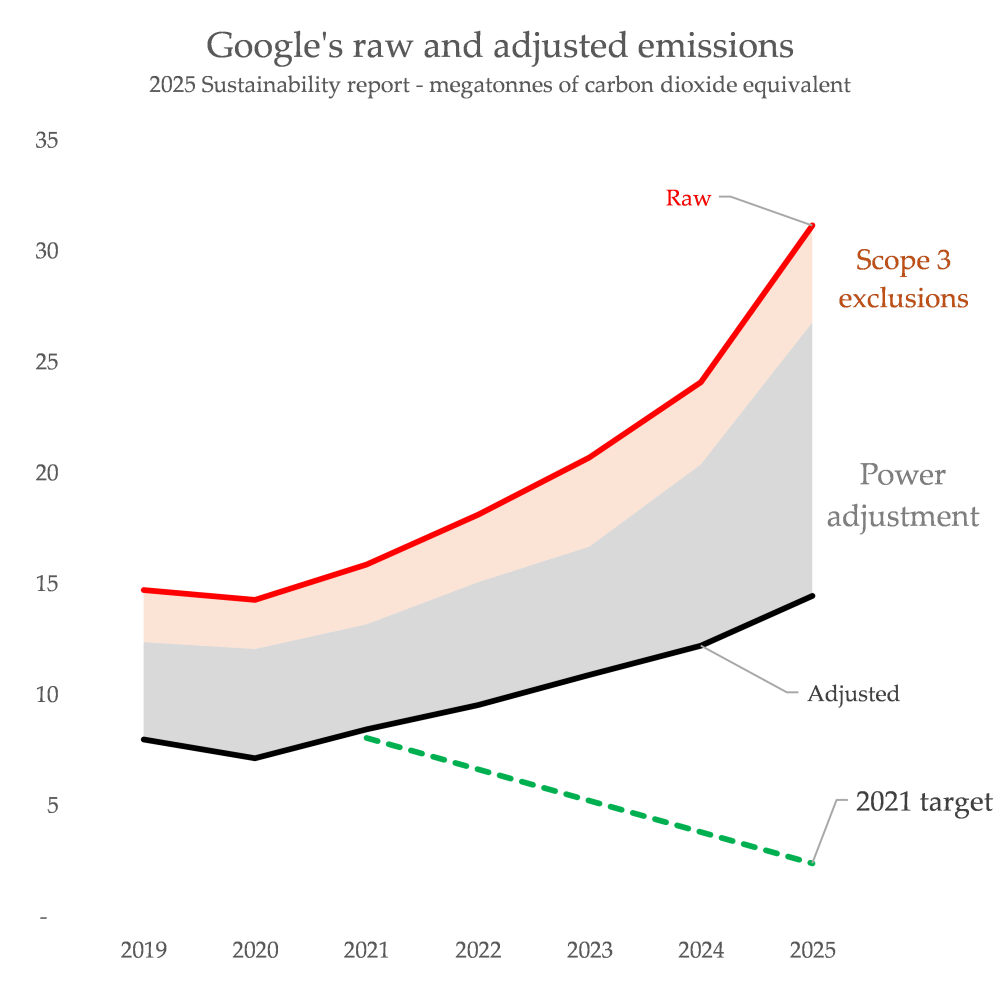 Google’s actual emissions trajectory
against its published climate targets — the gap is widening sharply.
Chart: Ketan Joshi
Google’s actual emissions trajectory
against its published climate targets — the gap is widening sharply.
Chart: Ketan Joshi Cowork across web and mobile
surfaces. Image: Anthropic
Cowork across web and mobile
surfaces. Image: Anthropic