Armin Ronacher (Flask/Jinja2) found that Claude Opus 4.8 and Sonnet 5
frequently invent fields absent from his tool schemas — adding
requireUnique, matchCase, or
oldText2 to edit-tool calls that never defined them — while
older models handled the same schemas cleanly. His hypothesis: newer
models are trained so heavily on Claude Code’s internal edit harness
that they’ve formed strong priors about tool shapes, silently
“repairing” non-standard schemas into malformed calls.
Grammar-constrained sampling eliminates the failures entirely. The
deeper takeaway: tool schemas on Anthropic models aren’t neutral —
schemas close to the training distribution work; schemas far from it
drift. Essential reading for anyone building MCP servers or custom
agentic tooling.
Immich
v3.0.0: automation workflows, real-time HLS transcoding, OCR, Android
gallery
The major v3 release of the self-hosted photo platform ships
drag-and-drop Workflows for automating library actions (chained
triggers, filters, actions); real-time HLS video transcoding with
adaptive quality (no offline processing); non-destructive mobile photo
editing; OCR text recognition with copy-on-select; Android
system-gallery integration; and an integrity-check tool that scans for
untracked files, missing references, and checksum mismatches. Breaking
API changes affect third-party integrations.
thundersnap:
Tailscale’s experimental btrfs-backed undo-everything for system
state
Avery Pennarun (Tailscale) released an experimental tool where
ts undo rolls your entire system back to the previous btrfs
snapshot — repeat for further rewinds. Three independent filesystems
(root/home/work) can be swapped between “frames” independently;
lightweight Linux namespace containers target millisecond startup; and
Tailscale-backed mesh replication syncs snapshots across machines.
Explicitly a toy rather than production software, but the architecture
is the point: content-addressable snapshots make experimentation always
reversible.
“The
Log Is the Agent”: event-sourced architecture for deterministic,
forkable agents
A paper from Yohei Nakajima (BabyAGI) proposes inverting conventional
agent architecture: treat the append-only event log as the source of
truth, with the agent’s working graph as a deterministic projection of
it. Behaviors react to graph changes and emit new events; no component
directs another. Claimed advantages: deterministic replay from any
checkpoint, cheap branching without re-execution, and full causal
lineage from high-level goals down to individual model calls. Apache-2.0
implementation included.
Bad
Epoll (CVE-2026-46242): 99%-reliable local root on Linux and Android, no
workaround
A race-condition use-after-free in Linux’s epoll subsystem
(introduced in a 2023 patch, fixed April 2026) lets any unprivileged
process become root. The exploit widens a six-instruction race into a
reliable retry loop, achieving 99% success without crashing the kernel.
Epoll is core infrastructure — it can’t be unloaded or disabled — so
there’s no mitigation short of patching. Affects kernels v6.4+. Among
~130 kernelCTF vulnerabilities, fewer than 10 can root Android; this is
one of them. Patch your kernel.
shadcn/ui
switches its default from Radix to Base UI — same team, clean
rewrite
New shadcn/ui projects now default to Base UI rather than Radix. The
reason: Base UI is built by the same people who created Radix, applying
lessons learned — now at v1.6.0 with 6M+ weekly downloads and active
component development. There’s no forced migration: Radix remains fully
supported and every new component ships for both. But
npx shadcn init now takes the Base UI path and the docs
lead with it. Bootstrapping a new TypeScript/React project, Base UI is
the default choice.
PS5
Linux loader: native Linux via hypervisor exploits on firmware
3.00–7.61
A new payload enables native Linux on PS5 (Phat and Slim) across
firmware 3.00–7.61 using two exploit chains: umtx2 (3.00–5.50) and Y2JB
(6.00–7.61). The hypervisor-level exploit was pioneered by flatz and
implemented by cragson. It exposes full hardware — 8 cores/16 threads at
3.5GHz, GPU at 2.23GHz, USB/Bluetooth/Ethernet — while the PS5’s
internal SSD stays reserved for the PS5 OS; Linux runs from an M.2
SSD.
 The St. Petersburg Oil Terminal
burning after a Ukrainian drone attack, seen from a distance. Photo:
Supernova+/Telegram
The St. Petersburg Oil Terminal
burning after a Ukrainian drone attack, seen from a distance. Photo:
Supernova+/Telegram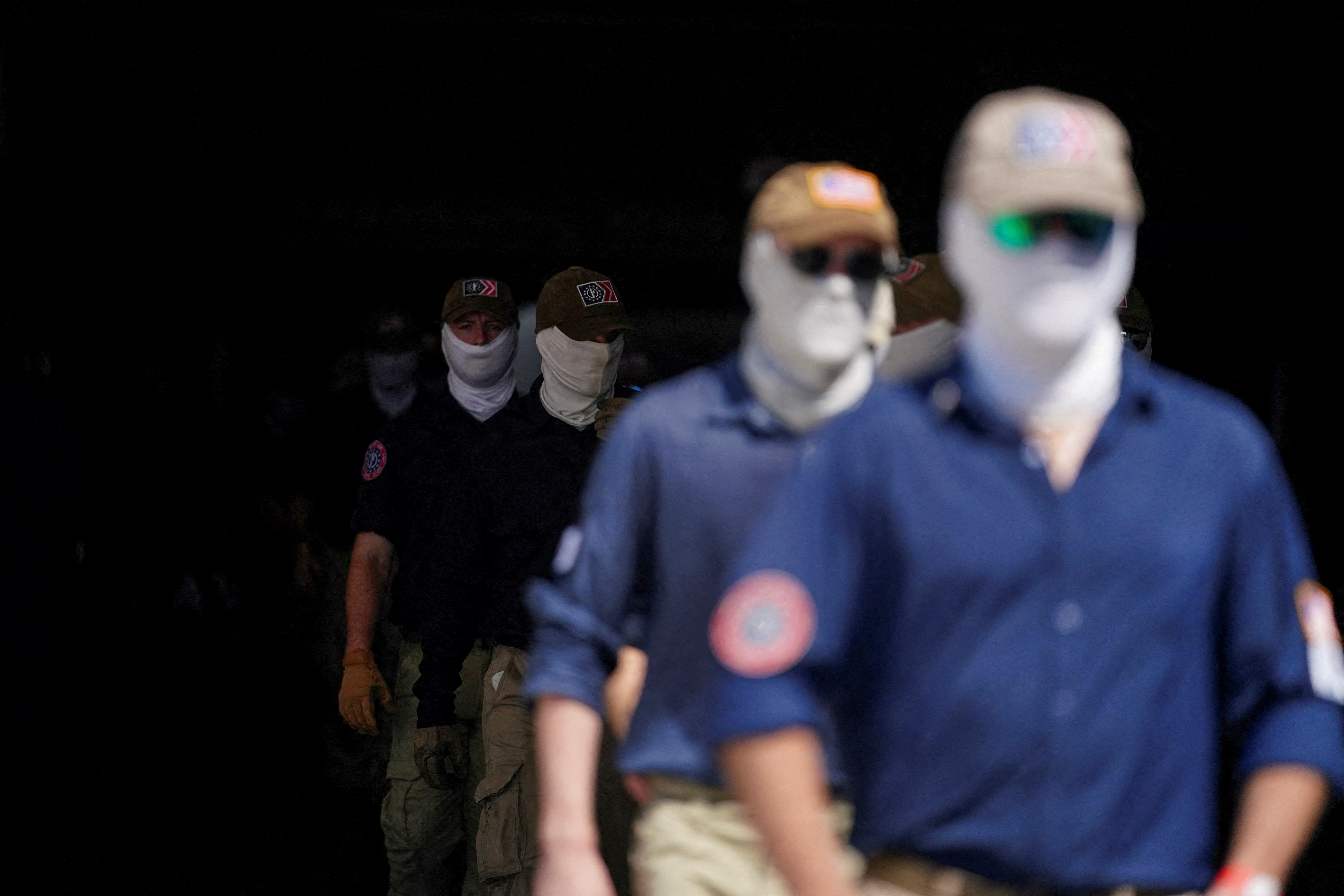 Members of the white-nationalist
Patriot Front exit a metro station in Maryland ahead of their July 4
march through Washington DC. Photo: Reuters
Members of the white-nationalist
Patriot Front exit a metro station in Maryland ahead of their July 4
march through Washington DC. Photo: Reuters Screenshot from HUR video showing a
Ukrainian attack drone striking a Russian MiG-29 at Belbek airbase in
occupied Crimea. Photo: HUR
Screenshot from HUR video showing a
Ukrainian attack drone striking a Russian MiG-29 at Belbek airbase in
occupied Crimea. Photo: HUR The new Workflow editor, with
drag-and-drop automation steps. Photo: Immich
The new Workflow editor, with
drag-and-drop automation steps. Photo: Immich