The Supreme Court closes its term defending birthright
citizenship; Doha talks stall as a report reveals Trump weighed all-out
war on Iran; Ukraine’s advance-rate collapse meets Putin’s order to plan
Kyiv’s capture; and Anthropic’s models return from export limbo —
trailing a fingerprinting scandal.
Supreme
Court upholds birthright citizenship, halting Trump’s immigration
push
On the final day of its term, the US Supreme Court ruled 6–3 to
preserve the 14th Amendment’s guarantee of citizenship to all children
born on US soil — the biggest constitutional setback yet to Trump’s
second-term immigration agenda. The court rejected his executive order
restricting the practice; Trump immediately threatened to pursue the
change through Congress instead. The same day, the justices upheld state
laws barring transgender women and girls from female school sports — a
ruling Trump called a “big win” — and agreed to hear challenges to state
bans on AR-15s, setting up a landmark Second Amendment ruling in 2027.
(More SCOTUS in World.)
US-Iran
talks stall in Doha as report reveals Trump weighed full-scale war
US envoys met Qatari mediators in Doha but held no direct talks with
Iran. Tehran’s chief negotiator said the country was unable to export “a
single barrel of oil” during the US blockade, and that nuclear talks
cannot begin until hostilities in Lebanon end and frozen funds are
released. A Wall Street Journal report revealed Trump seriously
considered launching an all-out war on Iran before opting to stick with
diplomacy. In an escalatory signal, senior Iranian clerics publicly
called for the assassination of both Trump and Netanyahu. A separate
analysis names China the single biggest winner of the Hormuz crisis.
(Regional fallout in Investigations &
Geopolitics.)
Ukraine’s
advance-rate collapse meets Putin’s order to plan Kyiv’s capture
Russian forces averaged just 3.79 km²/day in June — down from 16.65
in August 2025 — and made no confirmed gains on June 29–30, even as 256
clashes were logged on July 1. ISW counts 15 missed Putin deadlines for
seizing Donetsk Oblast; the December 2026 target is now unreachable at
this pace. Against that backdrop, Commander-in-Chief Syrskyi disclosed
that Putin has ordered the General Staff to prepare plans for capturing
Kyiv, and warned a Russian offensive into Chernihiv Oblast is
“realistic.” Meanwhile Ukraine struck the Ufa refinery for a second time
and hit defense plants in Penza and Volgograd — it has now struck at
least 8 of Russia’s 10 largest refineries. (Full report in Ukraine.)
Venezuela
quake: 58,000 buildings destroyed as state presence collapses
Preliminary satellite analysis suggests more than 58,000 buildings
were damaged or destroyed by last week’s twin earthquakes — a scale that
vastly exceeds official figures. A three-year-old was pulled alive from
the rubble in La Guaira state six days after the quake. The confirmed
toll stands above 1,719 and is expected to rise sharply. The disaster
compounds a political vacuum created when the US removed Venezuela’s
government earlier this year, leaving much of the country with little
functional state to coordinate rescue and rebuilding. Bellingcat’s
before/after imagery documents destruction the government has been slow
to acknowledge.
| Indicator |
Value |
Change |
| S&P 500 (f) |
7,521 |
−0.36% |
| Dow 30 (f) |
52,484 |
−0.35% |
| Nasdaq (f) |
30,360 |
−0.54% |
| Russell 2000 (f) |
3,030 |
−0.51% |
| VIX |
17.12 |
+4.07% |
| Gold |
3,975 |
−1.57% |
| BTC |
$58,615 |
−1.37% |
| EUR/USD |
1.1399 |
−0.12% |
| USD/NOK |
9.9492 |
+0.36% |
- VIX +4.1%, futures red across the board — the USMCA deadline
expired without a deal, Russia halted rail traffic at its Baltic and
Finnish borders, and the WSJ reported Trump weighed all-out war on Iran
(see World, Ukraine).
- BTC −1.4% — crypto falls even as disclosures reveal Trump’s
$1.4bn crypto haul in 2025; gold also off, unusual in a risk-off
session.
World
SCOTUS
upholds transgender athlete bans; will hear assault weapons case next
term
Alongside the birthright ruling, the court upheld state laws barring
transgender women and girls from competing in female school and college
sports, and agreed to hear constitutional challenges to state bans on
AR-15s and similar semi-automatic rifles — teeing up a major Second
Amendment decision in 2027.
Roof
collapse at unregistered Lahore tutoring centre kills 14 children
The ceiling of a private tutoring centre operating illegally inside a
residential building collapsed in the Kahna suburb of Lahore, killing at
least 14 children. Two people were taken into custody; authorities said
the centre was unregistered and had no authorization to function as an
educational facility.
South
Africa: thousands march against immigrants as foreigners flee
Mass anti-immigration demonstrations swept South African cities
including Durban as a deadline set by extremist groups for undocumented
migrants to leave passed. Many foreign nationals had already fled. The
government deployed heavy police forces fearing a repeat of the 2008
xenophobic violence that killed 62; rights groups documented widespread
intimidation and harassment.
AfD
vows to restore German-Russian energy ties as far-right numbers
swell
Germany’s far-right AfD is actively pushing to resume Russian energy
imports and dismantle the post-invasion sanctions architecture, with
leader Alice Weidel arguing the “failed” Ukraine invasion proves Russia
poses no real threat — a pledge now central to her bid for the
chancellery, as the party dominates polls ahead of two eastern state
elections. The timing is stark: domestic intelligence (BfV) has just
identified close to 60,000 far-right extremists in the country, more
than a quarter assessed as potentially violent.
Trump’s
crypto income topped $1bn in 2025, eclipsing his real-estate empire
Federal disclosures revealed Trump earned over $1bn — some reports
put it at $1.4bn — from cryptocurrency ventures in his first year back
in office, far outpacing income from the property portfolio he spent
decades building. He has enacted a sweeping package of crypto-friendly
policies since returning to the White House.
Democratic
socialist Melat Kiros ousts 15-term incumbent in Colorado
Twenty-nine-year-old newcomer Melat Kiros ousted Representative Diana
DeGette — who had held her Denver seat since 1997 — in Colorado’s
Democratic primary, running on a platform critical of both party
establishment policy and US support for Israel in Gaza. All but certain
to win the deep-blue general, she would become the first Gen Z woman
elected to Congress. Separately, Trump unveiled plans for a first-ever
Republican midterm convention in Dallas, breaking with the tradition of
holding such events only in presidential years.
Beijing
plane crash into office tower — China scrubs all traces
A small aircraft collided with a tower in central Beijing, punching
visible holes in its side. Chinese authorities rapidly scrubbed social
media posts and removed other evidence of the incident, issuing no
official statement about what happened, who was involved, or the cause.
The information blackout has drawn significant international
attention.
Also today
- Migration & rights
-
Sweden completes a decade-long overhaul into one of Europe’s strictest
migration regimes, now upending settled migrants’ lives — Al
Jazeera
-
Niger’s military regime arrests dozens in an LGBTQ+ crackdown, cutting
off PrEP access and risking an HIV resurgence — Guardian
-
UN chief warns a UNRWA funding shortfall threatens millions of
Palestinians amid “smear campaigns” against the agency — Al
Jazeera
- Trade & accountability
-
The USMCA renewal deadline passed with no deal, leaving North American
free trade in limbo — BBC
-
Gojek co-founder and ex-Indonesian Education Minister Nadiem Makarim
jailed ten years for corruption — Al
Jazeera
- Climate
-
The world’s oceans recorded their hottest June ever; EU monitors warn of
more heat records ahead — Al
Jazeera
Ukraine
Ukraine
strikes Ufa refinery again, hits Penza plant and Volgograd
Ukraine struck the Ufa oil refinery for a second time (1,300 km from
the front) and hit a military-industrial facility in Penza Oblast —
Zelenskyy framing both as “long-range sanctions.” FP-5 Flamingo missiles
struck the Titan-Barrikady defense plant in Volgograd, and the Dubna
Space Communications Center near Moscow was hit for the second time in
eight days. Ukraine has now struck at least 8 of Russia’s 10 largest
refineries. Russia launched 130+ drones overnight June 30–July 1,
hitting 17 locations; a drone strike on a bus in Kherson killed two
civilians.
Russian
home front fractures; Syrskyi reveals Putin’s Kyiv orders
A record 137,000 Yandex searches for “when will the war end” landed
in a single week (June 22–28) — a war-high concentrated in Moscow Oblast
and St. Petersburg — as Putin’s approval fell to 69% in Kremlin-linked
FOM polling. Syrskyi disclosed Putin has ordered the General Staff to
prepare plans for capturing Kyiv, likely an escalation signal or
domestic-pressure tactic, and warned a Russian offensive on Chernihiv
Oblast from Bryansk is “realistic.” On the political front, former
commander-in-chief Zaluzhnyi confirmed he intends to run for
president.
Russian
advance rate hits near-zero as Putin’s claims collapse
Russian milbloggers openly contradicted Putin’s June 28 claim of
encircling Ukrainian forces near Kupyansk, and the MoD continued
fabricating settlement seizures far from actual frontlines. With 5,305
km² still needed to take Donetsk Oblast, ISW assesses the pattern is
feeding Putin a distorted picture of the war and driving continued
expenditure on unachievable objectives. Meanwhile Crimea’s power grid is
buckling: Sevastopol imposed forced restrictions and Simferopol suffered
outages after sustained Ukrainian strikes on substations, with satellite
imagery confirming the Saky thermal plant’s main building and fuel tanks
destroyed.
Ukraine
signs Gripen E contract as Western arms flow expands
Ukraine signed a contract with Saab for 16 Gripen E fighter jets —
its first procurement of modern Western combat aircraft. In parallel,
Denmark approved a ~€590M package (its 30th), the EU began allocating
€3.9B for drones, and Ukraine signed a Rheinmetall deal for tens of
thousands of 155mm shells. Ukraine’s dedicated Drone Force, meanwhile,
has struck Russian air-defense systems 194 times this year,
systematically degrading Russia’s ability to intercept incoming
fire.
Assassination
attempt on Ukrainian-born oligarch in Monaco
A bomb packed with bolts and pellets exploded at the Monaco apartment
building of Ukrainian-born tycoon Vadym Iermolaiev, wounding him, his
wife, and their child. Monaco prosecutors classified it as an attempted
assassination — not terrorism — and launched an international manhunt
for the bomber, caught on CCTV approaching with a backpack. Iermolaiev,
whose fortune is estimated at $225m, has no known political profile,
leaving the motive unclear and raising questions about the targeting of
Ukrainian-linked business figures abroad.
Also today
- Russia abruptly halted rail crossings at its borders with Finland,
Estonia, and Latvia with no stated explanation — United24
· r/worldnews
- Canada’s CSE confirmed a Russian hacker group penetrated a Quebec
water treatment plant, reaching controls for pumps and chlorine dosing —
Yahoo/CSE
- Ukrainian police report explosives are being regularly found inside
the bodies of soldiers repatriated by Russia — a deliberate war crime
targeting handlers — United24
Investigations &
Geopolitics
Operation
Southern Spear: US drones kill 215 in the Eastern Pacific, fishing boats
vanish
Since September 2025, US forces have conducted at least 66 strikes
under “Operation Southern Spear” against suspected drug smugglers in the
eastern Pacific and Caribbean, killing 215 — what legal scholars
describe as an ongoing series of extrajudicial killings. The New Yorker
documents the Fiorella, an Ecuadorian fishing boat whose crew
of ten vanished on January 20th: no storm, no piracy evidence, gear
found floating 90 nautical miles from their last position. A second
boat, the Negra Francisca Duarte II, was attacked by drones
inside Ecuador’s exclusive economic zone; its crew was hooded and bound
by English-speaking men in uniform, then handed to El Salvador. US
SOUTHCOM denies involvement. The piece traces the pattern back to
documented US naval attacks on Ecuadorian boats in the 2000s.
China
is the biggest winner from the Strait of Hormuz crisis
A new analysis concludes China is the sole major beneficiary of the
US-Iran conflict that shut the Strait of Hormuz. Strategic petroleum
stockpiles and dominance in renewables manufacturing let Beijing weather
the energy shock — and now position it to capture surging global demand
for solar panels and EVs from economies scrambling to cut oil
dependency. A companion War on the Rocks piece traces a regional
paradox: the war, the PKK’s 2025 dissolution, and Assad’s fall have
strengthened central governments’ leverage over Kurdish groups, leaving
the Kurds’ negotiating position more fragile than ever just as a
historic settlement seemed near.
Europe goes
its own way as US reliability collapses
A Foreign Affairs analysis (Hertie School, Johns Hopkins SAIS)
documents Europe’s structural drift from American leadership — not a
crisis response but an accelerating strategic reorientation, with
rearmament, independent procurement, and EU-level security coordination
all advancing faster than at any point since the Cold War. A parallel
War on the Rocks essay shows the same dynamic fracturing the 86-year
US-Canada defense partnership: the Pentagon’s unilateral suspension of
the Permanent Joint Board on Defense is pushing Canada toward
diversification with Europe and the Indo-Pacific, fragmenting the very
industrial base Washington needs.
ICIJ:
Chinese military intelligence posing as recruiters to snare officials
and journalists
A Five Eyes-level investigation reveals Chinese military intelligence
operating fake consulting firms and think tanks to recruit government
officials, military personnel, journalists, and recently laid-off US
government employees. Operatives approach targets on LinkedIn offering
paid “consulting” — $300–$1,000+ for reports on defense, trade, and
China policy — before moving them to encrypted platforms and soliciting
increasingly sensitive material. The campaign is broad enough that
ICIJ’s own reporters received recruitment attempts; the US, UK, Canada,
Australia, and New Zealand have all issued formal warnings.
How
China really thinks about the US — and the three “firsts” a Taiwan
invasion would require
On May 13, as Air Force One touched down in Beijing for Trump’s state
visit, a premier Chinese think tank (CICIR) published a report applying
Mao’s three-phase conflict model to US-China relations — casting
eventual “strategic counteroffensive,” including Taiwan reunification,
as inevitable. A translation gap means the Maoist vocabulary carries
doctrinal weight English readers miss: “cooperation through struggle”
frames the summit’s stability as a competitive tool, not convergence. A
companion analysis lays out why an amphibious assault on Taiwan would
demand three unprecedented military firsts at once — a major opposed
landing against coastal cruise missiles, a large-scale airborne drop
against modern air defense, and a 100+ mile over-water helicopter air
assault — with each failure cascading into the others.
Pakistan
air strikes kill 36 Afghan civilians as Taliban launches drones
back
Pakistani air strikes into Afghan territory killed at least 36
civilians and wounded 160, per Afghan officials — a sharp escalation in
cross-border tensions. In response, Afghanistan’s Taliban government
struck targets across the border with drones; Pakistan’s military said
it downed four of the crude aircraft and warned of retaliation. The
exchange marks a significant escalation in already toxic relations
between the two states.
Also today
- Accountability
-
CPJ removed 20 names from its Gaza journalist death toll after reviews
identified 8 confirmed combatants and 12 other discrepancies; the
verified count now stands at 209 — CPJ
-
Bellingcat published an OSINT toolkit for tracking wildfire damage —
NASA heat signatures, Copernicus data, and QGIS burn-ratio analysis — Bellingcat
- Defense
-
The US plans a $4bn boost for UK airbases, putting nuclear-weapons
storage at RAF Lakenheath back in the spotlight — Guardian
-
Australia secured a basing-exclusion deal barring foreign — read:
Chinese — military installations from Vanuatu — DW
Tech
Claude
Sonnet 5 launches — and the gap to Opus all but collapses
Anthropic released Claude Sonnet 5, framing it as its most capable
autonomous model at the Sonnet tier — planning, tool use (browsers,
terminals), and self-verification at a level previously requiring
Opus-class models. On knowledge-work benchmarks it edges Opus 4.8
(GDPval-AA v2: 1618 vs 1615), with lower sycophancy, better
prompt-injection resistance, and real-time cyber safeguards on by
default. It’s now the default for Free and Pro users. Introductory
pricing is $2/$10 per million tokens through August 31 (then $3/$15) —
roughly half of Opus 4.8.
The gotcha: Sonnet 5’s updated tokenizer generates
~1.0–1.35× more tokens for the same input. At high or extra-high effort,
that erases the per-token advantage — Sonnet 5 can exceed Opus
4.8’s total cost per task despite the lower list price. Lower-effort
requests are genuinely cheaper and faster; peak-quality usage is
not.
Claude
Code caught fingerprinting Chinese users — Anthropic promises
removal
A developer reverse-engineered Claude Code and found XOR-obfuscated
code (present since v2.1.91, April 2) that checks timezone
(Asia/Shanghai, Asia/Urumqi) and proxy hostname against a hardcoded list
of 147 Chinese tech domains — Baidu, Alibaba, Ant Group, ByteDance,
Moonshot, MiniMax, Stepfun, and more. If triggered, it silently rewrites
a character in the system prompt — swapping the date separator, or
substituting visually identical Unicode apostrophes — as a
steganographic watermark. The likely purpose is anti-distillation
detection: flagging when outputs are used to train competitors. None of
it appeared in release notes. Anthropic’s technical team acknowledged
the code and said it will be removed in the next release. The blowback
centers less on anti-abuse intent than on the covert obfuscation —
critics note the irony of Anthropic protecting its own IP after training
on others’ copyrighted content.
US
lifts export controls on Fable 5 and Mythos 5; Claude Desktop lands on
Linux
The Department of Commerce lifted its ~3-week export ban on
Anthropic’s Fable 5 (public) and Mythos 5 (government-restricted),
imposed over cybersecurity-capability concerns; new safeguards add
latency to certain security tasks. Pro/Max/Team users get Fable 5
included for up to 50% of weekly limits through July 7, after which
access shifts to usage credits — with coding tasks falling back to Opus
4.8. API pricing is $10 in / $50 out per million tokens; Mythos 5
remains restricted to Glasswing partners and select biomedical
researchers. The episode briefly nudged European users toward Chinese
alternatives like GLM 5.2 — a recurring dynamic of US export policy
opening doors for non-US ecosystems. Separately, Anthropic shipped a
native Claude Desktop for Linux (Ubuntu/Debian beta),
including Claude Code, Cowork, and Chat on paid plans; Computer Use is
not yet included.
Brain2QWERTY
v2: non-invasive BCI reaches 61% word accuracy from typed brain
signals
Meta’s Brain2QWERTY v2 decodes typed text from brain activity using
non-surgical MEG headwear, hitting 61% word accuracy — versus 8% for
prior non-invasive methods. Nine participants were recorded for 10 hours
each (~22,000 sentences); the best hit 78% accuracy, with over half of
decoded sentences containing at most one word error. The system runs
end-to-end deep learning on raw MEG signals combined with fine-tuned
LLMs for semantic context, aimed at communication aids for people with
motor impairments — no implants required.
Local
reasoning as a path to verifiable global program properties
Laurence Tratt argues future languages should be designed so global
properties — data-race freedom, resource cleanup, state isolation — can
be verified through purely local inspection, using Rust’s ownership and
Send/Sync traits as the existence proof. He ties this to AI code
generation’s core weakness: AI excels at individual functions with tight
specs but produces bloated, defensively-checked code when system-level
structure is needed. Languages that enforce global properties locally
would benefit both humans and agents. In a complementary vein, a sharp
walkthrough shows how to bring “parse, don’t validate” to TypeScript via
phantom branded types
(type Email = string & { __brand: 'Email' }) —
compile-time proof that validation happened, at zero runtime cost.
What happened to
the fight for the internet?
Christine Lemmer-Webber (ActivityPub co-author) asks why the
once-vibrant internet-freedom movement has gone quiet. Her diagnosis:
centralization through five major platforms turned a public commons into
corporate infrastructure that feels non-contestable, and the 2012
Wikipedia-blackout era’s mass mobilization hasn’t returned for today’s
fights over age-verification laws, hardware lockdowns, and surveillance.
She calls for a return to decentralized, encrypted platforms as
essential infrastructure for democratic resistance — especially for
marginalized communities. Fittingly for the moment, arXiv officially
spun out from Cornell on July 1 after 25 years, becoming an independent
nonprofit with its free-access model unchanged.
Residential
proxies: 65% of enterprise traffic now touches compromised home
networks
Ivan Ristić’s security newsletter covers how residential proxy
networks — traffic routed through compromised home devices — have become
dominant attack infrastructure. An Infoblox report found 65% of
enterprise customers have traffic traversing these networks. The supply
side is grim: malware ships pre-installed on cheap digital frames and
smart TVs, conscripting homeowners into botnets. The most dangerous
variants include Android Debug Bridge access that can pivot to internal
enterprise networks. On the offense side, a new open-source “Invisible
Playwright” forks Firefox with C++-level fingerprint randomization —
evading page-side detection — though the authors note ~90% of proxy IPs
are already on blocklists, so browser evasion alone won’t cut it.
Also today
- Dev tools
-
jj_tui — an OCaml-built terminal UI for Jujutsu with a
custom graph renderer showing real-time previews of mid-rebase commit
graphs (vim keys, file-level splitting, revset filtering; jj 0.30.0+) —
tangled.org · Lobsters
-
A neat jj alias —
jj = ["util", "exec", "--", "jj"] — makes
jj jj jj show behave exactly like jj show; the
-- stops util exec from eating nested flags —
caiustheory.com
-
ZLUDA 6 lands Blender compatibility and PhysX effects
for AMD GPUs, plus improving PyTorch support — now a hobby project after
commercial funding ended — ZLUDA
blog
- AI research
-
REAP (arXiv 2604.01527) proposes auto-extracting
coding-agent benchmarks from real production sessions rather than
synthetic tests, capturing brownfield edge cases artificial benchmarks
miss — arXiv
-
Google’s agentic Paper Assistant Tool reviewed ~10K papers at STOC/ICML
(~30 min each), a 34% gain over zero-shot on math-error recall — arXiv
-
OpenAI’s Cerebras capacity deal has effectively killed the API waitlist
for smaller startups needing sustained 1–2K tokens/sec — r/MachineLearning
- Science
-
World first — Conception derived human primary oocytes entirely from
stem cells, guiding a blood draw through iPSCs into self-organizing
“mini-ovaries” that form follicles and enter meiosis — Conception.bio
· HN
 Trump speaks with reporters at the Oval Office, June 29, 2026. Photo:
AFP
Trump speaks with reporters at the Oval Office, June 29, 2026. Photo:
AFP Melat Kiros at her primary victory
party in Denver, June 30, 2026. Photo: AP
Melat Kiros at her primary victory
party in Denver, June 30, 2026. Photo: AP Ukraine’s Commander-in-Chief
Oleksandr Syrskyi. Photo: Getty Images
Ukraine’s Commander-in-Chief
Oleksandr Syrskyi. Photo: Getty Images Chinese Type 075 amphibious assault
ship (LHD-33 Anhui). Photo: China News Service / Wikimedia
Chinese Type 075 amphibious assault
ship (LHD-33 Anhui). Photo: China News Service / Wikimedia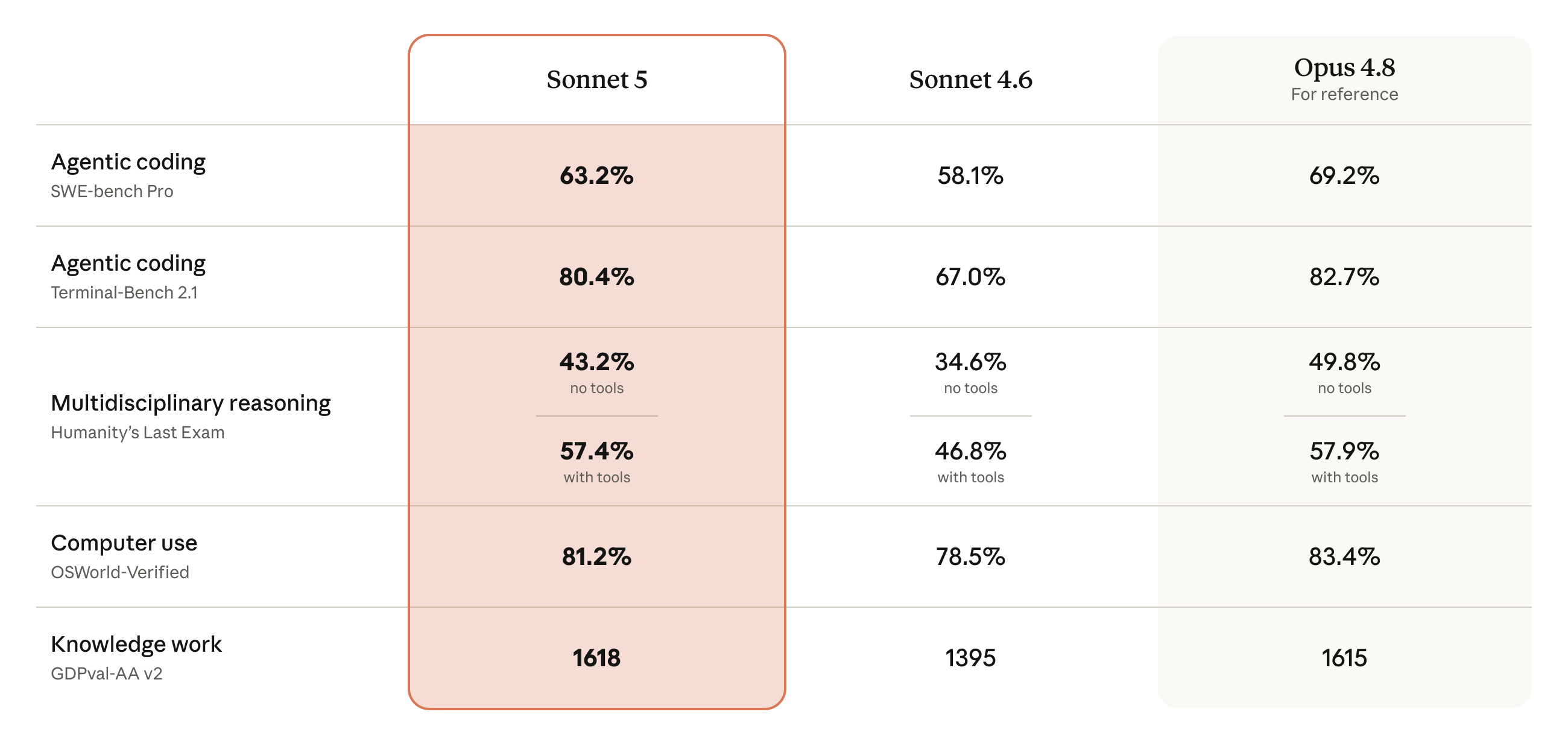 Benchmark comparison: Sonnet 5 vs
Sonnet 4.6 vs Opus 4.8. Image: Anthropic
Benchmark comparison: Sonnet 5 vs
Sonnet 4.6 vs Opus 4.8. Image: Anthropic The Fable 5 / Mythos 5 launch
graphic — a “5” composed of butterflies. Image: Anthropic
The Fable 5 / Mythos 5 launch
graphic — a “5” composed of butterflies. Image: Anthropic Brain activity decoding pipeline from Meta’s Brain2QWERTY research.
Image: Meta AI
Brain activity decoding pipeline from Meta’s Brain2QWERTY research.
Image: Meta AI