Researchers combined reinforcement learning with inverse design to
produce silicon RF power amplifiers covering 30–100 GHz, achieving the
best then-reported mix of bandwidth, output power and efficiency for
silicon at those frequencies. Unlike prior tools that optimise human
templates, this starts from scratch — RL picks architecture and
topology, then inverse design generates fabrication-ready
electromagnetic layouts. The results look like QR codes rather than
symmetric human designs, and design time drops from months to minutes.
IEEE Spectrum frames it as a threshold crossing: AI isn’t assisting RF
design, it’s outperforming it.
Data access
patterns that make CPUs really angry
A low-level systems post walks through how specific memory access
patterns can be worse than random access. The finding: striding
across 8 pages (~32 KB) at a time hits ~2.06B cycles versus ~1.57B for
true random access — roughly 33% slower. The mechanism is a perfect
storm — systematic stride destroys hardware prefetching, causes
cache-set conflicts, generates near-universal TLB misses, and triggers
DRAM bank/row conflicts. A good mental model for why data layout in hot
paths can matter as much as algorithmic complexity.
Prism:
a functional language that makes typed algebraic effects practical
Stephen Diehl published Prism, an experimental impure functional
language treating effects as first-class typed constructs. The key
insight: five paradigms — exceptions, generators, lenses, mutable state
and logical failure — all fall out of a single algebraic effect-handler
mechanism. Effects compose via row polymorphism (no monad-transformer
stacks), local mutation doesn’t leak into outer types, and the
implementation uses evidence passing rather than free monads for zero
per-operation allocations. It pairs with Perceus reference counting for
GC-free deterministic memory — worth reading for where practical
typed-effects research is heading.
Ansatz:
write Clojure, prove it in Lean4’s Mathlib, run as JVM bytecode
Ansatz brings dependent types and formal verification to Clojure via
a Lean4-compatible kernel built on the Calculus of Inductive
Constructions. Adoption is gradual — standard Clojure functions can be
incrementally converted to verified versions — and proofs have access to
all 210,000+ theorems in Lean’s Mathlib. Output is ordinary JVM
functions with no runtime overhead: an ambitious bid to make
proof-assisted programming practical on the JVM rather than confined to
dedicated proof assistants.
A peek inside Reddit’s
anti-spam machine
A detailed post reverse-engineers Reddit’s spam filtering from
observed removal metadata. The system layers Lua-based rule matching
(Spamurai), Google’s Perspective API scores (trained on NYT moderation
data), Hive AI for OCR and image classification across 12+ languages,
and heavy fingerprinting: ISP/org data, JA3-style TLS fingerprints,
browser RHS hashes, karma ratios and email-domain signals. Most striking
— Reddit fetches and analyses linked URLs to extract embedded
identifiers like GA codes, correlating evolving spam networks across
domains. The author notes simple character substitutions sharply reduced
Perspective scores, a now-patched evasion vector.
 Boats anchored off Oman’s Musandam
peninsula near the Strait of Hormuz, June 27. Photo: AFP / Al
Jazeera
Boats anchored off Oman’s Musandam
peninsula near the Strait of Hormuz, June 27. Photo: AFP / Al
Jazeera A firefighter calls through a tube
into a collapsed building in La Guaira, searching for survivors. Photo:
Reuters / Al Jazeera
A firefighter calls through a tube
into a collapsed building in La Guaira, searching for survivors. Photo:
Reuters / Al Jazeera Fire at the Slavyansk-on-Kuban
refinery after a Ukrainian drone strike, June 28. Photo: Militarnyi
Fire at the Slavyansk-on-Kuban
refinery after a Ukrainian drone strike, June 28. Photo: Militarnyi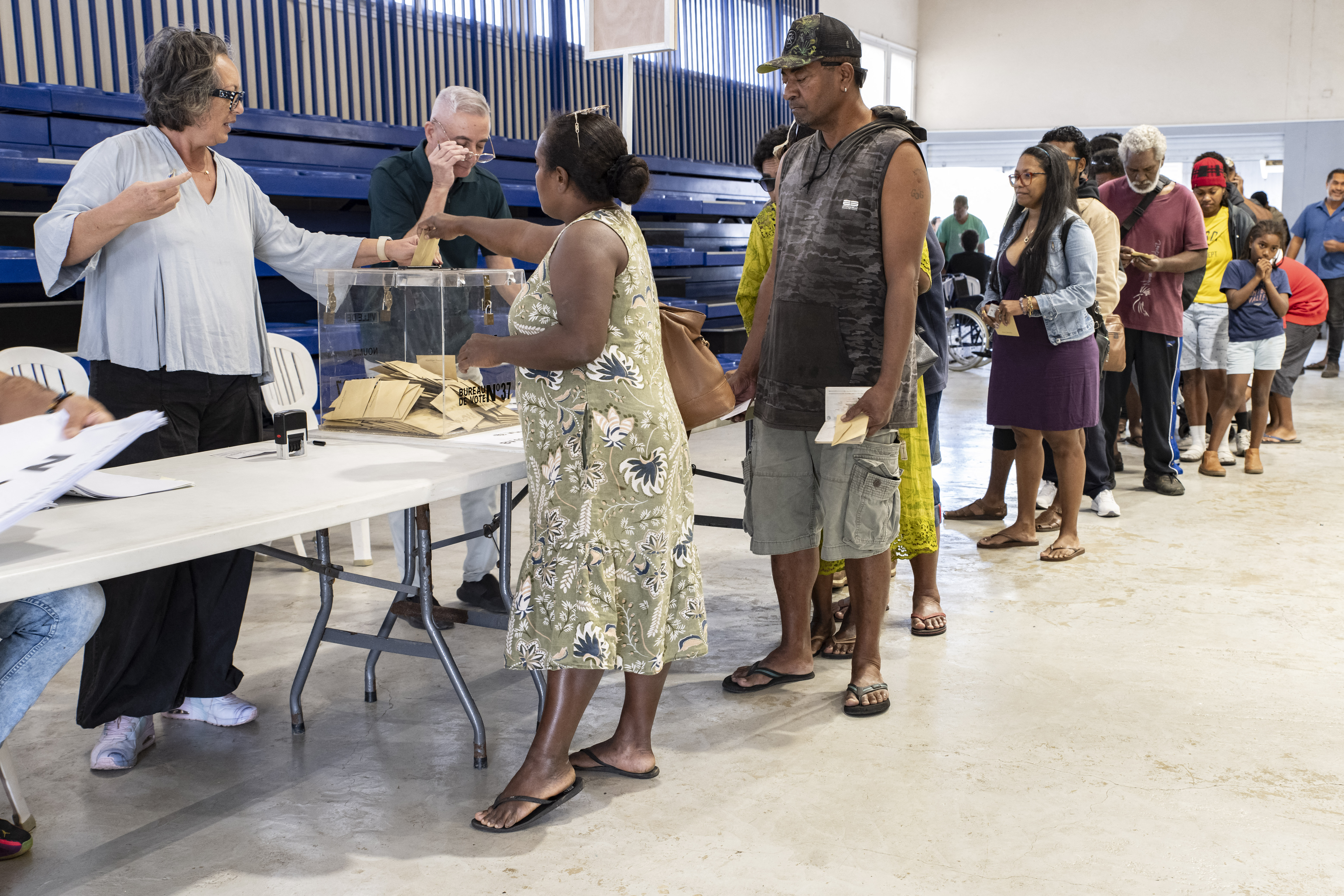 Voters in New Caledonia’s first
provincial elections since 2019, in Nouméa. Photo: AFP / Al Jazeera
Voters in New Caledonia’s first
provincial elections since 2019, in Nouméa. Photo: AFP / Al Jazeera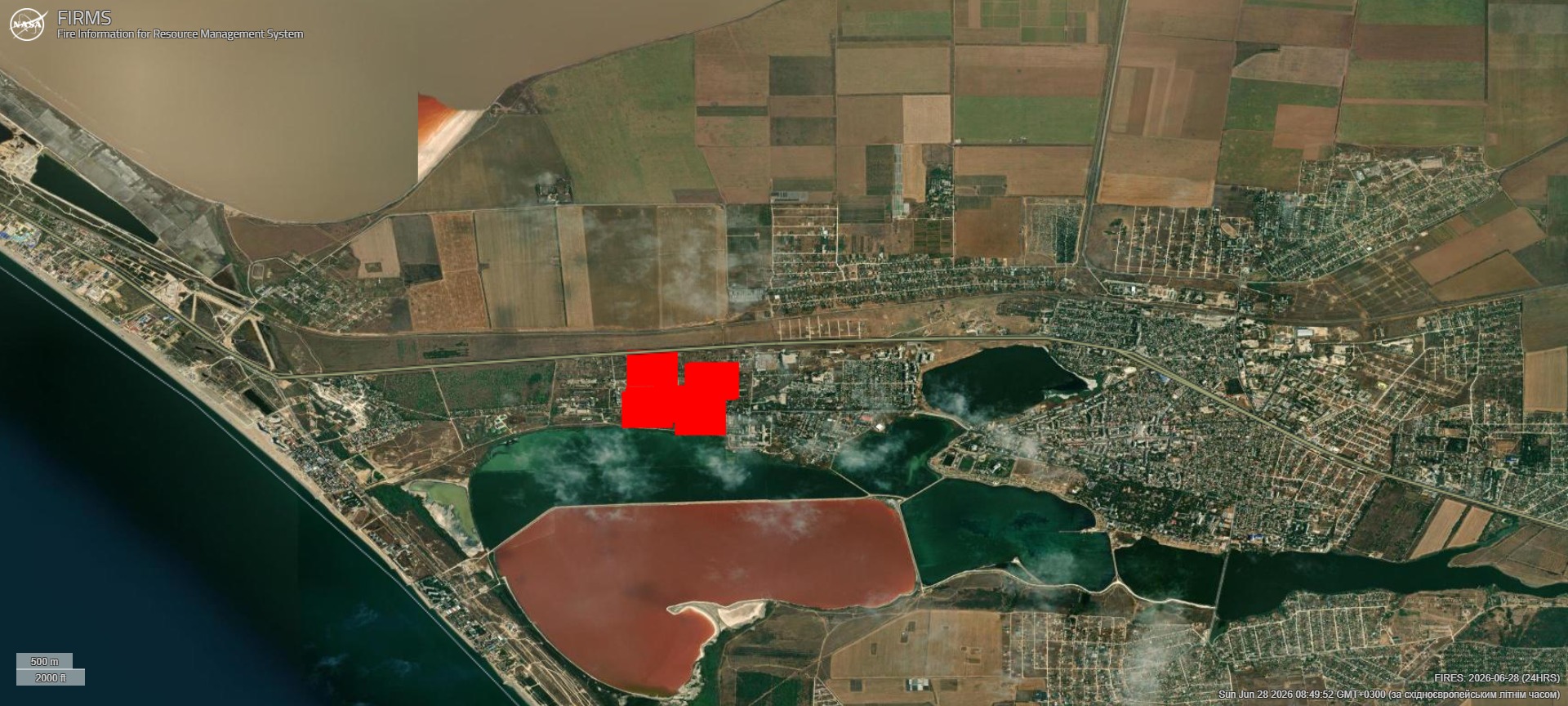 NASA FIRMS heat-anomaly data showing
the fire at Crimea’s Saky thermal power plant. Photo: Militarnyi / NASA
FIRMS
NASA FIRMS heat-anomaly data showing
the fire at Crimea’s Saky thermal power plant. Photo: Militarnyi / NASA
FIRMS Putin and Trump. Photo: Ukrainska
Pravda
Putin and Trump. Photo: Ukrainska
Pravda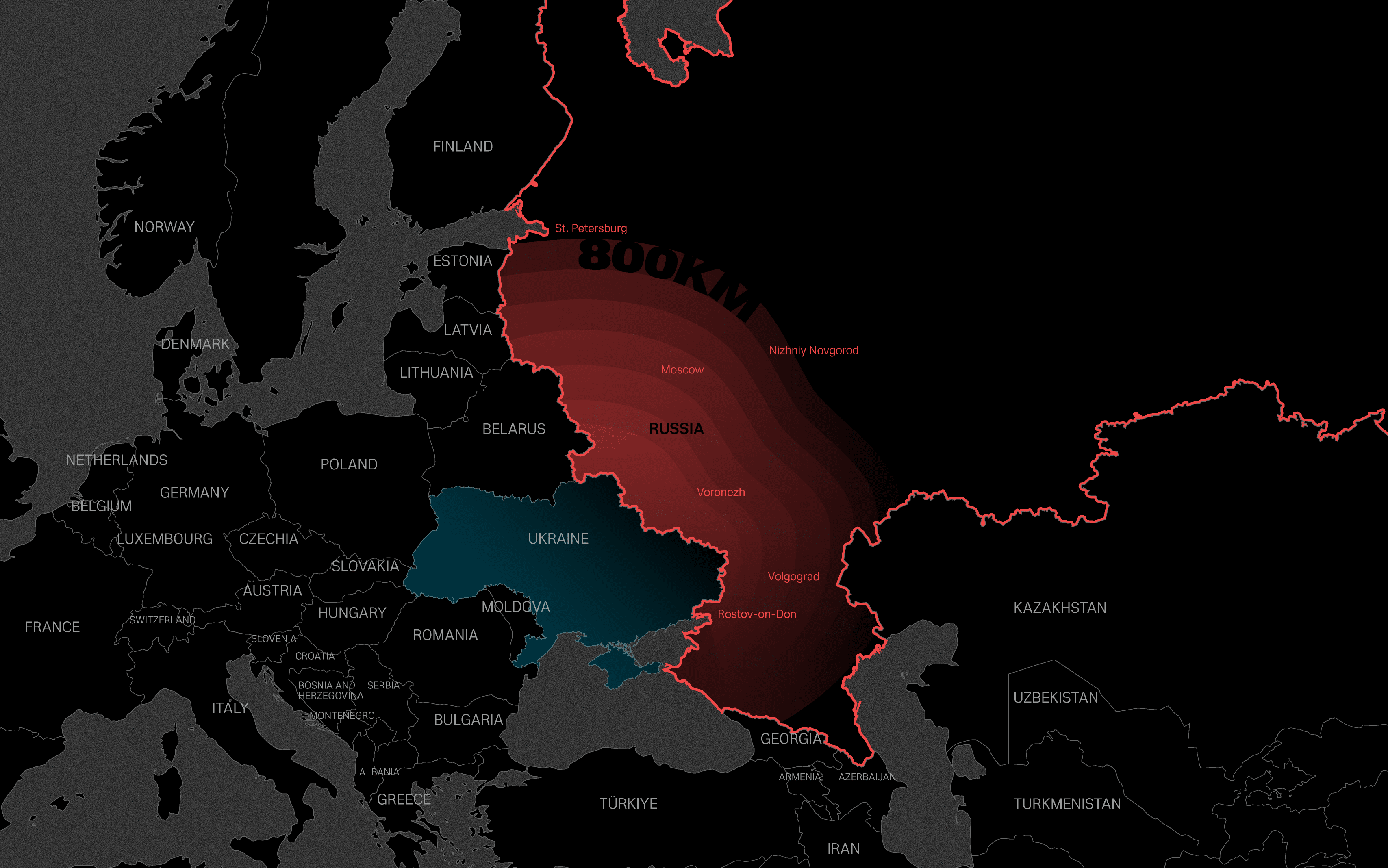 The FP-9’s projected 800 km strike
range from Ukrainian territory. Map: United24 Media
The FP-9’s projected 800 km strike
range from Ukrainian territory. Map: United24 Media Header art for the IEEE Spectrum
piece. Illustration: IEEE Spectrum
Header art for the IEEE Spectrum
piece. Illustration: IEEE Spectrum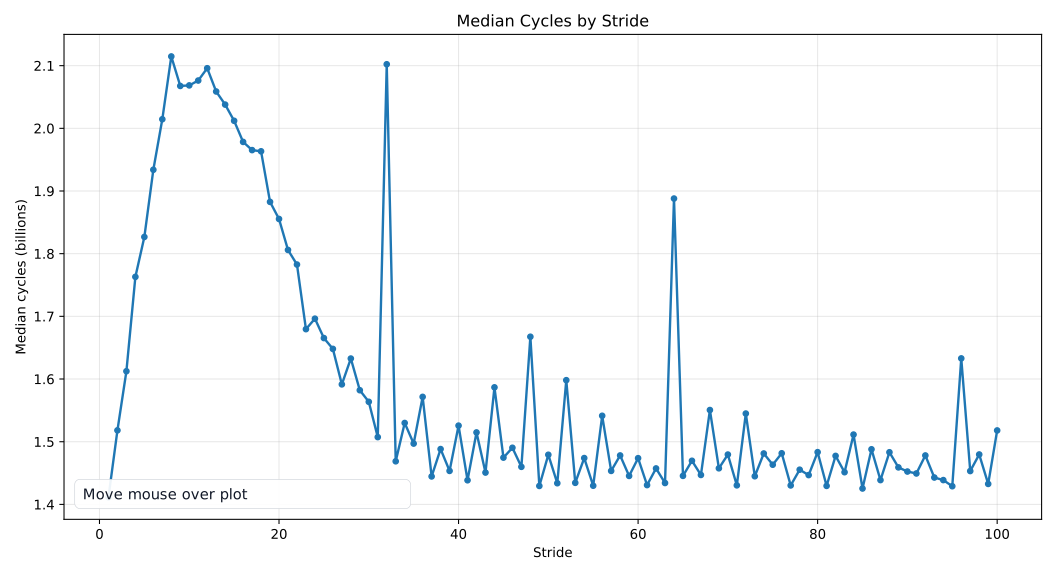 Cycle counts across memory access stride patterns — an 8-page stride
beats even random access at being slow. Chart: blog.weineng.me
Cycle counts across memory access stride patterns — an 8-page stride
beats even random access at being slow. Chart: blog.weineng.me