Ladybird Closes the Door
on Public PRs
The independent Ladybird browser project will no longer accept public
pull requests as it approaches its first alpha. Maintainers cite
browser-class security exposure and the difficulty of accountability for
AI-generated contributions. The code stays open source — external
involvement narrows to bug reports, testing, and feedback.
Python Steering Council
Freezes the JIT
Python’s Steering Council halted further development of the
experimental JIT, giving its champions six months to produce a
standards-track PEP covering maintenance commitments, compatibility
guarantees, performance targets, and redistributor impact — or see it
removed from main. The council’s concerns: integration with existing
CPython features and long-term sustainability without proper formal
planning.
ZML is a new Paris-based inference runtime that compiles models
directly to hardware-specific optimisations across NVIDIA, AMD, TPU, and
Trainium. The project deliberately strips intermediate abstraction
layers in favour of explicit design, composability, and predictable
behaviour. 3.5K GitHub stars at launch.
Google Ships
Quantization-Aware Gemma 4 for Mobile
Google released Gemma 4 QAT — quantization-aware training models
targeted at phones and laptops. They use static activations,
channel-wise quantization, and 2-bit compression where possible; the E2B
text-only variant runs in under 1 GB of memory. A meaningful step toward
genuinely capable on-device LLMs.
The
GPS Numbers Station: 19 Years of Hidden Military Cryptography
Researchers analysing two decades of GPS broadcasts discovered that
Subframe 4, Page 17 isn’t human-readable telemetry — it’s encrypted
military payloads transmitted every 12.5 minutes to every civilian
receiver on Earth. Statistical analysis of 12 million observations
confirmed it’s military-grade ciphered data with coordinated fleet-wide
key rotations. An operational cryptographic system hiding in plain sight
on a public frequency, potentially exposing communication patterns to
traffic analysis.
Microsoft Open Sources
pg_durable
pg_durable is a PostgreSQL extension that runs durable execution
workflows entirely inside the database via SQL DSL — automatic retry,
state persistence, and orchestration of multi-step operations without an
external workflow engine. Built on the Durable Task Framework. Aimed at
scenarios that need reliable coordination of DB operations with
automatic recovery from failures and interruptions.
No, Claude Did Not Make
rsync Buggier
A rigorous statistical analysis of rsync’s release history pushes
back on the narrative that AI-assisted coding ships more bugs.
Severity-weighted metrics across 36 releases, exact permutation tests,
and LLM-scored severity all find the Claude-assisted versions (3.4.2,
3.4.3) statistically unremarkable against historical baselines —
p-values of 46% and 74%.
Symbolica
2.0 — Programmable Symbols for Python and Rust
Symbolica 2.0 lands with programmable symbols, JIT compilation,
31-digit-precision arithmetic, and specialised functions (gamma,
polylogarithms, Bessel). High-performance symbolic computing of the kind
previously locked behind expensive commercial systems, now in Python and
Rust.
 Drones struck five ships covertly
moving cargo from occupied ports. Photo: Getty Images
Drones struck five ships covertly
moving cargo from occupied ports. Photo: Getty Images Approximate memory requirements for the new Gemma 4 QAT models. Photo:
Google
Approximate memory requirements for the new Gemma 4 QAT models. Photo:
Google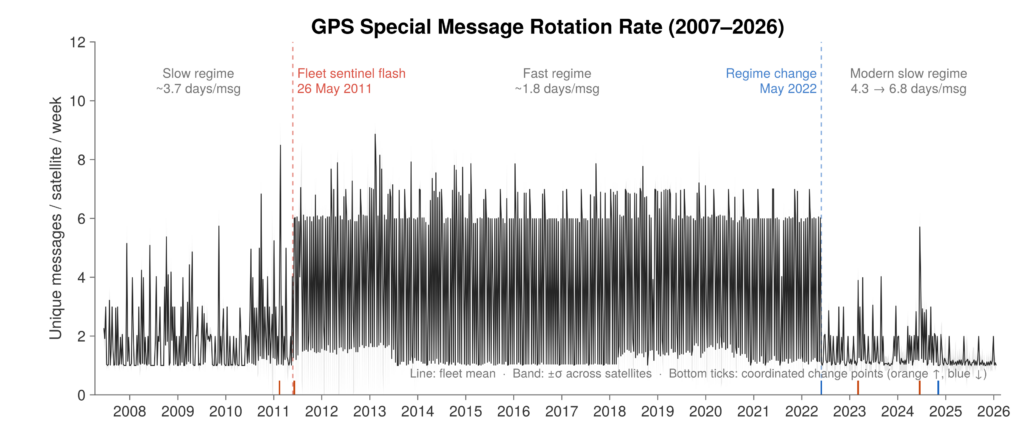 Fleet-mean rotation rate over 19
years, with operational transitions in 2011 and 2022.
Fleet-mean rotation rate over 19
years, with operational transitions in 2011 and 2022.