Josse-posten

Bombs fall during peace talks, flights are grounded over Moscow, and Microsoft bets on its own AI stack.

Iran Condemns ‘Gross Violation’ as US Strikes Continue During Doha Talks

US Central Command conducted “self-defense strikes” targeting Iranian missile launch sites and boats attempting to mine shipping lanes, responding to what it called “increasing and potentially threatening Iranian activity.” Iran condemned the strikes as a “gross violation” of the fragile ceasefire agreement. Despite the overnight military action, both sides indicate negotiations in Doha with Qatari mediators will continue toward a memorandum of understanding to end hostilities and reopen the Strait of Hormuz. Sticking points remain over nuclear monitoring mechanisms, frozen asset releases, and Lebanon’s inclusion in a broader regional settlement. Iranian officials expressed “deep suspicion” of US intentions while maintaining their negotiating position.

Ukraine Hits Aircraft Plant and Naval HQ; Russia Bans Flights Over Moscow

Smoke rises over Taganrog after strike on aircraft repair plant. Photo: Ukrainska Pravda

Ukrainian forces struck Taganrog Aircraft Repair Plant No. 325, a sanctioned military facility, and hit what Ukrainian sources identify as the Russian Naval Aviation headquarters in Sevastopol — a key Black Sea Fleet command center that Russian officials claim houses a bank branch. Russia responded by banning civilian flights across the Moscow air zone from ground level to 5,100 meters starting June 1, extending from the Belarusian to Ukrainian borders. Kaliningrad’s Khrabrovo airport was also closed for the first time due to drone threats, marking Ukrainian capability to reach Russia’s westernmost territory. Multiple countries summoned Russian ambassadors over threats of “systematic strikes” on Kyiv, while the EU warned Moscow aims to “destabilise” Europe and GCHQ cautioned Russia is “relentlessly targeting” UK infrastructure.

Microsoft Cancels Claude Code Licenses, Shifts to Copilot CLI

Microsoft’s Experiences + Devices team is winding down Claude Code usage by June 30, directing thousands of employees to transition to GitHub Copilot CLI. The decision appears driven by both cost — AI coding at current token prices doesn’t work with constant enterprise usage — and strategic preference for a Microsoft-controlled solution. “Copilot CLI offers a product we can help shape directly with GitHub for Microsoft’s repos, workflows, security expectations, and engineering needs,” a Microsoft VP said. The move signals growing tension between the economics of third-party AI tools and the imperative to control your own stack.

Indicator Value Change
S&P 500 (f) 7,544.5 +0.10%
Nasdaq (f) 30,108.75 +0.12%
VIX 17.01
Gold 4,481.2 −0.47%
BTC $75,677 −1.24%
EUR/USD 1.1642 +0.05%
USD/NOK 9.2961 +0.35%
  • US futures mildly positive across the board — markets pricing the Iran ceasefire as intact despite overnight strikes.
  • Gold down 0.47% despite a day heavy with geopolitical risk. Flight-to-safety demand notably absent.

World

Israeli Strikes Kill 31 in Lebanon as Ceasefire Strains

Israel carried out one of its heaviest bombing days in weeks, killing at least 31 people and striking over 100 Hezbollah targets across Lebanon. The escalation further strains the supposed ceasefire, with Netanyahu vowing to “crush” Hezbollah with “overwhelming force.” The strikes come amid broader regional tensions as the Iran war continues into its third month.

Iran’s Internet Blackout Ends After Record 88 Days

Iran’s access to global internet slowly restarted, ending a record 88-day blackout that contributed to thousands of job losses and provided cover for security operations. The shutdown continued despite an interim court order questioning the authority of the oversight body that imposed it. The restoration comes as Iran engages in critical peace negotiations, suggesting potential policy shifts around information access.

Netherlands Blocks US Takeover of Digital Identity Operator

The Netherlands blocked a US takeover of Solvinity, which operates the country’s DigiD digital identity system, citing national security concerns. The decision reflects growing European wariness about foreign control of critical digital infrastructure — particularly systems that underpin government authentication for millions of citizens.

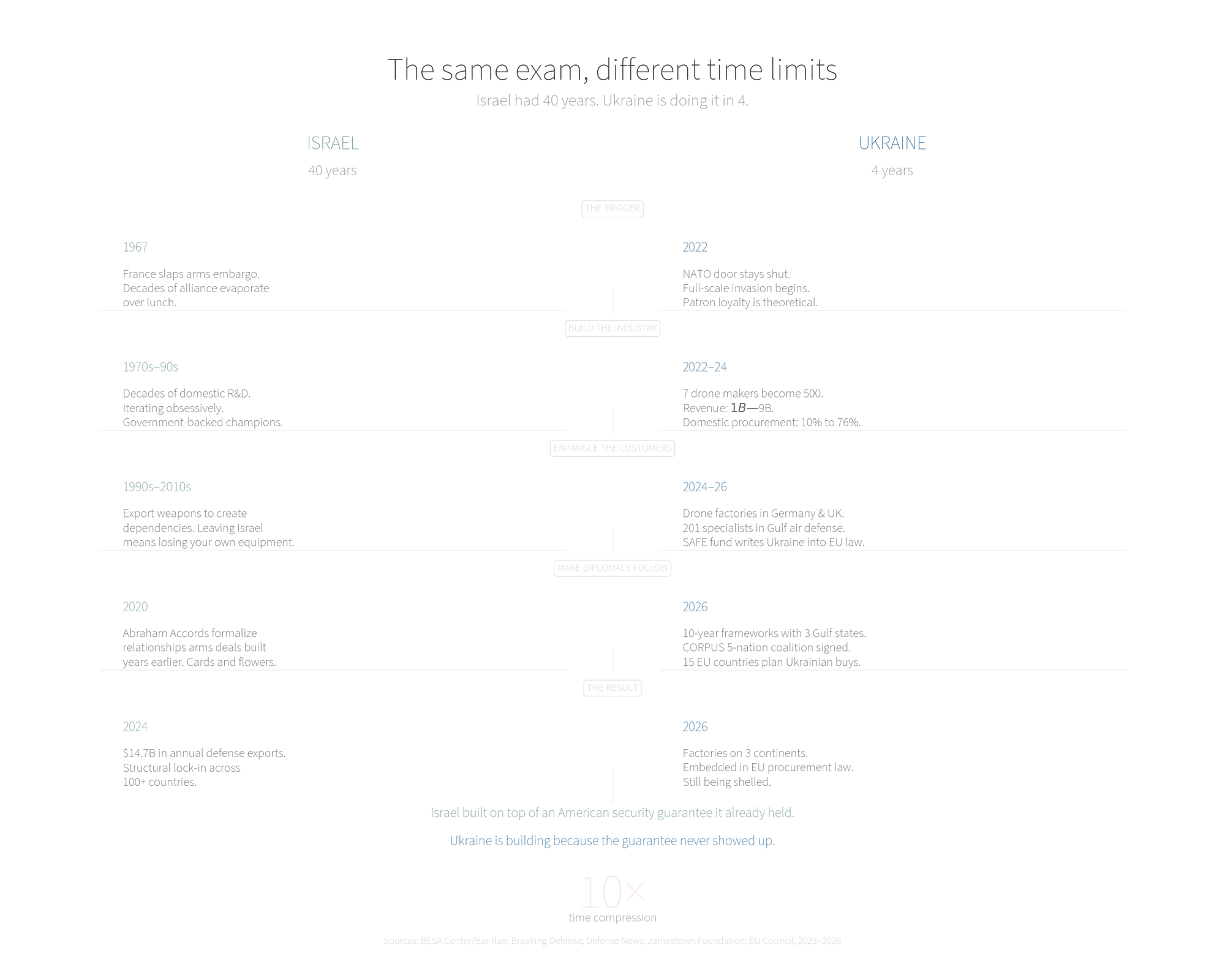
Ukraine’s Strategic Embedding Makes Western Abandonment Impossible

Israel’s 40-year defense export model compressed into Ukraine’s 4-year sprint. Read Uncut

Ukraine has systematically embedded itself in European defense infrastructure — drone factories in Bavaria, rocket fuel facilities in Denmark, 200+ specialists in Gulf air defense systems — making withdrawal economically and strategically costly. The EU classified Ukraine alongside member states in its €150 billion SAFE defense fund. This deliberate strategy, compressing Israel’s 40-year model into four years, transforms political commitments into economic necessities that survive electoral cycles. Germany, the UK, Gulf states, the EU, and the Nordics all stand to lose tangible capabilities if they walk away.

Iceland Foreign Minister Warns of ‘Brexit Moment’ in EU Referendum

Iceland’s Foreign Minister Þorgerður Katrín Gunnarsdóttir fears a “Brexit moment” in the country’s upcoming EU accession referendum, citing concerns over misinformation, foreign interference, and AI manipulation. With just over three weeks until the vote, opponents are accused of fearmongering about EU membership.

Also today

Americas
Trump-backed Ken Paxton ousts Senator Cornyn in bitter $100M+ Texas GOP primary — The Guardian · NPR · Al Jazeera
Chemical tank rupture at Washington state paper mill kills one, nine missing — BBC · Al Jazeera
Europe
Scottish Parliament endorses SNP independence referendum call — BBC
French voters reject Macron’s rearmament push despite Russian threat, prioritize welfare state — Washington Monthly
Seven heat-related deaths in France as May temperature records fall across western Europe — The Guardian · BBC
School minibus drives through closed barriers into train in Belgium, killing four — BBC
Turkish riot police fire teargas at rallies after opposition leader ousted by court — The Guardian
Asia & Global
Bangladesh measles outbreak tops 60,000 cases, hundreds of children dead — BBC
China’s EV exports surge 40% in April, Asia now the largest buyer — Al Jazeera
1.2 billion people worldwide living with mental disorders — El País
US and Armenia sign strategic partnership as Yerevan continues pivot from Moscow — Reuters
NASA outlines first phase of permanent moon base with drones and rovers — BBC · NPR
Analysis
Kristol: Trump’s Iran war strengthened the regime and damaged US credibility — The Bulwark
Hoover Institution develops framework for anticipating technological surprise — Hoover

Ukraine

Belarus Claims 116 Drone Crossings as Pretext for Expanded Operations

Belarus claims 116 Ukrainian drone border crossings in one week, alleging deliberate infrastructure targeting. Ukraine dismisses the claims as Russian-orchestrated provocation. ISW assesses this is designed to justify Russian strikes from Belarusian territory against western Ukrainian supply routes — potentially enabling remote-controlled Shahed operations against Polish-Ukrainian logistics corridors that current Russian positions cannot reach.

Oil Campaign Forces Russia Toward Diesel Export Curbs

Russia confirmed the shutdown of Syzran Oil Refinery following Ukrainian strikes, with repairs expected to take over a month. The facility processes 170,000 barrels daily. Officials are now considering restrictions on diesel and aviation fuel exports as attacks have reduced Russian refining capacity to 16-year lows. Russia exports 40% of its diesel production globally, making restrictions potentially significant for world fuel prices.

Russian Economy Contracting 8% Despite Official Growth Claims

Rosgvardia serviceman on Red Square, April 2026. Photo: Getty/Fortune

Swedish intelligence analysis using nighttime luminosity data suggests Russia’s economy contracted 8% between 2020–2024, contradicting Moscow’s claimed 13% expansion. Real inflation may be running at 15% rather than the official 5.2%, forcing central bank rates to 21%. Putin’s approval rating has fallen from 77.8% to 65.6% this year. Russia faces severe labor shortages — 3.1 million workers needed by 2030 — and depleted financial reserves as war costs mount. The analysis suggests Moscow is systematically overstating its purchasing power and military spending capacity.

Banned Russian Cluster Munitions Found in Mali After Airstrikes

Left: Unexploded ShOAB-0.5 submunition found near Aguelhok. Right: Reference image. Bellingcat

A Bellingcat investigation documented unexploded Russian ShOAB-0.5 submunitions in Tadjmart village following Mali military airstrikes. The discovery violates the Convention on Cluster Munitions, which Mali signed. Evidence includes geolocated submunitions and RBK-500 cluster bomb dispensers. The investigation highlights Russian military involvement supporting Mali’s operations against Tuareg separatists using prohibited weapons systems.

Tech & Development

Claude Managed Agents Gains Self-Hosted Sandboxes and MCP Tunnels

Self-hosted sandbox architecture: agent tool execution within customer infrastructure. Anthropic

Anthropic released two enterprise features for Claude Managed Agents in public beta. Self-hosted sandboxes allow agent tool execution within customer infrastructure (Cloudflare, Modal, Vercel) while keeping orchestration on Anthropic’s servers. MCP tunnels enable agents to reach Model Context Protocol servers in private networks without public exposure, using encrypted connections with no inbound firewall rules. Both address the core enterprise requirement: agentic automation that respects data governance and network boundaries.

Agent Trace RFC: A Standard for Tracking AI Contributions in Code

An open specification establishes a vendor-neutral JSON schema for documenting which code came from AI versus humans. The spec enables line-level and file-level attribution, supports multiple VCS systems, and includes conversation linking to trace code origins. Designed as “a data specification, not a product,” implementations can store traces in local files, git notes, or databases while maintaining interoperability across tools.

Enterprise AI Costs Triple in Two Months, Forcing Cutbacks

Development teams report dramatic AI cost escalation forcing management intervention. One team saw costs go from “manageable to genuinely concerning” in about two months, with management pulling usage dashboards and mandating cutbacks. The problem isn’t that the tools are ineffective — engineers use them constantly, and constant usage breaks current pricing models at enterprise scale. (See also: Microsoft’s Claude Code cancellation in Leader.)

Zig Rebuilds Build System Architecture for 90% Performance Gains

Zig’s build system underwent fundamental restructuring, separating into a configurer process that compiles user build.zig logic and a cached maker process that executes the build graph. The split eliminates recompiling build infrastructure on every change and enables skipping build.zig execution entirely when nothing changed. zig build -h improved from 150ms to 14.3ms. The main breaking change: argument handling moves from direct access to addPassthruArgs().

WAVE: A Universal GPU Instruction Set Across Vendors

A new open-source project aims to be “the ARM of GPU computing,” enabling developers to write compute kernels once and execute them across Apple, NVIDIA, AMD, and Intel GPUs without modification. The compiler supports Python, Rust, C++, and TypeScript, with four hardware-specific backends. Testing on Apple M4 Pro, NVIDIA T4, and AMD MI300X shows blocked GEMM operations achieving ~53.5% of Apple MPS performance while maintaining cross-vendor reproducibility.

Canada’s Bill C-22 Mandates Data Retention and Surveillance Capabilities

Canada’s proposed “Lawful Access Act, 2026” would require electronic service providers to develop technical capabilities for government access, install monitoring equipment, and maintain metadata for up to one year. Tailscale warns this creates mandatory databases expanding attack surfaces and could pressure companies to weaken encryption architecture: “the safest database is the one you never created.”

Monoid Reductions Transform Sequential Algorithms Into Parallel Ones

An algorithmic exploration shows how certain sequential folds become parallelizable by finding associative operations with neutral elements. Three surprising applications: Horner rule polynomial evaluation becomes parallel through (value, base) pairs, Boyer-Moore majority voting decomposes into an “embarrassingly parallel” monoid reduction, and nested grouping-aggregation uses “vertical monoid composition” for complex analytics in one pass with constant space.

Also today

Dev tools
Theseus emulates Win32/x86 by translating to WebAssembly — runs .exe files in browsers using real OS threads mapped to workers — Blog · Lobsters
AsyncIO executor built for the Nintendo 3DS, modeling cooperative multitasking as discrete yielding tasks — Blog · Lobsters
Comprehensive Claude Code guide covers cascading CLAUDE.md, skills, subagents, and three-tier memory — Blog · HN
ML
DCGAN inference running on a RISC-V microcontroller with 512KB RAM — 12.6M parameters, int8 quantization, 26-second cat face generation — Zenodo · Reddit
Delta Attention Residuals achieve 3x sharper cross-layer routing by focusing on per-sublayer changes — GitHub · Reddit
Infrastructure
Void Linux with Runit chosen for bare-metal home server — shell-script services, no appliance abstractions — Blog · Lobsters
Posthorn: single Go binary for self-hosted email, bridges apps to transactional providers via HTTP, API, and SMTP ingress — GitHub · HN
Security
Cornell researcher argues HDLs need the same memory-safety push as software — “the next Building Blocks crisis will happen in hardware” — Blog · Lobsters
cd ~/repos/ratatosk && claude --resume bd1d879c-573d-4e96-a361-a2defccc269c