Josse-posten

An Iran deal may land today — but the terms look like American defeat; Russia’s heaviest strike of 2026 destroys Kyiv’s cultural heart; Ukraine systematically disables Russian refinery capacity.

Iran deal ‘pretty solid’ — Rubio says agreement may come Monday

Pro-government demonstration in Iran, April 2026. Photo: Jerusalem Post

Secretary of State Marco Rubio said Sunday that a US-Iran peace deal is “pretty solid” and could materialize as soon as Monday, with Trump describing talks as proceeding “constructively.” The proposed framework involves a 60-day ceasefire extension, reopening of the Strait of Hormuz, and unfreezing billions in Iranian assets. Oil prices fell to two-week lows on deal optimism.

But the substance behind the handshake is in dispute. Iran says it has not agreed to surrender its highly enriched uranium stockpile — contradicting White House claims of an “in principle” commitment. Trump reportedly told Netanyahu that no final deal will be signed without full dismantling of Iran’s nuclear program, a condition far beyond what’s actually being negotiated.

Republican hawks are publicly breaking with the president. Ted Cruz and Lindsey Graham called the emerging deal a “disastrous mistake,” questioning why the US launched the war in the first place if the result is unfreezing billions for a regime more hardline than before hostilities. Trump pushed back: “I don’t make bad deals.”

The Atlantic’s David Frum and Tom Nichols argue the war ends in strategic defeat for the United States — Iran outlasted Trump’s will to fight and the deal concedes most of Tehran’s demands, leaving Iran with a stronger chokehold over Persian Gulf oil traffic than it had before. A Jerusalem Post analysis goes further: Iran’s real victory is structural — distributed command survival, strategic partnerships with China, Russia, and Pakistan, governance proposals for submarine cables carrying $10 trillion in daily transactions, and control over the world’s second-largest lithium deposit.
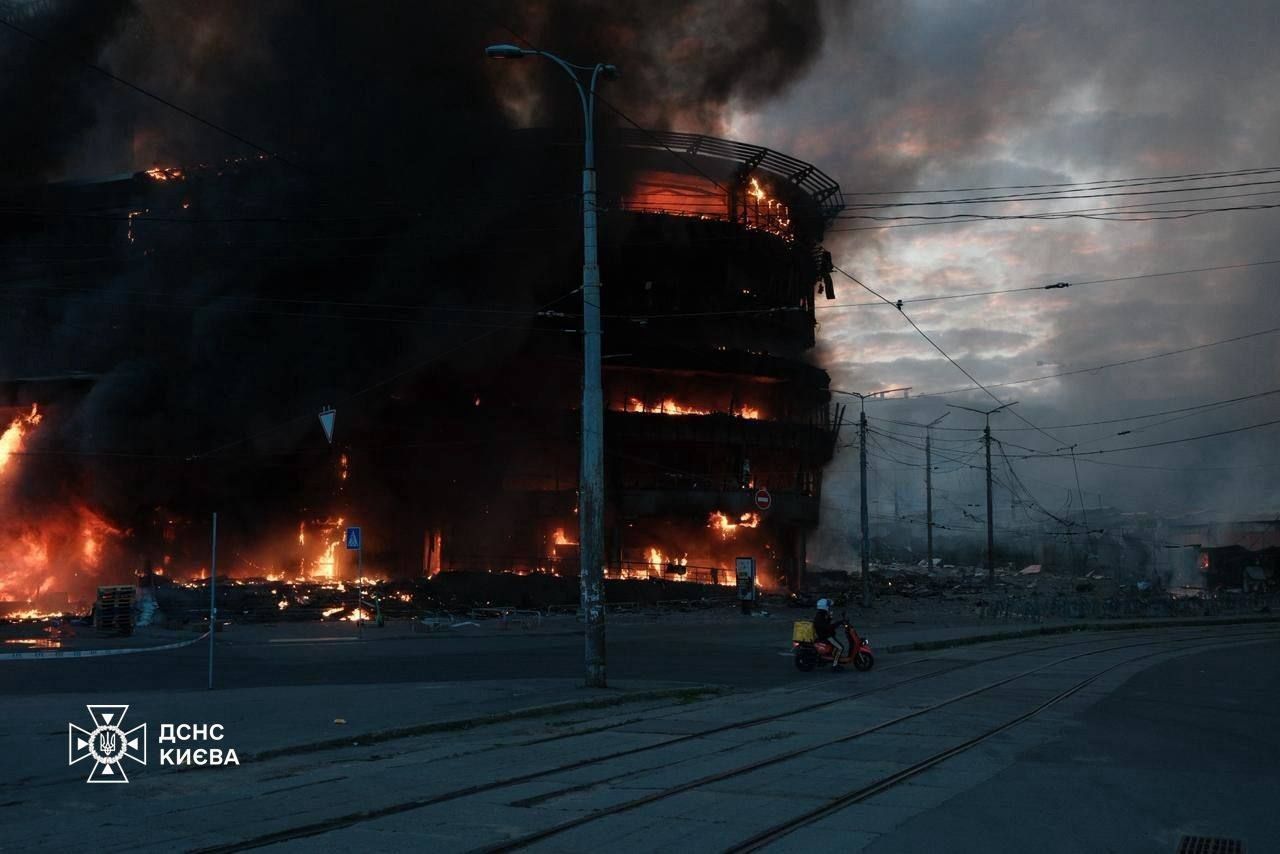
Russia’s heaviest strike of 2026 devastates Kyiv — death toll climbs to 8

Aftermath of the mass strike on Kyiv, May 24, 2026. Photo: Ukraine State Emergency Service
The death toll from Russia’s mass strike on Kyiv has risen to 8 — including a 12-year-old child — with 87 injured. The attack deployed 90 missiles and 600 drones, the largest combined package of 2026: mass Shahed waves to exhaust air defenses before the ballistic salvo. The Oreshnik hypersonic missile was used for the third time in the war, striking Bila Tserkva, a city of 200,000 south of Kyiv. Ukraine has no defense against the Oreshnik — Patriot systems were not designed for its speed.

The cultural damage is the worst since the full-scale invasion began. The National Chornobyl Museum was destroyed entirely. The National Art Museum, Kyiv Opera, Philharmonic, National Library, National Music Academy, Taras Shevchenko University, and several churches were all hit. The Foreign Ministry building sustained damage for the first time since World War II. Zelensky, visiting the attack sites, called it “deranged.” The EU’s Kaja Kallas called the Oreshnik use “political scare-tactics and reckless nuclear brinkmanship.”

Ukraine’s deep strike campaign disables Ryazan refinery — Moscow’s main fuel supplier

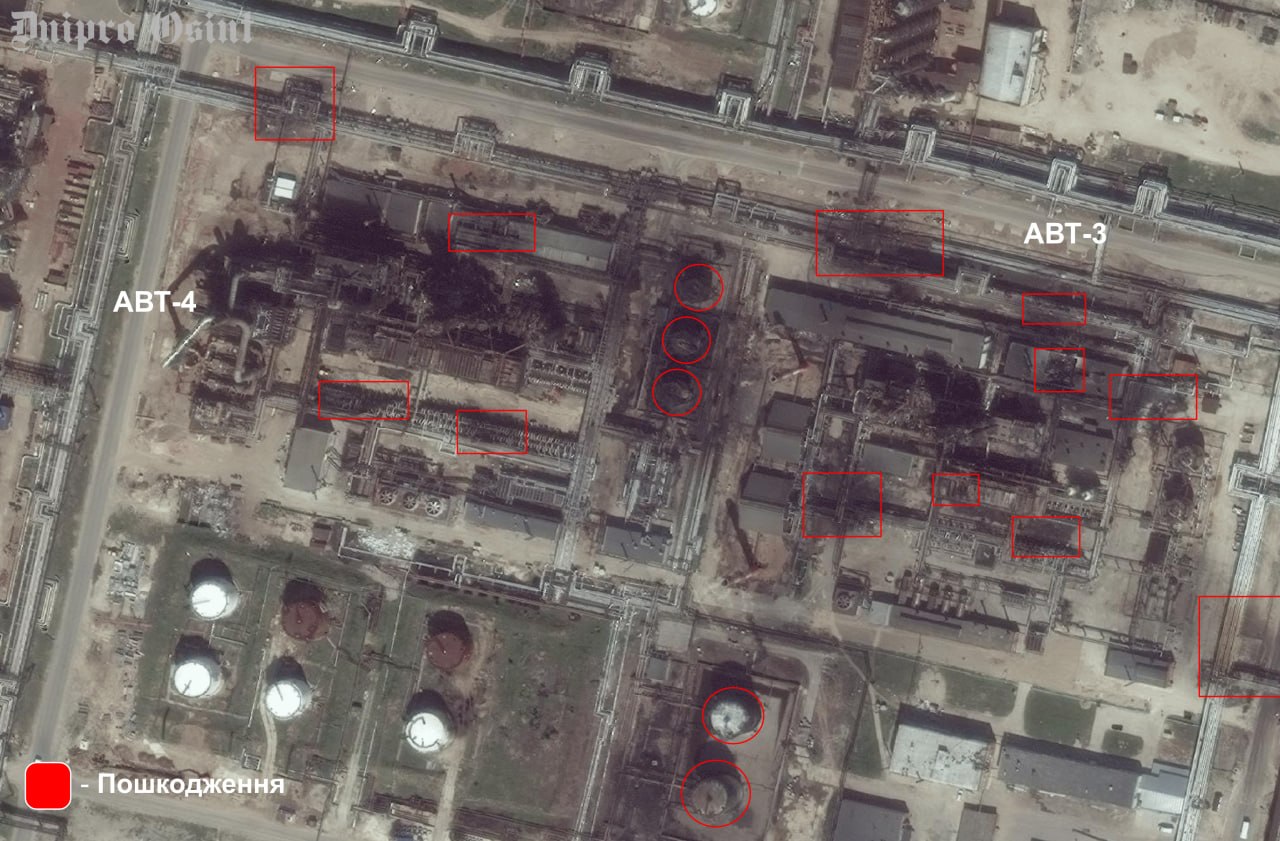
Satellite image of damaged processing units at Ryazan refinery, May 24, 2026. Photo: Dnipro OSINT

Satellite imagery confirms Ukraine’s cumulative strikes on the Ryazan refinery have disabled 90–100% of processing capacity, with multiple primary distillation units and storage tanks destroyed. The refinery is Russia’s main fuel supplier for the Moscow region. Overnight strikes also hit the Vtorovo pumping station in Vladimir Oblast (feeding petroleum pipelines to Moscow airports), the Tamanneftegaz oil terminal at Volna (20 million tons/year export capacity), and a patrol ship plus hovercraft at Novorossiysk Naval Base. The campaign is systematically degrading Russian energy logistics at increasing depth.

World

Khamenei in hiding; Iran executes 37 political prisoners since March

US intelligence reports that Iran’s supreme leader Ali Khamenei is holed up in an undisclosed location as the country navigates post-war negotiations. Iran’s judiciary confirmed it executed a person for sending intelligence to the US and Israel during the war — part of a pattern of 37 political executions since March. The executions signal hardline elements remain firmly in control even as diplomats pursue a deal. Separately, Trump has been privately urging Muslim-majority country leaders to join the Abraham Accords once the conflict is resolved, framing a post-war Middle East order centered on normalization with Israel.

DR Congo Ebola outbreak tops 900 suspected cases — spreads to Uganda

The Ebola outbreak in eastern DRC has surpassed 900 suspected cases, with the WHO rating the risk as “very high” for the region. Cases have now been confirmed in Uganda. Red Cross volunteers have died after contracting the virus before the outbreak was formally identified. Health workers face armed attacks and severe aid shortages — partly driven by cuts to international aid programs — severely hampering containment.

Drones are turning Sudan’s ‘forgotten’ war into a relentless civilian killing field

Drone warfare has fundamentally changed the character of Sudan’s civil war, enabling the RSF and SAF to conduct precision strikes on civilian targets with a frequency and scale that was previously impossible. The conflict, which has caused one of the world’s worst humanitarian crises, receives a fraction of the media attention of Ukraine or Gaza despite comparable or greater human suffering.

Pakistan: suicide car bomb kills at least 24 on military train in Quetta

A Baloch Liberation Army suicide bomber detonated an explosives-laden vehicle alongside a passenger train in Quetta, Balochistan, killing at least 24 people and wounding dozens. The train was carrying military personnel home for Eid al-Adha. The BLA called it a fidayeen mission targeting Pakistani security forces — among the deadliest attacks on Pakistan’s military in recent months, underscoring the persistent insurgency in Balochistan.

Israel continues strikes on Lebanon despite ceasefire

Israeli strikes hit southern and eastern Lebanon on Sunday, killing at least six people and prompting fresh evacuation orders — a day after 11 were killed in a separate raid. A Lebanese civil defence facility in Nabatieh was destroyed. The strikes continued despite an existing Israel-Hezbollah ceasefire and the near-complete US-Iran peace deal.

Bangladesh measles outbreak has killed 528 — mostly children

A measles outbreak in Bangladesh has killed 528 people, the vast majority children, with cases in the thousands. The outbreak has received minimal international attention despite its scale. The country is racing to vaccinate but faces vaccine shortfalls and logistical challenges.

NPR

Also today

Middle East
1.5 million Muslims begin annual Hajj pilgrimage amid Iran war ceasefire tensions — NPR
Syria holds legislative elections in former Kurdish-controlled areas for the first time — Al Jazeera
Turkey: riot police storm opposition HDP offices after court removes party leaders — BBC
Africa & Americas
Senegal parliament speaker resigns, clearing path for Sonko — Al Jazeera
California: cracked chemical tank threatens explosion, 50,000 under evacuation — NPR · The Guardian · BBC
Cuba thanks China for emergency rice shipment amid Trump fuel blockade — Al Jazeera
Other
China coal mine gas explosion kills at least 82 — worst mining disaster in over a decade — BBC
China launches Shenzhou 23 — one astronaut assigned a yearlong stay — NPR
France: 100+ allegations of violence and sexual assault by school monitors prompt ‘massive’ investigation — The Guardian

Ukraine

Five NATO powers block Rutte’s Ukraine aid proposal

The UK, France, Spain, Italy, and Canada have blocked NATO Secretary General Rutte’s proposal to commit 0.25% of GDP to military aid for Ukraine, with at least seven other members in favor. The rejection leaves the alliance without a binding collective aid framework ahead of the June summit. Separately, European Commission President von der Leyen announced additional support to reinforce Ukrainian air defense following the Kyiv strike.

NATO trust crisis: US reducing alliance commitments as Russia watches for fractures

The Atlantic reports that the US has informed NATO allies it is reducing forces available to the alliance in a crisis — directed by Hegseth, framed as making room for European “primary responsibility.” The US previously withdrew ~3,000 troops from Romania without replacement. European leaders are mostly staying silent out of fear of provoking further reductions. A Harvard Belfer Center report warns Russia sees a “unique window” to fracture NATO’s security architecture through limited probing operations.

Inside Ukraine’s battlefield innovation engine

Ukrainian frontline R&D. Photo: ArmyInform via War on the Rocks

A War on the Rocks interview with the Snake Island Institute details how Ukraine’s frontline R&D labs have become the backbone of its military-technological edge. The Dopkhin Pavuk long-range drone originated in the 3rd Assault Brigade’s lab before becoming a mass-produced product via Omnitech. Ukraine has deployed cheap interceptor drones ($2,500/unit) to defend US allies against Iranian Shaheds — a powerful cost asymmetry argument. Ukraine’s projected 2026 defense production capacity is ~$55B but only $15B is funded; the piece argues for reforming Ukraine’s export regime to let NATO allies buy directly.

Frontline: 233 clashes, Pokrovsk hottest sector

Ukraine’s General Staff recorded 233 combat clashes, with Pokrovsk the most contested (38 attacks). Russian forces continue small-group infiltration west of Pokrovsk, relying heavily on drones for logistics interdiction. Ukrainian forces confirmed a local advance in Minkivka. ISW assesses Russian forces are failing to make operationally significant gains in their spring-summer 2026 campaign.

Also today

  • GPS jammed on RAF jet carrying UK Defence Secretary for three hours near Russian border — pilots switched to backup navigation — The Guardian · BBC
  • Cheap attack drones penetrating Israel’s Iron Dome — system designed for rockets, not commercial-grade drone swarms — DW
  • British carrier group shadowed Russian intelligence ship Yuri Ivanov in Norwegian Sea during NATO anti-submarine exercise — UK Defence Journal

Investigations

Growing frustration with Putin spreads among Russian elite

The Guardian reports a widening gap between Putin and Russia’s elite, with growing behind-the-scenes frustration over the war’s costs, economic pressures from sanctions, and the lack of a clear end-state. Finland’s President Stubb separately said he would be willing to represent Europe in Ukraine peace talks if asked.

Xi positions China as the indispensable power

Putin’s Beijing visit came days after Trump’s, with Xi rolling out near-identical ceremonial treatment for both — a deliberate signal of China’s centrality. The headline economic item Russia wanted most, the Power of Siberia 2 gas pipeline, again failed to materialize: Russia needs the deal, China holds the leverage and chose not to grant it. Around 40 agreements were signed on trade, tech, and civilian nuclear. At the Trump summit, Xi separately raised alarm over Japan’s “remilitarization.”

CNBC · FT

Also today

  • Venezuela’s unelected interim leader Delcy Rodríguez courts Trump while blocking elections — WSJ
  • Russia squeezes Armenia as Pashinyan bids for EU membership ahead of elections — Bloomberg
  • Africa pays 9% to borrow vs. Asia’s 4.7% — the gap costs the continent $75 billion a year — EBC

Tech & Development

Anthropic releases official knowledge-work plugins for Claude Code

Anthropic published knowledge-work-plugins, an open-source collection of 11 role-specific plugins for Claude Code covering Sales, Legal, Finance, Data analysis, Customer Support, Product Management, and more. Each plugin bundles skills, connectors, slash commands, and sub-agents for its domain. The repo hit 14.4k stars and ~382K downloads on day one. This is a meaningful shift: rather than individuals hand-crafting system prompts, Anthropic is now shipping domain-specific agentic configurations that small teams can deploy in minutes.

LLM coding agents show major performance drops with complex requirements

Research on “constraint decay” reveals that capable LLM agents lose ~30 percentage points in test pass rates when moving from basic to fully-specified backend coding tasks. The study across 100 tasks and eight web frameworks found agents struggled particularly with convention-heavy frameworks like Django and FastAPI, with most failures stemming from incorrect database queries and ORM violations.

ArXiv · HN

Jira proven Turing-complete through register machine implementation

A clever proof demonstrates Jira’s computational universality by implementing a Minsky register machine using the platform’s automation features. Registers map to linked issue counts, program states to Epic statuses, operations to issue creation/deletion. A working addition program (2+3=5) successfully executed through cascading automation rules.

Jujutsu version control tackles “git rigour fatigue”

A developer workflow piece addresses the exhaustion of maintaining clean commit history during feature development. Instead of constant discipline, Jujutsu allows natural messy commits during development, then reorganizes them afterward using interactive squashing — reducing cognitive burden and conflict management while enabling better commit narrative for reviewers.

GPT-4 exhibits human-like biases when picking random numbers

Distribution from 10,000 GPT-4.1 random number selections — spikes at 37, 42, and 73.

Research testing 10,000 calls to GPT-4.1 reveals the model inherits distinctly human random-number biases from training data. Numbers 37, 42, and 73 appeared 3.4–4.0 times more often than chance, while multiples of 10 were almost never selected. The number 69 — often over-picked by humans — was actually under-selected, suggesting safety training filtered this particular bias.

GitHub · HN

Memory-safe Go rsync avoids 8 out of 12 original vulnerabilities

Analysis of gokrazy/rsync shows how Go’s memory safety features prevent entire vulnerability classes found in the original C implementation. Automatic bounds checking eliminates buffer overflows, zero initialization prevents information leaks, and the absence of manual memory management removes pointer-related bugs. The minimal feature set further reduces attack surface.

Nix cache performance optimized with intelligent routing proxy

A developer created ‘ncro’, a 3,000-line Rust proxy that solves Nix’s cache routing inefficiency. Rather than sequentially checking caches in static order, the tool races all upstream caches in parallel and remembers which responds fastest, using exponential moving average latency tracking and signature verification.

Also today

AI & Agents
Persona fine-tuning: first-person statements beat synthetic docs for LLM character injection — Towards Data Science · Reddit
Agent production failures: the framework is never the problem — orchestration is 10% of readiness — Reddit
AI agent impact on open source: plausible but wrong diagnoses create extra maintainer work — lucumr.pocoo.org · HN
PapersWithCode.co relaunched as open-source by Hugging Face — Reddit
NuExtract3: open-weight 4B VLM for structured extraction from documents — HuggingFace · Reddit
Dev tools
task-observer: meta-skill that self-improves your Claude skill library — 600+ logged improvements across 40 skills — GitHub
Open-source skill automates screencast recording for Claude Code — GitHub
Go to Rust migration guide: 20–60% CPU reduction, 30–50% memory savings typical — corrode.dev · HN
Memory costs dominate AI chip economics at 63% of total spending, HBM surged to $32B in 2025 — Epoch AI · HN
Other
White Rabbit: CERN’s open-source sub-nanosecond timing for distributed systems — ohwr.org · HN
Didgeridoo training reduces sleep apnoea — 6.2 fewer breathing interruptions per hour — PMC · HN

Health

Simmaron rapamycin pilot: 74% PEM improvement signal in ME/CFS

An uncontrolled pilot study enrolled 86 ME/CFS patients on low-dose rapamycin (6 mg/week). Of 70 who reached the T1 timepoint, 52 (74.3%) showed improvement in fatigue, PEM, and orthostatic intolerance. Clinical response correlated with restoration of autophagy markers: BECLIN-1 upregulated, pSer258-ATG13 suppressed — consistent with the mTOR/autophagy-impairment hypothesis. No serious adverse events. Major caveat: uncontrolled design means placebo effect cannot be excluded. The Mount Sinai (NCT06257420) and Simmaron (NCT06960928) placebo-controlled Phase 2 trials are still running, expected November 2026.

β2-adrenergic autoantibodies map to POTS, dizziness, and concentration deficits

A cross-sectional study (n=194) using a cardiomyocyte bioassay profiled functional GPCR autoantibodies and matched them to symptom phenotypes. β2-fAAb (found in 92.8% of patients) showed significant association with dizziness, lack of concentration, and POTS. ET-A-fAAb was specifically linked to deterioration of pre-existing neurological disorders. The study validates that different GPCR-AAbs drive distinct symptom clusters.

Tracking

  • ADDRESS-LC (bezisterim, BioVie) — H1 2026 readout now clearly overdue; no data released
  • IA-PACS-CFS (Charité) — treatment completed Jan 2026; peer-reviewed results still pending
  • IAMPOCO (Mainz) — data collected Oct 2024; results still pending
  • REVERSE-LC (baricitinib) — recruiting, 550 adults; results Nov 2026/Jul 2027
  • ANKTIVA INTERRUPT_LC (UCSF) — still recruiting; results est. Oct 2026
  • Daratumumab ResetME (Haukeland) — 66 participants; results ~2027
  • Rapamycin Phase 2 (Mount Sinai + Simmaron) — placebo-controlled trials running; Nov 2026
cd ~/repos/ratatosk && claude --resume fd89f8f6-2d35-40a5-ac04-058a1cff7d9c