Josse-posten

Russia fires its third Oreshnik at Kyiv overnight; Trump claims an Iran deal is ‘largely negotiated’ while Tehran disputes his terms; Ebola triples in a week in the DRC.

Russia executes mass Oreshnik strike on Kyiv, killing at least 3

Damage to residential buildings in Kyiv from the overnight strike. Photo: Ukrainska Pravda

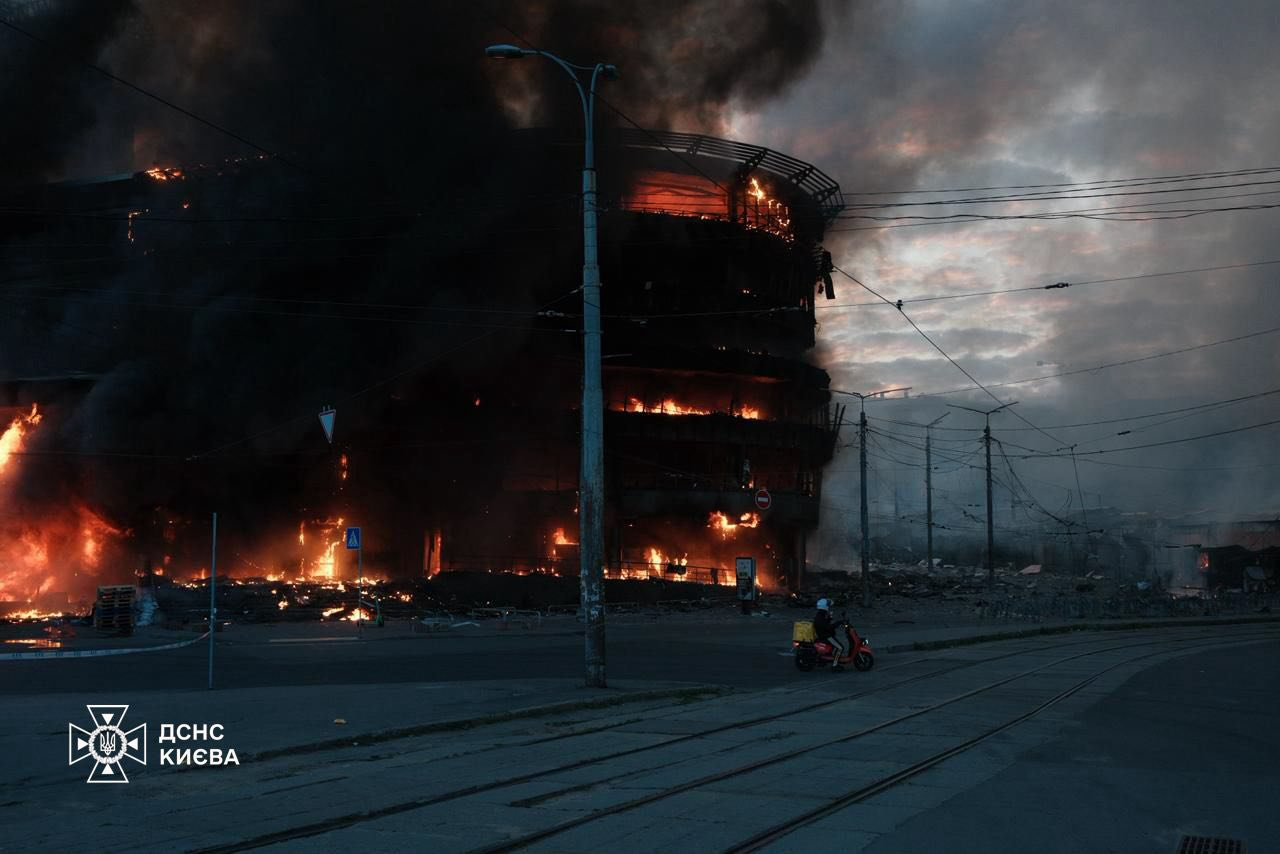
The attack Zelensky warned about materialized overnight: Russia launched a combined Oreshnik IRBM, ballistic missile, and Shahed drone assault on Kyiv and surrounding oblast, killing at least 3 and injuring over 50, including three children. An Oreshnik reportedly struck Bila Tserkva — Russia’s third use of the weapon against Ukraine — while drone hits were recorded in every district of the capital, including a fire on a residential high-rise and a destroyed local market. Kyiv residents sheltered in the metro overnight.

Zelensky called the strike “a global precedent for other potential aggressors” and demanded preventive international pressure on Moscow, not post-factum condemnation.

Trump claims Iran deal ‘largely negotiated’; Tehran disputes Hormuz terms

Trump speaking about the Iran deal. Photo: AP via Al Jazeera

President Trump announced that a peace deal with Iran has been “largely negotiated,” including provisions to reopen the Strait of Hormuz, following calls with Middle East leaders and active Pakistani mediation. The Financial Times reports a framework involving a 60-day ceasefire extension with nuclear talks to follow. Iran’s Fars news agency pushed back sharply, saying Hormuz will “remain under Iranian control” and that Trump’s reopening claim is “far from reality.” UAE, Saudi Arabia, and Qatar are all pressing Trump not to restart hostilities. The president told reporters it is “a solid 50/50” on whether he strikes Iran or concludes a deal.

The UN has warned the world has roughly six months to avert a major food price crisis driven by the prolonged Hormuz closure. Separately, Secretary of State Rubio met PM Modi in New Delhi, with US energy exports high on the agenda as Washington seeks to offset supply disruptions from the war.

Ebola spiraling in DRC: cases triple, patients escape, Red Cross workers die

Overwhelmed healthcare facilities in the Goma region. Photo: Reuters via Al Jazeera

The Ebola outbreak in the DRC has rapidly worsened: suspected cases tripled in a single week, two Red Cross volunteers died after contracting the virus before the outbreak was identified, and 18 suspected patients escaped when a treatment tent was set on fire for the second time. Aid groups cite a new viral strain, collapsed healthcare, violence, overcrowding, and cultural burial practices as compounding factors. The WHO has warned of rapid spread and health workers report every facility is full.

The US is requiring travelers from affected countries to enter through one of three designated airports for screening, will temporarily halt deportations to the DRC, and is requiring DR Congo’s World Cup squad to complete 21 days of isolation before entering the country.
Indicator Value Change
S&P 500 7,473 +0.37%
Dow 30 50,580 +0.58%
Nasdaq 26,344 +0.19%
Russell 2000 2,869 +0.91%
VIX 16.7 −0.36%
Gold 4,523 −0.42%
BTC $76,800 +3.06%
EUR/USD 1.1604 0.00%
USD/NOK 9.2721 0.00%
  • Risk-on across equities, VIX dipping — Trump’s Iran deal claim reduced near-term war premium; small caps led the rally
  • Gold −0.42% — safe-haven selling as ceasefire optimism offset Ukraine escalation and Ebola fears

World

Iran’s internet blackout enters 13th week

Iran’s nationwide internet blackout, imposed when the US-Israeli strikes began, has now lasted 13 consecutive weeks, severely restricting information flow inside the country as diplomatic talks over a ceasefire continue.

Thousands rally in Taiwan for higher defence spending after US pauses arms sale

Thousands gathered in Taipei calling for increased defence spending amid heightened tensions with China, following the US government’s decision to pause a $14 billion arms sale to Taiwan — raising concerns about the reliability of US security commitments.

Gaza flotilla activists allege abuse in Israeli detention; Ben-Gvir banned from France

Activists from the Global Sumud Flotilla, detained after Israeli forces intercepted their vessel, allege they were slapped, hit, humiliated, and subjected to sexual violence in custody — claims denied by Israel’s prison service. Flotilla supporters were also beaten and forcibly detained by police at Bilbao Airport in Spain. France responded by banning far-right minister Itamar Ben-Gvir from French territory over his role in “brutalising” the activists.

Separately, a former ICC prosecutor urged EU member states to enact a blocking statute against US sanctions imposed on nine ICC judges and a prosecutor — retaliation for the court’s arrest warrants targeting Israeli cabinet members. She called the sanctions “thuggish” and “bullying” interference with international justice.

Secret Service kills gunman who opened fire at White House checkpoint

A suspect approached a Secret Service checkpoint near the White House, drew a weapon from a bag, and opened fire. Officers returned fire and killed the shooter. A bystander was also wounded.

Israeli strikes kill paramedics and civilians across southern Lebanon

Israel carried out overnight strikes on Lebanon’s Bekaa valley and the southern province of Tyre, killing at least four people and reducing buildings to craters. The attacks followed strikes a day earlier that killed a child and six paramedics; funerals for the first responders were held Friday.

Protests sweep Senegal, Spain, and Serbia

Tens of thousands fill Belgrade’s Slavija Square. Photo: Reuters via Al Jazeera

Three separate mass protests played out across continents. In Senegal, President Faye sacked Prime Minister Sonko — once his closest ally — and dissolved the government amid a serious debt crisis. In Madrid, thousands demanded PM Sánchez resign over corruption allegations involving his family. In Serbia, tens of thousands continued the student-led movement that began after the deadly Novi Sad train station roof collapse, demanding accountability and early elections.

Philippines building collapse traps 19; China mine blast kills 82

An unfinished nine-storey building collapsed near Manila early Sunday, with 19 construction workers feared trapped under the rubble. In China’s Shanxi province, a gas explosion at a coal mine killed at least 82 people — the country’s deadliest mining disaster since 2009. Xi Jinping urged authorities to “spare no effort” in rescue operations.

Also today

  • DOJ removes January 6 case records from public website — The Guardian
  • Big tech guts safety review from Trump’s AI executive order at the last minute — The Guardian
  • Germany’s AfD vows to “make history” as far-right eyes regional governance in Saxony-Anhalt — DW
  • Cannes Palme d’Or: Romanian director Mungiu wins second top prize for Fjord, a culture-war drama set in Norway — Al Jazeera · NPR
  • Hunger as a weapon of war: new analysis documents over 20,000 incidents of food-related violence since 2018 — The Guardian

Ukraine

Ukraine hits Perm Krai at 1,700km; strikes Novorossiysk naval base and Black Sea oil infrastructure

A Ukrainian serviceman prepares an An-196 Liutyi long-range drone before launch. Photo: AP via Time

Ukraine’s deepest publicly confirmed strike in recent months hit the Metafrax Chemicals plant in Perm Krai — over 1,700km from the front — forcing a production halt at a facility supplying Russia’s military-industrial complex. In a separate Novorossiysk raid, drones struck the frigate Admiral Essen (for the fourth time) and a Project 1239 hoverborne corvette, and hit shadow fleet tanker Chrysalis in the Black Sea. The Sheskharis and Grushova oil terminals struck the previous night continued to burn. Six of Russia’s ten refineries have now been hit in May 2026 alone. Russian occupation forces closed the Dzhankoi train station in Crimea and restricted truck traffic through Kherson after interdiction strikes.

A strike on Russian-occupied Luhansk killed 18 and injured 42. Putin accused Ukraine of hitting a student dormitory and vowed retaliation; Ukraine said it struck Russia’s elite Rubicon drone unit.

Ukraine launches mechanized push near Borova, breaching up to 5km

Ukrainian forces conducted a significant mechanized counterattack southeast of Borova with at least 15 armored vehicles, reportedly penetrating up to 5km into Russian-held territory before Russian forces struck the column. The operation targeted the 3rd and 144th motorized rifle divisions of Russia’s 20th Combined Arms Army during a regrouping phase. Russian milbloggers acknowledge Ukrainian presence in Andriivka, Ridkodub, Vovchyi Yar, and southwestern Karpivka, and warn the line south of Borova may not hold.

Separately, Ukrainian forces cleared Ryasne in northern Sumy Oblast, reversing a Russian mechanized assault from May 3. Ukraine has now liberated 590 sq km of territory since January.

Zelensky rejects EU ‘associate membership’; demands full membership

Zelensky publicly pushed back on Germany’s proposal for “associate” EU membership, calling it “unfair” and warning it would leave Ukraine “voiceless” — without a vote or meaningful say. He is demanding full membership, framing it as a security requirement, not just a political aspiration. Sweden’s defence minister separately stated the country backs Ukraine’s NATO membership. Moldova’s president called for increased economic pressure on Russia to force substantive ceasefire talks.

Russian FPV drone targets funeral procession in Sumy

A Russian FPV drone struck a funeral procession on the outskirts of Sumy city, killing one person and injuring 14. A follow-up strike on the city hours later injured four more, including a minor. The deliberate targeting of a civilian gathering is part of a continuing pattern of strikes on non-combatants.

Tech

The 80386 fully disassembled — and rebuilt as an open-source CPU

The three ALU/register boards from the 1980 NASA Spacelab computer. Photo: Ken Shirriff

A remarkable cluster of hardware archaeology this week. The internal microcode of the Intel 80386 has been fully disassembled and documented, and that work fed directly into z386 — a working open-source FPGA implementation that runs original Intel microcode through a reconstructed datapath. It boots DOS 6/7, runs DOS extenders, and plays Doom at near-hardware speeds, in only ~8,000 lines of code.

Meanwhile, Ken Shirriff digs into the CIMSA Mitra 125 MS, a French minicomputer used aboard NASA Spacelab missions, reverse-engineering its ALU/register cards with annotated die photos and board scans. And Microsoft released what it describes as the earliest DOS source code discovered to date — predating what was previously public.

A good week for understanding where computing came from.

Bambu Lab threatens developer over AGPL compliance; Software Freedom Conservancy confirms violation

Bambu Lab sent legal threats to developer Paweł Jarczak for maintaining a fork of OrcaSlicer that bypassed Bambu Connect restrictions — despite Bambu Studio being AGPL-licensed open-source code. The Software Freedom Conservancy has since confirmed Bambu Lab violated the AGPL’s copyleft terms. The incident has galvanized open-source advocates (including Louis Rossmann) and could reshape expectations for corporate compliance with strong copyleft licenses in the hardware/firmware space.

How Grothendieck revolutionized 20th-century mathematics

Young Alexander Grothendieck, 1954. Photo: Paul R. Halmos collection

Quanta Magazine’s deep profile traces how Grothendieck rebuilt the foundations of algebraic geometry through radical abstraction — replacing geometric objects with functors, schemes replacing varieties, topos theory generalizing topology. One of those rare mathematical stories where the person’s philosophy and the mathematics are inseparable.

.NET/C# finally gets discriminated union types

.NET 11 Preview 2 introduces union types to C# — a feature long available in F# and requested by functional programmers for over a decade. Andrew Lock’s writeup covers the syntax and how it compares to F# and TypeScript equivalents. Significant for the type-systems-interested crowd.

Wayland compositor implemented as a Minecraft mod

Someone built a working Wayland compositor as a Minecraft mod — running inside the Java game engine, it exposes a real Wayland socket and can render actual desktop applications as in-game surfaces. Absurd and technically impressive.

AMD/Xilinx Vivado drops Linux support for free tier

Vivado 2026.1 removes Linux support from the free WebPACK tier, forcing hobbyists, students, and researchers to either pay for a commercial license or stay on older versions. The HN thread surfaces strong pushback and notes this may accelerate adoption of open-source FPGA toolchains like nextpnr and F4PGA.

Also today

  • Byrne’s Euclid — Oliver Byrne’s 1847 color-coded geometry proofs, beautifully recreated for the screen — c82.net · HN
  • C constructs that still don’t work in C++ — flexible array members, compound literals, VLAs, and more — lospino.so · Lobsters
  • Does bulk memmove speed up std::remove_if? No — careful empirical investigation into cache behavior vs. performance intuition — quuxplusone.github.io · Lobsters
  • Don’t Roll Your Own — a concise guide to not implementing security primitives yourself — susam.net · Lobsters
  • Architecture of BerkeleyDB — classic systems literature on embedded transactional store design — aosabook.org · Lobsters
  • remind(1) — a mature, scriptable Unix calendar and alarm CLI with its own calendar language — dianne.skoll.ca · Lobsters
  • Scammers abusing an internal Microsoft account to send spam that passes SPF/DKIM checks — TechCrunch · HN
  • “Long-Term Support” doesn’t mean what you think — the latest stable is often safer than the LTS — pointieststick.com · Lobsters
  • R7RS Large Scheme: Procedural Fascicle first draft published — r7rs.org · Lobsters
cd ~/repos/ratatosk && claude --resume 26b61e44-8d59-42d8-8726-7e3215e8c237