Day 21: the war spreads to refineries and LNG terminals — but in
quieter corners, clinical trials are delivering answers.
The Infrastructure War
Iran struck Israel’s Haifa refinery overnight, answering Netanyahu’s
claim that Israel “acted alone” in destroying Iranian enrichment
capacity. Meanwhile, Qatar confirmed what energy markets feared: Iranian
retaliation against Ras Laffan has knocked out 17% of the world’s
largest LNG exporter’s capacity — for three to five years. The IEA is
now advising emergency measures: work from home, reduce highway speeds.
Six allied nations issued a joint statement on Hormuz, though France
made clear it won’t participate in combat operations to unblock it.
China, sitting on vast strategic reserves and renewable capacity,
watches from a position of strength.
The First GPCR Autoantibody
Win
Rovunaptabin (BC007) passed its Phase IIa trial — the first
randomized controlled evidence that neutralizing GPCR autoantibodies
improves Long COVID symptoms. Effect sizes were substantial: Bell score
improved with p=0.0004, fatigue scores significantly better than
placebo. For patients with elevated GPCR-AAbs, this validates the
autoantibody mechanism and opens a treatment pathway. Separately,
ImmunityBio’s Anktiva trial is now testing IL-15 to reconstitute
depleted CD8+ T cells — targeting a different piece of the puzzle.
Denmark’s Greenland
Contingency
Denmark flew blood bags and explosives to Greenland after the US
seized Venezuela’s leader. The plan: destroy the runways before American
troops could land. The revelation captures a remarkable moment — a NATO
ally preparing sabotage operations against the United States.
Also today: Hungary’s Orbán blocks €90bn EU loan to
Ukraine, called “gross disloyalty” by Germany’s Merz — though von der
Leyen insists funds will still reach Kyiv. Belarus releases 250
political prisoners in deal with US; Washington lifts sanctions
benefiting Russia’s defense base. Al-Aqsa mosque closed at Eid for the
first time since 1967.
Markets
|
Value |
Δ |
| Oil |
— |
−3.5% |
| Gold |
— |
−4.1% |
| S&P 500 |
— |
−0.2% |
| EUR/USD |
1.0843 |
— |
| USD/NOK |
10.82 |
— |
| BTC |
$71,200 |
+1.4% |
Profit-taking after weeks of war-driven gains; IEA measures may
be tempering demand fears
World News
Iran War & Energy Crisis
Iran
war day 21: Tehran warns of “zero restraint” if energy sites targeted
again (Al Jazeera) — Iran strikes Israeli oil
refinery in Haifa as regional energy infrastructure becomes the new
battlefield. Netanyahu claims Israel has destroyed Iran’s uranium
enrichment capacity and says Israel “acted alone” in the South Pars gas
field attack, though Trump had requested no further such
strikes.
Iran
attack wipes out 17% of Qatar’s LNG capacity for 3-5 years
(Reuters) — Retaliatory Iranian strike on Qatar’s gas
infrastructure causes major long-term damage to global LNG supply.
European gas jumped 35% in response. (Also covered in Investigations)
Joint
statement from UK, France, Germany, Italy, Netherlands, and Japan on the
Strait of Hormuz (UK Government) — Six allied
nations coordinate response as just under 100 ships have passed through
Hormuz since March began, per BBC analysis.
Though notably, France
will not participate in combat operations to unblock the strait
during active hostilities.
IEA
advises emergency measures: work from home, reduce highway
speeds (The Guardian) — World energy watchdog
issues 10 recommendations to combat soaring oil prices and impending
fuel shortages.
China’s
years of energy crisis preparation paying off (The
Guardian) — While other Asian economies scramble to conserve, China
sits on huge strategic reserves of oil and gas plus major renewable
capacity.
Oman
claims Israel pushed US into Iran war when deal was
possible (The Guardian) — Oman’s foreign minister
says US has “lost control of its own foreign policy.” Meanwhile, US
intelligence chief admits American and Israeli war goals are not
aligned. (Also covered in Investigations)
Al-Aqsa
mosque closed at Eid for first time since 1967 (The
Guardian) — Palestinians say the closure is part of Israeli
strategy to leverage security tensions to tighten restrictions on
Jerusalem’s most sensitive holy site.
Europe
Americas
Middle East & Africa
Asia-Pacific
Science
Other Notable
cd ~/repos/ratatosk && claude --resume 929c5228-0970-4ba2-9711-9f87bde1ef66
Ukraine
Ukraine continues to impose mounting pressure on Russian forces
across tactical, operational, and strategic levels. The Ukrainian drone
campaign has shifted to prioritize Russian artillery, drone operators,
and logistics in the near rear — degrading both offensive and defensive
capabilities and enabling local Ukrainian advances, notably in the
Oleksandrivka direction where Ukrainian forces have reportedly liberated
over 285 square kilometers in one month. Mid-range strikes (50-250km
depth) have quadrupled since November 2025, with Ukrainian forces
destroying 80 Russian air defense systems over Winter 2025-2026 alone. A
Ukrainian drone unit destroyed an entire battery of six Grad MLRS in the
Pokrovsk sector.
These combined effects appear to be disrupting Russian preparations
for their anticipated Spring-Summer 2026 offensive, with Russian forces
now facing competing dilemmas — insufficient strength to simultaneously
advance on Orikhiv, Dobropillya, Kupyansk, and Zaporizhzhia City while
maintaining a buffer zone in northern Kharkiv and Sumy oblasts. Russia
recorded one of its deadliest days of the year with an estimated
1,610-1,700 casualties on March 19.
Overnight drone attacks saw Ukraine intercept 133 of 156 Russian
drones, though strikes damaged educational, residential, and energy
infrastructure in multiple oblasts, including a hit on the SBU building
in Lviv. Russian drones also damaged two grain vessels in Odesa.
cd ~/repos/ratatosk && claude --resume b4d9e938-1e98-49d8-845d-b82bf6a56d2d
Investigations &
Geopolitics
The Failure of Iranian
Deterrence
Nicole Grajewski and Ankit Panda analyze in Foreign Affairs
how Iran’s
deterrence strategy collapsed — and what it means for global
security. Separately, Joe Kent, the recently resigned head of US
counterterrorism, told Tucker Carlson that officials were “not
allowed” to express concerns about the Iran war to Trump, claiming
“there wasn’t a robust debate” and that the president relied on a small
circle including Israeli officials and US media figures.
- How
Wildlife Traffickers Are Using Coded Language to Sell Protected Animals
On Facebook (Bellingcat) — Investigation
identifying nine Facebook groups with 70,000+ members where illegal
wildlife dealers used coded pricing systems (A, B, C for currency
denominations) to sell endangered species including silvery gibbons and
Javan langurs. Researchers traced six interconnected profiles sharing a
phone number to a physical pet shop in Jakarta. All accounts removed
after Bellingcat contacted Meta.
cd ~/repos/ratatosk && claude --resume 79548c2d-90e6-4a7a-8dcb-052ad558a489
Tech
Push
events into a running Claude Code session with channels |
HN — New
feature allowing external events (Telegram, Discord, webhooks) to push
messages into running Claude Code sessions. Enables true agent autonomy
— Claude can react to CI results, chat messages, and monitoring alerts
while you’re away. Research preview requiring v2.1.80+. (Also
covered in AI)
Anthropic’s
Hidden Vercel Competitor “Antspace” | Lobsters
— Reverse-engineering an unstripped Go binary revealed Anthropic’s
internal PaaS. Antspace handles deployment for Baku (their internal web
app builder), auto-provisions Supabase databases, and represents a full
deployment protocol built from scratch.
Kin:
Semantic version control that tracks code as entities, not
files | HN — Replaces
Git’s file-diff model with a semantic entity graph (functions, types,
modules). Designed for AI agents: offers graph queries via MCP instead
of file dumps. Claims 69/70 task wins, 50% faster, 45% fewer tokens. HN
skeptical about maturity.
Scaling
Karpathy’s Autoresearch with GPU Clusters | HN — Claude
Code given 16-GPU Kubernetes cluster ran ~910 experiments over 8 hours,
improving baseline by 2.87%. Agent self-discovered hardware optimization
(screening on H100s, validating on H200s). Total cost ~$300 compute + $9
API fees.
Security
Systems & Infrastructure
Noq: n0’s
QUIC implementation in Rust | HN — Hard fork
of Quinn adding first-class multipath, NAT traversal at QUIC level, and
address discovery. Already running on hundreds of thousands of
devices.
dial9: A
flight recorder for Tokio | Lobsters
— Runtime telemetry capturing polls, parks, and wakes as a log. Revealed
production issues invisible to standard metrics — one AWS service found
10ms+ kernel scheduling delays. Under 5% overhead.
From
Oscilloscope to Wireshark: A UDP Story | HN — Oxide
Computer debugged intermittent network issues by soldering probes to
traces, capturing at 1 trillion samples/second, then building a Rust
tool to decode through multiple layers into Wireshark-readable
pcaps.
Programming Languages &
Theory
“AI’s impact on mathematics is analogous to cars on cities. Cars
offered speed but created congestion, sprawl, and community destruction.
The solution wasn’t faster cars or demolishing old infrastructure — it
was thoughtful planning and rules allowing both to coexist.” — Terence
Tao
cd ~/repos/ratatosk && claude --resume 0cc71259-f896-4de5-b0dc-f4e08ba29d46
AI
Research
Models & Benchmarks
Claude Ecosystem
Patterns & Industry
cd ~/repos/ratatosk && claude --resume d0b3627b-2c7e-43aa-a4c5-7093af9253e1
Long COVID Research
Takeaways
Rovunaptabin (BC007) Phase IIa results are positive — first
RCT evidence for GPCR autoantibody neutralization. The reCOVer
trial showed significant improvements in fatigue (FACIT effect size
2.10, p=0.038), Bell score (effect size 3.64, p=0.0004), and quality of
life in patients with GPCR functional autoantibodies. For patients with
elevated GPCR-AAbs, this is the most directly relevant trial result to
date — it validates the autoantibody mechanism and shows that
neutralizing them produces clinical benefit. Combined with the
daratumumab pilot (eliminating the cells that produce them), the GPCR
autoantibody pathway is now supported by two separate interventional
approaches with positive signals.
Anktiva (IL-15 agonist) enters Phase 2 for Long COVID —
directly targets CD8+ T cell reconstitution. ImmunityBio’s
trial of N-803 is the first to specifically target NK and CD8+ T cell
recovery. For severe CD8+ memory T cell depletion, this is
mechanistically the most relevant trial to watch. IL-15 is the canonical
cytokine for CD8+ memory T cell homeostasis. Trial runs through July
2026.
Paxlovid fails in Long COVID — viral persistence may require
different approaches. Both STOP-PASC and PAX LC trials showed
no benefit from 15-day nirmatrelvir/ritonavir. This doesn’t rule out
viral persistence as a mechanism, but suggests that longer treatment,
combination antivirals, or reservoir-specific approaches are needed.
RECOVER-AUTONOMIC ivabradine results in 8 days (March
28).
Directly relevant
Rovunaptabin
(BC007) reCOVer Phase IIa trial (eClinicalMedicine,
2025-07) — First RCT of a GPCR autoantibody-neutralizing agent in
Long COVID. n=30 randomized, crossover design. Significant improvement
in FACIT fatigue (effect size 2.10, p=0.038), Bell score (effect size
3.64, p=0.0004), Fatigue Severity Scale (effect size -2.66, p=0.009),
and 4/8 QoL domains. Good safety profile.
Anktiva
(N-803) IL-15 agonist Phase 2 trial (ImmunityBio,
2025-08 to 2026-07) — First IL-15 agonist trial for Long COVID.
n=40, single-arm. Primary: safety. Secondary: lymphocyte counts.
Exploratory: NK and CD8+ T cell recovery and function.
CD8+
T cell hyper-reactivity and IL-3 in Long COVID
(Clinical Immunology, 2025) — German study finding CD8+ T cells
are hyper-activated: 4-fold higher CD25 expression, 2-fold more
effector-memory cells, 7-fold higher IL-3 release. Suggests the
remaining CD8+ cells may be dysfunctional/exhausted rather than
simply absent.
Significant developments
Paxlovid
fails in Long COVID (STOP-PASC & PAX LC) (JAMA
Internal Medicine, 2024 + Lancet ID, 2025) — Two RCTs of 15-day
nirmatrelvir/ritonavir showed no benefit. Important negative evidence —
if viral persistence drives symptoms, 15 days of protease inhibition
isn’t enough.
FOXP4
gene variant increases Long COVID risk by 60% (Nature
Genetics, 2025) — Largest GWAS (6,450 cases, 1M controls). FOXP4, a
lung-expressed transcription factor, associated independent of severe
COVID-19. Not immediately actionable but may inform risk
stratification.
$20M
Sequence ME/Long COVID project announced (Action for ME
+ Schmidt Initiative, 2026-03) — Largest long-read whole genome
sequencing study of any disease: 9,000 ME/CFS + 9,000 Long COVID
patients. Uses Oxford Nanopore to find structural variants missed by
short-read studies.
Soluble
biomarkers for Long COVID respiratory symptoms (Nature
Immunology, 2025-04) — Plasma biomarker signature linking
breathlessness with apoptotic inflammatory networks. Higher neutralizing
antibody titers in healthy convalescents vs. Long COVID — opposite of
what might be expected.
REVERSE-LC
baricitinib trial expanding (Vanderbilt/RECOVER-TLC,
2026-02) — Now recruiting 550 patients across 17 US sites.
Neurocognition data expected November 2026.
cd ~/repos/ratatosk && claude --resume 7bb31ecb-d0fc-4190-922b-261f74d35512
cd ~/repos/ratatosk && claude --resume 5bb96346-66b0-47d5-8b3d-5436e7f0bd83
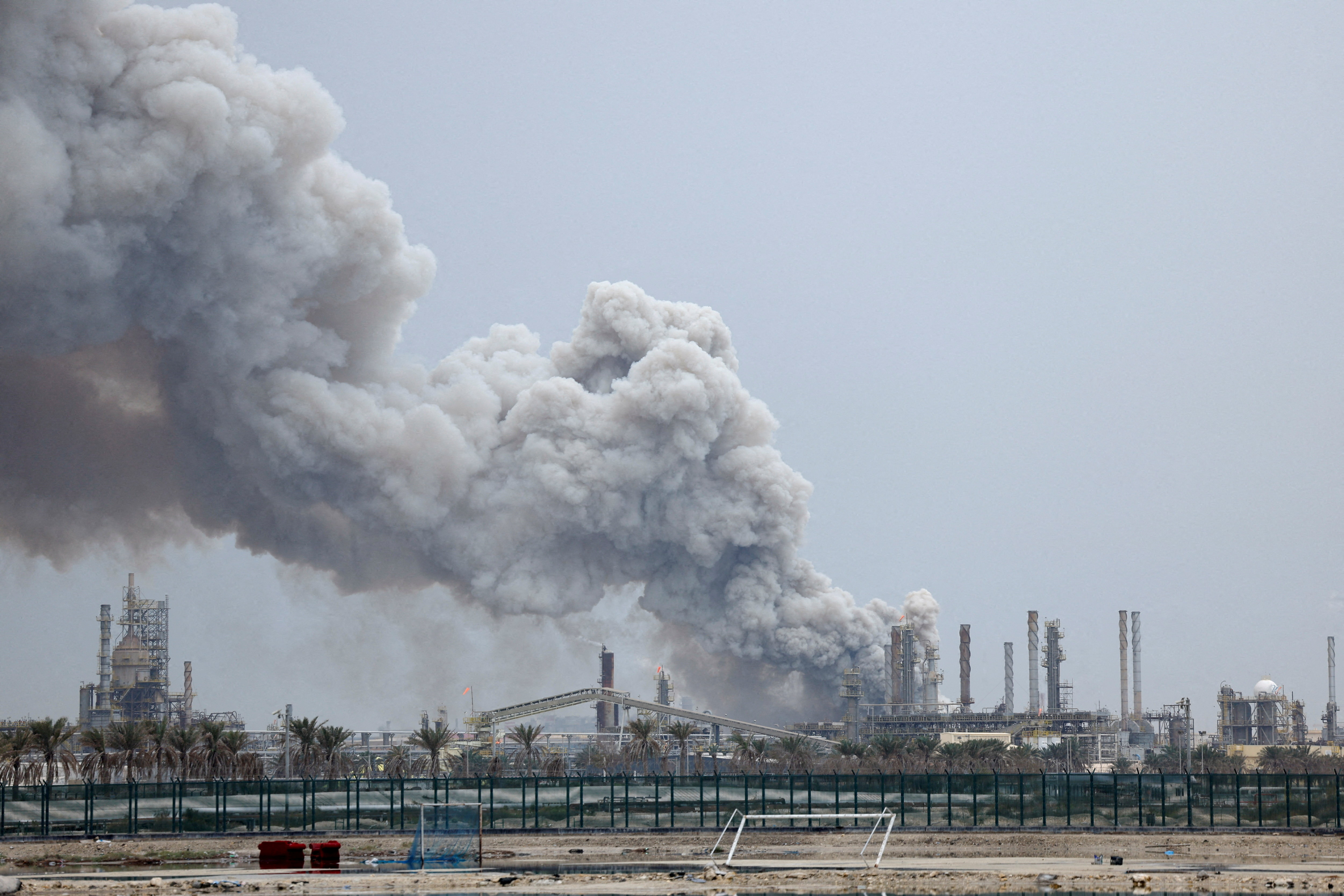 Smoke rises from the Bapco
refinery on Sitra Island, Bahrain, after Iranian strikes spread the
energy war deeper into the Gulf.
Smoke rises from the Bapco
refinery on Sitra Island, Bahrain, after Iranian strikes spread the
energy war deeper into the Gulf. Donald Trump embracing the
American flag at CPAC.
Donald Trump embracing the
American flag at CPAC. Camouflaged Russian BM-21 Grad
MLRS destroyed by Ukrainian Lasar’s Group drones in the Pokrovsk
sector.
Camouflaged Russian BM-21 Grad
MLRS destroyed by Ukrainian Lasar’s Group drones in the Pokrovsk
sector. Two infant silvery gibbons
advertised on Facebook — an endangered species sold through coded
pricing.
Two infant silvery gibbons
advertised on Facebook — an endangered species sold through coded
pricing.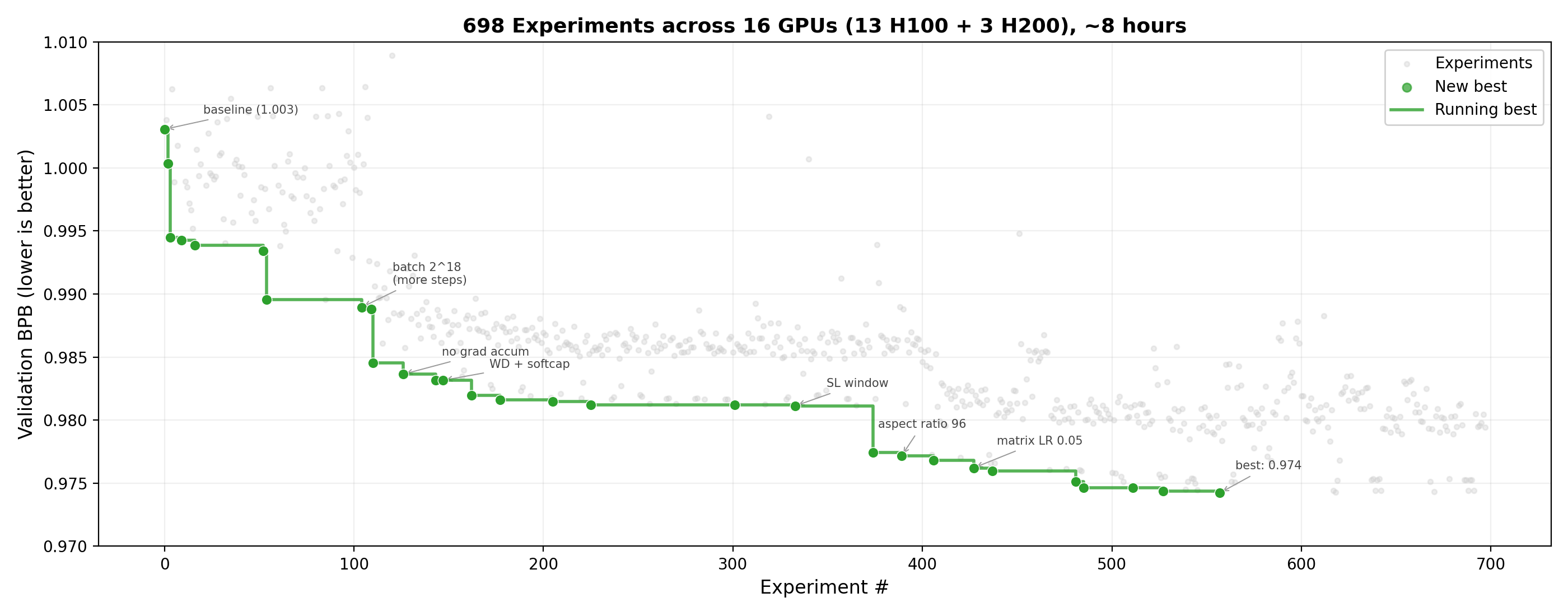 Scatter plot of ~700
experiments run by Claude Code with GPU cluster access — green dots mark
improvements over baseline.
Scatter plot of ~700
experiments run by Claude Code with GPU cluster access — green dots mark
improvements over baseline. T-Deck device running
Marauder showing a malicious access point with XSS payload.
T-Deck device running
Marauder showing a malicious access point with XSS payload.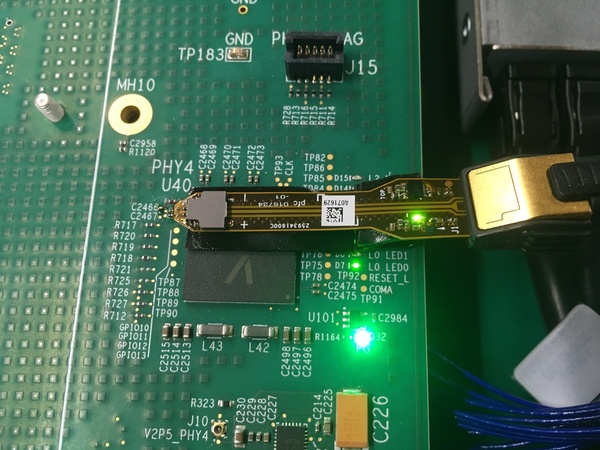 Differential probes
soldered directly to circuit board traces for packet capture at Oxide
Computer.
Differential probes
soldered directly to circuit board traces for packet capture at Oxide
Computer.